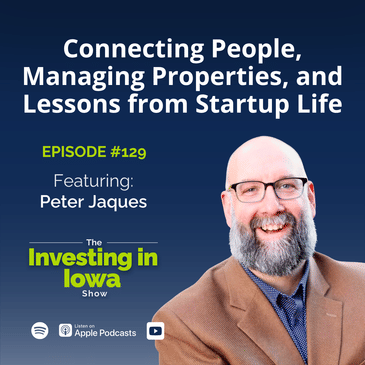
What happens when a commercial broker spends years inside venture-backed startups and then brings all of it back to property management?
Peter Jaques has worn a lot of hats. He got his start in commercial real estate through a cold call to a broker named Doug Seidenberg, found his footing in retail and restaurant leasing, and then spent seven and a half years running a family office with over a million square feet of real estate. From there, he moved into technology, working with farmland marketplace Farmland Finder, single-family sale-leaseback company Easy Knock, and farmland brokerage platform Tillable before returning to where he began.
Today, Peter is a managing member of The Real Estate Department alongside his wife Megan, who runs day-to-day operations. Their focus is property management and development grants, and Megan has become a go-to resource for identifying public funding that helps investors improve both their properties and their returns. Together, they manage a mix of shopping centers, multifamily, and single-family properties across the Des Moines market.
Peter shares what he learned watching venture capital money move through early-stage companies, why the social signaling inside startups often masks deeper problems, and how a FedEx truck crash once led to a house being sold twice. He also talks about why thoughtful property management built around dignity creates better outcomes for owners and tenants alike, and what three metrics he would track if he were stranded on an island for a year.
🧠 Peter Jaques' Top 5 Takeaways:
- How years in venture-backed tech taught him what good data looks like and why trust drives investor decisions
- Why property management built around dignity produces better long-term returns for owners
- How Megan Jaques turned a cash-flow-negative 50-unit project into a property generating five to ten thousand dollars monthly with a six-figure reserve
- Why the real estate brokerage and technology spaces have fundamentally different economic structures
- How tracking a maintenance-to-receipts ratio helps measure both financial performance and quality of stewardship
👤 About Peter Jaques:
Peter Jaques is a Des Moines-based connector, commercial real estate professional, and managing member of The Real Estate Department, a property management and development company he runs with his wife and business partner, Megan. With a background spanning retail leasing, family office management, farmland technology, and single-family sale-leasebacks, Peter brings an unusually broad perspective to every conversation about real estate and business.
Contact Info:
Instagram: Peter Jaques
Facebook: Peter Jaques | Peter Jaques - Commercial & Residential Professional
Email: peter@therealestatedept.com
Learn More: www.littleguyloans.com/learnmorepod
[00:00:00] The company that we worked with for the title work and the filing overnights the documents to the local county office to have it recorded. The FedEx truck literally crashed and burned. The documents never made it to the office. Somehow the guy that we bought the house from figures out the sales never recorded, sells it twice, and disappeared.
[00:00:19] From cornfields to high-rises, office to industrial, houses to hotels, and every other asset class in real estate, we cover the people, the projects, and the profit. Welcome to the The Investing in Iowa Show. This show is for go-doers, action-takers, and business owners. It's for people like you who are sick of Uncle Sam taking a huge bite of your apple.
[00:00:42] If you're looking to get ahead of what's taking place in Iowa, learn who is doing what and how you can get in on the action, you're in the right place. Hosted by Neil Timmins, an Iowa native who has been involved in over $300 million in real estate right here in Iowa. Recording in studio from West Des Moines, here's your host, Neil Timmins. I've got Peter Jaques here on the show. Peter, welcome. Hi. Good to see ya. Good to be seen.
[00:01:10] Hey, see, for the audience's sake, who are you, where are you from, what do you do? Peter Jaques. Born and raised in Des Moines land. Urbandale area predominantly. Lived in the Drake neighborhood for about 20 years now. I'm out west in a little acreage with an Adel address. A whole bunch of different stuff in the real estate space. And some technology. Narrow that down for me and start in the real estate space. Meaning you do a whole bunch of things? Give me a couple of bullet points.
[00:01:34] So, presently, if I hand you a business card, it's going to say the real estate department on it. That is a company that I'm a managing member of. Partners, Megan Jaques, my wife. Very much related. Very much related. She's been my life and business partner. Jeez, we're in our 21st year and she's been running the real estate department for us for seven years now. So, I have bounced around a little bit last couple of years. So, she was running that and growing it.
[00:02:03] It's predominantly a property management and development grants. Those are probably our three fortes in that space. What's your wheelhouse? My wheelhouse? Connecting people. Connecting people. That is my wheelhouse. Yeah. I love people. Yeah. Yeah. I like numbers too. Yeah. If anybody asks me, like, what do I do? I'm like, I typically just call myself a connector. Connector. Yeah. So, take me to the beginning. How'd you get into real estate?
[00:02:27] Oh, man. Well, my short version as I tease, it was Providence. Got to look it over my shoulder. I was in a specialty construction space serving mining companies all over the globe. Had a bunch of people. I'm like, my early mid-20s, maybe just married at this point. I had people tell me this beforehand, but I had some people tell me I should be in real estate. And at the time, especially, you'll love this. At the time, it's like 2003, 2004 when that bug was first planted.
[00:02:57] And I had some friends in the mortgage space back then who were, I mean, 300 to half a million dollar producers every year just through mortgages. They were printing money back in that era. Some of them got investigated by the FBI, incidentally. I was like, oh, I want to do that. Didn't go anywhere. Never, like, the door never opened. And in the process, somebody goes, you know this guy named Doug Seidenberg?
[00:03:23] I'm like, do I know Doug? Like, well, you know his son because he's a drummer in the band that you play with at church. I'm like, oh, yeah. I love Doug to death. He will tell you, I feel like the number goes up every time he tells the story. He'll say I called him like 25 times and he smiles. I think it was six or seven times I called and said, hey, want to learn about getting into the real estate space? And at the time, I didn't even know that he was commercial real estate.
[00:03:50] I didn't know. I didn't know. My parents couldn't remember who sold their house to him. Like, I didn't know anybody in the space. So Doug returns my phone call and we end up having a cup of coffee, if you can imagine this. I've got, y'all listen to audio. I've got a shaved head and beard that's graying now. When he and I sat down, both my ears were pierced. I had a beard, either a beard or a goatee that was probably close to my belly button. If I wasn't working in the construction space, I was working with high school students in my church ministry.
[00:04:19] We get done with a conversation at the Friedrichs on 86th in Urbandale and he goes, you should do commercial real estate. And he talked to me through the differences and I went home to my bride, my new bride, and I said, hey, this is going to be hard, but I think this is where I'm supposed to go. So I'm going to do that. It was hard. She was a project manager for a web design company here in town and kind of provided for us while I was getting ramped up. But first year was actually really good. I know I bucked the system from a first year standpoint.
[00:04:48] So Doug got me into the industry. I learned with Seidenberg that I really like retail and started to learn more about shopping centers and working with tenants. Got really good at restaurants. Had a quick stint. So as we're coming into the recession, it was end of 2007, early 2008. Ended up at Buyer's Realty for a couple of months. And then get hired from buyers to run a family office here in town with, at the time, 2 million square feet, give or take.
[00:05:18] I might be exaggerating that a little bit. I'd have to go back and look at the numbers. Maybe a million and a half square feet of real estate. But office, retail, a lot of farm development grounds at the time. So I worked with them for seven and a half years. Great group. Came time to do my own thing. So I went back into brokerage again and then went through two different firms there. And I ended up in technology. I actually have now had a couple of years in the venture capital space working with technology companies that are real estate adjacent. Oh, okay.
[00:05:47] So I have some very interesting, really interesting learning experiences through that. Two most recent kind of leadership roles were I got hired to help lead Coldwell Banker in Des Moines. It does not exist in Des Moines anymore. So that was interesting journey. Made a lot of great friends, a lot of good people.
[00:06:06] But that was really my, so three, almost three years ago now, that was my first foray actually into just residential real estate and seeing homes, marketing, sales, agents, learning from the agents. Totally different business. What's important to them. Yeah. How brokerages keep their doors open and their lights on. Yeah, because the two different businesses have two very different economic structures. Between commercial and residential? Yes. Oh, significantly. Night and day on the brokerage side. Night and day. Yeah.
[00:06:37] Right. Yeah, night and day. So yeah, Coldwell Banker didn't exist, right? When Marvin passed, that was sold. Correct. Yeah. Well, that'll do it. Big one. When you're making one payment a year. Okay. Yeah. Yep. So missed the payment. I was the last employee in Des Moines. That's not true. I was the last one kind of running it. I believe there's still one employee helping them with their back office stuff. The window. Yep. But they did that and then got invited to help lead Whitecourt Realtors, a 515 agency.
[00:07:03] Helped there for just about 16 months and the real estate department is doing well enough. It was hard to straddle. Needed to pick a horse. Went and talked with my friend Ryan and said, which you've had on the podcast, Ryan Hoover. Great guy. Great guy. One of the best. We had a conversation. Went, let's, doesn't have to be bad. Tell me about the technology space. What were you doing there and maybe what kind of interesting things are taking place as it relates to technology and mill estate? Oh, man.
[00:07:33] So the first one was a company called Farmland Finder. In the crudest sense, it started off as like a Zillow for farmland. A young man named Steven started it at Iowa State University. I was the first hire after he did his seed round. And it's the, I think the biggest macro lesson I learned in that was there are people, groups, people and groups with wealth.
[00:07:57] And the venture capital space is a wild, wild space from both a communication storytelling standpoint and how the money moves through it. I mean, we talk about like equities and, you know, the stocks being gambling. Yeah. Venture capital's next level gambling. Right. In this space. So that, that was a wild lesson. Realizing. So started with them in 2019. Okay. October 31st, 2019.
[00:08:26] March 2020 happens with COVID and I'm in the, in the technology stuff. COVID happens. And what was the wildest thing for me, right? Real estate guy. Bricks and sticks, relationships, leases, sales, contracts, legal stuff. You get into the technology space and start learning real quick how much of us is out in cyberspace. How it can be manipulated.
[00:08:51] And man, I saw firsthand just through developing friendships with engineers, computer engineers, how fragile our security is. That was wild. Wild. Finding new data sources for stuff. Like there were, there were ways to find information on finances and individuals that freaked me out. So anyway, model was, we started off as, like I said, Zillow, Pharma and Data. And we ended up building a marketplace. So bring in demand and supply together.
[00:09:21] Our supply in this instance, where we focused was, we were a licensed brokerage in 10 states. I was like the broker. And if you were a farmer, you didn't want to give up operational control of the field, but you had a need for some kind of cash event to do whatever. We would connect you with an investor to do a sale lease back. A long-term sale lease back on the field with an option to buy it back. That was the product. Ended up putting all that through the interwebs. And it worked.
[00:09:49] It just didn't happen at the volume that we needed it to happen for our venture capitalists to be really excited about it. Ends up, we ended up running out of money. We don't have any more VCs standing in line. So we ended up selling off the technology. You didn't work this hard to earn next to nothing on your money. Savings accounts barely moved the needle. Tech stocks, AI stocks. It kind of feels like Vegas out there right now. Rentals? Too often times it means tenants, toilets, termites, and not the cash flow you were thinking.
[00:10:18] Well, so I've got an alternative. Little Guy Loans Co-Lending Fund. Qualified, accredited investors are earning 10% to 11% annual passive returns. It's paid quarterly by co-lending with us alongside me. On short-term, first lien real estate loans right here in the greater Des Moines area. Your money's backed by a real property, not promises. It stays close to home. We've successfully funded well over $10 million in loans right here in central Iowa.
[00:10:48] So if you want steady income without headaches, click the link below in the show notes. Let's connect. We'll see if it's a fit for you. And then I moved from there to another kind of same church, different pew company called Easy Knock. Based out of Manhattan, they were doing sale leasebacks on single family homes all over the country. I joined them, director of customer success. And we were, when I joined, I think we were acquiring 60 homes a month.
[00:11:15] At the height of our productivity, we were doing almost 130. Right. Acquiring 130 homes a month through this process. Also in a bunch of lawsuits, which is interesting. There are states that have outlawed prior, I don't even know if prior to us, but sale leasebacks on single family homes, depending on the states frowned on. Not legal. Really? Yep. That's odd. Yeah. Think about it.
[00:11:36] You have, as a borrower, especially if you're dealing with a local bank or a national bank, your protections as a borrower, as a consumer, are significantly higher than if you're a tenant. Correct. And so I think the states, what little bit I saw about the case law, because my curiosity wouldn't let me, because I had the same reaction. Right. I was like, really? They're illegal? Come on. It's a transaction. In the states where they were illegal, there had been cases won against people where they would do a sale leaseback.
[00:12:06] And the day they don't make their payment, the owner takes the house. So it was, I could see where it could be. It falls under tenant law at that juncture. Correct. Yep. And so they would just go through the tenant process, make life difficult for them, get them out. Yeah. And so it became predatory. I've seen hundreds done in the city. Oh, yeah. Uh-uh. Yeah. It's, I, well, it's not a lawyer, but I don't think it's illegal. There's a lot in the realtor world that gets done that way on temporary short-term leasebacks. Sure. Not a leaseback with an option to purchase at the end. Yeah.
[00:12:36] Sure. Right. Yeah. We see, dude, I sold a house. I'm selling a house and then I need to rent it for 60, 90, 120 days because the new one's not done. Yep. So all day, every day it happens in the city. Yep. Wow. Well, that's unique. Yeah. There's probably some weirdness in those contracts. Yeah. So the way we would do these sale leasebacks, sometimes part of the enticement would be, hey, and you can live in the house. You're going to get all this cash. You write your financial ship and we'll let you stay in the home for free for four or five months.
[00:13:06] Great. Great deal. Great opportunity. Sure. As a consumer, if you can be responsible and actually write your ship, it would be great. Right. All right. Month five or six comes, no payments received. Hey, we're all over the country as a team. Correct. Trying to manage this process. Phone calls. You know, after 45 days, an hour, two months, actually delinquent. Right. Send somebody to do a door knock.
[00:13:37] Family answers the door. Hey, we're serving you for not paying your rent. What are you talking about? We own the house. Like, what do you mean you own the house? By the way, this isn't our name on the paper. You own this house? Cool. Reverse is, well, please, please call this number. It happens to be mine. What's going on? Like, well, we bought this house four months ago. Huh. We bought it eight months ago. Who's the person you dealt with? It was the guy that we bought it from. All right.
[00:14:05] Punchline is the company that we worked with for the title work and the filing overnights the documents to the local county office to have it recorded. The FedEx truck literally crashed and burned. The documents never made it to the office. Somehow the guy that we bought the house from figured this out. Figures out that the sale was never recorded. Yep. Figures out the sale's never recorded. Sells it twice and disappeared.
[00:14:31] There was obviously all sorts of stuff that we were going through to track that down and remedy the situation. No doubt about it. Rates go up while I'm there. Our model was fee-based at the front end with transactions. Rates go up and there just wasn't a product market fit anymore. I mean, we were borrowing money in the low threes. And then all of a sudden we were borrowing at like six and a half. And so the value proposition to make all the numbers work for us, the value proposition to the consumer broke. Yeah.
[00:14:59] So we went from buying 130 homes a month to 30 again. And it was just like, oh, okay. So a typical startup, venture capital back. Right. So you're firing people. Everybody gets new jobs. Went from there to another startup called Tillable, which is back in the farmland space. This was, I was just running a very traditional farmland brokerage. But it was backed by a venture capital company, Tillable. Almost same thing as Farmland Finder, which was, how do you make, how do you buy and sell farms faster?
[00:15:28] I mean, get the farmers out of their, out of the field was really what it boiled down to. And how much money we have to save. You've never called that riddle yet? No. No, you just call Steve Brewer at people's company. He just had. Sure. You can call Steve. Yeah. Lots of good, lots of good people doing farmland. He's one of them for sure. No. Or his group. It's a genuine question. Has anybody figured out how to do it faster, more efficiently than putting 50 people in one room? And then hopefully two of the neighbors. Auctions. Send a new record. Okay. I got to tell you a story about this.
[00:15:56] I learned this lesson at Farmland Finder. So one of the first transactions we did was almost 300 acres, Northwest Iowa. It was a great case study in how this solution was a great solution. It's not for everybody, but when it was needed, it worked. And so I go up and meet with the farmer, right? So he's going to sell to the investor that we found who incidentally was out of Omaha. And we're driving around and I had gone up because there were a couple of farmland auctions and I hadn't actually been in the room of a farmland auction.
[00:16:26] I've watched online either through video or I've actually just done online auctions. I'm like, great. I'm looking forward to these auctions and he's prepping me. We're driving down a dirt road. I mean, there's nothing. There's no lines. There's no fences anywhere, Northwest Iowa, maybe a couple of hall confinements. And he goes, oh yeah, my nephew, he got this 160 right here on a couple of years ago at auction. I'm like, oh, how'd that go? Oh man, he got a great, he got a great deal on it. I'm like, what do you mean by great deal?
[00:16:54] And he gives me the number and it's 40% off of what it probably should have been at the time. Right. Well, we all, which is the neighborhood, showed up at the auction and kept our hands in our pants. Hands in our pockets. The sellers there in the room, they made the auctioneer work for it. It was a no reserve situation.
[00:17:15] Apparently the landlord was, and the nephew had been the tenant forever, landlord's out of state, and it was, had inherited it and apparently wasn't all that great to deal with. And so they just slow played it. And he ended up getting this crazy deal on this farm ground. Another half section on the same dirt road. He goes, oh yeah. Yeah, and then my uncle sold that piece about the same time. And I'm like, oh, okay. What'd he get there?
[00:17:42] And it's almost 100% more than what the nephew paid. I'm like, all right, what's the story there? Same group, same room. Didn't like the guy that was farming it. And the room bid it up. But he had to have it for his operation. He'd been the tenant forever. Almost identical story. Same thing. Somebody passes, current owners are going to sell it at auction, and they just sit in the room and they bid it up. So does that mean it's the market? That day, that time. Right? That's the argument.
[00:18:12] Everybody's like, how do you actually pinpoint? Because I have good friends who are auctioneers, and they'll say the auction is the purest form of what the market is. Maybe. Maybe. But then you see that, and you go, okay, well, it can be gamed. It can be gamed like anything. So anyway, great auction story. What's the alternative? Blind auctions, probably. Yeah. Online. You're still back to an auction format.
[00:18:38] I mean, this is why, what, 70% of all property, real property, I'm talking houses in Australia are sold by auction. Mm-hmm. Right? The unique system that we have in this country relative to single-family houses is totally different. Yep. And is it the truest form? Well, it kind of depends. I mean, if you got 10 offers in one weekend, then I would argue that it's auction-like. Yeah. You go 22 days, get one offer? Hard to say. The market's telling you something.
[00:19:07] The market is telling you something. You better have hired a very skilled realtor, because your skilled realtor will help you discern what it's telling you, because the average consumer is not skilled enough to be able to ascertain what it's telling you. And Claude or Chachy BT at this sub-level, this market on this day, this number of bedrooms, this baths. Tough to tell you your exact situation. But I wonder, is there another solution coming down a pipeline at some point?
[00:19:37] Probably. Probably. Probably. I would agree. Yeah. Yeah. Probably. Right. I think one of the other lessons in the technology space that I had in this was, both from a team member standpoint, for those who haven't met me, I'm 6'10". I walk into most rooms and can comfortably say, if I'm not at the top, I'm near the top of the food chain. Sure. Physically. I try not to be in the rooms where I'm the smartest guy. And not the dumbest guy. Like, hmm, I wonder who the dumbest guy is. Usually if you have to ask that question, it's you. Was my replaceability.
[00:20:07] That was really interesting, getting into the technology, building a business space, and just going, man, there are a lot of really good people out there that are as sharp or sharper than I am.
[00:20:16] And so really wrestling with the fact that I'm replaceable and seeing, guys, and this is five years ago, four years ago, three years ago, seeing how technology can operationalize and bring data to a situation where two complete strangers did a $1.8 million farmland transaction, never talked to each other. The buyer never actually put their, never set foot on the ground.
[00:20:44] And farmland, as it goes, there's more data and it's a simpler asset class, to be sure, than maybe a residential property. Sure. But, or a commercial property even, but it's not that far off. Correct. So just seeing that and going, man, technology is, it's just, it's changing everything. Yeah. And now we have AI, so it's completely different. So the founder of Farmland Finder, we've just introduced his mutual, with mutual friend. And it was, it was funny. He goes, the mutual friend goes, Peter, you're a real estate guy that loves technology.
[00:21:14] This kid is, loves technology. He's building technology and it's in the real estate space. Farmland, you guys should just be friends. Yeah. And it started off as a friendship. And he was trying to solve problems. And so over a few breakfasts, listening to his mind as a founder, which is a very interesting quality to have, that they're not, they're not everywhere. Not everybody can be a founder. No, they're not normal. Not like this. Not a founder in a startup in this sense. It's, it's wild. Yeah. And we got done.
[00:21:43] His last question of me to help, he asked for help with was around creating a role. Like, all right, kind of decoded the space, the real estate space a little bit, farmland space a little bit. How does it work from a compliance standpoint? How would technology maybe solve this? Anyway, we kind of got done figuring out like what the roles looked like, the skill sets, personality type, that type of thing. And I didn't check all the boxes, but knowing where he was going with this, I was like, um, I think I want to toss my hat in the ring. Yeah. And he was surprised. Yeah.
[00:22:13] He's like, you're not going to make as much. I'm like, I know, but I want to see if we can do something with this. This will be, if it hits, it'll be huge. And, uh, it was, it was competitive. I had to, uh, there was other people and I had to interview with the board and the venture capitalists. I met some really neat, uh, allocators is what they're called in the space. If you're money allocators. And so the other juxtaposition, this is in the real estate space, you're affecting the life of on the residential side. What do you got?
[00:22:40] Let's say if you got both sides fully stacked 20 people, you're changing the lives of 20 people. The families using average family size, your title people, your attorneys, your bankers, your loan officers, your inspectors, right? It's going to be 20 people. If you got everybody involved.
[00:22:56] Uh, when you build something in technology that hits, you're affecting hundreds of thousands, if not millions of lives through that, that, that piece, that solution they created. And I was like, wow, this is, that's interesting. Yeah. So I think that was, that was one of the things I thought was pretty neat. Going through that whole experience, what did you, what were your takeaways relative to the investors?
[00:23:23] What did you learn that investors do that you may have applied or may apply in the future? I mean, one of my first, first big what moments was realizing when we went live and the names that started showing up on our platform, that was wild. And the amount of money, and this is, this is just a farmland asset class. Sure.
[00:23:44] The volume of dollars that were looking for a place to go and specifically wanted to go into, in this case, farmland was wild. Um, so that was a big aha. Learning how to explain a cap rate, which is really interesting. Everybody, that's the industry standard. If you're an investor, we throw this word around and the cap rate is really only as good as the data that backs the cap rate.
[00:24:09] And so for us building a platform that was trying to earn trust from the investors, we had to have their trust for them to buy $1.8 million in farm ground without ever actually touching it. And that was actually our goal. They, they were welcome to, once we got far enough into, far enough into the transaction, uh, they could go look at it. Yeah. But, um, had to have a high degree of trust.
[00:24:34] And so learning how to provide, um, the, the right amount of information at the right time. Um, so they would trust it and then make a decision. That was really interesting. At the end of the day, it's all, it's all in a return profile. It was amazing to me how many sophisticated investors are out there. Uh, and you would know this by their questions. We'd have, I mean, we had, uh, multiples of thousands of investors on our platform.
[00:25:03] Every once in a while I'd have one call me and ask to, um, modify the terms of service and privacy policy and the commission agreement. So we had a commission agreement that was built into all that. And, uh, that was always interesting. Like I appreciate the effort, but I'm not, I got thousands of people like you I'm working with. I'm not changing it for you because I'm not going to, I can't manage that. So that's on the investor side. On the venture capital side, especially when a company is struggling, what was interesting
[00:25:32] was the social signaling and there's language that is used in that space on a consistent basis that signals, Hey, we're okay. We're in growth mode and Hey, we know what we're talking about. And it's, it's all signaling within the space. And I'm in the background going, it ain't working. You're, you're signaling to this investor who you need as a VC.
[00:25:55] Um, I was learning this through easy knock cause we, we were series C and which ended up being kind of like a rolling series C. Then if you know anything about the space, that's not supposed to happen like that. So that was, it was just survival mode. Uh, but you listen to the leaders of the company and, and they're the metrics that they wanted to use to indicate and signal to the venture capital marketplace that we're good. We're great. We're growing.
[00:26:22] This is all opportunity, uh, would change a little bit, but that was the social signals in this space. And it wasn't just at the VC, like the actual allocator space founders level, all the employees, especially if you're in the director or VP level of the startup, man, they're might as well call them peacocks. Like it's all this when they're interacting with you, they want you to know as a team member that, you know, stuff too. And it takes one extra question to know if they actually know what they're talking about
[00:26:52] or if they just happen to get hired for this role. I don't know if it was Mark Twain that said that, but you get promoted to your highest level of incompetence. Saw that a lot. That's probably corporate. I mean, it's like, I'm like, I'm a, I was a loan ranger, right? I'm brokerage space. And I get thrown into these, invited into these spaces of leadership and growing these companies, which is great. So that was really my only foray into like companies, like any kind of corporate environment. I've never been in any other corporate environment. And now I'm not.
[00:27:20] If you're a house flipper, execute the birth strategy or do double closings and are in need of money. Little Guy Loans is your go-to lender here in the Des Moines area. Time is money. Loan approvals in 24 hours, closings in five days. Little Guy Loans was founded by Neil Timmins, an investor just like you. Since he has been in over 10,000 homes in Des Moines, there's never an appraisal. Houses, multifamily and commercial property loans up to 1 million.
[00:27:49] Check out www.littleguyloans.com. What are you working on now? What are you excited about for the next one to three years? So working on the real estate department specifically. So want to grow that, see a lot of opportunity to have really thoughtful property management in Iowa, I think, let alone the Des Moines marketplace. We've had our clients raving. And this is to be absolutely clear. My wife is a wizard and how good at this she is.
[00:28:18] As I've been out brokering for the last 20 or so years, she's been managing and she is amazing at it. And then I mentioned grants earlier for several of her clients with larger projects. She has become a single source of truth, if you will, for the public money that's out there, for investors to leverage to improve not only their properties, but the returns that get on their properties. And she has got that dialed in. So that is an art, not so much a science.
[00:28:48] Correct. And the old adage of it's not what you know, it's who you know. And it's even beyond that. It's not even who you know, it's how you know them. Should have my wife on your podcast. She's incredible. You meet her. She's this genius mind that cares about people at every level. One of our values for the real estate department is dignity. And we struggle with that work because we're like, well, there's dignity with the investors that we're working for. Right.
[00:29:15] Everybody that we're serving as a manager is an investor. How do we help them with their dignity? Because not every investor is made the same. We've worked with some investors that got into a situation where they needed a manager because they didn't know. And then we have projects that we're managing that have some subsidies in them. How do you interact with a tenant in a way that gives them dignity? Not just solving the problem for them and not necessarily bringing the hammer down, but having these boundaries and these hard conversations with them.
[00:29:45] That just recognizes them as humans and goes, hey, I know that you know how to figure this out. You don't have to lie to me. We can figure this out together if you want to. And in the process, I'll brag about her. And again, this is not, granted, it's a company I'm with, but it was on my wife because I was off doing some other stuff. Took over management of an almost 50-unit project.
[00:30:07] Previous management company had been, the free cash flow to the owner was in this like $2,000 to $3,000 range for years. And then like the last six months, it had gone to zero and they'd actually been calling him to feed it. The owner calls me and says, hey, is this something you think you guys would like to do? I'm like, well, let's at least meet and look at it. It's never a straight yes.
[00:30:33] Well, first of all, I want to make sure that we aligned, that our values aligned with the owner. And then let's look at the project. And we'll just give our thoughtful like, hey, this is what you're dealing with. Ultimately, just I'll summarize with, it was just poorly managed. Fast forward three years. So take over a couple grand a month or zero, no reserves for the property. Sure. Which is why they were calling the owner to get wife takes over. Oh, and I had a vacancy issue.
[00:31:01] Vacancy was double what the market was saying it should be. Megan takes over. She's had some choice words for me over the years. Since we took over this project, by the way. She's like, I cannot believe you introduced me to this or talked me into this thing, which is all fair. But she has increased, based on appraisal, she increased the value by a million dollars. Wow. The vacancy rate is below the standard in our town.
[00:31:27] The owner is now making between $5,000 and $10,000 in free cash flow. And then this is the really interesting punchline. She has managed to accumulate a $100,000 reserve for him. He or his family will never have to feed this thing again because of how she managed it and set it up.
[00:31:48] And the magic of that was some grit and truly watching her work with the tenants, some dignity, figuring out when you see somebody, the tenants that want to play games don't feel comfortable with that anymore. And the ones that don't know how to do it otherwise but actually have the ability in them to do it right, they come around. And so she, I mean, through just cash flow and rent. And what's interesting is when you have this high degree of relational equity now with the tenants, getting higher rents isn't hard. It's not hard. It's not hard. They go, okay.
[00:32:17] I mean, we're not trying to couch them. No. But now you've done a good job for them. You've provided service. They feel valued as a tenant. And so when you show up to bump the rent a little bit, okay. Yeah. And they're the people you want. So anyway, we want to keep growing that. And we have both shopping centers and multifamily and some single family. We'd like to add a couple of shopping centers this year to the management portfolio. Yeah. So that's what we're working on. It's going to be exciting. It is. I'll tell you, my wife is my best friend.
[00:32:45] We're a couple of weeks into this, but it'll be great. Like working with her. Yeah. At a level. Yeah. Well, she's always been the boss at home and now she's the boss from nine to five too. Dude, this girl bosses. And she hates that term. Like, oh, you girl. Oh, I say that. I say that respectfully for my staff. Oh, a hundred percent. Yeah. Yeah. Well, you met her. Well, I met her multiple times. I was trying to think when we first met 15, 18 years ago. I mean, it has been a while.
[00:33:13] Somewhere when you were at the family office. No. So for the record, for posterity in the podcast. So this is how Peter and Megan Jacobs meet Neil Timmons the first time. We were renting a duplex in the Drake neighborhood. And there's this cute little dead end street north of University 37th. There's a church on the corner. And I had been, I'm in the commercial side. I didn't know anything about residential.
[00:33:40] And there was a duplex at the corner of 37th and where it tees. And I think you were the listing agent. Okay. Called you. Yeah. That was actually the first time we met. And I remember, we wrote an offer. It was really low. And the duplex was rough. Yeah. Rough shape. I actually think it's been converted back to single family now, if I'm not mistaken. But it was rough. And so we, we, man, I hadn't even thought about this.
[00:34:07] You may have been, you're the guy that wrote the first offer for me ever on any real estate transaction. How about that? Yeah. Incredible. I remember being in the house. I just didn't remember what the whole context was there. Forever. I mean, you're talking almost 20 years ago? Yeah, it's almost 20 years. Yeah. Because we're in our 21st year. So 19, 20 years ago. Wow. Uh-huh. Yeah. That's crazy. You know what's interesting too? I think back now, I know all these processes as well. I don't even remember.
[00:34:35] I don't remember if we even had a pre-approval letter at the time. No pre-approval letter and you wrote the offer? What a terrible agent. Yeah, right. I think you're taxing my way. So I can't argue one way or another. So now I know these pieces, right? So I'm thinking, man, this listing was rough. Guys, when I tell you this, this duplex was rough. It was rough. And that's what makes me think it's not my listing. I was just on the, somehow we got connected and I showed you the place, but I have no idea why or how. Let me ask you the final three questions. Okay.
[00:35:04] One piece of advice for your 20-year-old self. One piece of advice for my 20-year-old self. A couple things. Don't stop going to the gym. Keep surrounding yourself with people that have what you want. And that isn't just stuff. Like there is an economy out here in this world that is about people and souls. Stay close and surround yourself with the people that know that world. Don't stop reading. I think I would start there. With that, two books that changed your life. Two books that changed my life.
[00:35:34] First one's the Bible. Can't give it up. And then second one, I read a lot now. If you haven't read 1984, get into that. Read it. It's actually a good audio too, but make sure you're listening to it because for as old of a book that is in the times that we live in now, it's wild. Man, great books. Never split the difference. Chris Voss, Negotiations. I have read Rich Dad, Poor Dad. It was good. Wasn't life-changing. Millionaire Next Door. That was an interesting one to read Millionaire Next Door as a guy that was raised middle class.
[00:36:04] Thomas Stanley. Yep. Terrific book. Great book. Kind of go, oh, that was interesting learning. If you were cast away on an island for a year, you can only get three pieces of data about your business each and every month. What three things must you know every month to know how your business is running? I would like to know how many phone calls we've had with new potential business relationships. So on the service side, how many people have we talked to this month that are thinking about changing property managers?
[00:36:29] We have a ratio that we are measuring in our, from an accountability standpoint between our maintenance and maintenance billings and receipts. There's a ratio that we had to create in there to monitor it. That one's really interesting. And it tells us a couple things. Just to elaborate on that a little bit, it tells us how well we're managing other people's money. It was like our primary reason for measuring this.
[00:36:56] And then simultaneously, when we understood, when we figured this out, we're like, well, this is how, if we measure it like this, we know how well we're actually serving and stewarding. Stewardship is one of our values. How we're stewarding for our clients. And incidentally, it also means that financially from a cash flow standpoint for our business, it's doing well. So that was interesting. You said three metrics and we have a reserve account.
[00:37:22] So I would want to see the deposits or credits on the reserve account. If we're getting credits or debits, I know that the other stuff is being handled properly. Or I can ask if it's getting debited, I can go, hey, what's going on? Yeah. And sometimes it's normal. Yeah. Yeah. Some of that's seasonal. Yeah. Yeah. Absolutely. Yeah. Makes total sense. Yeah. What's one question I did not ask that I should have asked? Yeah. You asked lots of good questions.
[00:37:51] Did you ask me why real estate? No. We asked how you got into it. So we did that. You should have asked me why I stayed. Yeah. Why is a much bigger question. I think the why for me is the people. It's three really interesting things. We've got people, problem solving, and finances. I just, I can't get enough of that. Yeah. For people, they want to find you, follow you, connect with you. Where can they go? What should they do? Man, on most of the socials, I'm dsmjaques. J-A-Q-U-E-S.
[00:38:20] So at that time I'm on X. I know that's my Instagram handle. Actually, Instagram might be dsmcre. Facebook, Peter Jaques. J-A-Q-U-E-S. There is no C. Yeah. Hit me up and I'm Peter at therealestatedept.com. That's my email. Links will all be below in the show notes, everybody. Cool. Appreciate being here. Thanks for having me, man. Thanks, buddy. Thanks for listening. If you're enjoying the show, may I ask a favor of you? Naturally, subscribe so you never miss an episode.
[00:38:49] But would you rate and leave an honest written review on Apple Podcasts? There's a lot for us here at the show, and I appreciate reading your thoughts. Great guests make for a great show. If you know of another Iowan who would be a great guest or you yourself have interest in being a guest, well, get on our radar. Visit Investing in Iowa to fill out an application or recommend a guest.
[00:39:13] And if you want to connect with me one-on-one, go LegacyImpactInvestors.com. Click on the Invest With Us button in the top right corner. And there, you can pick a time for the two of us to get on the calendar and connect. Until next time, keep investing in Iowa.