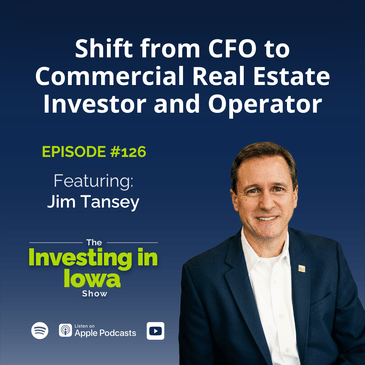
What does it really take to go from corporate finance to building a dominant real estate business?
Jim Tansey shares a grounded, experience-driven look at his path from Waterloo, Iowa, to leading Hawkeye Commercial Real Estate and Hawkeye Real Estate Investment Company. Starting as a financial analyst and rising to CFO, Jim built a strong foundation in understanding numbers, inefficiencies, and business operations before making a major pivot into commercial real estate.
That transition was anything but easy. The early years in brokerage were defined by learning, hustling, and taking every opportunity possible. Jim leaned heavily into education through CCIM, which became a turning point in his career and helped him specialize in investment real estate. Over time, that focus compounded into deeper expertise, stronger relationships, and more opportunities.
In 2012, Jim and his partner took the leap into ownership, acquiring their first portfolio and launching what would become their investment arm. Shortly after, they started their own brokerage, driven by a desire to build a better culture and eliminate the frustrations they experienced elsewhere. Today, that people-first, relationship-driven approach has helped them grow into the largest brokerage in their market.
Jim's philosophy is simple but powerful: do your job well, treat people right, and play the long game in both business and investing.
🧠 Jim Tansey's Top 5 Takeaways:
- Early career skills in finance and analysis translate directly into real estate success
- The first years in brokerage require volume, learning, and persistence
- Specializing in investment real estate creates long-term opportunity and credibility
- Owning real estate builds wealth while brokerage creates income
- Culture and relationships, not transactions, are the foundation of a sustainable business
👤 About Jim Tansey: Jim Tansey is the President of Hawkeye Commercial Real Estate and Hawkeye Real Estate Investment Company, based in Eastern Iowa. He oversees brokerage, investment strategy, and property management operations across a growing portfolio.
With a background in finance and leadership experience as a former CFO, Jim brings a disciplined, numbers-driven approach to real estate. He is also actively involved in the CCIM Institute, serving as its 2026 Treasurer, and remains committed to education, mentorship, and industry leadership.
Contact Info:
Company: Hawkeye Commercial Real Estate
Website: www.thehawkeyegroup.com
LinkedIn: Jim Tansey, CCIM
Learn More: www.littleguyloans.com/learnmorepod
[00:00:00] One piece of advice I got from Dave Weiner was that you broker commercial real estate to make a living, but you invest to build wealth. That resonated with me from the beginning. So it was always my goal to get involved, to understand investment real estate as much as I could, and to put myself in a position where I could be an investor.
[00:00:17] From cornfields to high-rises, office to industrial, houses to hotels, and every other asset class in real estate, we cover the people, the projects, and the profit. Welcome to the Investing in Iowa Show. This show is for go-doers, action-takers, and business owners. It's for people like you who are sick of Uncle Sam taking a huge bite of your apple.
[00:00:39] If you're looking to get ahead of what's taking place in Iowa, learn who is doing what, and how you can get in on the action, you're in the right place. Hosted by Neil Timmins, an Iowa native who has been involved in over $300 million in real estate right here in Iowa. Recording in studio from West Des Moines, here's your host, Neil Timmins. I've got Jim Tansey here on the show. Jim, welcome. Thanks, Neil. Great to be with you. Appreciate the invitation.
[00:01:08] It's good to see you. Say, for the audience's sake, who are you? Where are you from? What do you do? So, name is Jim Tansey. I live in Beddendorf, Iowa with my lovely wife of 33 years, Stephanie. I am the president of Hawkeye Commercial Real Estate based out of Davenport, and we are a full-service commercial brokerage firm and property management firm. And then also president of Hawkeye Real Estate Investment Company based out of Coralville, where we do our own investing on our own account.
[00:01:36] And then in my spare time, I'm also the 2026 treasurer of the CCIM Institute and sent on a couple of other local boards and things just to round it out and keep myself busy. Well, I don't know how you do it all today, but let's start with where it began. Where'd you grow up? Born and raised in Waterloo. I grew up there my first 18 years of my life. Loved Waterloo. I think it's a great place to be from.
[00:02:00] I'm happy to have moved on from there. I went to the University of Iowa, only school I ever thought about going to. Just a Hawkeye all my life and still a Hawkeye to this day. What'd you study? So, when I went to school, coming out of high school, I was actually a math major, and I thought at the time that I would be a math teacher. I thought that that would be a good thing to do coming out of high school. I enjoyed high school, and that was kind of the world at the time.
[00:02:24] And I thought, wow, what a cool job. I could teach this. I could coach some sports, and it would be a fun life to live. And it took me a couple years of that to realize it probably wasn't the best fit for me. Yeah. So, it was my, at the end of my sophomore year, I realized a couple things. Number one, that I really didn't enjoy advanced math classes. Really dry subject matter stuff. I couldn't imagine doing that the rest of my life. But also, I was starting to realize kind of how the world works.
[00:02:53] And thinking about the lifestyle that I wanted to provide to my family eventually, and knowing what we pay teachers, didn't seem like those two were going to be compatible. Sure. For me, long term. So, after my sophomore year of college, I switched to finance through the business school and went full steam toward finance at that point. You graduated at Hawkeye, and then what do you do? Graduated at Hawkeye, and then actually I had met my future wife at that point. She was from the Quad Cities, so we moved back to the Quad Cities.
[00:03:21] Took a job as, my title at the, my first position was financial analyst, but I was basically an entry-level accountant working for a wholesale distributor that had been around a long time, but was, well, as it turned out, it was coming to the end of its business cycle. Give me a little color on that. What, a wholesale distributor inside of what industry? Yeah, so it was a wholesale distributor providing non-food merchandise to grocery and convenience stores.
[00:03:48] A company had been around since 1947, and it had really done well. Kind of found a niche, there was a whole industry around this service merchandiser type of wholesale distribution. And, you know, into and even through the mid-80s, really did well as a company. But, as it turns out, the supermarket industry was going through some massive change at that time. Introduction of Walmart into the mix, certainly, and then just massive consolidation on the retail side.
[00:04:17] The customers of the company that I worked for were all independently owned grocery and convenience stores. And every city and town in the country had an independently owned grocery and convenience store. But, as times have changed and the Hy-Vees of the world grew up and grew bigger and realized that they could build their own warehouses and deal directly with the manufacturers involved and effectively cut out the middleman.
[00:04:44] And it was pretty easy to see at that point that being in the position of the middleman was not the right position to be in. So, that was kind of running its course. It was a great job, though. It was a great company. I learned a lot there. I really learned how to assemble financial statements from that perspective, going from the academic side of it into the real world, seeing how that actually works. But the fun part of the job for me was I was effectively an internal auditor.
[00:05:09] I got to go in and dig into the numbers and look at the trends and do some benchmarking and kind of figure out, you know, not only where what was behind the numbers and where they were coming from, but where they met, you know, compare them to other areas and find inefficiencies, find things that weren't running the way they were supposed to, and really had fun digging into those numbers and finding some real savings and opportunities to be more efficient. So, it was a good training ground for me. Yeah. How long were you there? So, about nine years. Yeah.
[00:05:39] Had been promoted up through to the controller position and eventually to the CFO position there. And then I negotiated the sale of the company. And effectively, myself out of a job. I had a job with a successor entity and that was fine. I was running the Quad City operation for them after the sale. But I knew that wasn't what I wanted to do the rest of my life. So, it was a nice transition for me.
[00:06:04] But once the sale closed, I started to look around and see what might be on the other side. You didn't work this hard to earn next to nothing on your money. Savings accounts barely moved the needle. Tech stocks, AI stocks. Well, it kind of feels like Vegas out there right now. Rentals? Too often times it means tenants, toilets, termites, and not the cash flow you were thinking. Well, so I've got an alternative. Little Guy Loans Co-Lending Fund.
[00:06:31] Qualified, accredited investors are earning 10% to 11% annual passive returns. It's paid quarterly by co-lending with us alongside me on short-term first lien real estate loans right here in the greater Des Moines area. Their money's backed by a real property, not promises. It stays close to home. We've successfully funded well over $10 million in loans right here in central Iowa.
[00:06:56] So, if you want steady income without headaches, click the link below in the show notes. Let's connect. We'll see if it's a fit for you. What were you giving thought to at that time as you decided to look around? You know, I knew I was employable, but I wanted to find something that I enjoyed, something that would be fun, something that, yeah, hopefully it would take me through the end of my career. And as it turns out, my brother-in-law, who's now my partner,
[00:07:22] had gotten into commercial real estate about a year before that and was working with a mentor, and it was going really well. He was doing well. You know, it's hard to ramp up when you first get into this business, but he was doing well and thought that I would do well, that my skills would translate. But the bottom line really was that he was enjoying what he was doing. He was really having fun in commercial real estate. And I had been in a high-stress environment, and it seemed very appealing.
[00:07:48] And he had been working with a mentor on a team basis. I think that's a great way to get into this business. That's a model we've tried to utilize over the years to help other younger agents break into this business and really help out older agents that are, you know, toward the end of their career with, you know, transitioning their portfolios as well. So it looked appealing, and I jumped right in.
[00:08:15] So you came in the industry as an agent on the commercial side. Came as an agent, and right away, even before I got into the business, I had heard about CCIM. The mentor that David, my partner, was working with is a guy named Dave Weiner, who was a longtime SIOR and had owned his own brokerage for a long time. He was in his late 60s at this point. Dave's still a great guy. He's into his early 90s now.
[00:08:45] He just gave up his license a couple years ago, but he kept it hanging with us just until a couple years ago. But Dave was familiar with certainly SIOR, and that network had been very valuable to him through the years. Dave knew my skill set, knew of CCIM. He had taken CCIM classes, and he thought, well, this would be perfect for you, Jim. So I got in, I got my license, and I started taking CCIM classes right off the bat.
[00:09:09] Maybe for those who aren't familiar with CCIM, what it is, how it works, classes, maybe help give a little color to that. Yeah, happy to. So the CCIM Institute is an affiliate of AR, but it represents commercial real estate brokers, and it's the gold standard in providing commercial real estate education. It's got a specific designation curriculum that if you take these four core classes, there's a negotiations class, a couple other requirements.
[00:09:37] You have a portfolio that can back it up, and then you pass the six-hour final exam, you earn the CCIM designation. And so it's a great organization. Certainly, as somebody who was getting into a new line of work, you want to learn as much as you possibly can. You want to gain as much competence as you can as quickly as possible. And for me, it was a perfect match. It was a great education. The instructors at CCIM are phenomenal.
[00:10:04] Definitely the best instructor cadre in commercial real estate anywhere in the world. I would put them up against any university or other entity you've got up there. These are real-life practitioners of commercial real estate who are also excellent instructors. And it's all based on the CCIM curriculum. It's been around for, I think, 60 years now as an institute, and it's just – it was a game-changer for me right from the beginning. Yeah. So you get in there. You get in there from the beginning. You're getting educated, and you're going out and making things happen. What were the first handful of years like?
[00:10:34] Well, the first couple years were tough because you're just trying to get as much experience as you can. You're just taking on any role you can, helping out anybody with any other transaction, any other senior brokers you can, just trying to get, as Dave Weiner would say, as many at-bats as you can to learn as much as you can. So it was kind of a whirlwind. And I was, again, learning as much as I possibly could at the time. So it's – looking back, you know, I think I had young kids at the time.
[00:11:03] There was a lot of things going on, but somehow we made it through those first couple years. And it seemed like once I – so I got my CCIM designation in 2005, and that really just seemed to be the catalyst for a lot more things going forward from there. So walk me through, you know, you passed the first handful of years. You start to get your feet under you, right? Yep. What types of things were you doing?
[00:11:28] I imagine just given your geographic location, just everything, right, versus a particular niche? Trying to do everything as much as possible to get a little bit of taste of everything. But I really wanted to focus on investment, real estate as much as possible, learn as much about it as I could. And certainly CCIM helped with that.
[00:11:46] And then once I had that designation, and I was at the time the only one in my office, in my brokerage company that had that designation, I kind of became the go-to guy for valuations, for investment property, and just dove into that as much as I possibly could. So, you know, it's just one of those things that you do something successfully for somebody, and hopefully they appreciate it, and it leads to another opportunity.
[00:12:13] And if you just keep stacking one opportunity on top of another, hopefully it gets you where you want to go. So I was reminded that, you know, when I got into the business, again, one piece of advice I got from Dave Weiner was that you broker commercial real estate to make a living, but you invest to build wealth. And that resonated with me from the beginning. And so it was always my goal to get involved, to understand investment real estate as much as I could, and to put myself in a position where I could be an investor.
[00:12:44] So talk to me about that. Do you recall the first one, or how did you decide to attack that avenue? Yeah. So what worked out is, again, my partner is David Gellerman, and we worked together. We brokered for probably another eight, nine years after that, trying to just rack up as many transactions and get involved with as many relationships with clients as we could to keep moving forward.
[00:13:09] And we had an opportunity to acquire a majority interest in a small portfolio of properties. And so went through and did all the analysis and all the underwriting of everything and found out how we could do it and how much of our lives we would have to mortgage to where we needed to go. And in 2012, we acquired this operation, which is today Hawkeye Real Estate Investment Company. And then we've taken it from there. What did the portfolio consist of at that time?
[00:13:34] At that time, there was a couple of smaller industrial properties, a couple of retail properties, and I think one multifamily property. So we had a nice little mix there, some older, some newer. And we still have a couple of those. We've turned over most of them and tried to find some things that are a little more compatible with where we are today. 2012, probably a pretty darn good year to buy. What were you buying then in the last 10 years or so?
[00:14:02] How has that portfolio changed, that side of the business for you? It's been, it was a good time to get in, definitely. And since then, we've focused primarily on retail. That's kind of been our sweet spot. Small tenant strip centers, neighborhood strip centers. You know, it's all about the location. We've also acquired some smaller office properties. We did divest out of the industrial that we had. And we've picked up a little more multifamily as well.
[00:14:29] So it's really kind of just seeing what opportunities are available and making sure that they're a fit for what we're trying to do. Geographically concentrated there, just in the backyard. Yes, definitely. And we've got a number in the Coralville, Iowa City area. We've got a number in the Quad City area. But we like to be able to drive past them and put our hands on them and make sure that we see what's going on there on a daily basis. We do manage some properties that are a little bit out on the periphery for some of our investor clients.
[00:14:59] And you can do that, but it's just a little more comforting when you can also drive past it. There's no doubt about that. How do you, bring me to the next question, how do you manage what you guys have? What does that look like? And how do you manage things internally with your partner? So yeah, we've got a team now that works with us. It's great. We've got property managers. We've got accountants. We've got maintenance staff, certainly, to oversee all of that. So when we invested, it was 2012.
[00:15:27] I was actually, I think I was the Iowa chapter president of CCIM in 2013. And then in 2014, we started the brokerage company. So it was definitely a busy time then. And how we split it up amongst ourselves with David and I is that he pretty much oversees our brokerage operation. And I oversee our investments and our property management.
[00:15:49] But I'm also still an active broker and work with past clients and friends and referrals primarily these days. You kind of have to do a little bit of everything. Yeah. Yeah. It was a series of things over the years. Certainly, we were working for the largest broker in the area and had a great group of fellow brokers. And they're people that we really enjoyed working with.
[00:16:19] And so that helped. But there were just a number of little things that just kind of piss you off that were bothering us. And so we thought, you know, if we had a chance, we would think about this. And once we purchased the investment company, we licensed that entity and we moved our licenses to it. So we were still brokering under the other company. But we were licensing their name. And we were our actual own broker.
[00:16:46] So when we made the decision, it was easier because we already had control of our own listings. And that helped. But another catalyst in that process was when the FBI and the IRS showed up at our other broker and kind of raided the office and shut it down. And that was another indication that maybe this isn't the right place for us. That would be a good indication it's not the right place for anybody. Yeah. Pretty surreal experience. But it's much better if the FBI shows up and they're not looking for you. Yeah, exactly. Exactly. No, down the hall. Last one on the left. Yeah, right.
[00:17:17] So that worked out well. And when we started the company, you know, it wasn't to try and pay the biggest brokerage company in the area. It was just a vehicle for the two of us. And at that time, Dave Weiner, who I think was in his late 70s at that point, still active with his license, but working and spending half a year in California and an assistant. It was just so basically the four of us and doing our deals. And we figured we'd just be a little boutique shop the rest of our career and go about our own business.
[00:17:46] But it's grown a little bit. Yeah, I was going to say, if memory serves me, Rick, I know you didn't intend to be the largest brokerage there, but are you not the largest brokerage there?
[00:18:22] We are right now. Come join us. And we've appreciated that very much. How have you been able to build that and be distinctly different to create that culture of a place that resonates obviously very well with lots of folks? Culture is the key word. Culture is the key word. And we've been very fortunate in this position that we've been able to choose who we invite to work with us. And we're very appreciative of the people that choose to continue to work with us on a daily basis.
[00:18:49] We know that, you know, people can work wherever they want. We know that everybody, that work is a means to support your family and that family is what comes first to everybody. So we're very family centered as an organization. We take our business very seriously, but we don't take ourselves very seriously. So everybody checks their egos at the door and we all try and help each other succeed as best we can.
[00:19:12] So we try and remove all the obstacles, all the crap that nobody wants to deal with, make it as easy for our people to be as successful as they can. And it's just a culture that's based on relationships, not transactions. You know, that's not how can I squeeze the most money out of this next deal? It's how can I get the job done for the client? And that's the bottom line. And so we've got a great group of folks that work with us and see where it goes from here. 2026, what are you most excited about?
[00:19:42] Well, we're off to a good start this year. I think it's going to be a good year. I would love to see the Fed cooperate and lower some interest rates for us and really kick some momentum into the machine a little bit. Certainly, I think there's a lot of geopolitics at play and we'll see what happens as the year goes. But I think the economy is strong. I think there's a lot of people that are looking to do some things that have kept some powder dry. And I think it's going to be a good year. Yeah, that's fantastic.
[00:20:09] If you're a house flipper, execute the burst strategy or do double closings and are in need of money. Little Guy Loans is your go-to lender here in the Des Moines area. Time is money. Loan approvals in 24 hours. Closings in five days. Little Guy Loans was founded by Neil Timmins, an investor just like you. Since he has been in over 10,000 homes in Des Moines, there's never an appraisal. So, houses, multifamily and commercial property loans up to one million.
[00:20:39] Check out www.littleguyloans.com. Jim, you ready for the final three questions? I am ready. Bring it on. One book that changed your life. Well, I'll give you two. So, the first one I would say, you know, when I got into business out of school, I wanted to read as many business books as I could to understand what I was getting into and how to be more effective. And the one that really resonated with me first was Seven Habits of Highly Effective People by Stephen Covey.
[00:21:08] And it's just a really good book that I've read a number of times throughout the years and go back and reference occasionally. There's some other books that Covey put out as well that I've gone through, but I thought that was the most effective one for me. It's just really good reading, kind of timeless lessons in there where it applies to everybody. The second one might surprise you a little bit. I would go with the Harry Potter books. Okay, it does. Yes. And the reason I would say that is because when my kids were little was when those books came out.
[00:21:37] And as they were starting to read and get more excited about that, we would read those books at night in bed. And then, of course, as they grew up, we would watch the movies as they came out. And Harry Potter became kind of a thing for our family and our kids that they're still into today, as a matter of fact. And so it was a great bonding thing. So it wasn't business related, but I would say that that changed my life effectively to answer the question because it was just a great bonding thing for the entire family. That's great. If you had one piece of advice for your 20-year-old self, what would it be?
[00:22:06] So over time, I've kind of developed two rules for success. And these rules really apply to anybody in any role that you're in. You follow these rules, you will be successful. The first rule is get your shit done. There's simple rules. I'm a simple man, Neil. But if you can just, whatever role you're in, whether it's a husband, father, parent, child, or employee, employer, you've got responsibilities. You've got things that need to get done.
[00:22:35] You've got people that are counting on you to get those done well and done on time. And if you can do that consistently, you are ahead of most people at that point. If people know that they can rely on you to get your responsibilities done on time and done well, it's funny how more opportunities will follow that. So the first rule is just simple. It's get your shit done.
[00:22:59] And that came actually from raising kids because my kids, when they were in their high school years and had other things they wanted to get done, the stuff I wanted them to do would come last on their priority list. Naturally, yeah. So that was our rule that they had to get their shit done first. Yeah. And then they could do whatever they wanted to do. Yeah. So that's rule number one. And rule number two is just as simple, and it is don't be an asshole. Nobody wants to deal with an asshole.
[00:23:26] Everybody knows somebody that you deal with that you're like, oh, my God, I don't want to deal with that person again. Just be a good person. Be nice to everybody. Do what you say you're going to do. If you follow those two simple rules, in any role you're in, you will be successful. Incredible advice. Jim, if you were cast away on an island for a year, you can only get three pieces of data about your business each and every month. What three things must you know every month to know how your business is running? Well, that's great.
[00:23:56] That's an interesting question. I mean, I was thinking before, as you were saying that if I was cast away on an island, the first piece of information I'd want is when am I getting off the island? Yeah, right. You said a year, so I appreciate that. First thing I would want to know and first thing I always want to know is what's the bottom line. Look at the bottom line. And so in the financial packet that we put together for our business each month, we've got a dashboard sheet on the front of it. And I try and put all of the key performance metrics that I want to see at a glance right there.
[00:24:26] So it's probably a 25-page packet when it's all put together. But right on that first page, I've got the gross revenue. I've got the expenses. I've got the net operating income. I've got loan balances. I've got all of the pertinent information that I'm looking for right there at a glance at me. So if I could just get that one sheet on a monthly basis, that's probably what I would take. That's it. It's that simple. It's that simple. Let's, yeah, try and keep it simple.
[00:24:55] I figured you'd have that one boiled down to something extremely tangible and easy. It's always the bottom line first. Yeah. Jim, I've asked lots of questions. What's one question I did not ask that I should have asked? Well, you didn't ask about how you can join the CCIM Institute. Tell me that and tell me who it's for. The type of person that best belongs there is, is somebody who wants to improve themselves. You know, when I got involved, after I got my pen, I got involved with the Iowa chapter.
[00:25:25] And the Iowa chapter is very Des Moines-centric because our state economy is very Des Moines-centric. I think more commercial real estate volume is done in Des Moines than probably done in the rest of the state put together. And so I got involved with the chapter and, you know, you learn a couple of things. First of all, every time you show up, you meet new people. You meet people that are successful, that also want to improve themselves. You get to observe how they go about their business.
[00:25:54] And just, I mean, even being a young guy in the business, how they run meetings, how they just get things done between meetings, how they set goals for themselves. So you get to meet new people. And every time you show up, you also get to know better the people you've already met. You get to bond with them. And that was a springboard. I, you know, I met a lot of great folks 20 plus years ago that I'm still in touch with today. Great leaders in the industry. From then, I got involved at the national level. As I told you, now I'm the treasurer this year.
[00:26:24] And it's the same thing, but broader scope. I've got leaders in the industry from across the country that I can reach out to and call up with any issue I've got. If I've got a referral somewhere, I know who to send it to. If somebody's got a referral coming to Iowa, they know where I am and how to get it to me. But if I've got a property management question, an issue I'm trying to deal with, I've got a buddy in Mississippi that also owns a similar company to mine that may have gone through something similar.
[00:26:53] So it's both exposure to great leaders from around the industry and just the opportunity to observe and learn from all these different people. It's been a game changer for me. So I would encourage anybody, especially people getting into this business, to get involved. For people who want to find you, follow you, connect with you, and or find more, find out more about CCIM, where can they go, what should they do? So yeah, our company website, again, we're Hawkeye Commercial Real Estate.
[00:27:20] Our website is thehawkeyegroup.com. Hit me up there. I'm on LinkedIn and I'll be at just about any CCIM event in Des Moines that you can find me at. We've got certainly our annual commercial, the Iowa Commercial Real Estate Expo that we co-sponsor with iCREA every year. I think we're in the 30-something year of that and we'll have 500 plus professionals from across the state in the building for that. It's always a great day.
[00:27:49] I just encourage all your listeners to get involved. If you want to learn about how to be successful at investing, CCIM is a great resource for you. Yeah, I couldn't agree more. The Expo is a fantastic place to see you and learn a whole, see all sorts of things. So good. We'll put all the links and all the details below in the show notes for everybody. Jim, I appreciate you being here. Neil, thank you so much. It's my pleasure. Thanks for listening. If you're enjoying the show, may I ask a favor of you?
[00:28:18] Naturally, subscribe so you never miss an episode. But would you rate and leave an honest written review on Apple Podcasts? Does a lot for us here at the show and I appreciate reading your thoughts. Great guests make for a great show. If you know of another Iowan who would be a great guest or you yourself have interest in being a guest, well, get on our radar. Visit Investing in Iowa to fill out an application or recommend a guest.
[00:28:45] And if you want to connect with me one-on-one, go LegacyImpactInvestors.com. Click on the Invest With Us button in the top right corner. And there you can pick a time for the two of us to get on the calendar and connect. Until next time, keep investing in Iowa.