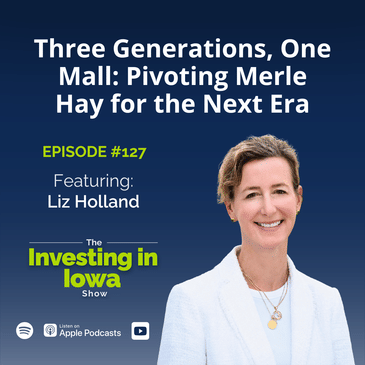
What does it take to keep a 70-year-old mall relevant across three generations of family ownership?
Liz Holland is the CEO of Merle Hay Mall and the third generation of her family to lead the business that originally bought the land in 1956. In this episode, she walks Neil Timmins through nearly three decades at the helm, starting with the day her 87-year-old grandfather called her in 1997 and told her to leave her legal career in New York and move back to Chicago to take over.
Liz breaks down the pivots that have kept Merle Hay alive while other malls have faded. She explains how bringing in Target in 2005 with a mall entrance reshaped the property into a weekly destination, how the addition of junior anchor boxes like Ulta, Ross, and Five Below hybridized the center, and why Flix Brewhouse became an early bet on entertainment in 2014.
She also gets candid about the harder chapters: losing both Yonkers and Sears as anchors within 45 days in 2018, the long road of the Iowa Reinvestment Act award, and the eventual pivot from a Buccaneers ice arena partnership to a national volleyball league, Dinks Pickleball, and a multi-use arena that will host Drake Hockey and the Iowa Demon Hawks.
Liz contrasts Merle Hay's path with Valley West's structural challenges, shares her vision for the next 20 years, and reflects on what her grandfather taught her about location, patience, and the fact that the work is never really done.
🧠 Liz Holland's Top 5 Takeaways:
- Why adding Target with a true mall entrance in 2005 turned Merle Hay into a weekly needs destination
- How hybridizing the mall with strip-center style junior anchors expanded the universe of potential shoppers
- Why leaning into sports and entertainment fights the obsolescence of the traditional anchor box
- How losing Yonkers and Sears within 45 days forced a global rethink of the property
- Why real estate is a three to five year business when it comes to capital allocation and return
👤 About Liz Holland:
Liz Holland is the CEO of Merle Hay Mall and the third generation of her family to run the business, which originally purchased the land from the Passionist Fathers in 1956 and built Merle Hay Plaza. A former Wall Street professional and bankruptcy attorney with federal government experience, Liz returned to the family company in 1997 at her grandfather's request and has led its evolution ever since.
Under her leadership, Merle Hay has navigated the arrival of Jordan Creek, the loss of major anchors, and a pivot toward sports and entertainment, including partnerships with Flix Brewhouse, Dinks Pickleball, and a planned multi-use arena. Liz lives in Chicago and continues to focus on Merle Hay's role as a mid-market, value-driven, regional destination.
Contact Info:
Website: www.merlehaymall.com
Website: www.abbell.com
LinkedIn: Elizabeth Holland
Learn More: www.littleguyloans.com/learnmorepod
[00:00:00] I was ready to go back to the practice of law at the end of my government service in 97 and my grandfather called me up and he said I'm 87 and I'm ready to only come into work three days a week and you need to move back to Chicago and take over my business. It wasn't a question. There was a draft. My number was one. They only needed one person. And so I moved back to Chicago and took over. From cornfields to high rises, office to industrial, houses to hotels and every other asset class in real estate.
[00:00:27] We cover the people, the projects and the profit. Welcome to the Investing in Iowa Show. This show is for go doers, action takers and business owners. It's for people like you who are sick of Uncle Sam taking a huge bite of your apple. If you're looking to get ahead of what's taking place in Iowa, learn who is doing what and how you can get in on the action. You're in the right place.
[00:00:51] Hosted by Neil Timmins, an Iowa native who has been involved in over $300 million in real estate right here in Iowa. Recording in studio from West Des Moines. Here's your host, Neil Timmins. I've got Liz Holland here on the show. Liz, welcome. Thank you. Thank you for having me, Neil. I'm excited you're here. Say for the audience's sake, who are you? Where are you from? What do you do?
[00:01:14] So my name is Liz Holland. I am the CEO of Merle Hay Mall. I am the third generation of the family who originally bought the land from the Passionist Fathers in 1956 and built Merle Hay Mall. And I came back, I got drafted back into the family business at the end of 97. I was blessed to work for my grandfather for two years before he passed away. And so that was a long time ago, 20, almost 29 years. Where'd you grow up?
[00:01:40] In Chicago, outside of Chicago. Our company's always been based in Chicago. So you grew up in Chicago. Where'd you go to school? I went to big public high school and then I went to a tiny college in upstate New York called Hamilton College. Also the alumnus of Governor Vilsack and Christy Vilsack also went to Hamilton College. That was kind of exciting when they were in charge. And then I moved to New York and worked on Wall Street. And then I went to law school and I was practicing law in New York and went to work for the federal government.
[00:02:09] Was all ready to go back to the practice of law at the end of my government service in 97. And my grandfather called me up and he said, I'm 87 and I'm ready to only come into work three days a week. And you need to move back to Chicago and take over my business. Wasn't a question. There was a draft. My number was one. They only needed one person. And so I moved back to Chicago and took over. Yeah. You took over there. What'd you start doing? Well, the only then in the diagram with what I've been doing before and what he asked me to do was that Montgomery Ward was in bankruptcy.
[00:02:39] I had been a bankruptcy attorney. And so my first order of business when I came back to the company was to get control of the Montgomery Ward store, which we did. And we brought in Famous Bar. Okay. How many properties did you guys have at the time? Um, so I, I don't think of it as properties. I think, you know, we were all commercial real estate. We were retail and office. Merle Hayes was always far and away our largest project. And so it was really office. 75% of the portfolio is retail and the rest was office.
[00:03:07] Okay. How many properties outside of Iowa? Uh, four. Okay. Yeah. All right. So you were focused heavily on Montgomery Ward at the time and then that transition took place. And then what did you focus on? You know, he eventually passes away and then how did your role, whatever, or, and, or what's it, what changed in the family dynamics at that time? Well, I think, um, what changed was really kind of bringing the business into the 21st century.
[00:03:37] Right. Because it was still being run for better or worse, like it was 1966 and the business had become much more sophisticated than it had been back in the day. Um, in many respects, if I think back from today, 1957, when they first started leasing Merle Hay Plaza, it's much more similar to the 1956 than it was in that interim period.
[00:03:58] And so the focus was really on retenanting the mall and bringing in tenants like Old Navy opened at the mall in 1999. That was a big deal. We moved Walgreens out. They moved up the road to 70th and Douglas. Old Navy opened and then we were kind of on our way and adding all of those kinds of mall retailers to our assortment. Yeah. What was taking place in that, that early 2000s there? And maybe, maybe walk me through that 2000 to 2010 era.
[00:04:24] Well, you know, I think probably the first thing that we became aware of after we kind of embarked on our retenanting, we renovated the interior of the mall in 2000, had kind of a re-grand opening when Famous Bar opened, um, was really the advent of Jordan Creek.
[00:05:08] Mm-hmm. moving over to take the famous bar store was to bring Target in and take down the Yonker store, um, and transfer that land to Target and for them to open what, you know, is now their store there. What year was that? Uh, Target opened in 2005, in July of 2005. And remind everybody, Jordan Creek opened when? In, uh, 2004. 2004, okay. I think October of 2004, right before Christmas. Got it.
[00:05:37] I'm curious about your perspective at that time. I always wondered at that time to go, well, is Jordan Creek really going to do significant damage to Merle Hay Mall or is it going to do significant damage to Valley West Mall? Because they seem like two different trade areas that serve two different populations. No, I think that's right. I think it was a question of, I think Valley West and Merle Hay got the same disease. I just think it was terminal for Valley West because of the proximity. Exactly to your point.
[00:06:05] Um, and you know, in our view, it was going to barbell the market, right? The market had been pretty tightly, you know, Merle Hay and Valley West are really only less than five miles as the crow flies, but Valley West to Jordan Creek are three miles as the crow flies. So it's those, that's a very close proximity for the density of the communities that are around them to support. And so we knew that time was going to be the determinant factor. And so how are we going to pivot the business even further?
[00:06:33] So Target was the first piece and I've, and then once Target was open and operating and doing great, you know, Merle Hay really became a weekly needs destination for the people in our trade area. It had a full grocery store. Um, it was attached to the mall with a full mall entrance. And so we took kind of the 60,000 square feet that sat between the new Target store and the prior Sears store. And we redeveloped it into those indoor outdoor, you know, where those stores all have storefronts on the parking lot.
[00:07:02] You know, it was, I mean, the original ones were Ulta and Shoe Carnival and Staples. And now it's, and the success of those stores now it's five below Ulta, Shoe Carnival. Ross took over Staples and expanded. And, you know, we're planning to move Old Navy now to the space south of Ross because now they want the same advantage of having the mall traffic on one side of the store and the parking lot traffic on the other, the convenience piece on the other. Seemed to me, educate me.
[00:07:32] Target moves in there. How many locations did Target have at that time in 2005 and how many were situated inside of a mall? So they had about 1,200 stores at the time, I believe, I recall. I know that less, probably 60 of those stores were attached to malls. And of those stores, virtually none of them had mall entrances because we really were very fixed on it being an anchor to the mall and not simply kind of an appendage at the end of a hallway.
[00:07:59] So, and it's worked out for everybody. Well, I can imagine, as you said earlier, it's become a destination that is weekly, unlike a traditional mall, which is nowhere near a weekly destination. Yes. Especially if you're a guy like me. You might get there once a year. Sears used to change that equation though for Merle Hay a lot. Yes. A lot. No, there's no doubt about that. Yeah. But there, and what Sears used to do, Target does actually to an nth degree. Yes. Because. Except for craftsmen. Sure.
[00:08:28] Yes, that's exactly right. But it does have the staples that one needs on a weekly basis. Yes, for sure. And you're there and then the dollars go further as you wander down the hall. I mean, it always marveled me when I first started in this company that our number three or four zip code to that Sears store was Newton, Iowa. Oh, really? Okay. Yeah. Because that was, that was the pattern of traffic. People just got in the interstate and that was the first Sears store. Yeah. Well, that's, that's interesting. Interesting.
[00:08:57] Where did some of this come from conceptually? The idea of putting Target there, the idea of making sure it's attached, not just an opinion, dear word. You know, my verbiage would be turning them all inside out. Right? Yes. Having, having that, having those exterior entrances. Where did this come from? What kind of research? I mean. Well, so it wasn't really any research. It was just kind of being curious and observant and seeing a lot of property. I mean, when I first started in this business, I knew nothing about it other than what went on at the Sunday dinner table.
[00:09:26] And so it was really in watching what other people were doing other places, you know, this is not an, you know, back to the grand bazaar. This is not kind of a new concept. And so it was really, but it really struck me that particularly for who we were and what we were. My view of Merle Hay was if you look at the income distribution bell curve in Des Moines, there's a, you know, because it's the state capital, it's a huge insurance center. There's a big, wide, fattest part of the bell curve.
[00:09:55] And I really felt like Merle Hay as a, as a project appealed to the biggest part of that bell curve. Right? It was kind of high. It was low. It was value. It was convenience. It kind of grabbed all of those pieces together. And Des Moines isn't a hard place to get around. So from that standpoint, I felt like providing the widest opportunity, the widest part of the trade area with the goods and services they were looking for just dictated the choices of those stores.
[00:10:24] When you say a lot of it came from being curious and being observational, did that have you going to other places, other cities that look like the mine? And then what research went into that? How do you, how do you pick Omaha versus New York or, or Council Bluffs or some other place? Well, you know, I mean, what's, what's fascinating about it for me was just because they're doing it in a much larger metropolitan area at a much different level in downtown Paris doesn't mean that there's not a part of that that can translate to Des Moines. Right. For sure.
[00:10:52] And so I just felt like, you know, we certainly knew our customer better than anybody else. Right. We'd been doing business in Des Moines for a long time. And so just having a feel for what that customer was looking for. Target was at the top of our A list for who was going to replace Yonkers when they relocated. And then understanding what were the other stores that we, you know, would kind of draft off Target, right?
[00:11:15] If Target is the boat in front of you, who is the best, you know, operator who can follow that, that progression? And there was no question that that was who it was. And so we're, we're just excited, you know, Kohl's then relocated to the front recently. And now we're looking at another operator north of Kohl's to take that spot. So one of the interesting additions that you put in there was Flick's Brewhouse. Yes. I'm curious about the, how that came to be, you know, some of these I always find interesting.
[00:11:44] What's the genesis of that? And then because it takes a long time from having an idea to go making anything happen. So it's kind of a very curious story. You know, I'm an attorney and I'm admitted to practice in Illinois. So you have to do the continuing legal education and you hate to pay for it. You hate to do it online. And what law firms used to do was they would have speakers come and do like an hour or two hours of continuing legal ed and they would invite potential clients or clients and like me.
[00:12:12] And we would do our two hours of continuing legal ed and then we'd have a sandwich and a beer and kind of meet each other. So I went to one of these and I'm sitting next to a gentleman named Matt Silver. Great. Nice to meet you, Matt. He was working for, I think, a medical device company at the time and I was working for a bell. And so we just became friendly, just sitting there listening to this group and then sitting and having a sandwich and a beer and meeting people. And I would say in 2000, so that was probably 2004.
[00:12:40] In 2012, he called me up and he said, so I live now in Round Rock, Texas, and I'm working for this guy who has this concept. And post-GFC, we're now, we built a theater inside an old grocery store that we had in this strip shopping center and it's really taken off and it's called Flick's Brewhouse. And we look for markets that have big homebrew communities, right? Because we brew our own beer, that's our thing.
[00:13:08] And we look for markets that don't have a lot of competition in the entertainment space. And he said, and I remember you said that you had a mall in Des Moines. Do you still have the mall in Des Moines? I said, I do. He said, let's talk about it. That was the genesis of Flick's. And I went down to Round Rock and I drove around and I saw a couple of movies and I ate the food and I got to know them. We negotiated the lease in their conference room because we were their only second location. Oh, really? Okay. So that's, you know, it's a risky proposition for them.
[00:13:38] It was a risky proposition for us. But the more I got to know them, you know, by 2013, if you could operate an iPad, you could run a movie theater. It wasn't like it used to be with film and changing reels and all the other stuff. And so what was hard about their model was the hospitality piece, the food, getting food to people hot, getting beer to people, all that. They had been in the hospitality business and then got into the movie business.
[00:14:05] They weren't in the movie business and then tried to kind of glom the hospitality piece on. They were in the hard part first. They were in the hard part first. That's a great way of putting it. And so I felt like if I was going to take a flyer on an operator, which you always do, entrepreneurship can be rocky, that this was the one to take a chance on. You know, and look, we rode through the pandemic with them. We worked with them. We're now limited.
[00:14:31] I think we have preferred shares in the company because, you know, they kind of did a debt for equity swap with the people that they owed money to. And so we were happy to be partners with them and keep it going. Yeah, it's fantastic. You didn't work this hard to earn next to nothing on your money. Savings accounts barely moved the needle. Tech stocks, AI stocks. And well, it kind of feels like Vegas out there right now. Rentals, too often times it means tenants, toilets, termites, and not the cash flow.
[00:14:59] You were thinking, well, so I've got an alternative. Little Guy Loans Co-Lending Fund. Qualified accredited investors are earning 10 to 11% annual passive returns. It's paid quarterly by co-lending with us alongside me on short term first lien real estate loans right here in the greater Des Moines area. Their money's backed by a real property, not promises. It stays close to home.
[00:15:24] We've successfully funded well over $10 million in loans right here in central Iowa. So if you want steady income without headaches, click the link below in the show notes. Let's connect. We'll see if it's a fit for you. Talk to me about the future. Maybe in the last handful of years. Well... My knowledge is limited to what I read around now. Right. Yes, for sure. But being in this business, I know there's always way more to the street. Right, right.
[00:15:49] Well, so I would say that the next pivot, right, if we pivoted into Flix to kind of recapture our regional draw in 2014 when they opened, I would say the next pivot really came at the beginning of 2018. At the beginning of 2018, the owner of Yonkers had been in bankruptcy, was in bankruptcy. And by the spring of 2018, they knew that they weren't going to be able to reorganize the company.
[00:16:17] And so they kind of told their landlords, we're closing in August of 2018. Now, Yonkers owned that store because Famous Bar owned that store. So they owned it. We just owned the land around them. And so now we were kind of in dire straits. What do we do? Well, we talked to other department store operators in the state, other places. How can we reposition this, bring you in? It was a beautiful store.
[00:16:44] And so as we kind of went down that path, right, the department store business was challenged. But then in July of 2018, so really a month before we knew Yonkers was closing, Sears announced that they were going to close our store in October of 2018. So now, Neil, what you had within 45 days of each other, because we were prepared for Sears. We had been prepared for Sears for a long time.
[00:17:13] Sears had eroded what was an unbelievable business, right? The merchant to end all merchants was Sears Roebuck. And so we were prepared for that in our other leases. What we weren't prepared for was having two dark anchors at the same time. And so I'm kind of the business person that says you can't let a good crisis go to waste.
[00:17:34] So if I'm now can rethink Merle Hay in kind of a more global way, what is the next thing, right? We knew entertainment by 2014 was going to be necessary because we had to compete with the internet. We had to compete with e-commerce. And so then what was the next thing? And so kind of what we leaned into and in our partnership with the Buccaneers was sports and then sports and entertainment. And what did that look like?
[00:18:03] The idea that you couldn't do this at home in your bunny slippers, right? And so that was fighting that obsolescence of the box was to lean into sports and entertainment. And so that's where we are. You know, we partnered with the Bucs and they elected not to move forward in, you know, June of 2022. I'm sorry, 2024. And we got our final award in 2022. And then we tried to work with them for another two years. So by 2024, we knew that they weren't going to move forward. We still loved sports.
[00:18:32] We still loved entertainment. We had already brought in Dink's Pickleball, right? Once the Bucs kind of, you know, kind of pulled back, we knew that they weren't going to do four sheets of ice, the original plan. And so we brought in Dink's. Dink's built 13 first rate pickleball courts. It's packed. 60,000 visitors a year. I mean, it's really hugely popular. And so, but we still loved the arena. We still loved sports.
[00:18:57] And so what we ended up doing was we partnered with a national volleyball league and practice facility that was going to come in in 50,000 square feet that we were going to deliver to them, brand new building, and put in eight volleyball courts so that they could host, you know, 35 team tournaments. And we were going to have the multi-use arena. Both cities, I mean, what people also may not know about Merle Hay is that the western third of it sits in Urbandale. The eastern two thirds of it sits in Des Moines.
[00:19:26] So I'm going to spend no time in purgatory because the idea that, you know, you're trying to, you know, return the Queen Mary and having to deal with two different city halls and two different political structures is a challenge. But it's, you know, it's been definitely educational. But I would say that we still wanted sports. And so volleyball is huge.
[00:19:50] And what we felt like we were doing, I think, in pivoting away from four sheets of ice. If you think about, okay, Liz, you want to do sports. Well, if you're all in on hockey, that is going to be Mecca. But not everybody's all in on hockey. And so when we went to pickleball and we saw how that traffic changed, and then we thought about other sports that would widen the funnel of potential users, potential visitors, love volleyball, right? And we would still have a nice arena.
[00:20:18] We would still be that now we're the home of Drake hockey. We're going to be the home of the Iowa Demon Hawks, men's and women's indoor soccer. I mean, the men are the national champions. You know, we'll be the home of Central Iowa figure skating. We'll be one of the locations for the Des Moines Youth Hockey Program to bring kids in every day of the week to play. And so we really felt like, back to the original question of how do you broaden your appeal amongst everybody in the market, right?
[00:20:48] Well, we do that with the selection of our stores, right? We're very mid-market. We're value. We're convenient. And now we're just taking that to the next level in sports. And so we're very excited about moving forward. It has been a very complex program. I think it's an amazing program, the Iowa Reinvestment Act, because what it does is it's the state really investing in the future and not giving up any dollars in the past.
[00:21:14] What I think everybody in this process appreciates now, which I'm not even sure the Department of Revenue appreciated when we got this award, you know, four years ago, was that all of the other IRA projects were kind of, if you build it, they will come. They were starting at zero. They were starting at the DICO site downtown. Right. It's a good example. We started with 100 retailers and $71 million of retail sales every year. Very strong base. Even in our crippled state, we were there.
[00:21:44] Nobody had their arms around the complexity of that and making sure everybody's sales tax numbers were correct and all of the inner workings of it. But I think we're now getting there. So we've used the time wisely. It doesn't look like we have, but I can assure everybody that everybody is smarter. You know, we were able to persuade IEDA that the new project was as solid as the old project, that we brought in strong local partners to be there with us, which I think was part of the appeal of the original plan.
[00:22:12] And so we're ready to move forward. It's exciting. It's going to be fun to see the whole transition take place. Now, what's taking place in the last handful of years, last two years or so, is Valley West Mall. Yes. That has gone to the wayside, let's call it. Yes, yes. I'm curious about your take about what – how do you end up in your spot and they end up in their spot? Well, I think it's a couple things.
[00:22:38] I think that they had a different legal configuration, right? Their stores were all leased because it was originally built on a family farm that was ground leased. So when Fred Watts and Bill Valley West Mall, it was on a ground lease. Sure. And so all of those stores were leased, which gave those retailers different flexibility. Sure. Right? I mean, Von Maurer was easily able to relocate in ways that I'm not sure if they had invested in that brand new store would have been the choice.
[00:23:06] And so I just think it was really proximity. You know, and for our purposes, you know, we had already pivoted, right? So when Yonkers was going out in 2018, if we hadn't brought in Target and all of those junior anchor boxes and really hybridized the mall, expanded the universe of potential shoppers by bringing in what were traditionally strip center tenants, I'm not sure we would have survived either. You know, it's similar to what they did at Southridge when they pivoted that project.
[00:23:35] And so I think Valley West had some structural challenges. Literally, it's a two-level mall. Right. That's a different animal. It's harder to hybridize. A two-level project where you have such extreme grade changes at Valley West from the east to the west. You know, and I think the plan that they have now is very exciting. In some respects, it will be easier for them to scrape the whole thing and start over if that's the choice that they take. Right. Because it was all, there was no fractional ownership there. Yeah.
[00:24:05] Going back to your fractional ownership, the idea that you said, if they were forced to invest, they may have not moved. The idea being there that the tenant spending their own real dollars instead of spending landlord dollars through TIs and through putting a lease package, that they're actually stroking the check. Yeah. Almost like that of an owner of a house versus somebody who rents. Yes. Yeah. Yeah. It's just a different capital allocation question for the tenant. How do you give thought to that?
[00:24:33] Even if dollars and cents are the same in your world, operating Merle High Mall, how do you give thought to that? The idea being, if we go this path, it's stickier. That tenant is stickier. Oh, well, for sure. That's, I mean, we sold Kohl's the building they were in in the back in 2008. And I remember saying to the person I was working with who was helping me structure a proposal to them, I said, we have to make them an offer they can't refuse because they're in the back. We want them to be sticky.
[00:25:02] We knew that every, you know, once Rider Corner developed, everybody wanted Kohl's to relocate from Merle Hay out to Rider Corner. Right. And I think, you know, the question really for why would von Maurer move was really, I think, that the writing at that point was on the wall for Valley West. I think von Maurer held it up as long as they could. And certainly Jordan Creek is a spectacular project. And they, von Maurer builds a spectacularly beautiful store and they've done that. And so I think it will get redeveloped.
[00:25:31] If you're a house flipper, execute the burst strategy or do double closings and are in need of money. Little Guy Loans is your go-to lender here in the Des Moines area. Time is money. Loan approvals in 24 hours. Closings in five days. Little Guy Loans was founded by Neil Timmins, an investor just like you. Since he has been in over 10,000 homes in Des Moines, there's never an appraisal. Houses, multifamily and commercial property loans up to $1 million.
[00:26:02] Check out www.littleguyloans.com. 10, 20 years from now, what's it look like for you? What's Merle High look like? You know, I think that it will be done. Yeah. That would be a good thing. You know, the hope is that we have completed the Arena Project, that it will become a super regional destination again, right?
[00:26:25] If we're hosting 35 team tournaments, one of the appeals for this volleyball operator is that we are at the crossroads of two interstates, right? You're three hours from, you know, the Twin Cities, five hours from Chicago, four hours from Kansas City, you know, and two hours from Omaha. That we are very central for those kinds of events. For folks, I don't know about your listeners, but I have three daughters, two 16-year-olds and one 19-year-old.
[00:26:50] And the juggernaut that is sports industrial complex for them is amazing. So we hope to add a hotel because I think that that's a natural. We hope to densify parts of the project where we can.
[00:27:04] What's intriguing to me, back to your question about curiosity, is if in 20 years we live in a world where you don't need a parking lot anymore because you have five people heading to the mall, you call a car for five people and it picks you up and it drops you off and it goes back to a central garage and recharges. That, what do I do with those parking lots, right? What then becomes, what goes into the parking lot, right? Then you really have kind of a clean slate of do you do apartments?
[00:27:34] Do you do more retail? Like what is the demand driver for that parking lot? Very interesting. I had not thought that far ahead in that analysis to go if, not yet, but when that day occurs from the driving standpoint to that, the city's now come down with a different mandate of X number of parking spots per thousand square foot build out. And you get some, you can now get some property. Serious land. Yes. That'll be amazing. Yeah. Very interesting.
[00:28:03] Well, that changed my thought about how I look at some properties in the future. For sure. For sure. Is, is Chicago home for you or is to my? Yes. No, I live in Chicago. I live in the city of Chicago. Yeah. Yeah. Yeah. Knowing what you know now, is there anything you would have done differently? Looking back. Oh gosh, lots of things. Lots and lots of things. Say it at, you know, say it at 97, the day you came into the company and looked at it.
[00:28:27] Well, I think my misperception about this business was I could see what needed to change, but in my tiny 33 year old pea brain, I thought, oh, and then there'll be a day when I'm done. Right? Yeah. You fix it. You leave it, always leave it better than you found it. Right? That's what your grandmother teaches you. And then you are done and then you move on. And what I have learned is that you are never done. So that's been very eyeopening for me.
[00:28:53] And I think these big assets, particularly retail, they stand still for a very short period of time. They're either getting stronger or they're getting weaker, but the static state is a very brief time. And so that's the piece of it that I didn't appreciate when I started. You know, my grandfather taught me so much, but that wasn't one of the things that he taught me. One of the most vivid memories I have of him, Neil, was I was trying to get somebody to come in to, you know, the center.
[00:29:22] Where could we put them? We have to, you know, bring it into the 21st century, grandpa. And so one of the tenants that I was really going after was Bass Pro Shop because they were everywhere. And I remember being on the phone. I finally got somebody on the phone there and he said, well, is it on the interstate? Because if it was on the interstate, we'd be really interested in it. And I said, no, it's on a four-way interchange, but it's really just about a mile south of the interstate. And he said, well, you know, we're really looking for interstate locations. And I said, well, thanks for your time. And I went into my grandfather's office and he was sitting behind his desk.
[00:29:52] And I sat, I kind of threw myself into one of his desk chairs. And I said, you know, Grant, when you built Merle Hay Plaza, couldn't you have built it on the interstate? And he looked at me over his glasses, which I knew meant it was not a good sign. And he said, Elizabeth, when I built Merle Hay Plaza, US 6 was the interstate. And I felt about two inches tall and I slunked out of his office because he had built Merle Hay Plaza on the interstate. It was the interstate that moved. It wasn't, it wasn't, the shopping center wasn't in the right location.
[00:30:20] So that was a long time ago. Yeah. Yeah. Just amazing how things change. What's, what's next for the next generation? What's after you? So there are five in G4 and I would say two of them are cut out for the commercial real estate business. I have shared that with them. One is my brother's daughter and one is one of my daughters because they're the sharks. Between them, they have more executive function than entire rooms of people that I have met. It is quite remarkable. Both the eldest?
[00:30:50] No, no, both not the eldest. Interesting. One is the youngest. My brother has two children. One is my middle daughter, middle by 10 minutes, but still the middle. I mean, they are just, they're animals. The other ones are brilliant. Don't get me wrong. No. But for commercial real estate. That's right. Yeah. That's a different kind. Yeah. Fully. Yeah. Liz, are you ready for the final three questions? Absolutely. If you had one piece of ice beer, 20 year old self. Yes. What would it be? I think don't let the bastards grind you down.
[00:31:20] I think there's a part of, you know, as a person, I'm a Soviet tractor. I have one forward gear and no reverse. So that, that helps, but it can be dispiriting, right? No doubt. And you have to, you have to hear no a lot. And so I think I would tell my 20 year old self, you only need one yes. That would be the best advice. Only one person has to say yes to you. And then you just move on from there and you build, you build the choice after that. Two books that changed your life. Oh, that, well, I was a literature major in college. So that's a great question. Okay.
[00:31:49] So I would say the book that probably changed my life philosophy would be the Odyssey. Sure. For sure. Because I was, Homeric Greek was one of my languages and compelit. So I would say the Odyssey. The other book that I tend to go back to a lot just to reread it because I feel like it's just been very instructive for me coming into a family business.
[00:32:15] You know, I'm forever writing my autobiography in my brain and the title of it would have been The Reluctant Matriarch because I really felt like I didn't so much rise to the power position because I wanted it. It was more that everybody else kind of fell away and I ended up in it. Right. It's like, you know, it's Dwight Eisenhower in the Second World War. He became a four star general because he just kept he stayed alive and that was it.
[00:32:42] But I would say the second book that really has affected me would be War and Peace because I'm such a fan of Russian literature and I feel like it's just an amazing story. And it has, you know, the Russians do family dynamic better than anybody. And so that would be, you know, and Dostoevsky too. Picking two is hard, but I would definitely say War and Peace and the Odyssey. Cast away on an island for a year, you can only get three pieces of data about your business
[00:33:11] each and every month. Yes. Three things must you know every month to know how it's running. The sales report. Only one thing. That's it. That's it. The monthly sales. Yeah. All this, all the tenants would have to report because there are some that we have to chase for the sales. I believe that. But if I could get one complete piece of data every month, all I would need would be the sales reports. Liz, I've asked lots of questions. This has been fantastic. This has been a wonderful education for me in the history of Merle Hay Mall.
[00:33:39] And also understanding the person behind it. And as a result of that, I now understand why it has not just survived, but why it will thrive. So my hat's off to you. What's one question I did not ask that I should have asked? What's interesting about Merle Hay versus other projects of its kind and other projects of its kind that are owned by more institutional owners is we have a very personal relationship with our tenants.
[00:34:07] And so one of the things that we've been very proud of is the diversity of merchants and the diversity of selection at the mall. And I think that that's very unique in the enclosed mall business. And so I would say that seeing it as a partnership and less as a zero-sum game, which I think is essentially, you know, any lease negotiation is a zero-sum game.
[00:34:33] And so I think we very much see our partnership as a positive-sum game back to us continuing to be a preferred shareholder of Flix. And when all the other landlords sold, I said, nope, I'm happy to be a preferred shareholder. So I think that's what distinguishes us from other owners. And maybe it's lent itself to us having a longer lifespan. I don't know if that's the case, but I would say that it definitely makes us unique.
[00:34:59] I'm going to pay you back relative to your longer lifespan comment. When you view the decisions that go into the mall, what time frame are you viewing these through? Well, I think, you know, anytime you implement a strategy, you have to have a rational for the capital allocation piece of that strategy. But you also have to have an achievable time frame. Sure. I will tell you, Neil, that when I first sat down with the mayor of Urbandale in April of
[00:35:27] 2018 to let him know that we needed to figure out what to do with the Yonkers store, because Yonkers was closing in August, I did not think that it would be eight years later that we would still be wondering, what are we going to put in the Yonkers store? Because that is a long time. That doesn't mean that we, I don't think that we've picked the right path and we've certainly navigated a number of minefields. But, you know, I would say in my own mind, real estate is really a three to five year business.
[00:35:54] If you can't see a return on your investment in three to five years, then you probably haven't made the right investment. I appreciate you taking the time to connect. For people, they want to find you, follow you, connect with you, learn about the mall, lease space at the mall if they're a retailer. What can they do? Where should they go? So they should come to merlehaymall.com and abel.com. And you can always find me and you can always find Jared Hassman has done a fabulous job. He's our local leasing person.
[00:36:22] So if you are interested in learning more, learning more about the haunted basement, Jared is your guy. There's no doubt about that. And if you don't know what that is, reach out to Jared and you'll find out. I'll put the links below in the show notes for Buddy. Liz, thank you for being here. Thank you, Neil. Thanks for listening. If you're enjoying the show, may I ask a favor of you? Naturally, subscribe so you never miss an episode. But would you rate and leave an honest written review on Apple Podcasts?
[00:36:49] It does a lot for us here at the show and I appreciate reading your thoughts. Great guests make for a great show. If you know of another Iowan who would be a great guest or you yourself have interest in being a guest, well, get on our radar. Visit Investing in Iowa to fill out an application or recommend a guest. And if you want to connect with me one-on-one, go LegacyImpactInvestors.com. Click on the Invest With Us button in the top right corner.
[00:37:17] And there you can pick a time for the two of us to get on the calendar and connect. Until next time, keep investing in Iowa.