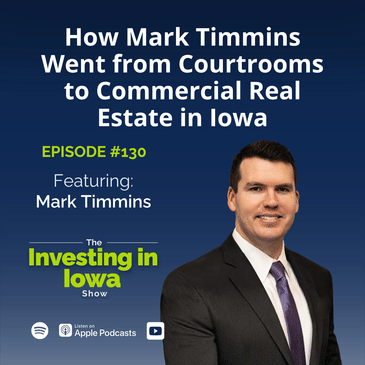
What happens when a lawyer realizes the courtroom is the wrong room for him?
Mark Timmins traded litigation for leases, and over the past decade, has built one of the more active commercial brokerage practices in the Des Moines market. In this episode, he joins his brother Neil to talk through the winding path from the University of Iowa to Ave Maria Law School in Naples, Florida, and eventually to a desk at Cushman & Wakefield Iowa Commercial Advisors.
Mark reflects on his first year in commercial real estate, six deals and roughly fifteen thousand dollars in commissions, and what that grind taught him about relationships, patience, and not chasing quick money. He shares how a book recommendation from Neil opened his eyes to commercial investing, why he and partner Jordan Balaslog have worked exclusively together for nearly nine years, and how the team reads market cycles well enough to buy strip centers in 2020 and sell most of them two years later at cap rates that produced fifty percent returns for clients.
The conversation also covers how Mark and his team stumbled into mobile home parks through a referral to Joanne Stevens and why that niche has become a major focus. He details the current listing of Summit and Grandview, two parks owned by the Haymes family in the Cedar Rapids market, totaling 936 sites, roughly 904 occupied, and listed at $110 million. Nine days after hitting the market, the team had 36 NDAs signed and two offers in hand.
🧠 Mark Timmins' Top 5 Takeaways:
- How reading the market in 2020 led to buying retail strip centers at mid-eight caps and selling most of them two years later at significant gains for clients.
- Why chasing relationships instead of commissions is the only sustainable strategy in commercial brokerage.
- How a referral to mobile home park expert Joanne Stevens opened an entirely new and active niche for the team.
- Why uninformed sellers in the mobile home park space frequently undervalue their assets, sometimes by as much as 300%, and why proper representation matters.
- How the Haymes family's fully integrated manufactured-housing business, covering home sales, remodeling, insurance, safety, and financing, represents the gold standard for park ownership in Iowa.
👤 About Mark Timmins:
Mark Timmins is a commercial real estate broker at Cushman & Wakefield Iowa Commercial Advisors in Des Moines, where he focuses on investment property sales and mobile home park transactions. A University of Iowa graduate and licensed attorney, Mark practiced general litigation before pivoting into commercial real estate in 2016. He has built a long-running brokerage partnership with Jordan Bouslog and, alongside mobile home park legend Joanne Stevens, has become an active voice in Iowa's manufactured housing and homeownership market.
Contact Info:
LinkedIn: Mark Timmins
Website: Iowa Commercial Advisors
Learn More: www.littleguyloans.com/learnmorepod
[00:00:00] You gotta keep pushing forward and make the calls, make the follow-ups, not take the shortcuts, because that's the biggest downfall you can have in this business is trying to get a quick buck. You can't chase money, you gotta chase relationships. From cornfields to high-rises, office to industrial, houses to hotels, and every other asset class in real estate, we cover the people, the projects, and the profit. Welcome to the The Investing in Iowa Show. This show is for go-doers, action-takers, and business owners.
[00:00:29] It's for people like you who are sick of Uncle Sam taking a huge bite of your apple. If you're looking to get ahead of what's taking place in Iowa, learn who is doing what and how you can get in on the action. You're in the right place. Hosted by Neil Timmins, an Iowa native who has been involved in over $300 million in real estate right here in Iowa. Recording in studio from West Des Moines. Here's your host, Neil Timmins.
[00:00:57] I've got Neil Timmins here on the show. Mark, welcome. Thank you so much for having me. Say, for the audience's sake, who are you, where are you from, what do you do? Who I am, I'm your brother. You've known me for a little while. From West Des Moines, Iowa. Born and raised here. Dallian Catholic grad, Iowa grad. And then I am a commercial broker at Cushman & Wakefield, Iowa Commercial Advisors. Focusing on investment properties pretty much across the board.
[00:01:22] Great. Well, say, yes, I have known you for a while, but the audience does it. Take me back to the beginning. You went to Dowling. You graduated from there. And then what'd you do? Where'd you go? I went to the University of Iowa. Made the odd choice to be a history major. After the University of Iowa, I went to a smaller law school. Ave Maria University School of Law down in Naples, Florida.
[00:01:43] After that, I came back to Des Moines, did my internships here, did my first four years of practice here, and then escaped as quickly as possible. What the heck did you come back to Iowa for? From Naples, Florida. Yeah. I graduated Iowa in 2009. Not a great time for new hires with financial crisis just before my graduating class. I'd been open to law school, and I think that kind of accelerated my push towards law school.
[00:02:11] At that point, it was 2012. I got my internships here, worked at Weatherwax Law at On Mills Civic in West Des Moines. And at that time, all the lawyers that had made a bunch of money for years, their 401ks, their retirement plans, were up in smoke. No one was hiring because no one was quitting. So it took a while to find an opportunity, found an opportunity with my previous employer who I held my internship with and got my life experience there.
[00:02:39] It was eye-opening. The biggest thing that it opened my eyes to was law was not for me. What kind of law were you practicing? General practice. General litigation. So pretty much anything under the sun. Wills, trusts, and estates. In the same week, I fought over a tractor. I fought over people's kids. A third of my business was, about a third of my business was divorce litigation. That was my biggest push to get me out of the business. Why not just pivot and then do something else in law? It didn't have my interest, didn't have my love.
[00:03:09] When I graduated, I was looking to work in a company, internal counsel, something of that sort. A little cushier, a little less fighting. And those jobs were not there. After a handful of years in the practice of law, practice of high-stress litigation, I realized I wanted to work for myself. I wanted to be my own boss. And I had a couple brothers that kind of helped me, pushed me along the idea of you don't need to work for somebody else. Work for yourself.
[00:03:38] How did you decide to make that pivot into real estate from law? I had a lot of exposure. I mean, granted, I knew you, obviously. I talked to you at lunch every day. I went home to walk my dog. I said, I got to get out of this. Got to get out of this. You, we talked about your job. We talked about, you know, working for yourself, being an entrepreneur. And that was a big push of it.
[00:04:02] My mom, obviously, and was at our realty, selling residential, I think, at that point for almost 20 years, 15 years. Right. Doing great. And so I'd always had the exposure there. And I just, I had the interest to learn a little bit more. And obviously, you know the story. But it got to a point, I believe it was roughly December of 15. And I said, all right, I'm done. I'll just, I'm getting my license. I already signed up for classes.
[00:04:32] I already took the 60-hour course. I probably got licensed faster than anyone in the history of the state of Iowa. I think I took the 60-hour course in a week while I was working full-time. And I took the 36-hour pre-courses in consecutive weekends. So I was done with all of it within the month of December. And I had to wait until February to get my FBI background check. Yeah, the fingerprint check takes the time in the state. Yeah. So, and during that time, I'd say, I'll just come work for you. And you're like, no. Like, you're going to hate it.
[00:05:01] Like, you're going to be fighting over carpet drapes. You're going to be fighting over this. Because at that time, 2015, all I was doing was residential, primarily on the brokerage side, but some investing. Yes. And you said, you're going to hate this. These pieces, this aspect, this personal, like, personal stuff, the same personal stuff I was dealing with, divorce litigation. And at that point, you gave me a book, Confessions of a Real Estate Entrepreneur. I believe it's James Randall was the author. And I was like, my eyes were open to commercial investments, which they've never been through.
[00:05:31] It really was not even a thought or an afterthought. And at that point, I was like, I could do this. Like, this makes sense to me. It's a little more analytical. It's a little more numbers and cents. I don't have a retail sales personality, which is fine. Yeah, by retail, you mean house sales. By retail, I mean, you know, I'm not going to be selling a ketchup popsicle to a woman in white gloves. What is it? Tommy boy. Yeah. I can surround myself with people like that. My team are much more salesy type. I'm a bit more analytical, a little less personable, you know, at times.
[00:06:01] But I see where my faults are and I surround myself with people that, you know, can cover those and do a much better job in that sense than I can. So that book, Confessions of a Real Estate Entrepreneur, written by an attorney out of the Northeast Massachusetts, Connecticut area. All right. So he's an attorney who then goes into investing primarily in commercial real estate. And it's like chapter after chapter, which just means story after story about some deal he's in or gets into. Yeah.
[00:06:30] And largely working through a career investing in real estate and various tales of that. And it goes through his highs and lows. I mean, he's honest about what he goes through. I mean, not every deal is a home run. And every time he thinks he hits a home run, it might be a, you know, a bunt at best. It might be a strikeout. So it's good to learn from other people's mistakes and from their triumphs. So that's a good one to start with. Yeah.
[00:06:57] Well, I suspect it resonated with you well because of who wrote it. Yes. In attorney. I just thought that would connect well. Yeah. Yeah, for sure. I mean, in real estate, especially in commercial, it's amazing how many people's, this is their second career, a lot of us. And there are several attorneys in town or past, you know, people that have retired at this point that were attorneys that made their way into this business and have done very well for themselves. Peter Brown, Adam Caduce.
[00:07:27] There's a handful of us that saw the light. Caduce, in that sense, was the smartest because he took the bar. I met him, the first time I met him was the day of the bar and he went to Drake. I went to Ave Maria. And Caduce went straight into practicing with R&R, commercial real estate. And he's done, you know, he's done very well for himself. Yeah. All right. You get, you decide to get in. Where do you get in? What does that look like when you enter the field of commercial real estate? Yeah. So I'll, I talked to my connections there.
[00:07:56] We had family connection with Kevin Sullivan. He said he was actually with the firm I am with now. At the time it was an optimum. And Kevin's like, oh yeah, we're not hiring. I was like, all right, well, you know, it's great meeting you. I'll bounce around, see if it's a fit in the future. And then I talked to Nathan Drew, who you've had on your show several times. Yeah, I know Nathan well. Nathan, I've known since junior high. Right. We played against each other in junior high football, played with each other in football in high school. Went to the University of Iowa together.
[00:08:26] Called Nathan. He said, come talk to Kevin. And, you know, there's definitely some stuff you can learn here. Pros and cons. He kind of walked me through the business and took me on almost like a job shadow. And, you know, I was intrigued. I wasn't intrigued with lots of land. He's great in his niche, but that's not a niche that I wanted to go along with. And I talked to another brokerage and they didn't even bother to read my resume before they interviewed me. They're like, oh, we don't have a job.
[00:08:51] And I was like, well, your team said we'd be, might be a good fit since I went to law school. And they're like, oh, you went to law school? You practiced law? And I was like, yeah, we're good. I'm going to go back. You're right. We're not a fit. Yeah, we're not a fit. I completely agree. So I went back and worked with a bit of musical chairs there. Which seems like it happens inside the commercial industry. Probably more routinely than the residential industry. For sure. So I cut my teeth there, learned the kind of sink or swim mentality.
[00:09:19] I went in with the mindset of I'm never working for anybody. Which at the time was completely, I mean, there wasn't going to be any other way. Looking back, I wish I would have found somebody that could have kind of taught me the ropes. You're saying into a team structure. Team structure, for sure. Because you by yourself early in your career, you're not going to make much money. But I was motivated. I knew what I wanted. I just knew that it would take me some time to get that ball rolling. Yeah, all right.
[00:09:49] So you're there. What was the first year like? Oh, it was rough. I know. It was good from really understanding who I am as an individual and entrepreneur. Learning the ropes. When I don't understand something, I read about it. And I'll read 10 books about it. It might take me five months to be able to put some of that to use situationally. But I'm going to read anything in front of me to try to provide me any ammo for an opportunity that I get to. What did you work on the first year?
[00:10:17] I worked on mostly retail at that time. So retail, smaller office. I think I got six deals done. I probably made $15,000, $16,000. Yeah. Big money. Big money. Yeah. So the intent was to build my experience to do what I want to do. And that's, I've been in the business for about 10 years now. And it takes some time, especially if you don't have that person holding your hand or keeping you accountable. I'm my own boss. Get myself accountable.
[00:10:47] And it just took some time. But we had some big wins along the way. And just, you got to keep pushing forward and make the calls, make the follow-ups, not take the shortcuts. Because that's the biggest downfall you can have in this business is trying to get a quick buck. You can't chase money. You got to chase relationships. And that was something that I actually did get from my practice of law. One case is not going to make you rich. One rich client will make you rich or, you know, help you push you along the way. Sure. Yeah.
[00:11:16] You didn't work this hard to earn next to nothing on your money. Savings accounts barely moved the needle. Tech stocks, AI stocks. And well, it kind of feels like Vegas out there right now. Rentals? Too often times it means tenants, toilets, termites, and not the cash flow you were thinking. Well, so I've got an alternative. Little Guy Loans Co-Lending Fund. Qualified, accredited investors are earning 10% to 11% annual passive returns.
[00:11:44] It's paid quarterly by co-lending with us alongside me. And short-term, first lien real estate loans right here in the greater Des Moines area. Their money's backed by a real property, not promises. The state is close to home. We've successfully funded well over $10 million in loans right here in central Iowa. So if you want steady income without headaches, click the link below in the show notes. Let's connect. We'll see if it's a fit for you. Early in your career, you connected up and formed a partnership.
[00:12:14] I did. Yeah. So for those who know me, they know Jordan. Jordan Bouslog. We were the youngest two members of IRL's commercial at the time. And Jordan is, in a lot of cases, the yin to my yang. Jordan is, well, he's extremely capable. He is usually the life of the party, the one that's out there making friends, making relationships.
[00:12:37] And I'm happy to counter that with the research, the analytics, all that good stuff. Jordan and I have been working exclusively with each other for almost nine years now. So after about a year into IRL's commercial was when we've basically solidified our partnership. Yeah. Since then, we moved to Cushman and Wakefield. We moved to Cushman in 2019, April.
[00:13:02] And I started in 16 at Iowa Realty Commercial, moved about three years later to Cushman and Wakefield Iowa Commercial Advisors. And about two years later, we picked up another team member, Brandon Fitz. Fitz is very much outgoing, very much a salesperson. But he's very organized, very smart. He likes to work on things I don't like to work on, which is great because we don't overlap. So he's focused predominantly on medical and predominantly on leasing.
[00:13:30] So whereas I prefer sales and investments. So if I get lease work, if I get medical work, it goes to Fitz and vice versa. So it's, and then Jordan sits a little bit on the fence. He does a good job on both. So when did it feel like you guys are, you really found your footing where we're chugging along very nicely in this commercial space? I feel like 2020, it was probably really like COVID where a lot of people were scared and didn't know what was going on.
[00:13:57] I don't know if it was because I had the foresight or because I didn't know any better, but we saw people, a lot of people scared about retail in particular. And while landlords had some issues on the retail side in the short term for COVID, most, a lot of those retailers did just fine by the end of 2020. So we said, buy, buy, buy. There's deals at like mid eight caps. So snatch them up, buy everything you can. We think that year we did, I don't know as far as volume goes, but I think we sold six
[00:14:26] or seven retail strip centers, anywhere from two to $8 million. And again, we saw the writing on the wall with the interest rates popping up. And I believe that was what, 22? 22, we said, sell, sell, sell. So we had several groups, including yourself, sold for, you know, made 50 cents, 50% returns in a two-year hold because the money was still cheap relatively and it was going to get a lot worse.
[00:14:53] So we sold pretty much everything that we bought in 20, we sold again in 22. So we doubled up on a lot of properties that year. And we have a lot of, still to this day, a lot of those buyers and, you know, buyers slash sellers come back to us and say, what do you got? What do you got? Back then in that, that sale era, there was a lot of C-class retail transacting at still, you know, like seven caps or maybe just slightly. Oh yeah. Sub-sevens. Yeah. Which is not the case today.
[00:15:21] Our best one we bought was a deal. We bought it for like a mid to high eight cap. We've, that was six and change million bucks. Two years later, we turned around and sold it. We actually lost a tenant, sold it for a six and a half cap and made the client million five, million seven in a 14, 14 month hold. So yeah, pretty, pretty incredible. Yeah. All right. Then at some point you, you decide that there is a unique and underserved asset class called mobile home parts. Yeah.
[00:15:51] That one, I'd like to think I had the foresight on that. I think part of that is, part of that is luck. Part of that is our, our group's character, just how we work with each other. If we don't know something, we're going to refer it out. We had an opportunity to list a mobile home park in Dubuque, Iowa, 35 sites, 29 occupied, about a million dollar deal. This was in the dark times of, what is it?
[00:16:16] 23 when interest rates went through the roof, nothing selling on the investment side. And we tried to refer to Joanne Stevens and Joanne, we always refer to her as the queen of mobile home parks, especially in Iowa. But I mean, predominantly really Midwest and nationally. And we tried to refer to her and she said, you know, I'm kind of slowing down a little bit, but I can show you, you know, we can deal with the underwriting.
[00:16:42] We can do it together, show you how to do it and then chase it and see how it goes. And so we underwrote the deal, brought it to market and I didn't think anything of it. Five days later, we had, I think eight offers on the deal, which was just incredible at that time because interest rates were terrible. Interest rates were in that industry would probably north of seven and we're selling an eight cap. We have eight offers and most of them are full price offers or darn close to it. And Joanne calls back a couple of days later and she said, how many offers do you have? We're like, we have like eight offers.
[00:17:12] She's like, oh yeah, that's pretty good. I'm thinking about stepping, you know, retiring or would you have an interest in taking over my business? I had known Joanne for a couple of years. We worked at the same company in previous years. I was absolutely this, like my eyes are open. I see this and me being the way I am given that opportunity, I think I read every mobile home park book, which turns out there's not a ton. So the biggest book that made an impact is Dave Reynolds and Frank Rolfe's book.
[00:17:40] I can't remember the exact title, but it's Mobile Home University is their outlet and it's like a 400 page book, like big binded book. And I think I read it in three days and it really walks through how to price everything out, how to, you know, different expectations on expense ratios and all that good stuff. I mean, it's a little dated now just because expense ratios are higher than they were even five years ago.
[00:18:04] But it was definitely an eye opener and I got all the basic lingo that Joanne didn't have to teach me. So I could try to come in the door at a job versus, you know, a crawl and try to add some value. So since then, Joanne, Jordan and I, since Fitz is not in the investment side, it's Joanne, Jordan and I have been doing mobile home parks together. It's been what, about three years now, which feels like it's been a lot longer than that.
[00:18:31] Working with Joanne, she's about as classy as they come. There's no doubt about that. She's been on the show. An impressive one. And a real pro and trying to provide the value and see to the relationships as well as she has over the years is, has been the learning experience of my life. I referenced earlier that when I, when I got in, I did not want a boss. There's no way I can, uh, Joanne's not my boss.
[00:18:58] We're, you know, in a partnership at this point, but had I worked with Joanne in 2016, it would have been incredible. Just the dynamics and the changes that we've seen in that industry that predate me just by a couple of years. Absolutely incredible. Uh, the fact that the private equity groups have swarmed that industry has made everything to an extent, let's say 40 plus units attractive to private equity. So we typically deal with sophisticated buyers.
[00:19:25] It makes our job a little easier because we're not holding hands or chasing deals and we don't have to educate. Uh, we have to educate the sellers a lot of times because a lot of times they're to some extent isolated. Well, a lot of them with a single park, not, yeah, not a portfolio and they don't sell every day. No, they don't sell every day. And the biggest issue is they don't know what kind of value they're sitting on. Correct. A lot of these people inherited their parks. So dad was in construction, uh, built this park in the 1980s.
[00:19:54] Kids one, two, and three pick up the park. They may have been gone for 20 years and come back home and they help run the park. And then unfortunately mom or dad passes away. They inherit this property. They don't know what the value is. Uh, so we see there's a lot of off market transactions in that industry where seller is uninformed and buyer's private equity. So they know everything about it. They know everything about the industry. They know where the rates should be. And our job, at least in those relationships is to try to jump in on if we can rep mom
[00:20:24] and pop, that's fantastic. We can say, Hey, it's not worth X. It's worth X plus another 50%, 100%, 150%. I mean, there's a lot of times where people undervalue assets by the worst I've seen is 300%.
[00:21:07] Wow. And I'm putting it cheek. Of course. Um, and in my mind, like in all seriousness on something extraordinarily impressive is listed a monster, a monster park. Tell the folks, give the folks some color about that. because I think this would, for anybody in the dollar and cents associated with this, is literally, it's eye-catching. I'll disagree with a little bit. It's not impressive until we sell it. So, fair. Yeah. That's a true broker stance. They don't count if they don't close.
[00:21:36] Now, through Joanne's relationships throughout the years, we were able to work with the Hames family, who's just an amazing family. They're a little different in the sense of a mom, you know, what we say, mom and pop owner, quote unquote. They are the gold standard for manufactured housing, maybe not in just Iowa, but really across the country. Their properties are unicorns. So, between their two parks, 936 sites, 100% physically occupied,
[00:22:04] roughly, I think as of today, we brought it to market last week. As of today, there's roughly 904 occupied homes. The family owns the remainder, so roughly 32 homes. Here in Iowa. Here in Iowa. So, two parks, almost side by side, almost with an eye shot, in the Cedar Rapids, that kind of Southwest Cedar Rapids market. They are, along with that, not just the parks, they have a fully horizontally integrated business model,
[00:22:31] which includes the home sales business, a home remodel business, an insurance business, home insurance for park. For the parks. For the parks. Yeah. Just specifically the homes, not the actual park. And then a finance business. So, they will fund and finance home sales within their parks. So, it is, again, unicorn, gold standard, what have you. It's an extremely impressive feat that they pulled off. And they run it extremely efficiently. Yeah. And they're just generally great people.
[00:23:00] And we are extremely, extremely excited to be a part of the transaction. What's the number? What's the asking price? So, the audience has an understanding of what we're talking about. $110 million for the whole package. And you've had it on the market how long? We bought it to market nine days ago. Nine days ago. And how many offers do you have? We had a couple pre-market offers. So, at that point, it was two. And they were aggressive offers as well. Yeah. If you're a house flipper, execute the birth strategy or do double closings and are in need of money.
[00:23:28] Little Guy Loans is your go-to lender here in the Des Moines area. Time is money. Loan approvals in 24 hours. Closings in five days. Little Guy Loans was founded by Neil Timmins, an investor just like you. Since he has been in over 10,000 homes in Des Moines, there's never an appraisal. Houses, multifamily, and commercial property loans up to $1 million. Check out www.littleguyloans.com.
[00:23:57] There's so much money inside this industry. It's incredible. We've had, to date, 36 nondisclosures signed. We're in constant conversations with probably 20 of those, 20, 25 of those groups. We're going to have some tire kickers, obviously. Sure. But, and they're all groups that, you know, a lot of these are publicly traded groups or groups that have an extremely good background and investment philosophy. And they see a lot of value in this property. There's potential upside there, too. So we've been really happy with our activity so far.
[00:24:27] We'll probably, in the next 10 days, so probably about by the time this airs, we're going to be probably listing our date to provide your offer, to even be considered. Sure. And then we'll move forward from there. So that'll probably be the end of June when we're asking for our call for offers. Yeah, you know, it's wildly impressive. Certainly inside this industry, specifically in Sasset class, you know, brokers, both on the residential side and the commercial side, occasionally get pushback about their fees for service. And at the end of the day, it's about the value one adds.
[00:24:57] And I think inside the mobile home part realm, there is so much value that can and is added with proper counsel. For sure. Because there are just so many moving parts. And as you said, the people just don't have any real conception in many cases, what these things are worth. And part of that is the level of transactions that take place off market. Yes, for sure. I mean, like I said, a lot of these owners are isolated. So they might know a couple of the owners, let's say Cedar Rapids market,
[00:25:27] the 8,000 sites in the Cedar Rapids market, this being 16% of that. Right. Probably 10 to 16% of that. There's no place you can go that lists what everyone else is paying for rent, what their services are. So a lot of times when we're doing our research, it'll take three, four, five days because we got to call the different parks, see what their rents are, see what their services are, whether we're driving it or seeing pictures, what the properties look like. The best properties don't always get the best rates because a lot of,
[00:25:56] I mean, a lot of times the best properties are owned by people that aren't pushing rates. The middling properties that might be owned by private equity, there's a fair chance that they are going to be getting better rental rates than the nicest thing in the market. Yeah. The underlying difference between those two is who manages it and how they manage it. Exactly. That's the biggest thing is who manages, how do you manage, what's your rates, what can you cut on costs, what are you pushing through to the tenant that should be tenant costs, what are you retaining. There's, you know, 50 different aspects that you got to look at
[00:26:26] when you're underwriting a different property. And then ultimately sometimes you're just like, that's not right. It's like, this should be more. I mean, Hames's properties in particular, Summit and Grandview, they are the gold standard. They're in the nicest parks. You drive through, it looks like what Stepford vibes, kind of like community and everything is nice. Lawns are mowed, concrete's in great shape. You have community buildings, you have great management, like across the board, everything is in fantastic shape, but they're not all that way.
[00:26:54] A lot of times they can be in very rough condition and have an opportunity to provide value to those tenants for the rents that are getting paid by shaping up operations and bringing in value. It's not just what are the rents being paid, it's what are the costs that are going out. Hey, and a little cheeky here, but size matters. What I mean by that is you could have the exact same thing. One's 50 units, one's 100 units, and the 100 units go sell for something materially different.
[00:27:21] And that's because the buyers at the 100 unit pool are not the same. Yeah, you could, I mean, it could be 150 basis points. It could be sizeable. Yeah. I mean, we've sold very nice parks that are 80, that don't quite, I mean, a lot of times if it's in a metro, private equity will look at 50 sites, but we sold one that was 80, that was in very good shape. There was some issues, and it sold for considerably less than if it was 100, just because of the eyes on it. Yeah. So. 2026, what are you most excited about?
[00:27:51] I'm going to have another child. So my wife and I are pregnant. I'm going to have a little boy, and. Yeah, it's fantastic. We are. Number two. We are so excited. Number two. November. Number one will turn two in November, and number two will probably be there in the next week. Yeah. So we're blessed. So. Yeah. Can't wait. It's fantastic. Selling this property would be nice too. But we'll see. Number two, child. Mark, you ready for the final three questions? Maybe.
[00:28:18] If you had one piece of advice for your 20-year-old self, what would it be? Go to law school. Don't practice law. What benefit is derived as a result of going to law school? Your association with contracts. Really figuring out what you're negotiating. What are your five, ten points of contention? So typically when I walk into a negotiation, I know I have the things listed out. So these are our pressure points. What can we give? What can we take? Like what's a non-starter or what's a deal killer?
[00:28:48] I would definitely say if you're going to law school, do your internships for litigation. Get more exposure on the real world in that sense. Because it is definitely different than reading a book about somebody negotiating a contract. But for sure, there is definitely exposure there that I've utilized to my benefit over the years. Okay. So that's for your 20-year-old self. But let's say you're a 20-year-old today. Can't Claude just do it? There's an argument out there that I hear made from my peers who have kids, you know, about the same age as my kids going, yeah, dude, I'm not sending my kid to law school.
[00:29:16] They're going to use AI and a bunch of attorneys are going to get replaced. But let's say you. Relative to the thinking, the line just went down. Yeah. I mean, critical analysis is more important for, you know, we use Claude. I love Claude. It's a tool. It's not a solution. So critical analysis on negotiate, it's not going to negotiate for you. Are you going to call Claude and say, hey, can you talk to this guy for me? It'll provide you options. It'll provide you context. But it's never going to be able to give you the life experience
[00:29:44] to make a critical decision that, you know, may cost your client hundreds of thousands, if not millions of dollars. So you really have to do the hard work and use Claude as a tool. And that, because that's all it is. It's not going to do your job for you. It will help you do your job better. Two books that change your life. I would say, I mean, we could easily say Confessions of a Real Estate Entrepreneur. That kind of pushed me on the route that I am today. And I would never turn back. I love what I do. The lifestyle associated with it. I love that I, you know,
[00:30:15] that I'm not practicing residential real estate or law because the lifestyle is better. I can golf. I can see my wife and kid, soon to be kids. And that's something that both of those professions would have infringed on. If you were cast away. Second book. There you go. Second book. I was already moving on. Yeah. Come on. I would say, I think everyone else said rich dad, poor dad. Probably the same answer. It definitely changed my opinion on, in our job, we don't have a matching 401k. We don't have this and then.
[00:30:45] It changed my mind on, you know, being rich. Quote unquote rich versus having wealth. And I think that's important because especially in our industry, not having that support structure, not having the 401k match, not having all that good stuff. You might have a bad year. You need income. Right. Well, you should have made those investments. Make sure that that income's coming. So if you were cast away on an island for a year, you can only get three pieces of data each month about your business. What three things must you know every month to know how your business is running?
[00:31:14] I would say lead report, another generic, probably lot rents in different markets. And then probably interest rates, honestly. That's... Interest rates, the idea behind that being that would give you an idea from a cap rate perspective. I mean, a lot of times, I mean, a lot of the deals we sell are below, or they're going to be negative leverage.
[00:31:41] So, but it's how negative really is what it comes down to. So deals that we see off market where rents are low relative to market, they're going to be three, four, five caps. I mean, they're going to be below interest rates. Well, I mean, I understand that. They're below interest rates because they're not modeling this to year one. They're modeling this to year three or year five. Yeah. Yeah. What's their state of life's cap? Ultimately, that's number three. Number two is more important for us. What are the lot rents? What do you want to know about interest rates?
[00:32:10] What does that inform you of if you had a report each month about interest rates? It is important regarding relative cap rates, but it really is kind of a how competitive is this deal going to be, especially for the stuff that private equity is not going to chase because those do have relative... They're going to have interest rates that are normal in our markets, seven, eight percent for 35, 40 sites. You're going to see seven, eight caps. Given today's borrowing rate. Yes. Therefore, if today's borrowing rate fell by 200 basis points,
[00:32:38] you would see a cap rate that looks materially different. We're going to drop by 150 to 200. And institutions, those have become even more aggressive. Exactly. Okay. Understand there. Mark, I asked lots of questions. What's one question I did not ask that I should have asked? Got nothing. I think we covered quite a bit. That's a lazy response. Yeah. Wow. You didn't ask if I wanted a beer when I walked in. That's true. Which was rude. That is true. I am sad to say...
[00:33:04] You have a giant refrigerator and there's like six bottles of water. And I think there's literally nothing else. It's true. Yeah. There might be five ice cubes in the freezer and nothing else. So just various states of water. Yes. We do have room temperature water here as well. I know. That's what I picked. But this has been a great conversation. I appreciate you taking the time. For people, they want to find you, follow you, connect with you. Where can they go? What should they do? Just look for me on LinkedIn.
[00:33:33] Mark Timmins and Iowa Commercial Advisors is our website. We've got a great team. So if it's not me that's a fit, pick one of the other guys, the industrial guys, the office guys. Everyone does a great job. Links are below in the show notes, everybody. Mark, thanks for being here. Thank you so much. Thanks for listening. If you're enjoying the show, may I ask a favor of you? Naturally, subscribe so you never miss an episode. But would you rate and leave an honest written review on Apple Podcasts?
[00:34:01] It does a lot for us here at the show, and I appreciate reading your thoughts. Great guests make for a great show. If you know of another Iowan who would be a great guest or you yourself have interest in being a guest, well, get on our radar. Visit Investing in Iowa to fill out an application or recommend a guest. And if you want to connect with me one-on-one, go LegacyImpactInvestors.com. Click on the Invest With Us button in the top right corner.
[00:34:30] And there, you can check the time for the two of us to get on the calendar and connect. Until next time, keep investing in Iowa.