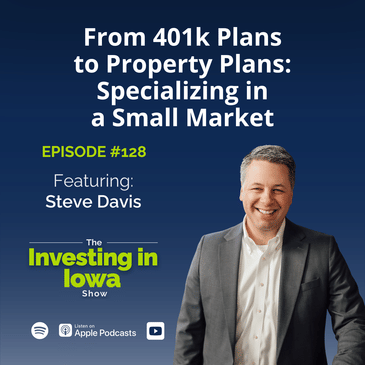
What does it take to become the only CCIM-designated broker in your entire market?
Steve Davis joins Neil Timmins to share how a financial advisor-turned-commercial real estate broker built a thriving practice in Dubuque, Iowa. From his early days at 801 Grand in Des Moines to launching Equity Real Estate Group, Steve's path is a study in patience, specialization, and serving clients first.
Steve walks through his transition from W-2 employee to full-time broker in 2018, the role COVID played in earning his broker license, and why CCIM training opened doors to bigger deals and a wider network. He also explains how a partnership with developer clients, retail leasing, and industrial transactions now drives his business.
Looking ahead, Steve is partnering with Greater Dubuque Development Corp on a market-wide commercial inventory project, growing his brokerage team, and mentoring agents who want to move from residential into commercial work.
🧠 Steve Davis' Top 5 Takeaways:
- How a fiduciary background from financial advising shapes a client-first approach in brokerage
- Why does earning a broker license and CCIM designation set Steve apart in a small commercial market
- How focusing on geography rather than a single asset class works when you serve a smaller city
- Why collecting proprietary market data gives both brokers and the community a long-term edge
- How collaboration and mentorship inside a brokerage produce better outcomes than competition
👤 About Steve Davis:
Steve Davis is a commercial real estate broker and property manager based in Dubuque, Iowa. He is a partner and managing broker of Equity Real Estate Group and a partner and managing broker of Premier Property Management Group. A graduate of Buena Vista University, Steve began his career in financial advising in Des Moines before returning home to Dubuque, where he later transitioned into real estate full-time in 2018.
Steve holds the CCIM designation and is currently the only CCIM-designated broker in Dubuque. He focuses on development, retail leasing, office, and industrial transactions, and partners with Greater Dubuque Development Corp on commercial market research.
Contact Info:
Website: www.equityrealestatedbq.com
Website: www.premierdbq.com
LinkedIn: Steven Davis, CCIM
Learn More: www.littleguyloans.com/learnmorepod
[00:00:00] David Davis on Specialized in a Small Market, The Investing in Iowa Show, Neil Timmins
[00:00:30] David Davis on Specialized in a Small Market, The Investing in Iowa Show. This show is for go-doers, action takers, and business owners. It's for people like you who are sick of Uncle Sam taking a huge bite of your apple. If you're looking to get ahead of what's taking place in Iowa, learn who is doing what and how you can get in on the action. You're in the right place. hosted by Neil Timmons, an Iowa native who has been involved in over $300 million in real estate
[00:00:55] right here in Iowa. Recording in studio from West Des Moines. Here's your host, Neil Timmins. I've got Steve Davis here on the show. Steve, welcome. Thanks, Neil. Thanks for having me. I'm excited you're here. Say for the audience's sake, who are you? Where are you from? What do you do? Sure. Steve Davis. I'm from Dubuque, Iowa. I am commercial real estate broker and property
[00:01:17] manager. So I have a partner and managing broker of Equity Real Estate Group and also partner and managing broker of Premier Property Management Group, both in Dubuque. Where'd you grow up? Born and raised in Dubuque. Graduated high school there and went to school out in Storm Lake, Iowa. Went to college on Buena Vista. And then after college, graduated, moved down to this area,
[00:01:44] Des Moines, actually. And spent about three years here before moving back to Dubuque. What'd you do here? I was an assistant, sales assistant, a financial advisor, advisory firm. So that came about as the result of an internship that I did for a couple of years, actually out in Denver, Colorado. Had family out there with some connections and spent a few years out there or a few months, actually, out there enjoying Colorado and learning the ropes of financial advisor business.
[00:02:12] Turned into a job here. So I was hired out of college to do that. It was working out of 801 Grand downtown. Remember it vividly a couple months into the job is when September 11th happened. So quite the experience and the memory for me every time I come back to Des Moines to recall like what that scene was, looking out the windows at the airport and all the planes coming in and that type of stuff. But yeah, really good experience for the first few years after college. What'd you learn?
[00:02:39] I learned that Des Moines was a really small town. It seemed big coming from Dubuque, but it's really all about connections and who you know, learn how to network, learn how to be an advisor to people rather than a broker. And that kind of quality just, you know, followed me throughout the rest of the life so far in the roles that I've played since then. The core of your training was being a financial advisor, a fiduciary.
[00:03:05] Right. Some real estate agents are heavily transactional. They do not, they do not assume a fiduciary responsibility for their clientele. How did that play an impact in the totality of your career coming from that training? Well, I understood the importance of working for the client and putting their interests ahead of my own company. And having that piece, that integrity piece is, is a clear differentiator among brokers and advisors.
[00:03:32] Sure. Yeah. So you decided to go home, head back to Dubuque. What, what was the transition there? Yeah. So my wife now of 20, 23 years, we were high school sweethearts, went to be invested together, lived in Des Moines together, and we decided to get married. This was 2003 and 2004. We decided we want to start having kids and felt more comfortable back home in, in Dubuque. Small town, knew the doctors, knew the
[00:03:58] schools, all of those types of things. It was, you know, grandparents are there to babysit. So it was, it was more of a comfort level thing to move back, but a really good transition. What'd you do from a job standpoint to make that change? Yeah. So it, with the financial advisor role, I was assistant to a few advisors that were working heavily in K stuff and also REITs, which kind of how I somewhat became interested in real estate, but heavily in the 401k world. So I worked for a plan administrator. I took a job with a print plan administrator back in Dubuque,
[00:04:27] a client consultant role. So traveling around the country, servicing, you know, 401k plans for employers. Yeah. So yeah. How'd you get interested in real estate? Picked up a single family rental in a, while I was a W2 employee, you know, just was sacking money away in a 401k and knew there needed to be more than that. And this was of interest handyman work, construction jobs growing up and all of that type of stuff. So, you know, the structures and that aspect was pretty familiar. So it seemed like a natural fit, had some family members ever looking
[00:04:55] to do something. So we pooled a little bit of money together and, and bought a single family rental and turned out to be a really great investment. So we were kind of hooked at that point. You didn't work this hard to earn next to nothing on your money. Savings accounts barely moved the needle. Tech stocks, AI stocks, you know, it kind of feels like Vegas out there right now. Rentals too. Oftentimes it means tenants, toilets, termites, and not the cashflow you were thinking.
[00:05:22] Well, so I've got an alternative. Little guy loans, co-lending fund, qualified accredited investors are earning 10 to 11% annual passive returns. It's paid quarterly by co-lending with us alongside me on short-term first lien real estate loans right here in the greater Des Moines area. Their money's backed by a real property, not promises, stays close to home. We've successfully
[00:05:47] funded well over $10 million in loans right here in central Iowa. So if you want steady income without headaches, click the link below in the show notes. Let's connect. We'll see if it's a fit for you. What year was that? That was 2011. Okay. Walk me forward then in your experience in real estate. At what point did you make a transition into the industry full-time? Yeah. So we had bought a couple of smaller multifamily properties in the meantime. I was
[00:06:14] working, I had moved from the 401k job to selling group health insurance for a health plan that was owned by a multi-specialty clinic in Dubuque. So we, that role was largely working with employers to deliver benefits to their employees. Kind of interesting to understand the dynamic between HR directors and CFO, CEO types. And so really in that role, it was, it was interesting through the
[00:06:40] Affordable Care Act and that rollout and figuring out how to provide value to clients when everyone else was talking about the political aspects of that. Just kind of dig into that and understand it as best as possible to deliver value to your client was my approach. After the, you know, after a few years of double digit increased renewals every year and costs really not being maintained, I definitely got repetitive and just not interesting to me anymore. Eventually that I knew that I needed
[00:07:07] something different. So kind of went back to the roots a little bit and said, what's really interesting to me? And every time I thought about, you know, my free time essentially is all in rentals and houses. What's the housing market look like, um, property values, those types of things, what's going on, um, you know, across town, you know, the new, the new thing, um, that that's all really interesting. It's tangible.
[00:07:33] So, um, I ended up looking for a new career path connecting with a real estate broker when we talked about buying, you know, potentially buying a business to run and all these different types of things. I, I considered, uh, was talking to a real estate broker about that. And, um, he said, have you considered real estate? I'm like, nah, I don't want to do that. You know, um, residential agent and that type of thing doesn't, doesn't really interest me. But the more we talked, the more, um, I knew it kind of really fit my
[00:08:02] personality and not so much on the residential side, but the commercial brokerage did working with employers. It's, you know, largely analytical. Um, you're looking at numbers and strategies and that type of thing rather than real, the real big emotions that go into that. So ended up quitting basically the W2 cold Turkey and jumping into real estate brokerage full-time in 2018. Worked for at that point, a residential firm and was doing a lot of residential deals to work into
[00:08:30] the business. At the same time, I had been focusing on, um, multifamily sales was a really good transition for me into the commercial world. Um, again, much more analytical and really focused on the deal rather than the emotions of, of the client. So I was doing a residential deals in the meantime for just personal cash cashflow reasons and, and, uh, support the family. We had three young kids at the time. So it was good, but I was doing as many multi small multifamily deals as it was single family home
[00:09:00] residential deals. Yeah. Walk me through COVID hits and what did your world look like then? Yeah. So COVID hit and probably like most people sat at home for a little bit and wondered what's going on. Um, I actually jumped on Iowa realtors had converted a lot of their stuff, their trainings and classes to virtual. They were kind of in the process of doing that at the time. So I jumped down and did the classes and ended up getting broker licensed during COVID. But after a couple of weeks,
[00:09:26] not being able to be out and about too much, I said, I can't sit here anymore. So I, I, I did and, and our profession was rendered, you know, a, an essential business. Um, so we were out and about doing deals and it was a vibrant time and, and we did quite a bit of, of residential stuff at that time. Um, that was really the turning point though. The broker license versus just a salesperson license was kind of key in my transition to being fully commercial. So the brokerage that I
[00:09:55] was with is widely known as residential brokerage. I wanted to set myself apart as a true commercial broker that focuses only on commercial, which is completely rare in Dubuque. It almost didn't exist before that. And so getting the broker's license allowed me more flexibility and aligning with a firm or creating my own. That is truly a commercial, commercial outfit that started the training and courses and all of that type of stuff. That reflection period during COVID really kicked off the
[00:10:24] desire and, and understanding of how CCIM could benefit me. And so I started in on those courses at that time too. All right. So for anybody who does not know what CCIM is, maybe use a little detail. Yeah. Certified commercial investment member, um, CCIM Institute, worldwide Institute of commercial real estate professionals. And it's for brokers and anybody else that is, does anything with commercial real estate. So lenders, uh, 1031, uh, intermediaries, uh, attorneys, uh,
[00:10:52] appraisers, everybody that is, um, aligned with commercial real estate in some way is, is part of CCIM. Merely, um, provides a really good education, uh, and, uh, all of the resources needed to analyze deals, um, site selection, you know, demographic information, all of those types of tools are available to CCIM members. It also, for me, one of the biggest values that CCIM has provided
[00:11:18] to me, just a wider network of people, mentors, other brokers that were doing deals with in a small town like Dubuque. Uh, there I am the only CCIM designated member there. And so when there are some of the bigger firms that are representing national clients that have a presence in Dubuque and they need assistance on the local level, they're seeking me out knowing that I've had the training and the, and the education needed to help them complete the deal. Well, yeah. What kind of assets are you
[00:11:47] focused on asset classes? It's interesting. Dubuque is pretty small. So in the commercial real estate world, I'm a generalist, but I've done some coaching recently and it's, it's pretty interesting where they're suggesting that brokers focus on a specific asset class or specialize in something. Sure. And there's three questions that, that they ask. What are you most interested in? Where is your knowledge base? What are you qualified to, to specialize in? And then where's the deal velocity? So when you blend
[00:12:16] those two, uh, those three items together, that should help you define what that specialty is. And for me, especially in Dubuque and, and working primarily in that market, the specialty is commercial real estate and that geography. So we're doing a little bit of everything. It's kind of early on in the brokerage career, uh, in the commercial focus was small lease deals worked. It was fortunate enough to begin working with a really excellent client, a developer that was doing big things in Dubuque.
[00:12:45] So we were sourcing land for, you know, a single family developments for commercial strip buildings and, and various projects. So really got latched onto this development process and, and learned a bit about that. At the same time, we're leasing those retail units that were being built. And then obviously looking at the investment sale process to sell that to an investor so that those dollars could then be reinvested by the, by the developer. So, um, it's a whole process. So a lot of development
[00:13:11] related stuff, some retail, and we've been doing a few office deals lately, which is, there's not a ton of volume there in Dubuque, but that's been kind of a bright spot lately. And then, uh, industrial is, um, where most of the transaction volumes come from as of, as of late. So 2026, what are you most excited about? Most excited about our brokerage. Um, so, um, I started equity real estate group in 2022 and partnered with a gentleman by the name of Carl Dolter, uh, last year, last January and his team,
[00:13:40] um, we are growing and, um, we are, um, bringing on agents that, um, in, in some cases have want to have a focus on commercial and sort of helping them transition from residential to commercial. And so that's exciting. We do have agents and teams that also work primarily in residential. So we do a little bit of everything in the firm, although some of us really focus and specialize
[00:14:06] on commercial. So that growth is really exciting, but primarily the, um, just brought on a, an intern who's going to be a junior at the university of Dubuque happens to be my son. And we've got him working on a project that will, and we're partnering with greater Dubuque development core to take inventory of the market in Dubuque of all commercial property, really get good numbers for inventory levels and, you know, identify where there's needs, uh, where there's opportunities,
[00:14:31] um, and really focus on growing, growing Dubuque as a community and having that data, allowing us to do that. Obviously it'll be beneficial for us in our business, um, to have that data and to own that data, but it's also, um, it's, it's also going to be really good for the community to be able to thrive going forward as well. If you're a house flipper, execute the burst strategy or do double closings and are in need of money. Little guy loans is your go-to lender here in the Des Moines area.
[00:15:00] Time is money loan approvals in 24 hours, closings in five days. Little guy loans was founded by Neil Timmins, an investor just like you, since he has been in over 10,000 homes in Des Moines, there's never an appraisal houses, multifamily and commercial property loans up to 1 million. Check out www.littleguyloans.com. Steve, you ready for the final three questions? Absolutely.
[00:15:28] If you had one piece of advice for your 20 year old self, what would it be? I think the most important thing I, and we all know this, but at that age you're invincible and nothing can stop you. But, um, it is, as we get older and learn and grow, it's really becoming evident that we all have an expiration date and have fun, enjoy life and live it to its fullest from day one. And, um, that, uh, you know, I have no regrets, but I would want to make sure I know,
[00:15:55] knew then what I know now about how quickly time passes. Two books that changed your life. Oh, um, there's a lot of, a lot of really good books. Um, Rich Dad, Poor Dad obviously got me out of my W2 and into this type of world, which has been extremely beneficial. Um, The Greatest Salesman is, um, a really good one. How to win, uh, win friends and influence people. Recently, the,
[00:16:21] the, the book that's had the most impact on me is The Gap and the Gain. So this is Dan Sullivan and Dr. Benjamin Hardy. Really, really interesting for high performing individuals who really stress themselves out and sometimes to the brink of disaster, really about reaching that next goal and only focusing on that goal. So it's been a really impactful to think about that consciously for the last several months since I've read the book. Um, and, and really reflect on where I've come
[00:16:49] from and what's been achieved so far just in the recent couple of years, there's been a lot of change for the better and really over the course of the career as well. The other book that I read and reread every couple of years is Endurance, a story about Sir Ernest Shackleton and his journey to the, or attempt to reach the South Pole. I just think it's a fascinating story, unbelievable drive, and
[00:17:13] really tells a story about how a leader should lead. And, and I think, I mean, just the man himself seems like he would have been an incredible person to maintain his composure through all of that and have the drive to return everybody safely. So. If you were cast away on an island for one year, you could only get three pieces of data about your business each and every month. What three things must you know to know how your business is running? Yeah. Uh, from the brokerage standpoint and managing that
[00:17:42] business, it is where our deal flow is, you know, pending deals, what's, what's stacked up and when, and making sure our, our agents, our brokers are performing and, and watching to be able to step in when, when they need some assistance as a producer, it is the, the contact blog. I need to see that those contacts are being made. That's a future deal flow. So it's CRM stuff, right. And, um, that, that, you know, if those contacts are being made, things will happen in the future. Um, and then from
[00:18:11] property management is, you know, we're, we're fortunate enough that I would say rent rolls, make sure rents are being collected, but just keeping an eye on that vacancy. We're fortunate that we have a really good pool of tenants in our properties that we're doing third-party management for, but making sure those rents are coming in, that's everything else will take care of itself. So. Steve, I've asked lots of questions. What's one question I did not ask that I should have asked? One thing I like to know about everybody is anybody I meet is what is
[00:18:37] your definition of success? Oh yeah. Great. So, um, for me, this is collaborating with others to improve the community around us. If that collaboration is key, this is how we run our brokerage. We bring on agents who are interested in learning, who are interested in sharing. We make each other better. Obviously we can provide that support and that expertise to agents who need it. Um, as I mentioned, some of the folks that are wanting to convert their business from residential to
[00:19:05] commercial sales, we're, we're sharing deals with them. We're, we're mentoring them along the way. Um, we could be greedy and just go out and do them ourselves, but, uh, working together and, and sharing best practices and what's worked in a deal, what hasn't. We meet a couple of times a week with the commercial team to go through some of that stuff. You know, here's a deal. Where does, you know, where are the challenges? How can we all help solve that challenge? That's the type of
[00:19:31] people that we're working with on a daily basis and choose to work with very intentionally. And that is better for everybody. I mean, if we can help an agent do their job, then we know the business is going to be fine. Yeah. Great. Steve, for people that want to find you, follow you, connect with you, where can they go? What should they do? Uh, LinkedIn, uh, and, uh, the website, equityrealestatedbq.com and premieredbq.com for the property management. Perfect. Thanks for all the show notes for everybody. Steve, thanks for being here. Thanks, Neil.
[00:19:59] Thanks for listening. If you're enjoying the show, may I ask a favor of you? Naturally, subscribe so you never miss an episode, but would you rate and leave an honest written review on Apple Podcasts? Does a lot for us here at the show, and I appreciate reading your thoughts. Great guests make for a great show. If you know of another island who would be a great guest, or you yourself have interest in being a guest, well, get on our radar. Visit Investing in Iowa to fill out an application or recommend a
[00:20:29] guest. And if you want to connect with me one-on-one, go legacyimpactinvestors.com. Click on the Invest With Us button in the top right corner, and there you can pick a time for the two of us to get on the calendar and connect. Until next time, keep investing in Iowa.