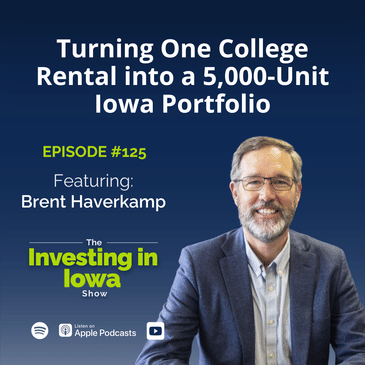
Brent Haverkamp shares how a simple college rental purchase sparked a decades-long journey into multifamily real estate. Starting in Ames, Iowa with no experience and borrowed money, he slowly built a portfolio by focusing on cash flow, value opportunities, and creative financing. Within 15 years, he scaled to roughly 1,000 units.
But rapid expansion into retail businesses exposed the risks of overconfidence and leverage. Brent was forced to sell nearly 80 percent of his real estate holdings to survive. That painful reset became the turning point that reshaped how he thinks about risk, growth, and long-term success.
Coming out of the 2008 financial crisis, Brent leaned into opportunity. By partnering with banks and repositioning distressed condo projects into apartments, he scaled back up to thousands of units across Iowa. Today, his company manages around 5,000 units and continues developing multifamily communities with a disciplined, process-driven approach.
🧠 Brent Haverkamp's Top 5 Takeaways:
- Early success without respect for risk can quickly lead to overextension
- Creative financing and persistence are critical when capital is limited
- The best opportunities often appear during market dislocation
- Building a business around systems and people creates long-term sustainability
- Success evolves from personal achievement to legacy and impact on others
👤 About Brent Haverkamp:
Brent Haverkamp is the founder and CEO of Haverkamp Group. Haverkamp Group had its start when Brent purchased the house across the street from his own. Beginning with that humble investment, he has overseen more than $1 billion in multifamily and commercial projects. Over the last thirty years, Brent, with the help of an amazing team, has grown the company into a vertically integrated organization that handles acquisitions, development, construction, and management, all under one roof.
Now, with a portfolio valued at $750 million, Brent guides Haverkamp Group with vision and innovation, hoping to extend a legacy of success in multifamily real estate to the next generation.
Contact Info:
Company: Haverkamp Group
Website: www.haverkampgroup.com
Website: www.haverkampinvestments.com
LinkedIn: Brent Haverkamp
Learn More: www.littleguyloans.com/learnmorepod
[00:00:00] Success, particularly at an early age, kind of gives you the feeling that you're invincible. And my confidence probably exceeded my abilities at that point. We actually started building convenience stores and then we made the mistake of building several of our convenience stores next to Come and Go caused us a lot of difficulties. Before we knew it, we were negative cash flow on that portfolio a lot.
[00:00:29] From cornfields to high-rises, office to industrial, houses to hotels, and every other asset class in real estate, we cover the people, the projects, and the profit. Welcome to the The The Investing in Iowa Show. This show is for go-doers, action-takers, and business owners. It's for people like you who are sick of Uncle Sam taking a huge bite of your apple.
[00:00:51] If you're looking to get ahead of what's taking place in Iowa, learn who is doing what and how you can get in on the action, you're in the right place. Hosted by Neil Timmins, an Iowa native who has been involved in over $300 million in real estate right here in Iowa. Recording in studio from West Des Moines. Here's your host, Neil Timmins. I've got Brent Haverkamp here on the show. Brent, welcome. Thank you, Neil.
[00:01:18] I'm excited you're here. Say, for the audience's sake, who are you? Where are you from? What do you do? My name is Brent Haverkamp. I grew up in Sibley, Iowa and founded a real estate investment company. We do investment design, construction, development, and property management. Nowadays, we're mostly focused in the multifamily side of things. We're on the gamut on everything there from cradle to grave, practically. Tell me about Sibley, Iowa. What was that like?
[00:01:47] Yeah. You know, I'm the son of an immigrant. My dad immigrated from Holland in 1960, so first generation America, and grew up small town Iowa. So native Iowan. And so very similar story. Wanted to get out of small town Iowa. Came to school at Iowa State University. Had no idea what I wanted to do. I got a computer science degree and graduated, and I had two job offers at the end of 1989.
[00:02:16] One was in Salt Lake City, and one was for working for Iowa State University as a systems analyst in their business computing department. And so I took that job. And then my wife and I bought a little house in Campus Town. And so we moved in there, and a few months later, the house across the street went up for sale. And it was for sale by owner. The owner was pounding a sign in the yard. And I went over and I said, how much do you want for the house? And he said, $75,000.
[00:02:45] And it was one of those turn-of-the-century, five-bedroom houses. And I was just graduated from college. And so I was the same age as the tenants across the street. And I said, what do you guys pay for rent? I went, and they said, we pay $150 a piece. So there's five of them in there, and they paid $150 a piece. And, you know, I was tended towards the analytical side. And so I kind of penciled it out.
[00:03:10] And, you know, I said, oh, I think someone could make a couple hundred dollars a month on this property. And, you know, the interesting thing is I really had no experience with real estate investment. I didn't know of anyone. I had no idea how to buy a house. And so other than the house I had bought. So I called the bank and I said, hey, I want to buy this investment property.
[00:03:33] And they essentially said, well, if you can come up with 20% down, $15,000, we'll give you a loan for the rest, and you go ahead and buy the property. And so I maybe had $7,000, $8,000 in my account. Called my parents, and I said, hey, if I can borrow $7,500, then I can go ahead and buy this house. And, you know, to their credit, they said, okay. I borrowed the money and bought the house. I wasn't very good at the fixing up side, but I did the best I could.
[00:04:01] And fixed up the house, raised rents. You know, pretty soon they were all paying $180 or $200 a month. And before I knew it, I was making maybe $300 a month on that house. And this was at a time in, what was it, 1991. Maybe my take-home was $1,500 a month. And so it was really meaningful. Material, yeah. Yeah. So it was really meaningful money for me. And all of a sudden, I kind of had a vision for my life.
[00:04:29] And I said, oh, well, if I can do this five times or eight times or 10 times, then I don't have to get up and go to work. And, you know, with computers every day. And so that started a long journey for me, Neil. Incredible start. Yeah. Yeah. All right. So walk me through it. Fast forward me from there. You had a vision. And then how does it come to play? So it's not that easy to get from zero to wherever you're going.
[00:04:58] And so clearly, I needed something to live on. And so I kept working for the university. I worked for them for four and a half years. And the entire time, I was just trying to figure out how to buy property that cash flowed. And that's really all I knew. So I tended towards, well, I'll put quotes around value. But, you know, it was this stuff that wasn't the prettiest. Right. Yeah. It wasn't the prettiest girl at the party. And, you know, that's just what I bought and tried to figure out how to buy things.
[00:05:28] With not very much equity. You know, early 90s, there's a lot of contract sales. Particularly on something that would be a bit troubled or that sort of thing. Yeah. We were in a recession in the early 90s. Yeah. And so really, over those next four and a half years, I probably ended up with maybe 40 or 50 properties over that time period. And at that point, I couldn't juggle both things anymore.
[00:06:02] Mm-hmm. It helped. But I needed something part-time. So, you know, that was kind of the start of the networking computing era. And I had done some of that work at Iowa State. And so I just hung out a shingle and I did network computer consulting. I did a lot of work here in the Des Moines metro. Worked for some larger law firms. Working on their networking systems. And then, but my real passion was real estate. And so that allowed me the time to really jump in.
[00:06:32] The network consulting gig actually went pretty well. And so I had a little bit of extra equity. And so, you know, it was a journey from 1991 from that first house to about maybe 2005. I went to about 1,000 units in Ames, Iowa in that 15 years. And actually started construction during that time period.
[00:07:00] But yeah, that was pretty fast and furious during that time period. During that time period, do you have investors? What does it look like from a capital stack standpoint? Yeah, it was a pretty casual environment. As best I could, I played, I will call it the bigger, better game. And whenever I saw something that caught my eye, I tried to see, well, can I sell something? Can I refinance something?
[00:07:27] There clearly was, you know, an informal network of family and friends that, okay, this deal needs $200,000. I've got 150 and can I piece together the rest of it? And so we would go that way. A lot of times I did some seller financing, some seller carrybacks. I did some contract purchases, you know, whatever I could to kind of make things work. Yeah. Yeah.
[00:07:57] Yeah. Incredible. What was the biggest challenge during that time frame? Yeah. You know, really the biggest challenge was, so that was kind of the decade of the 90s for me, was starting real estate. And then around 1999, 2000, you know, success, particularly at an early age, kind of gives you the feeling that you're invincible.
[00:08:24] And, you know, my confidence probably exceeded my abilities at that point. And so a buddy and I, we started what we call, yeah, a retail management group. And we started off, we bought Jiffy Lube and a car wash. And then we actually started building convenience stores. And then we had a chain of Amco transmissions and really grew that quickly, way more quickly
[00:08:50] than we should have probably had, I don't know, maybe 300 employees after a few years. And then, you know, as can easily happen to an over leveraged, started to run into, you know, both management problems, leverage problems. We made the mistake of building several of our convenience stores next to Come & Go.
[00:09:14] You know, I think Come & Go did really appreciate that a lot and, you know, lowered the prices. Gas prices blow our costs at the store and caused us a lot of difficulties. Before we knew it, we were negative cash flow on that portfolio a lot. And, you know, we were sitting around saying, okay, how are we going to fix this? And my buddy, who's very wise, came to me and said, hey, you, we can't sell these retail businesses right now. We're in trouble.
[00:09:44] And you need to sell some real estate. And we need to use that equity to fix the problem. And I didn't like that idea. The real estate was what I had built. And, yeah, and it was cash flowing. It was working. And I didn't want to sell it. But it became really clear. Oh, yeah, that's the only way out of this mess.
[00:10:07] And so between 2005 and 2007, I had sold about 700, 800 units. So about 80% of my portfolio while during that time. And so we use those dollars to kind of fix our problems on the retail side. You didn't work this hard to earn next to nothing on your money. Savings accounts barely moved the needle. Tech stocks, AI stocks. And, well, it kind of feels like Vegas out there right now.
[00:10:37] Rentals? Too often times it means tenants, toilets, termites, and not the cash flow you were thinking. Well, so I've got an alternative. Little Guy Loans Co-Lending Fund. Qualified, accredited investors are earning 10% to 11% annual passive returns. It's paid quarterly by co-lending with us alongside me on short-term first lien real estate loans right here in the greater Des Moines area. Your money's backed by a real property, not promises.
[00:11:06] It stays close to home. We've successfully funded well over $10 million in loans right here in central Iowa. So if you want steady income without headaches, click the link below in the show notes. Let's connect. We'll see if it's a fit for you. We actually ended up selling our convenience stores to come and go. We kept the real estate on the side. And we divested in some of those businesses. But we set it up.
[00:11:32] And, you know, the really interesting thing about that, Neil, is I think we know what happened then in 2007, 2008. Right. That's why I'm smiling to go. You. And. Yeah. I'd love to tell you I saw what was going to happen. And, of course, I didn't. I was forced. Sorry. Into selling. But here I was in 2008 with quite a bit of real estate experience, a pretty decent team, and a smidge of equity.
[00:12:01] You know, I probably had a million or two dollars in the bank, probably as much as I had ever had. And then all of a sudden, it's like, you know, it depends how you work. You know, some of my buddies were in the real estate business as well. Well, the doors closed for them. Right. But as long as you weren't over leveraged, the doors opened for me. Well, heaven's gate opened for you. Yeah.
[00:12:27] And so it was an incredibly interesting time. Yeah. And I had never done much outside of the Ames market before. I'd just done essentially most every tenant in Ames is a student. And so I'd done student properties in Ames. And that was my entire experience.
[00:12:45] But we know what happened in 2008 and so many of the for sale condominium builders, Triton and, you know, Klein and Walters and Triton and all those. Pretty much anybody who built. The big Regency. Regency. You know, so they all stopped doing business in the Des Moines market. But what we had throughout that market was bank owned, partially finished. Some of it was partially sold townhome communities.
[00:13:15] And I was an apartment guy. And I said, huh, I wonder what can be done with these. And so I started going to banks. And my pitch was, listen, you have an asset on your books that you don't want. And I said, if you sell it to me and finance it, that was the key because there's no money in 2008. But if you finance it, I will build it out as an apartment community. And we're going to get it cash flowing and stabilized.
[00:13:44] It's going to come off of your books. It's going to be an asset again for you. And that's really what I started to do. And that brought me, and we probably did 1,500 units of that product in the Des Moines metro from 2009 through 2015-16. And, you know, if it wasn't a partially finished project, it was land that had been repoed, you know, for that purpose.
[00:14:12] And so that was, you know, just an amazing time for us. Did that stay on the bank's balance sheet or did you take them out then? Yeah. So typically, you know, I would probably get five-year money on that project and then we would refinance it. My typical mode now is we'll take those projects out with the agencies, Freddie and Fannie, and go from there. So we started that, yeah, probably 2015 or so. We started to refinance that from the local banks to the agencies.
[00:14:42] So, yeah. You entered the Great Financial Recession crisis with how many units? Well, so I had about 1,000 units, perhaps 2005, 2006, and we got down to 200 in 2000. By the end of, I bought a property just at the beginning of 2008. So there was a time there I was down to 200 units. 200 units. And then let's call it came out of it in 2015 with how many units?
[00:15:12] Yeah. I bet a couple thousand. Yeah. A couple thousand units, somewhere in that range. 10X coming through that. Yeah. Yeah. Probably six, seven years. Yeah. Yeah. So 2015 rolls around. I mean, you built an incredible business and a machine. You had to be doing well then. Walk me through, you know, the next 10 years. Or what was it like coming into COVID?
[00:15:37] Because it seemed to me like a lot of operators were going, maybe 2019, pre-COVID, maybe the year prior to COVID. It was going, okay, let's get a little more cautious. Felt like things were creeping in and maybe COVID kicked a can down the line and we're experiencing some of the quietness over the last couple of years. You know, kind of back to pre-financial crisis for me was all about growth. You know, how can I get more? How can we do more? How can I get more units?
[00:16:06] And then, you know, I almost failed in that process, you know, so through over leverage and that process. And then the financial crisis hit and I said, I feel like I got a do-over. I got an opportunity to do it again. And I had several friends that didn't get that opportunity. And so in my mind, I said, I want to do this one right. And so before, risk was not a primary part of the equation.
[00:16:35] And, you know, a lot of real estate guys, and I feel like they discount risk. And the second time I said, I got into trouble before this time, I'm going to build it the right way. I'm going to consider risk and we're going to grow, but we're going to grow in a sustainable way. And I really want to build a multi-generational business, you know, something that's going to last. And, you know, I got a second chance to do that.
[00:17:02] And so, you know, from the very beginning, I was pretty aggressive in that 2009, 2010 period. But the values were such that it didn't feel very risky. Yeah. I mean, it was a crisis of banking. You know, nobody had any money to lend. But if you could get something bought, you knew it was a good deal. And so then that just really opened my eyes and I said, okay, we're a multifamily developer.
[00:17:29] And, you know, what's typical for us is we'll build 200, maybe 250 units a year. And we started, we've been doing that for quite a long time. And we've just kind of built a sustainable model with that process. So, yeah. Specifically in student housing or coming to Des Moines, you know, was that the stepping stone to go, hey, we're outside of this at this point?
[00:17:55] Yeah. Up until 2005, hadn't really done anything outside of Ames, Iowa. And so inside of Ames, the vast majority of housing is student housing in some fashion. And so then when we went to Des Moines, we tried to buy and build, you know, Class A multifamily properties. And so that's what we built all through Des Moines. And today we manage 5,000 units. We have ownership in about 4,000 units.
[00:18:24] And of those units, about half are student properties. Those student properties are in Ames, Iowa City, and then at both of Iowa's large community colleges, DMACC and Kirkwood Community College. And then about 40%, 45% of that portfolio is just conventional housing, mostly in the Des Moines and some in the Iowa City market.
[00:18:50] And then, oh, last five, six years, we've gotten into age-restricted active adult communities that we've been building. That's probably 5, 10% of our portfolio. How have you had to change over the years from being a landlord? It's one thing to own one unit or 10 units. You're running this yourself. It wouldn't put you in a category of a landlord. You're a leader inside of an organization of people who have to execute at the level in which you do.
[00:19:19] Yeah, I think probably the biggest change for me probably happened in my late 40s. I'm going to turn 60 this year, so maybe 10, 12 years ago. And I realized that I built the business that I wanted, but not the life that I wanted.
[00:19:39] And that was a typical entrepreneurial-led business where I had a team, but I was the center of that team, and I made all those decisions. And so I was good at optimizing, but I wasn't good at really building a business that I wasn't the center of. And I hired a business coach, and he really kind of helped me think about where I wanted to go in the future.
[00:20:07] And I realized that my second act of the business was not going to be about real estate, but it was going to be about building a team. Building a team that could manage a business around me. And that actually takes a lot of different skills. I was better at the first, you know, in terms of I got pretty good at the real estate deal.
[00:20:32] And I had a lot to learn about what it was to build a business full of people. It's that old attitude, you know, what got you here won't get you there. Yeah, exactly right. It was a different skill set, one that I'm still working on. What was the genesis? What was the turning point to hit the switch for you to go, something's got to change? Yeah. You know, so kids were in high school, and I kept on running into limits.
[00:20:59] I wanted to go backpacking with my daughters and trying to find the time to do that. And here you are on some mountain, you know, looking at your cell phone, trying to figure out how your deal is going. And I said, this is not the life I want. How can I do the things that I want to do? And so it really involved people at that point. And so how do you actually build a business?
[00:21:26] This is one thing kind of having a great business, but having a business that manages itself is a whole different animal. Yeah. So I really respect those people that have been able to build a business beyond them. And so, yeah, the challenge is go away for a month. And how does your business do if you never were there? And I think I'm getting pretty close to that, Neil.
[00:21:56] So, yeah. How will it feel that when you go away for a month and you come back and the business has done better? Yeah. How are you going to reflect internally about that? Yeah, it's pretty awesome. It helps you reflect really on what's important in your life. If you've taken a lot of the first part of my life, I took a lot of value in outcomes. And so I did a good deal. I had a great refinance. And so I sold something.
[00:22:24] And it was always about outcomes. And now I'm trying to look more at processes and systems and people and investments into those things and say, do we have a good process here? Is there a good system here? Do I have a great leader there? And, yeah, it's from a deal guy. Yeah, that's a long ways to go.
[00:22:50] Yeah, I can imagine, you know, if we call that what you just described, the process, the procedures, the good people, if we call those outcomes as well, it's a little, I would imagine at times it's harder to define. Did we achieve it or do we not achieve it? Or you got a structure around the KPIs and, you know, red light, green light, yellow light. And are we there? Yeah, I think you really have to question what you're satisfied with. Yeah.
[00:23:19] And, you know, if you're addicted to the deal or addicted to the outcome, you kind of have to change the game. And, you know, really, I think one of the things that really helped me, I have four children, two sons, two daughters. Both of my sons now work in the business with me. And almost every week we'll go, the three of us will have lunch and we'll kind of talk about the business.
[00:23:46] And that for me is one of the highlights of my week because what I'm doing is we're not talking about outcomes. We're really talking about what can we build for them? You know what I mean? And I have 100 employees now. And so it's not just my sons, but it's all my 160 employees that, you know, many of them will be around long after I'm there. And it's their livelihood.
[00:24:17] And so, you know, I would love, you know, when I'm done with a business for somebody, yeah, he built a business at last, a business that matters, a business that's multi-generational. That'd be a cool thing. Shy of that, you just have a building. Exactly right. A few buildings, right? Exactly right. Yeah. Yeah. That's incredible. How did having a degree in computer science and working in that field, how did that serve you and what it is you built in our building? Yeah.
[00:24:46] It's really interesting. I mean, like many 18-year-olds. I didn't know what I was good at and I didn't know what I wanted to do with my life. And, you know, computers were kind of the hot thing. And in the early 90s, and so I said, oh, that seems like fun. I'll do that. And just learned a very, yeah, mathematics process, equation-driven sort of business. That's how I got into this thing was I would always analyze the deal.
[00:25:14] And this will surprise. And so what I would do is I had probably an early version of spreadsheet, probably Lotus 1-2-3. Sure. That would just come out. And I would always calculate return on investment. And, you know, that was just something that intuitively would make sense for me. Well, then somewhere early along the way, I found this concept of cap rate. And so what you could do with a cap rate is you could analyze deals regardless of how you put debt on them.
[00:25:44] And I said, you know what I mean? It was like a light bulb that turned on. And I said, this is how you actually do it. And, you know, so I didn't come at it from an educational perspective. I just came at it from, you know, hey, I'm trying to compare this deal to this deal to this deal. And all of a sudden, you know, it's like I found a light bulb, you know, that I'm sure if I had a real estate degree, you know, that's something I would have learned a lot earlier on.
[00:26:08] But sometimes when you learn things by doing, you know, they just stick with you a lot more. So, yeah, I always came at it from the math side of the equation. And I wanted to analyze a deal. I wanted to proform it out. And, you know, from there is kind of what led me. So, yeah, the pure science degree helped with that. Would you agree that from when you entered this space, 91 to today, that the space has become far more institutionalized than what it once was? Yeah.
[00:26:38] Yeah, shockingly so. And part of it is I was in early on on the mom and pop side of the business, you know, the house next door, the duplex down the street, the fourplex across town. Several trends really have happened during that time period. You know, I think the first is real estate used to be very localized, particularly in towns like Ames, Iowa or Iowa City.
[00:27:08] And if you were in Ames, Iowa, then Ames, Iowa people would buy real estate and invest in real estate in that town. I'll never forget my first sale was in first large sale was in 2005. I sold 480 units for I can't remember, 42, 44 million, whatever the number was. And it was it was the largest sale at that time in Story County. And it was to a group out of Connecticut.
[00:27:36] And, you know, it hit the newspapers at the time because somebody from out of town was going to make that kind of. And so for the first time, you know, in those early thousands, we saw outside capital, typically from the coast, come in and make local real estate investments. And I'm sure that happened in Des Moines, you know, a decade earlier than that. You know, that was a fascinating thing to me. And what it did, obviously, was it drove cap rates down.
[00:28:05] It drove valuations up. And, Neil, we are still in that trend. Right. I don't know when that trend is going to end. Ever. Ever. Maybe not. Right. You know, we are building a property in Omaha and we're doing a joint venture group out of California. I believe Santa Cruz, California. And, you know, I met with their principal.
[00:28:29] And the reason that he likes the deal is because cap rates are so much higher here than they are within what he's used to in California. And so even though we've had perhaps a 20-year trend of outside capital coming in, it still has a long way to go. And so it'll be interesting to see what that happens. And so the capital trend is really, really interesting.
[00:28:56] I often ask myself if I could do what I did today. I don't know the answer to that question. I'd like to think so, but maybe not. I don't know. So that's one trend. And the second is professionalization of management. In order, particularly as you move up the asset class, particularly in that class A, be it student or conventional or senior's housing, whatever it happens to be,
[00:29:22] there is an expectation of speed of service on the maintenance side, professionalism on the leasing side. You know, just the ability. I can't tell you how many student apartments that a student will search for the apartment, look at the apartment, look at the 3D walkthrough, and will lease that apartment, never having talked to a person, never having visited that piece of real estate in person.
[00:29:51] And they will show up on move-in day with the expectation that that apartment is what we advertised it to be. And so that's a long ways from, you know, I've spent hundreds of thousands of dollars putting classified ads in newspapers. That's what you did in the 90s and the early 2000s. That's how you lease departments. And, you know, you get really good at, you know, your classified ad and where are you going to place it? And, oh, do we do, you know, a blow up? Do we put a picture? All of this stuff.
[00:30:20] But professionalization of the leasing and the management side really has gone a long, long ways. And then design and amenities in new construction and even in existing properties, there's a high expectation for quality of housing nowadays, particularly on the upper end of the housing stack. And so, yeah, it's a different business today than it was 30 years ago.
[00:30:46] If you're a house flipper, execute the burst strategy or do double closings and are in need of money. Little Guy Loans is your go-to lender here in the Des Moines area. Time is money. Loan approvals in 24 hours. Closings in five days. Little Guy Loans was founded by Neil Timmins, an investor just like you. Since he has been in over 10,000 homes in Des Moines, there's never an appraisal.
[00:31:12] Houses, multifamily and commercial property loans up to 1 million. Check out www.littleguyloans.com. It takes a lot of professionalism and expertise. And I don't see that ending. You know, a little bit kicking and screaming, but we just implemented an AI solution on some of our properties. And so, if you call, you're going to get, I think we call her Elise.
[00:31:41] She has a name. And, you know, and she's going to ask you questions. If you have a problem with your kitchen sink, it's going to say, oh, have you tried this? Have you looked at this? Is, you know, open your cabinet? Is there water running under the sink? It's going to try to determine if it's an emergency or not. If it's not, then it'll thank them. And then they say, hey, I'm going to put in a maintenance request. And that's going to be done in the next 24 hours. It'll walk through that process. But we have a long ways to go in that process. Yeah.
[00:32:11] It remains to be seen. Have we seen more changes in the last 30 years than we'll see in the next 30 years? I don't know the answer to that. Yeah. 26. What are you most excited about here this year? 2026. Yeah. It's an interesting world. We talked about the flood of capital into the market. We're finding acquisitions difficult.
[00:32:35] There's a lot of capital sources out there that will accept a lower rate of return than we're willing to take. We've decided to continue on the development front. We've got probably $60 million in developments going right now. And there's not as much competition in those markets as there's been previously. And so you can't be a real estate guy without being optimistic. So, yeah.
[00:33:01] So I envision those developments being delivered in 27 and 28. And, you know, they're going to be the bright, shiny thing in the market. And they're going to lease up and be wonderful top of the market investments. Yeah. Excited about that. That's great. Brent, you ready for the final three questions? Sure. If you had one piece of advice for your 20-year-old self, what would it be? Yeah, we talked about it a little bit.
[00:33:29] I was pretty concerned about outcomes. And I would drive towards an outcome. Somewhere along the way, I think you realize that life's not all about outcomes. And the process is at least as important. So I've learned to enjoy the process that leads to the outcome at least as much as I do the outcome. And so I would say, hey, slow down a little bit and enjoy this process. You only get to go around one time.
[00:33:59] So enjoy this process a little bit more. Two books that changed your life. You know, I'm going to give you, I think, kind of a genre. And, you know, this will take us back a little bit. But so here I am, 1990, 1991, wanting to do real estate. But I had no mentors. Nobody I knew did what I wanted to do. And so the only way you could do that was to read books.
[00:34:27] And you didn't go on Amazon and get the latest Audible book and listen to it on your phone. But you would go to the bookstore. And so I would frequently go to the bookstore. And they'll show you a little bit of the nerd that I was. But I would literally buy every book that they had that I hadn't read on real estate. And so that's how I got an education. And there's one, I was trying to remember, I knew you were going to ask this question. So I was trying to remember. And there's one book.
[00:34:57] It was kind of called something like Nothing Down for the 90s. And that would be a typical book that I would have read, 1991, 1992, 1993. And it was just, you know, some guy saying, listen, you want to buy real estate? You don't have any money. And so here's some techniques. Here's what I did. And I read dozens, dozens of those kind of books. And so that was a kind of a formative time of education for me.
[00:35:26] If you were cast away on an island for a year, you'd only get three pieces of data about your business each and every month. What three things must you know every month to know how your business is running? Yeah, probably the piece of information that I get now that I find the most valuable. My CFO does what I call a cash flow projection. And it's pretty simple. It just has Excel spreadsheet as an incoming. She takes it out six, nine months or something.
[00:35:56] And then an outgoing. And, you know, real estate developers, you can chew up cash pretty quickly. Particularly if you're doing multiple deals at once. So cash flow is really, really important. And so every week when that comes out, I take a look at that and I say, hey, what about this? What about this? And we put in our refis or sales. Hey, we're buying this. Hey, we're investing in this.
[00:36:19] And so that cash flow projection that looks down the road, six, nine months is really, really helpful. Particularly for a real estate developer. I'd say second one, I'd have to know occupancies across the portfolio. Yeah, just it's kind of a leading indicator. On the student side, it's really about pre-leasing. So that's on a seasonal basis and you pre-lease those apartments. So we're sort of starting to get to the end of pre-leasing season.
[00:36:47] So I've got a pretty good idea how our student properties are going to do for the following year. And then just look at sort of occupancies for the existing properties. I'd say third is, you know, particularly in an environment like this, I'd want to know interest rates. It's both on the short term and on the long end.
[00:37:14] So just to kind of know, you know, construction projects, you're going to borrow short. And on your refinances, you're going to typically borrow long. And so I'd want to know what interest rates are doing. Brent, this has been a fantastic conversation. I've asked lots of questions. What's one question I did not ask that I should have asked? I think, you know, particularly for people that might be starting out, I would probably ask what success is.
[00:37:43] Yeah, I think that's an important question. Yeah, well, let's do it. Okay. How does one define that? Yeah, so it's changed for me. Yeah. And, you know, I'm a goal-driven guy. And so early on, I would write out typically tangible financial unit-based, equity-based, net worth-based metrics. And if I hit those, I felt good about myself and where I was going.
[00:38:13] The real interesting thing about that is what do you do once you achieve those? You know, and so once you hit those, then you have to look to something else to be successful. And so today, it has a lot to do with my team, my employees, my family, my grandchildren.
[00:38:39] And, okay, how do I leave something for the next generation? How do I ensure the success moving down the road? You know, it just helps you kind of lift your eyes up a little bit and say, okay, what I thought was successful is really only a small piece of the whole picture.
[00:39:01] And so that's my encouragement for, you know, real estate has been so, so good to me. But lift your eyes up and make sure it doesn't stop there. And make sure there's other things in your life that give you fulfillment and how you define success. Wonderful. Brent, I appreciate you taking the time to be here. For people that want to find you, follow you, connect with you, learn about the company, where can they go? What should they do?
[00:39:28] Yeah, I probably start, probably our main webpage is havercampgroup.com. I'm sure you'll be able to find information about you, about me and my organization, and you can reach out to us. We have another investment page if you want to invest with us. It's probably havercampinvestments or something like that. You'll find us and yeah, you'll be able to reach us that way. We'll have the links below in the show notes. Fantastic. Brent, thanks for being here. All right. Thank you very much. Appreciate it. Thanks for listening. If you're enjoying the show, may I ask a favor of you?
[00:39:58] Naturally, subscribe so you never miss an episode. But would you rate and leave an honest written review on Apple Podcasts? It does a lot for us here at the show and I appreciate reading your thoughts. Great guests make for a great show. If you know of another island who would be a great guest or you yourself have interest in being a guest, well, get on our radar. Visit The Investing in Iowa Show to fill out an application or recommend a guest.
[00:40:25] And if you want to connect with me one-on-one, go LegacyImpactInvestors.com. Click on the Invest With Us button in the top right corner. And there, you can take a time for the two of us to get on the calendar and connect. Until next time, keep investing in Iowa.