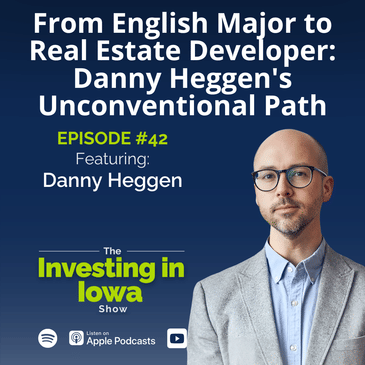
As an English major turned real estate developer, Danny Heggen has a unique perspective on the role of communication in the industry. In this episode, he delves into the significance of storytelling, both in terms of presenting projects to stakeholders and in fostering strong relationships with investors, partners, and community members. Hop in!
What you'll learn from this episode
-
Advantages of wearing multiple hats as a developer
-
How focusing on local real estate impacts local economies and supports growth
-
How to strategically employ tax credits, TIF agreements, and other tools to make rural development financially viable
-
The value of long-term stability over quick profits
-
Why keeping teams aligned and organized is critical for successful real estate projects
Resources mentioned in this episode
-
Against the Gods by Peter L. Bernstein | Paperback, Hardcover, and Kindle
-
Travels with Charley in Search of America by John Steinbeck | Paperback and Kindle
-
The Checklist Manifesto by Atul Gawande | Paperback, Hardcover, and Kindle
-
Pattern Breakers by Mike Maples Jr and Peter Ziebelman | Hardcover and Kindle
About Danny Heggen
Danny initially pursued a career in medicine but discovered a passion for writing, eventually leading him to an unexpected yet fulfilling role in real estate development. As the CFO of a development team, Danny has been deeply involved in acquisitions and projects across Iowa for over a decade, living by his mantra, "Never a dead end."
In recent years, he has honed a unique expertise in leveraging city, state, and federal incentives for housing projects. Over the past three years, Danny has successfully led and supported more than $60 million in development projects, securing over $21 million in incentives to support housing and community growth across Iowa.
Connect with Danny
-
Website: DEV Partners
-
LinkedIn: Danny Heggen
Connect with us
For more insights and updates, follow us on social media and visit our website: https://theinvestinginiowashow.com/.
[00:00:00] [SPEAKER_05]: There are certain things where in life, self-efficacy is really important to me. The idea that you actually have control of what's happening in the world around you and you impact the world doesn't impact you. And when you start to look at increasing your odds for something happening, if you want something to happen, you have to tell people what you want.
[00:00:13] [SPEAKER_00]: From cornfields to high rises, office to industrial, houses to hotels, and every other asset class in real estate, we cover the people, the projects, and the profit. Welcome to the Investing in Iowa Show.
[00:00:26] [SPEAKER_00]: This show is for go-doers, action-takers, and business owners. It's for people like you who are sick of Uncle Sam taking a huge bite of your apple. If you're looking to get ahead of what's taking place in Iowa, learn who is doing what and how you can get in on the action. You're in the right place.
[00:00:45] [SPEAKER_00]: Hosted by Neil Timmins, an Iowa native who has been involved in over $300 million in real estate right here in Iowa. Recording in studio from West Des Moines.
[00:00:55] [SPEAKER_00]: Here's your host, Neil Timmins.
[00:00:59] [SPEAKER_03]: I've got Danny Hagan here on the show. Danny, welcome.
[00:01:01] [SPEAKER_03]: Thank you so much. Glad to be here.
[00:01:03] [SPEAKER_03]: I'm excited you're here. Say, for the audience's sake, who are you? Where are you from? What do you do?
[00:01:06] [SPEAKER_05]: All right. Name is Danny Hagan. I live in Des Moines, close to Roosevelt with my wife and two kiddos.
[00:01:13] [SPEAKER_05]: And I guess I'm one of the lucky ones who's a real estate developer and all-around multifamily real estate guy.
[00:01:19] [SPEAKER_05]: Where'd you grow up?
[00:01:20] [SPEAKER_05]: It's a long story short. All right. I graduated from Woodward, Granger, just northwest of Des Moines.
[00:01:25] [SPEAKER_05]: But my dad used to start jazz programs in all these small towns. And so I went to elementary
[00:01:31] [SPEAKER_05]: school up near Mason City, a small town called Rockwell, Swelldale. And then went to preschool
[00:01:36] [SPEAKER_05]: down in Creston. And then was born into a really small town called Essex, which is about 600 people
[00:01:43] [SPEAKER_05]: soaking wet. So it's a long story. Families from Des Moines live back here now, but have had the experience,
[00:01:48] [SPEAKER_03]: the blessing of growing up in a lot of different great little communities.
[00:01:52] [SPEAKER_03]: Where'd you go to school?
[00:01:53] [SPEAKER_05]: Ended up going to Simpson, but went to school to be a doctor.
[00:01:56] [SPEAKER_05]: Okay.
[00:01:57] [SPEAKER_05]: So I had gone and interviewed a lot of different schools. I had a personality that wanted to go
[00:02:02] [SPEAKER_05]: to Grinnell. And my mom goes, Danny, I don't think you're going to have any fun.
[00:02:06] [SPEAKER_05]: I think it's really important that you have fun.
[00:02:08] [SPEAKER_05]: Yeah.
[00:02:08] [SPEAKER_05]: And so I ended up going to Simpson. I was going to go through the DO program. But all of a sudden,
[00:02:13] [SPEAKER_05]: two weeks after I left for college, my best friend from high school passed away from brain cancer.
[00:02:17] [SPEAKER_05]: So it wasn't unexpected, but you just have this moment where you're going through this.
[00:02:22] [SPEAKER_05]: You're looking around and everybody having fun and you realize you're suffocating.
[00:02:27] [SPEAKER_05]: And so I started reading, started writing, and I changed my major to English and decided I want
[00:02:33] [SPEAKER_05]: to be a writer because I knew that would be critical to understand how to relate to people
[00:02:39] [SPEAKER_05]: and to communicate. If I was going to be successful in life, I needed to know how to do those things.
[00:02:43] [SPEAKER_03]: So you'd feel like an outlet for some of the things that are inside of you?
[00:02:47] [SPEAKER_05]: Oh, absolutely. Just being able to communicate what you're going through to somebody,
[00:02:52] [SPEAKER_05]: what you're experiencing, you relate that to then having ideas. You start to realize,
[00:02:56] [SPEAKER_05]: oh, some of the best ideas in the world. If somebody doesn't know how to communicate it,
[00:03:00] [SPEAKER_05]: it's not the best idea.
[00:03:01] [SPEAKER_05]: That's right. And so understanding the key and core of being able to communicate with people
[00:03:05] [SPEAKER_05]: became just a critical part of who I was becoming as a young adult.
[00:03:09] [SPEAKER_05]: Well, and then I think about that now that so much of our life is being able to connect and to relate
[00:03:15] [SPEAKER_05]: and also draw from examples to be able to tell those stories. It means this because of X or Y,
[00:03:22] [SPEAKER_05]: being able to draw those connections for people really helps you understand what you are experiencing
[00:03:26] [SPEAKER_05]: and also relate that to somebody else, especially when you think about investing. What are we getting
[00:03:30] [SPEAKER_05]: ourselves into? There's a story that needs to be told up front. Here's what the numbers mean.
[00:03:34] [SPEAKER_05]: Here's what we're thinking about in real estate. Yeah. So I ended up as an English major,
[00:03:39] [SPEAKER_05]: published a couple of books, graduated into the recession. I'll say I got stuck in Des Moines,
[00:03:43] [SPEAKER_05]: did what most English majors did. I decided to deliver some pizzas, but started a publishing
[00:03:47] [SPEAKER_05]: company. I've always had this sort of harebrained entrepreneurial approach to life. And I had
[00:03:53] [SPEAKER_05]: studied abroad while I was in school to Australia. And while I was down there, I was able to collect
[00:03:58] [SPEAKER_05]: stories of women in prison and the university decided to publish it. So I stayed for a year,
[00:04:03] [SPEAKER_05]: came home with all this experience in 2008 and graduated. Thought I would try to replicate the
[00:04:09] [SPEAKER_05]: process and realize publishing wasn't that hard. But then you go through it, spend a couple of years
[00:04:13] [SPEAKER_05]: in publishing and realize it also doesn't make that much money. Yeah. But it was a really great
[00:04:17] [SPEAKER_05]: way to just build a resume. As I was thinking about, okay, how do you spend your life, whether
[00:04:22] [SPEAKER_05]: you're in the creative field or you're working on projects in general, but you have to be able to
[00:04:26] [SPEAKER_05]: pursue desired outcomes. You have to have a vision for where you're going. And worked with a buddy,
[00:04:30] [SPEAKER_05]: we started a business, we did publishing, we wrote a book, we produced another book,
[00:04:35] [SPEAKER_05]: but at the same time was working in the background, both as an artist. I was studying music and was
[00:04:41] [SPEAKER_05]: traveling the Midwest playing music. And then also started running afterschool programs.
[00:04:46] [SPEAKER_05]: And I was community gardening one day with a bunch of high schoolers. And I was thinking to myself,
[00:04:51] [SPEAKER_05]: I want to be the idea guy. Don't we all?
[00:04:53] [SPEAKER_05]: Sure.
[00:05:00] [SPEAKER_05]: Somebody comes up with an idea and they hand it to somebody else and say, figure out how this works.
[00:05:07] [SPEAKER_05]: So then that person figures out how it works and they hand it to somebody else and say,
[00:05:10] [SPEAKER_05]: go make this work. And I was like, I'm really good at being that person.
[00:05:14] [SPEAKER_05]: I like being the idea guy, but you have to start somewhere, especially when you're
[00:05:17] [SPEAKER_05]: looking forward to your career. So I thought to myself, okay, the person who figures out how it
[00:05:21] [SPEAKER_05]: works is a product manager or developer. And the person who puts it to work as a project manager.
[00:05:27] [SPEAKER_05]: So I went home and put project manager on my LinkedIn profile and had a recruiter reach out
[00:05:32] [SPEAKER_05]: to me within hours saying, oh, we're working on this statewide health project called the Blue
[00:05:36] [SPEAKER_05]: Zones Project. And we think you'd be a great fit. You have this non-profit and entrepreneurial
[00:05:40] [SPEAKER_05]: background. We think you'd be an excellent person to be able to come in, work from Des Moines,
[00:05:46] [SPEAKER_05]: but travel to Spencer, Mason City, Waterloo, Cedar Falls, Oskaloosa to really help support these
[00:05:51] [SPEAKER_05]: teams that are getting built in small communities and make sure they have the right tools,
[00:05:55] [SPEAKER_05]: the right resources to be successful. Also take, hey, this is how the product or strategy is working
[00:05:59] [SPEAKER_05]: in Spencer. Can we take that to Mason City and see if that also works there or Oskaloosa or
[00:06:04] [SPEAKER_05]: wherever it might be. So I did that for a couple of years. And all of a sudden,
[00:06:07] [SPEAKER_05]: met a real estate developer here in town about 11 years ago, Mike Nelson. And he said, I like your
[00:06:12] [SPEAKER_05]: personality. I'll teach about real estate. So sure, why not? Next thing I know, here I am 10 years
[00:06:17] [SPEAKER_05]: later in the career. And it's been an extraordinary ride, right? This whole experience of going from
[00:06:22] [SPEAKER_05]: where things were in 2014 to where they are in 2024. Never a boring day. Every day is a new Rubik's Cube.
[00:06:29] [SPEAKER_05]: You sit here and you feel like you're just spinning it, trying to figure out how it's going to come
[00:06:32] [SPEAKER_05]: together and figure out the next steps for things. Are you naturally inquisitive?
[00:06:36] [SPEAKER_05]: Oh man, I remember at that same time, I was trying to think about what I was going to do. I was
[00:06:39] [SPEAKER_05]: thinking to myself, I wonder if somebody would just get paid to be a problem solver.
[00:06:44] [SPEAKER_05]: I've always had this, oh man, I could just get paid to solve problems.
[00:06:48] [SPEAKER_05]: In a nutshell, that's what all entrepreneurs do.
[00:06:51] [SPEAKER_05]: That's what I realized now. And that's it. I run with this sort of internal mantra,
[00:06:55] [SPEAKER_05]: there's never a dead end.
[00:06:56] [SPEAKER_03]: Sure.
[00:06:57] [SPEAKER_05]: You have to, because as an entrepreneur, if there's a dead end, you're going to work for
[00:07:01] [SPEAKER_05]: somebody else. That's right.
[00:07:02] [SPEAKER_05]: And so just really embracing that, no, no, if you're at a dead end, you just don't see what
[00:07:06] [SPEAKER_05]: the next path is. You need to be thinking about your paths. What are your next moves? It's worked
[00:07:11] [SPEAKER_05]: for me this far. And you get into a career with all these other great entrepreneurs. I went from
[00:07:17] [SPEAKER_05]: years and then went to work for the Krauss family. So for Kyle and Sharon doing all their private real
[00:07:21] [SPEAKER_05]: estate for three years and was focused on all of their... They had just moved downtown. So all the
[00:07:26] [SPEAKER_05]: land surrounding headquarters, all the soccer stadium planning around Des Moines. But I was 75% of my
[00:07:32] [SPEAKER_05]: time in Des Moines and 25% of my time in Italy, working on hospitality projects as they were buying
[00:07:37] [SPEAKER_05]: all these vineyards. There was a building on them. The strategy was hospitality. So I worked on a 39
[00:07:42] [SPEAKER_05]: unit luxury resort. It was in Italy 10 times in 18 months. What a unique experience.
[00:07:48] [SPEAKER_05]: You don't want to let things like that normalize where you're traveling, you're learning a language.
[00:07:53] [SPEAKER_05]: And I remember thinking to myself, just an amazing family, loved working with them.
[00:07:58] [SPEAKER_05]: What I could learn from really the dynamics of these two different entrepreneurs. Mike, who is...
[00:08:03] [SPEAKER_05]: If it works on paper, the inspiration's there. We can figure this out. It's never going to be
[00:08:07] [SPEAKER_05]: perfect. You're always going to be solving problems.
[00:08:08] [SPEAKER_05]: So then you go to a group like Cross Group where there's competing requests for where the
[00:08:14] [SPEAKER_05]: capital is going to go each year. That's right.
[00:08:16] [SPEAKER_05]: And real estate was just one of the main sort of focuses of this because of the tax benefits and
[00:08:20] [SPEAKER_05]: all the investment opportunities for it. And so it became... But it still had to be a good deal.
[00:08:24] [SPEAKER_05]: So you go from feeling like you're on the farm team to feeling like you're the investment banking team.
[00:08:27] [SPEAKER_05]: It's a very different thing that you learn as an entrepreneur and as a developer and as
[00:08:31] [SPEAKER_05]: when you're underwriting and presenting. But it really... I think you go through this experience
[00:08:35] [SPEAKER_05]: on the smaller team and you don't really know what you're experiencing. Then you get into a more
[00:08:40] [SPEAKER_05]: formal setting going through all this. And I'm surrounded by, yeah, I was an English major.
[00:08:43] [SPEAKER_05]: I didn't think I was going to be doing real estate. You go through this experience and you sit at the
[00:08:47] [SPEAKER_05]: table and you realize, oh, I was drinking from five fire hoses. How lucky was I to be able to sit
[00:08:52] [SPEAKER_05]: at the table with the attorneys and talk through legal documents? How lucky was I to be able to run
[00:08:57] [SPEAKER_05]: the financial models for what something should be if we're budgeting for an architect, for example,
[00:09:01] [SPEAKER_05]: to then say, now we're going to go get an architectural contract and we're going to negotiate that.
[00:09:04] [SPEAKER_05]: Most people who just went to school for a finance degree, the numbers on a spreadsheet,
[00:09:08] [SPEAKER_05]: they don't get to go negotiate. That's right. And then you're sitting at the table working on
[00:09:12] [SPEAKER_05]: scope and schedule and budget with your design and planning teams. And then you're actually getting
[00:09:16] [SPEAKER_05]: the loan closed and the equity into the deal. And then you're building it. And building,
[00:09:21] [SPEAKER_05]: it's always like you start construction, you end construction on your timelines, but that's 12 to
[00:09:26] [SPEAKER_05]: 18 months of just pain of solving questions and trying to keep your team organized.
[00:09:31] [SPEAKER_05]: And you learn through those experiences where it could be a very successful project, but if the
[00:09:36] [SPEAKER_05]: team sucks, it's terrible. You don't have fun. So it's so much about just keeping your team organized
[00:09:40] [SPEAKER_05]: or it could be, hey, it didn't turn out how we thought it was going to, but I'd love to work
[00:09:45] [SPEAKER_05]: with the team. Let's do the next one. And you're thinking about that. Over the course of this time,
[00:09:50] [SPEAKER_05]: you learn, oh, those fire hoses you're drinking from. I'm a checklist manifesto mindset where if you
[00:09:56] [SPEAKER_05]: don't write it down, you're not going to remember it the same way the next time. And so when I started,
[00:10:01] [SPEAKER_05]: I kept asking people, does this happen again? You go through a design. Oh, okay. The schematic
[00:10:06] [SPEAKER_05]: design always happened. And so there are these phases of every project, but all these thousands
[00:10:12] [SPEAKER_05]: of action items going on. And I started taking those action items and bucketing them and realized that,
[00:10:18] [SPEAKER_05]: oh, for a development project, there's five buckets, legal, finance, design, construction,
[00:10:24] [SPEAKER_05]: operations. Each of them take during your planning and you're building the business,
[00:10:27] [SPEAKER_05]: each of those take certain specific periods of time, but all of them need each other.
[00:10:32] [SPEAKER_05]: You're sitting at the table with this architect working on, oh, this building is going to be
[00:10:35] [SPEAKER_05]: X number of square feet and cost as much. You then go meet with contractor and go get bids.
[00:10:41] [SPEAKER_05]: The banker needs the number, but you don't want your contractor sitting down with the banker.
[00:10:45] [SPEAKER_05]: As the developer, you need to be able to take that information, put it together, tell the story to
[00:10:48] [SPEAKER_05]: the banking team and say, this is why we're underwriting this deal this way.
[00:10:52] [SPEAKER_05]: And so all these buckets need each other, but it also helps me break apart who needs to be at the
[00:10:57] [SPEAKER_05]: table for which conversation. And then you also start realizing in problem solving that there's
[00:11:02] [SPEAKER_05]: two different types of problems. You have complex problems and you have complicated problems.
[00:11:07] [SPEAKER_05]: Complex problems are the calculus. All right, well, I can hire somebody to do calculus. I don't need to
[00:11:11] [SPEAKER_05]: know how to do calculus. The complicated problem is getting that person to show up and do calculus for
[00:11:15] [SPEAKER_05]: you. So as an entrepreneur and as a business owner, you got to focus on the complicated problems.
[00:11:20] [SPEAKER_05]: Right. And real estate deals are full of complicated problems all the time, right? They're also full of
[00:11:24] [SPEAKER_05]: complex problems. So you need subject matter experts for the complex and you need your own
[00:11:28] [SPEAKER_05]: sort of emotional, mental sort of intellect to be able to manage the complicated.
[00:11:33] [SPEAKER_03]: EQ and IQ at the same time.
[00:11:34] [SPEAKER_05]: Absolutely. Sorry, that was a lot, but I love this. You know, I could,
[00:11:37] [SPEAKER_05]: you know, we spoke a couple of weeks ago, just getting to know each other. It was one of these
[00:11:39] [SPEAKER_05]: things where I'm like, I probably share this with every single person I meet, but I'm like,
[00:11:44] [SPEAKER_05]: I just want people to hear how I think.
[00:11:46] [SPEAKER_05]: Yeah. Because it helps that team as you're building that out. And like in any project you're
[00:11:50] [SPEAKER_05]: working on, like your team and the way they understand and work together and navigate
[00:11:54] [SPEAKER_05]: problems is so clutch to what you do.
[00:11:57] [SPEAKER_03]: It's critical, especially in development.
[00:12:00] [SPEAKER_03]: Yes.
[00:12:01] [SPEAKER_03]: More specifically than, you know, largely what we do. Buy a property, buy a building. There's
[00:12:06] [SPEAKER_03]: still a plan. There's still stuff that goes into that, but significantly fewer moving pieces.
[00:12:11] [SPEAKER_03]: Absolutely. Yes.
[00:12:12] [SPEAKER_03]: It's then having a vision and then executing a vision from scratch, from zero.
[00:12:18] [SPEAKER_05]: Absolutely. I think you also start to realize, oh, recognizing people who know what they want.
[00:12:22] [SPEAKER_05]: Sure.
[00:12:23] [SPEAKER_05]: Because like laugh and gesture at when I'm meeting with, building new teams with architects,
[00:12:27] [SPEAKER_05]: whatever it is. I'm going to tell you, I'm the sort of developer that walks to the table and tells
[00:12:29] [SPEAKER_05]: you exactly what I want. And I can always see the look on my face and be like, oh, find me.
[00:12:34] [SPEAKER_05]: Yeah.
[00:12:35] [SPEAKER_05]: Like, you don't charge the architect with going in and be like, oh, this is what you're going to want
[00:12:38] [SPEAKER_05]: in the product. I walk in, I'm a finance developer first.
[00:12:42] [SPEAKER_05]: I want 36 units. It needs to be 30,000 square feet building. It needs to be accomplished in 12
[00:12:48] [SPEAKER_05]: months. And I want it to look like this. Here's my style. Because that's my project management day,
[00:12:53] [SPEAKER_05]: scope, schedule, budget. I've learned that as an owner, you also need to understand style.
[00:12:58] [SPEAKER_05]: When you're building buildings, you need to understand style. Because when you're thinking
[00:13:01] [SPEAKER_05]: about this box you're building... I read this incredible book like 12 years ago. I don't even
[00:13:05] [SPEAKER_05]: know if it ever got published. It was like a thesis from a master's student that was sitting in the
[00:13:10] [SPEAKER_05]: back room at this nonprofit. It was called How to Manage Creatives. And it was like one of those
[00:13:14] [SPEAKER_05]: paper bound books that never got published sort of thing, probably. But how to manage creatives.
[00:13:19] [SPEAKER_05]: And I was like, I'm a creative person. I should consider how to manage myself.
[00:13:23] [SPEAKER_05]: If I'm going to manage other people like this, I need to know how to guide them.
[00:13:27] [SPEAKER_05]: And it was, as the manager, you need to be able to build a box for a creative person.
[00:13:32] [SPEAKER_05]: Because if you don't give them parameters, they're never going to think outside the box.
[00:13:36] [SPEAKER_05]: And so you walk in, say scope, schedule, budget, style. The architect then knows what you're aiming
[00:13:41] [SPEAKER_05]: for, what your expectations are. And they come back and they deliver your expectations or beyond.
[00:13:47] [SPEAKER_05]: Great. We lose no time. We keep moving the same line. There's so many different pieces of the
[00:13:51] [SPEAKER_05]: puzzle to keep organized. But I think at the end of the day, it's know what your expectations are,
[00:13:55] [SPEAKER_03]: always. Yeah. To take it a step further, you really don't want your creatives...
[00:13:59] [SPEAKER_03]: Without a box, your creatives will spend too much money.
[00:14:03] [SPEAKER_03]: Absolutely. From a development standpoint. So I love what you said. I'm a financial developer
[00:14:07] [SPEAKER_03]: first. Yeah. There's a thing based on your background going through this. Of course,
[00:14:11] [SPEAKER_03]: not especially when you put your money in a line. It's got a pencil or it doesn't work.
[00:14:15] [SPEAKER_05]: Absolutely. And then those are your biggest risk exposures is having them redraw something.
[00:14:22] [SPEAKER_05]: Correct. And then I always tell them too, it's all my expectation is that you don't,
[00:14:25] [SPEAKER_05]: don't show me you're charging me for printing. It's things like this, right? It's like the brown
[00:14:29] [SPEAKER_05]: bowl of M&Ms that Van Halen asked for in their writer. It's okay. Don't show me your past. You're
[00:14:33] [SPEAKER_05]: charging me for printing, but that's part of your fee. Because those are little things that you like,
[00:14:37] [SPEAKER_05]: you give me the impression that you're nickeling and diming me. Yeah. Every minute that you have
[00:14:41] [SPEAKER_05]: to spend with them in the room is costing you money regardless. But you can stay focused in on
[00:14:45] [SPEAKER_05]: deliverables. But anyways, yeah, it's fun. I tried to set those... Probably the ultra millennial.
[00:14:51] [SPEAKER_05]: I reference music a lot because it's who I am and I attach a lot of my memory to music.
[00:14:56] [SPEAKER_05]: Like, but I remember listening, there's this band called Tame Impala. They're out of Australia.
[00:15:00] [SPEAKER_05]: And I remember listening to their third album when it came out and thinking to myself,
[00:15:05] [SPEAKER_05]: you could have given me all those same instruments and I never would have produced that same record.
[00:15:09] [SPEAKER_03]: That's right.
[00:15:10] [SPEAKER_05]: And so this sort of ultra millennial approach, not everything's open source. Like,
[00:15:14] [SPEAKER_05]: I'll give you my performer. Because you have to understand a lot of the context of how these
[00:15:18] [SPEAKER_05]: different pieces work together, how you're managing your design team, how you're guiding your
[00:15:22] [SPEAKER_05]: construction team, even down to your attorney producing legal docs that if you're not guiding
[00:15:28] [SPEAKER_05]: them and giving them the right parameters for things, they're stabbing in the dark. And if you
[00:15:32] [SPEAKER_05]: hand that off to somebody else and say, try to replicate that same project, if they don't
[00:15:35] [SPEAKER_05]: understand the context and parameters and expectations of these things, they're never
[00:15:38] [SPEAKER_05]: going to get to the same spot.
[00:15:39] [SPEAKER_03]: It doesn't even have to be that complicated. We've got a deep background in my office for
[00:15:43] [SPEAKER_03]: flipping houses and then interacting with folks who do. Being at the same home to 10 different
[00:15:48] [SPEAKER_03]: people, they're going to come up with 10 different scopes of work and they will sell it at 10
[00:15:52] [SPEAKER_03]: different price points. On the house.
[00:15:55] [SPEAKER_03]: On the exact same house.
[00:15:57] [SPEAKER_03]: On $1,400.
[00:15:58] [SPEAKER_03]: Yours and you imagine that same thing, but at the scale on which you operate on,
[00:16:03] [SPEAKER_03]: those things get significantly compounded.
[00:16:05] [SPEAKER_01]: Hey, Iowa investors, this is Ava Bauckamp, chief of staff at Legacy Impact Investors.
[00:16:10] [SPEAKER_01]: Have you thought about adding real estate to your portfolio, but don't have the time or desire
[00:16:14] [SPEAKER_01]: to play landlord? At Legacy Impact Investors, we do the heavy lifting. Our team finds the deals,
[00:16:20] [SPEAKER_01]: manages the properties and handles all the day-to-day operations. Our select group of
[00:16:25] [SPEAKER_01]: qualified investors co-invest with us, gaining ownership equity without opening a tenant email
[00:16:30] [SPEAKER_01]: or responding to a maintenance call. They just share in the income, appreciation and tax benefits.
[00:16:35] [SPEAKER_01]: These opportunities aren't for everyone. They are for qualified, accredited investors only.
[00:16:40] [SPEAKER_01]: If you want to learn more, please visit LegacyImpactInvestors.com to apply.
[00:16:46] [SPEAKER_05]: Absolutely. So then about three years ago, three and a half years ago,
[00:16:50] [SPEAKER_05]: I had been saving up some money. We're getting through the pandemic.
[00:16:52] [SPEAKER_05]: And I had somebody tell me once, it's probably the most perfect example of my personality.
[00:16:58] [SPEAKER_05]: If you want to know a little about something, you should go talk to this person. If you want to
[00:17:01] [SPEAKER_05]: know a lot about something, go talk to David. I'm just always down the rabbit hole. If I don't
[00:17:05] [SPEAKER_05]: understand something today, by this evening, I want to be a master of it.
[00:17:08] [SPEAKER_05]: So constant, infinite learner. And as I was watching the world during the pandemic days,
[00:17:14] [SPEAKER_05]: you're sitting at home, saving up some money. And I start watching where buildings are going for sale,
[00:17:19] [SPEAKER_05]: specifically websites. What buildings are getting listed where? I started seeing this
[00:17:25] [SPEAKER_05]: trend of old downtown buildings going up for sale on Zillow. Sure. And I was asking myself why.
[00:17:33] [SPEAKER_05]: And you start to realize, oh, there's this whole thing happening during the pandemic, which
[00:17:37] [SPEAKER_05]: is it's really hard. It's hard to be a landlord in good days. It's really hard to be a landlord when
[00:17:43] [SPEAKER_05]: you have, we can't evict people. We have to be responsible for all these different things.
[00:17:46] [SPEAKER_05]: So I started noticing was people were putting buildings up for sale on Zillow because
[00:17:51] [SPEAKER_05]: they wanted to get out of them. They only owned one. So then I started researching. And the first
[00:17:55] [SPEAKER_05]: one I found was in Mason City, Iowa. Four units upstairs, first floor commercial, about an 8,000
[00:18:01] [SPEAKER_05]: square foot building for sale for $500,000. And they'd already done all the hard work.
[00:18:05] [SPEAKER_05]: They'd done the historic renovation upstairs. Everything's done. I'm thinking to myself,
[00:18:08] [SPEAKER_05]: that same building in Des Moines is going to cost $800,000. Sure.
[00:18:11] [SPEAKER_05]: Why are they selling it for this cheap? And I'm like, oh yeah, it's Mason City. They probably
[00:18:15] [SPEAKER_05]: think they're winning. I was like, oh, okay. So we both feel like we're winning here. I feel like
[00:18:18] [SPEAKER_05]: I'm getting a low price. I feel like they're getting a high price. But then I start... I was telling
[00:18:22] [SPEAKER_05]: my wife this the other night. She's like, how do you find out who owns a property? I was like,
[00:18:26] [SPEAKER_05]: oh, my favorite website, the assessor's website. I'm like, just send her the immediate link
[00:18:29] [SPEAKER_05]: to Paul County Assessor's. So I start looking around the assessor's sites
[00:18:33] [SPEAKER_05]: of these communities, Mason City, and realize... Let's just say there are 40 commercial buildings
[00:18:38] [SPEAKER_05]: downtown Mason City. There are about 35 different building owners. What that says to me is you have
[00:18:43] [SPEAKER_05]: a bunch of people who only own one building. That's right. And so they don't feel a certain
[00:18:49] [SPEAKER_05]: level of ownership of the community because they only own one building.
[00:18:52] [SPEAKER_05]: What I understand... And back when I first started, I was the... I drew the short straw on the team,
[00:18:58] [SPEAKER_05]: which was, Danny, you get to go learn about all these incentives. Go figure out all the state
[00:19:02] [SPEAKER_05]: historic tax credits. Go figure out the federal historic tax credits. Go figure out what used to
[00:19:06] [SPEAKER_05]: be called the enterprise zone, which is now called the workforce housing tax credit. Let's go figure
[00:19:10] [SPEAKER_05]: out the brownfield, grayfield tax credits. Let's go work through TIF with the cities or tax
[00:19:13] [SPEAKER_05]: with the cities. The only tax credit I don't do right now is LITECH, the low-income housing tax credit.
[00:19:19] [SPEAKER_05]: And so when I put all this into context, I understand Mason City for workforce housing qualifies for a 20%
[00:19:25] [SPEAKER_05]: tax credit versus a 10% tax credit because it's in the smaller ADA counties. It qualifies for 12%
[00:19:30] [SPEAKER_05]: brownfield, grayfield. It qualifies for tax abatement because it's in the urban renewal
[00:19:34] [SPEAKER_05]: district of Mason City. So it has all these things stacked up for it saying, we're going to give you
[00:19:37] [SPEAKER_05]: incentives from the state and from the city. So I look at this building for $500,000 and think to
[00:19:42] [SPEAKER_05]: myself, I can raise a little money, buy this, but Mason City needs housing. All these communities
[00:19:49] [SPEAKER_05]: produce housing assessments. Right. Every one of them does. They all need housing.
[00:19:52] [SPEAKER_05]: They all need housing. None of these communities read each other's housing assessments.
[00:19:57] [SPEAKER_05]: I'm sitting out here reading like 14 of them a year. Like I'm that nerd who's just, I don't know,
[00:20:00] [SPEAKER_05]: I want to learn more about this community. Let's read the housing assessment.
[00:20:03] [SPEAKER_05]: So you read Mason Cities and you realize new housing, there hasn't been new housing built
[00:20:07] [SPEAKER_05]: downtown Mason City for 20 years. The average new home, if somebody's going to move in and buy a
[00:20:12] [SPEAKER_05]: new house, it's more expensive to buy a new home in Mason City than it is in Des Moines
[00:20:16] [SPEAKER_05]: because less of them are getting built and you have people who are traveling, right?
[00:20:19] [SPEAKER_05]: Right. So you have a young family moving to Mason City. Maybe it's a young doctor.
[00:20:24] [SPEAKER_05]: They don't know how long they're going to live there. Right.
[00:20:26] [SPEAKER_05]: So buying a new house for $450,000 isn't at the top of their to-do list.
[00:20:31] [SPEAKER_05]: So then you look around at existing housing stock was built in the 1970s. On average,
[00:20:35] [SPEAKER_05]: it's 50 years old, which means it probably hasn't seen much love.
[00:20:39] [SPEAKER_05]: So you're a new doctor moving in, thinking about your time energy that you have.
[00:20:43] [SPEAKER_05]: Renovating a house is not top of your list.
[00:20:45] [SPEAKER_05]: Correct.
[00:20:45] [SPEAKER_05]: So then you look around at the rental stock and you realize, okay, nothing new has been built here
[00:20:49] [SPEAKER_05]: for a long time. The existing housing rental stock is 80 years old. And so I started thinking about
[00:20:54] [SPEAKER_05]: Mason City needs housing. Housing assessment tells you that there's a 7% vacancy rate in the market,
[00:20:59] [SPEAKER_05]: but 13% of the rental housing has been deemed uninhabitable.
[00:21:03] [SPEAKER_05]: Which means you have 6% of the population living in housing that's been deemed uninhabitable.
[00:21:08] [SPEAKER_05]: The vacancy rate should be 13%, but it should actually be zero because that housing should be offline.
[00:21:12] [SPEAKER_05]: Correct. So the Rolodex of information running through my head here when I start analyzing this
[00:21:18] [SPEAKER_05]: is Mason City needs housing. And you look downtown at the map and it's surrounded by a sea of parking.
[00:21:24] [SPEAKER_05]: When you're on the assessor's website, you start seeing the city owns all the parking lots.
[00:21:29] [SPEAKER_05]: In Des Moines, how did all the parking lots get developed downtown 20 years ago?
[00:21:33] [SPEAKER_05]: Developers initiated proposals. We will come and build housing here for you.
[00:21:36] [SPEAKER_05]: Just give us the land. So I started playing that same strategy up there.
[00:21:39] [SPEAKER_05]: City, I walk in, I have clothes on this building. And in the meantime, I'd raise some money,
[00:21:43] [SPEAKER_05]: but I met a group of guys like, Hey, don't go off on your own. Why don't you just join us and be a
[00:21:46] [SPEAKER_05]: partner? So that's how I became a part of Dev Partners three and a half years ago.
[00:21:49] [SPEAKER_05]: So let's start doing multifamily. Let's use your incentives background. I said,
[00:21:53] [SPEAKER_05]: fantastic. We'll be in Des Moines, but I want to be in rural Iowa because that's where all the
[00:21:56] [SPEAKER_05]: incentives are for housing. You also look at Mason City, 27,000 people, but it's a $1.6 billion
[00:22:02] [SPEAKER_05]: economy. It's a really strong economy. We talked about this a little bit here when I just
[00:22:06] [SPEAKER_05]: arrived. But you look around, okay, primary markets, secondary markets, tertiary markets.
[00:22:11] [SPEAKER_05]: I look at what's the context of being a... You put Mason City on a national level. Sure,
[00:22:15] [SPEAKER_05]: it's not even on anybody's radar. On a local level, it's a primary market in the state of Iowa.
[00:22:20] [SPEAKER_05]: You have people actively not moving there and taking jobs every day because there's no housing
[00:22:24] [SPEAKER_05]: available. And there's nobody developing housing here. I could go be that person up there.
[00:22:29] [SPEAKER_05]: Now, I went to elementary school up in that area. So I had this connection. I want to be the guy who
[00:22:33] [SPEAKER_05]: came back. Knowing all this information, I go in to meet with the city and city manager,
[00:22:38] [SPEAKER_05]: you can have that parking lot. $25,000, what would you do with this? I'd build housing. It's
[00:22:41] [SPEAKER_05]: yours. And you can have that one and that one. I was like, oh, stop. Yeah, yeah.
[00:22:45] [SPEAKER_05]: Let me demonstrate integrity. There's such a long history of developers coming into these towns,
[00:22:49] [SPEAKER_05]: tying up lots, never doing anything. Sure.
[00:22:51] [SPEAKER_05]: And so I was like, let me show you what I'm capable of. And then I'll take the other ones off
[00:22:56] [SPEAKER_05]: your hands for you. And so we got to work, just finished up 11 units actually about a month ago.
[00:23:02] [SPEAKER_05]: And it felt like a gamble two and a half years ago. Hey, what are we going to hit for rents in
[00:23:06] [SPEAKER_05]: Mason City? But we delivered 11 units and we had 10 of them leased in the first month.
[00:23:09] [SPEAKER_05]: We should have the last one leased here in a couple of days. And we're hitting $1,400 a month
[00:23:13] [SPEAKER_05]: for two bedrooms. We're hitting almost $1,100 for one bedrooms. And those same four units I bought up
[00:23:18] [SPEAKER_05]: front, they were at $725. I don't want to be the guy who just came in and started gouging up rents.
[00:23:23] [SPEAKER_05]: But in a market like this, I want to understand the ceiling. We've raised rents from $725 to $1,100
[00:23:28] [SPEAKER_05]: for these beautiful one bedroom units, big skylights, historic renovation. But we still
[00:23:32] [SPEAKER_05]: lease them within 48 hours. And so I don't think I've found it yet. But I want to stop here because
[00:23:37] [SPEAKER_05]: these are like, we're entering in all the numbers work for the financial returns for our investors.
[00:23:42] [SPEAKER_05]: And obviously concerns about we have to refinance in two years now. Sure.
[00:23:47] [SPEAKER_05]: What's the rate going to be? And how we got to pay back down some principal. So all these things
[00:23:51] [SPEAKER_05]: running through my mind is we should get the financials up and looking good and we're paying down.
[00:23:54] [SPEAKER_05]: Yeah. But incredible rent numbers. It's unbelievable. So it doesn't feel like a gamble anymore.
[00:23:59] [SPEAKER_05]: And so it's things like that where now we've got the next parking lot, we're building another 36
[00:24:02] [SPEAKER_05]: units. But for both these projects, we got land for really cheap. I usually like when somebody comes
[00:24:08] [SPEAKER_05]: and asks me, hey, am I paying too much for this piece of land? But are you paying? When they tell
[00:24:12] [SPEAKER_05]: me, I was like, can you do a 10x factor of that cost? So the land cost should be about 10%
[00:24:19] [SPEAKER_05]: of every deal. Again, this is me like looking through hundreds of performers over the years,
[00:24:22] [SPEAKER_05]: like lands typically about 10 to 12% of your deal cost. So if you're paying 100,000 bucks,
[00:24:26] [SPEAKER_05]: can you do a $1 million project there? That should make sense.
[00:24:30] [SPEAKER_05]: So when I'm doing an $8.5 million project and got a $25,000 chunk of land, okay, I've already just
[00:24:36] [SPEAKER_05]: saved a substantial amount. I saved 9% of my project costs just like that.
[00:24:41] [SPEAKER_05]: Yes.
[00:24:42] [SPEAKER_05]: Got a million bucks for workforce housing. Again, because you can get 20% versus 10% in your
[00:24:46] [SPEAKER_05]: rural counties. So I can build 36 units and get a million dollars versus 72 units in Des Moines to get
[00:24:51] [SPEAKER_05]: a million dollars. Got $600,000 from Brownfield Grayfield. Got a 15-year TIF. Got a parking
[00:24:56] [SPEAKER_05]: agreement because we're building some additional parking on the site. It feels like I'm making this
[00:24:59] [SPEAKER_05]: stuff up. But it's just because they need it so much and they have to compete against them.
[00:25:05] [SPEAKER_05]: Correct.
[00:25:05] [SPEAKER_05]: You're looking at the incentives and these other elements.
[00:25:07] [SPEAKER_05]: Every other town in this state.
[00:25:08] [SPEAKER_05]: Absolutely.
[00:25:09] [SPEAKER_05]: But when I tell people about my strategy, it's why Mason City is, when I tell you about it,
[00:25:13] [SPEAKER_05]: you're going to want to be up there too. And actually, I would happily invite people up there
[00:25:16] [SPEAKER_05]: because all of a sudden, you start looking around and thinking about this strategy.
[00:25:20] [SPEAKER_05]: What's the risk? The risk is we own half the downtown.
[00:25:23] [SPEAKER_05]: Great.
[00:25:24] [SPEAKER_05]: But maybe it takes that long to get going until other people start seeing what's going on and
[00:25:28] [SPEAKER_05]: realize they missed the boat.
[00:25:30] Right.
[00:25:30] [SPEAKER_05]: And three years ago, my goal was to get three years ahead of people.
[00:25:32] [SPEAKER_05]: Two years ago, my buddy Ryan Callahan calls with Artisan Capital Groups like,
[00:25:37] [SPEAKER_05]: Hey, if you're not paying attention to what's going on in the lending world right now,
[00:25:40] [SPEAKER_05]: you should probably flip it on. And I was like, okay, look at this. I'm like, oh, okay,
[00:25:44] [SPEAKER_05]: we're going up. So I opened my phone and I started calling every banker I can,
[00:25:48] [SPEAKER_05]: take them out to lunch and just start asking them questions. What are you hearing? You've been
[00:25:52] [SPEAKER_05]: doing things conventional for a long time. Have you gotten lazy? What else should we be thinking
[00:25:56] [SPEAKER_05]: about? Are there other tools inside your institution that you haven't had to use since the last downturn?
[00:26:01] [SPEAKER_05]: And after all that, I came across Small Bank up in Fort Dodge. So I was also doing a housing
[00:26:05] [SPEAKER_05]: project up there. He said, Hey, it's an agricultural product, but it's called an ARC,
[00:26:10] [SPEAKER_05]: adjusted rate conversion note. It's like a swap. You're going to lock in for a five-year
[00:26:13] [SPEAKER_05]: turn against a five-year treasury. Yeah. When you do a conventional note,
[00:26:16] [SPEAKER_05]: five-year term, typically you have penalties attached to refinancing out. So five-year term,
[00:26:20] [SPEAKER_05]: five-year term. All right, we're locking in. But I locked in last year when the world was
[00:26:24] [SPEAKER_05]: closing deals between seven and a half, 8%. I was locking out 5.6% because I took time to sit down
[00:26:29] [SPEAKER_05]: and figure this out. Local lenders also don't have to put a 300 basis point spread over that. They put
[00:26:34] [SPEAKER_05]: a 230 basis point spread. And so it's like, that's how we're doing it. You have to make sure you're
[00:26:38] [SPEAKER_05]: asking the questions, figuring these deals out because they want this to have a better community more
[00:26:43] [SPEAKER_05]: than you do. And I really want it to happen. My investor's cash is on the line. My cash is on the
[00:26:47] [SPEAKER_05]: line. You start running these different types of strategies and realize, oh, banks in Des Moines
[00:26:50] [SPEAKER_05]: will also do that. And you just start building strategies together and you're very clear with
[00:26:55] [SPEAKER_05]: bankers. We're going to run a strategy together. We might be floating during construction,
[00:26:58] [SPEAKER_05]: which I don't want to do. We know, hey, this week, finally, rates are going to come back down
[00:27:04] [SPEAKER_05]: eventually. But we have to play a strategy where you're not going to lock me in really high and
[00:27:08] [SPEAKER_05]: then refuse to get out of this on the backside. Let's float for a little while,
[00:27:11] [SPEAKER_05]: get through construction and play a strategy where we're all waiting on the backside.
[00:27:14] [SPEAKER_03]: But you're right. Bankers over the course of the last two years, they had to blow some dust off
[00:27:17] [SPEAKER_03]: of their files and go, what did we do when things weren't this easy?
[00:27:22] [SPEAKER_05]: Absolutely. And I think about this, I want to be the old guy who comes into the office. I don't
[00:27:27] [SPEAKER_05]: have any hair left. Dusty walking in the office and come in with a hundred ideas and have my team
[00:27:31] [SPEAKER_05]: essentially be like, hey, Danny's going to be here in about five minutes. He's going to have a hundred
[00:27:34] [SPEAKER_05]: ideas. Probably what'll be good. Pay attention to that one idea. But okay, if I'm thinking I'm almost 40 now
[00:27:38] [SPEAKER_05]: and I'm doing this for another 45 years, 50 years, because I also don't think you ever turn it off.
[00:27:44] [SPEAKER_05]: And I can't turn it off.
[00:27:46] [SPEAKER_05]: No. And as much as you want to, you just need to have a hiker, enjoy biking and getting out.
[00:27:51] [SPEAKER_05]: Okay. I need that in my life. I need people who are like, Danny, get away from your computer. Let's
[00:27:55] [SPEAKER_05]: go. But you think, okay, 50 years from now, if I'm still doing this, we're going to go through
[00:27:59] [SPEAKER_05]: these cycles a few more times. And so I've been really sharp at thinking about, okay, what tools am I
[00:28:05] [SPEAKER_05]: learning now that I can't forget? Because you have to be teaching the younger generations that
[00:28:09] [SPEAKER_05]: come in behind you that there are tools that are out there. We're going to have to be able to use
[00:28:12] [SPEAKER_05]: those. How are you documenting that?
[00:28:13] [SPEAKER_05]: I write a lot. Yeah. I've been parked back to those communication days and thinking about,
[00:28:18] [SPEAKER_05]: what are you doing? So leave notes. Whenever somebody asks me, how do you remember all these
[00:28:21] [SPEAKER_05]: things? I'm like, I have a thousand point checklist and I keep track of all these things. And when
[00:28:25] [SPEAKER_05]: somebody asked me for it, I just give to them. These are the thousand things you have to do.
[00:28:28] [SPEAKER_05]: And I developed that checklist when I was at my Nelson days and I was watching these projects
[00:28:32] [SPEAKER_05]: happen. And I went through my first two years asking the question, does this happen again?
[00:28:36] [SPEAKER_05]: If yes, then when, if no, then it was unique. And so I was tracking all these things and just
[00:28:41] [SPEAKER_05]: realized when we finally got a commitment from a bank, there it was. The banks tell you everything
[00:28:47] [SPEAKER_05]: you need to do on the backside. Hey, in order to close this loan, here's your 40 things we need.
[00:28:52] [SPEAKER_05]: So I was like, okay, now I have validation for what we've been doing, what parts of these pieces
[00:28:57] [SPEAKER_05]: go together. But a thousand things that have to happen include, you have to form an entity,
[00:29:02] [SPEAKER_05]: but you also need to sign onto this website and fill out this form. And you need to have this
[00:29:06] [SPEAKER_05]: name convention or whatever it might be. And you just want to be able to have a team that,
[00:29:10] [SPEAKER_05]: oh, if Danny gets hit by a bus or he wants to spend a month in Italy,
[00:29:13] [SPEAKER_03]: we can keep doing this work without him. Yeah. What are you most excited about as you look forward to
[00:29:18] [SPEAKER_05]: 2025? I've been going back through and reading all the future projections, whether it's for
[00:29:24] [SPEAKER_05]: five-year treasury notes that I'm basing my ARC loans off of, or if I'm looking at
[00:29:28] [SPEAKER_05]: just whereas the Fed going, all these different pieces. 2025 is telling us that the world's
[00:29:35] [SPEAKER_05]: going to be back down. The five-year treasury could be in the twos, which means that we might
[00:29:39] [SPEAKER_05]: be seeing loan rates in the fours again. I think what I have found as I go through these
[00:29:44] [SPEAKER_05]: different models and updating them that five and a half percent is this golden number.
[00:29:49] [SPEAKER_05]: I've heard, I've been reading about this. People have been saying it, but-
[00:29:51] [SPEAKER_05]: On the housing side.
[00:29:52] [SPEAKER_05]: On the housing side, because what starts to happen is you have these, sorry, this is going
[00:29:56] [SPEAKER_05]: to be like Danny's most recent rabbit hole. What starts to happen with these is you have your models
[00:30:01] [SPEAKER_05]: that when interest rates were at seven, all of a sudden your loan to cost, loan to value ratio
[00:30:05] [SPEAKER_05]: on a deal got cut down to about 55 to 60%. But what happens when the interest rate hits five and a half
[00:30:11] [SPEAKER_05]: is that you're back at 75 to 80%. From what starts to happen from that point on, then it's just
[00:30:17] [SPEAKER_05]: instead of if you're at five and a half percent, but you're not paying that extra,
[00:30:20] [SPEAKER_05]: your debt service coverage ratio sort of locks in, right? The banks are always,
[00:30:24] [SPEAKER_05]: yeah, I want 80%. Your debt service coverage ratio is at 1.1. You can't get 80% regardless
[00:30:29] [SPEAKER_05]: of what interest rate you're paying.
[00:30:30] [SPEAKER_05]: Correct.
[00:30:30] [SPEAKER_05]: Or how much money you have. The bankers are always paying attention to the debt service
[00:30:34] [SPEAKER_05]: coverage ratio. But what starts to happen when you're at 5% or five and a half percent is
[00:30:38] [SPEAKER_05]: that your debt service, all of a sudden you're clearing 1.2 very easily. And when you're in the
[00:30:42] [SPEAKER_05]: fours, you're at like 1.4, 1.5. So what starts happening to your investor returns is that
[00:30:46] [SPEAKER_05]: your cash on cash starts going up. So your loan max is out about 5.
[00:30:50] [SPEAKER_05]: And your investor cash on cash raises from 4% to 7%. When you're in the fours, it's up to 8,
[00:30:55] [SPEAKER_05]: 9, 10, 12% again. And so it's been really fascinating digging back into those because
[00:31:01] [SPEAKER_05]: now charging into the next year, I'm like, I feel stronger than ever now, but all of a sudden it's,
[00:31:06] [SPEAKER_05]: okay, what are my investors thinking about?
[00:31:08] [SPEAKER_03]: Correct. On a forward basis, if you look at that, we're reverting to a more normalized market.
[00:31:13] [SPEAKER_03]: If you can get to that 70% to 75% at all, on the value basis and have it cover the coverage ratio.
[00:31:22] [SPEAKER_03]: Yeah.
[00:31:22] [SPEAKER_03]: Right. 50, 55 is way outside of historical norms.
[00:31:26] [SPEAKER_05]: Absolutely. And that's why incentives are so important. You're like, I still want to keep,
[00:31:30] [SPEAKER_05]: it's reasonable to have investor equity at 20%. That's the story I'm constantly telling,
[00:31:35] [SPEAKER_05]: whether I'm working with cities on TIF deals, if I'm working through tax credit applications,
[00:31:40] [SPEAKER_05]: it's reasonable to get 20% to a deal. As soon as you're over that, you start entering into
[00:31:44] [SPEAKER_05]: unreasonable territory. I'm a very reasonable person. But it's one of these things where
[00:31:48] [SPEAKER_05]: people understand is it reasonable is it not reasonable. And so when you have all of a sudden
[00:31:54] [SPEAKER_05]: 25% of a deal that needs to be made up somewhere, Danny, why are you in rural Iowa? Because I can get
[00:31:59] [SPEAKER_05]: a 55% loan. I can get 20% tax credit for workforce housing, 12% brown for Grayfield and a TIF.
[00:32:05] [SPEAKER_05]: I can keep my investor equity at 20%.
[00:32:06] [SPEAKER_03]: Yeah. You can fill that gap.
[00:32:07] [SPEAKER_05]: Yep. And that's what you need to do. And so as I had been going through this year,
[00:32:12] [SPEAKER_05]: you start getting calls. I joke that most of my introductions come from attorneys,
[00:32:17] [SPEAKER_05]: but in a good way. Someone developer on the other side of the table, sitting here lamenting
[00:32:21] [SPEAKER_05]: that they can't get the deal moving forward. And so the attorney's like, you should call Danny.
[00:32:25] [SPEAKER_05]: And I'm like, why are you calling me? You've been doing this for twice as long as I have or longer.
[00:32:29] [SPEAKER_05]: But it's because people haven't had to focus in on incentives as much as they have had to
[00:32:34] [SPEAKER_05]: in the last couple of years. And after Ryan had called me a couple of years ago,
[00:32:37] [SPEAKER_05]: one of the things I started to hypothesize was every developer right now is going to the board
[00:32:42] [SPEAKER_05]: and writing incentives on it. So I wanted to be three years ahead on getting to rural.
[00:32:46] [SPEAKER_05]: I wanted to be a couple of years ahead on getting to the incentives.
[00:32:48] [SPEAKER_05]: And I think what... I had somebody just the other day in a meeting say,
[00:32:51] [SPEAKER_05]: oh man, you're two years ahead of me out there. I was like, oh shoot, I was aiming for three.
[00:32:54] [SPEAKER_05]: But it's a piece of the puzzle that if you don't know how to do it,
[00:32:59] [SPEAKER_05]: you want to figure out who knows how to do it. So that way you can also make your deals look the same.
[00:33:03] [SPEAKER_05]: And I didn't think that this year for me would be as... It's a fool's errand to think you're good at
[00:33:09] [SPEAKER_05]: something. But it's okay to develop an expertise in things and consider yourself an expert in things
[00:33:13] [SPEAKER_05]: because you have to understand a lot of variables at play always. When you're applying for tax credits,
[00:33:18] [SPEAKER_05]: you're following a rubric. It's like an exam in college. Are you answering the question?
[00:33:21] [SPEAKER_05]: Did you get the things we need you to get? Because if you don't have that
[00:33:24] [SPEAKER_05]: and you submit an application, you're going to lose points.
[00:33:27] [SPEAKER_02]: If you're a house clipper, execute the burst strategy or do double closings and are in need
[00:33:32] [SPEAKER_02]: of money. Little Guy Loans is your go-to lender here in the Des Moines area. Time is money.
[00:33:38] [SPEAKER_02]: Loan approvals in 24 hours, closings in five days. Little Guy Loans was founded by Neil Timmons,
[00:33:45] [SPEAKER_02]: an investor just like you. Since he has been in over 10,000 homes in Des Moines,
[00:33:50] [SPEAKER_02]: there's never an appraisal. Houses, multifamily and commercial property loans up to 1 million.
[00:33:57] [SPEAKER_02]: Check out www.littleguyloans.com.
[00:34:01] [SPEAKER_05]: My audience is like my mom. She needs to know that the things we asked you for are here. We can
[00:34:06] [SPEAKER_05]: see them and they're spelled out very clearly. And so it's something like for this year, for example,
[00:34:11] [SPEAKER_05]: in years past, like for the workforce housing, there's $35 million typically of workforce housing
[00:34:15] [SPEAKER_05]: tax credits in the state. And they split them 50-50. So they say 17 and a half millions go into
[00:34:20] [SPEAKER_05]: rural, 88 counties. 17 and a half is going to our largest 11 counties. And you get about $90 million
[00:34:25] [SPEAKER_05]: worth of applications, requests. So it means that there's $55 million of awards not being given.
[00:34:33] [SPEAKER_05]: That's right.
[00:34:34] [SPEAKER_05]: Two years ago, for example, all of my projects took 15% of the entires. Like I didn't have one denied.
[00:34:40] [SPEAKER_05]: And so you're like, okay, it was a fluke. And then this year, I was like, I led one project
[00:34:45] [SPEAKER_05]: and supported three others. And I got $4 million of awards for this one year for different teams.
[00:34:50] [SPEAKER_05]: And you look at that and you're like, maybe I'm okay at this, right? You don't want to get big
[00:34:53] [SPEAKER_05]: headed about it, but no, you have to focus on the right communities. But so much of it is just
[00:34:57] [SPEAKER_05]: listening to what the state's telling you. I'm working on another deal down in Creston, Iowa for
[00:35:01] [SPEAKER_05]: right now. Another one of these small towns I grew up in. Went down, started working with the
[00:35:05] [SPEAKER_05]: economic development, found a parcel of land that are getting cleaned up. But Creston was a thriving
[00:35:09] [SPEAKER_05]: community designated or designated thriving community by the state last year, which means
[00:35:13] [SPEAKER_05]: if you apply for workforce housing projects in this community, you're going to get extra
[00:35:16] [SPEAKER_05]: points. I'd be dumb not to listen to the state.
[00:35:18] [SPEAKER_05]: Right.
[00:35:18] [SPEAKER_05]: Right. And so that's where you go build 36 units. It's going to cost about $200,000 a unit
[00:35:24] [SPEAKER_05]: right now to build multifamily in Iowa. You get a million bucks to do that. All of a sudden,
[00:35:29] [SPEAKER_05]: you're like a $6 million deal. And it's going to be real.
[00:35:32] [SPEAKER_05]: It's going to be worth seven and a half million bucks when you refinance this thing.
[00:35:35] [SPEAKER_05]: Right. Future.
[00:35:35] [SPEAKER_05]: Future. It's a way to see your equity investors and show your equity investors that the game we're
[00:35:40] [SPEAKER_05]: playing is pretty unique. We're going to go along for a ride together. And I think the last couple
[00:35:45] [SPEAKER_05]: of years too, have also shown us that as investors are looking for deals, what's more attractive,
[00:35:49] [SPEAKER_05]: keeping money in the bank where it's making 5% or putting it at risk. So I'm very thankful for the
[00:35:55] [SPEAKER_05]: teams that have, the investors that have come along with us these last couple of years, because
[00:35:58] [SPEAKER_05]: if you can get through this, the future becomes much more open.
[00:36:01] [SPEAKER_03]: And of course, the last two years, the game has changed in your playing with a different
[00:36:06] [SPEAKER_03]: playbook.
[00:36:07] [SPEAKER_05]: Yeah. Read about some of these like the tech companies were like, oh, they're a contrarian.
[00:36:11] [SPEAKER_05]: But there's this great... He has a podcast story just recently released a book called Mike Maples.
[00:36:15] [SPEAKER_05]: He's an angel investor out in Silicon Valley. And what he looks for and pays attention to is the
[00:36:19] [SPEAKER_05]: unconventional. And I like to think of myself more aligned with that sort of thought, which is like,
[00:36:24] [SPEAKER_05]: oh, as a developer, somebody calls me to help them out with a deal.
[00:36:27] [SPEAKER_05]: My approach to it as a developer is I'll do everything I would normally do as a developer
[00:36:32] [SPEAKER_05]: for you, but it's not my deal. And if I come get in the way because I want some ownership,
[00:36:37] [SPEAKER_05]: I'm going to get in the way of somebody else that might need to negotiate part of ownership
[00:36:41] [SPEAKER_05]: for you on the backside. I'd rather you just pay us. Pay me to do a deal, a fee, and I'm out of your
[00:36:46] [SPEAKER_05]: way. I'll act like it's my own deal. I'll be your fractional CFO, whatever you need me to be.
[00:36:50] [SPEAKER_05]: I'll get all your lending in place. I'll get your incentives in place. I just did this for the
[00:36:54] [SPEAKER_05]: Valor Ballroom. Oh, yeah. Here in West Des Moines. So worked with my buddy, Sam,
[00:36:59] [SPEAKER_05]: on that deal. Historic Innovation, we were able to get TIF from the city instead of the normal five
[00:37:03] [SPEAKER_05]: years from the city. We got 10 years from the state. They also had this tourism fund with money
[00:37:07] [SPEAKER_05]: that were available from the state. And we were able to land about $6 million in incentives.
[00:37:11] [SPEAKER_05]: And man, I joke someday I'll be as old as I look because every day is just as you're working
[00:37:16] [SPEAKER_05]: on these, it's stressful because it's just you're picking things apart with tweezers. But it's also
[00:37:19] [SPEAKER_05]: taught me a lot on when you're an artist and you're a musician, you want to be in front of
[00:37:23] [SPEAKER_05]: everybody. I think in real estate, I want to be behind everybody and I don't need anybody to know
[00:37:27] [SPEAKER_05]: my name. Because you think about the conversations you overhear about real estate. People enjoy talking
[00:37:35] [SPEAKER_05]: about real estate like they do the weather. And weather's complex. Real estate's complicated.
[00:37:42] [SPEAKER_05]: Understanding the different elements of how these things work is you got to be laying awake at three
[00:37:46] [SPEAKER_05]: o'clock in bed on a deal to really understand what these factors are. Most people talk and shop about
[00:37:51] [SPEAKER_05]: real estate over something they read in the papers. Never had to lose that much sleep over things.
[00:37:54] [SPEAKER_05]: Well, those of us in this business are obsessed with it.
[00:37:57] [SPEAKER_05]: Yes. Well, I know. I was like, I could talk day and night even just about the difference between
[00:38:02] [SPEAKER_05]: TIF and tax payment and the values of it. And I never thought I would become so focused on
[00:38:09] [SPEAKER_05]: property taxes and what's the difference between protected and discretionary taxes and how you
[00:38:13] [SPEAKER_05]: calculate these different things. But I'm explaining it to appraisers five or six times a year.
[00:38:16] [SPEAKER_05]: I have to know what I'm talking about. Or if I'm sitting down with communities and realizing,
[00:38:19] [SPEAKER_05]: oh, this is your love language. I'm taking a public lot private. You have to be able to walk up to the
[00:38:25] [SPEAKER_05]: table and be like, hey, a building burned down here 40 years ago and was quote unquote gifted to the
[00:38:29] [SPEAKER_05]: city. You just lost millions of dollars in property tax revenue. Plus you've had to maintain it.
[00:38:34] [SPEAKER_05]: Talk about putting this back on the private tax rule. And cities aren't playing a two or three year
[00:38:38] [SPEAKER_05]: game. They're playing a 40, 50, 100 year game. Their perspective over what's going to happen on the
[00:38:43] [SPEAKER_05]: site is very different than mine because it's going to outlive me.
[00:38:45] [SPEAKER_05]: Right. And yeah, it's that the love language of communities, the love language of all the
[00:38:51] [SPEAKER_05]: different groups that you have to work with. People ask, how do you manage the political
[00:38:55] [SPEAKER_05]: nature and the public nature of these things? By not being political, but by being very clear
[00:39:00] [SPEAKER_05]: that the person who's whatever ward you're in, that person needs to know first. Because if it hits the
[00:39:05] [SPEAKER_05]: newspaper about this thing going on and they're not in the loop, like you did not tell your story
[00:39:09] [SPEAKER_05]: correctly in the right order. And you need to be able to manage those conversations and be
[00:39:13] [SPEAKER_05]: fearless in those conversations. So we investor, so we have a holding company, we're a developer,
[00:39:18] [SPEAKER_05]: and then we also have a property management company. And we have about 250 units between
[00:39:22] [SPEAKER_05]: Iowa actually and over in Columbus. So two of my partners are in Columbus, Ohio.
[00:39:26] [SPEAKER_05]: We have a sister company, Shift Collective, that's design, construction, project management.
[00:39:31] [SPEAKER_05]: And they used to do a lot of work with Nationwide. So ended up in two markets. We have about 40
[00:39:35] [SPEAKER_05]: some people on the shift side. And then there's just five of us partners. And then
[00:39:41] [SPEAKER_05]: on that side. And I was having lunch with my property manager here in town yesterday.
[00:39:46] [SPEAKER_05]: So what's going on? I was like, I had to be extremely fearless lately.
[00:39:50] [SPEAKER_05]: And that's really, that's a lot to push down or not talk to people about.
[00:39:55] [SPEAKER_05]: Oh, you don't want to do something. If it's a conversation with a banker or working through
[00:39:59] [SPEAKER_05]: final details on a loan or with equity partners, whatever it is, you used to say,
[00:40:04] [SPEAKER_05]: Mike Nelson, the obstacle is the way.
[00:40:06] [SPEAKER_05]: Like you have to be the person at the front of all this that says, oh, we're going to go through it.
[00:40:11] [SPEAKER_05]: Work through every detail. Because as long as you want to run around it is as long as it won't get
[00:40:15] [SPEAKER_05]: solved. And that's really hard. Like when you don't have somebody else above you, that's all
[00:40:19] [SPEAKER_05]: take this. That's, that can be the real, the stomach of glass that you have to develop, right?
[00:40:25] [SPEAKER_03]: Yeah. So you're right about that.
[00:40:27] [SPEAKER_03]: You mentioned Ryan Callahan a couple of times. I was mentioning for the audience's sake, Ryan
[00:40:30] [SPEAKER_03]: may have been episode number one. Reference that he's the largest department owner in Iowa with over
[00:40:35] [SPEAKER_03]: 7,000 units. That'll tell you a lot about the circle and the caliber of people that you
[00:40:41] [SPEAKER_03]: Danny run with.
[00:40:42] [SPEAKER_03]: Yeah.
[00:40:43] [SPEAKER_03]: And that's the circle who you're closer with happily influences what the outcomes of your life
[00:40:47] [SPEAKER_03]: are going to be.
[00:40:48] [SPEAKER_05]: Absolutely. But you want to surround yourself with people who make you think, who are good
[00:40:53] [SPEAKER_05]: at challenge. I love a good challenge, right? I bet you can't do it to me. It's only a two
[00:40:56] [SPEAKER_05]: amount of that once. But Ryan and I met about eight years ago when he was starting to think
[00:41:00] [SPEAKER_05]: about getting into doing his own thing with Artisan. And then we reconnected about five years
[00:41:05] [SPEAKER_05]: ago and where he had grown in just that short period of time was like, oh, this is real.
[00:41:10] [SPEAKER_05]: You can do this. And then he was stowing off some of the smaller buildings in Des Moines
[00:41:14] [SPEAKER_05]: three and a half years ago. And I bought all those buildings.
[00:41:16] [SPEAKER_05]: Yeah.
[00:41:17] [SPEAKER_05]: And because I knew they're going to need some new love.
[00:41:19] [SPEAKER_05]: So you come into them, you're like, we bought a building down in Sherman Hill, which
[00:41:22] [SPEAKER_05]: is where in Des Moines where my office is now. But it's 42 unit, all studios. And it had
[00:41:28] [SPEAKER_05]: this adjacent 13,000 square foot commercial building.
[00:41:31] [SPEAKER_05]: The opportunity inside of all this is to do the historic renovation, but historic
[00:41:35] [SPEAKER_05]: renovation is not going to cover all the gaps. Here you need workforce housing, brownfield,
[00:41:39] [SPEAKER_05]: grayfield. You need tax payment from the city. You need some other gap fillers.
[00:41:43] [SPEAKER_05]: So it ended up being about a $6.6 million project for us. Got a million bucks cash in it. Lending
[00:41:50] [SPEAKER_05]: is about $4 million bucks. And we had to come up, was able to get, or sorry, three and a
[00:41:53] [SPEAKER_05]: half million bucks. So I had to come up with another $1.6 million in incentives for a deal.
[00:41:58] [SPEAKER_05]: Well, sometimes you're building these buildings while you're flying them. Right. And that's
[00:42:01] [SPEAKER_05]: one where if you would ask me if I would do it again, I would say probably maybe a ton of
[00:42:06] [SPEAKER_05]: work. I'm very happy with the outcome and how amazing to be office in a building.
[00:42:10] [SPEAKER_05]: Of course, you know, the owners of, but it's been a ton of work. My daughter was born about
[00:42:16] [SPEAKER_05]: three weeks after we acquired it. And so when you start measuring things in the period of
[00:42:20] [SPEAKER_05]: your kids' lives, Lila, I've been worried about this building longer than you've been around.
[00:42:26] [SPEAKER_03]: So anyways, Denny, ready for the final three questions?
[00:42:29] [SPEAKER_03]: Yes, sir.
[00:42:30] [SPEAKER_03]: If you had one piece of advice for your 20 year old self, what would it be?
[00:42:33] [SPEAKER_05]: I was always the kid in college that was in the library as long as possible. And I think I would
[00:42:39] [SPEAKER_05]: tell myself still to stay with that. I had more fun after college than I had in college,
[00:42:44] [SPEAKER_05]: but really learning how to learn was critical to who I am today.
[00:42:50] [SPEAKER_03]: There are seasons of life in which one sacrifices.
[00:42:52] [SPEAKER_03]: Yes.
[00:42:53] [SPEAKER_03]: One sows those seeds and then there's a time to read that harvest.
[00:42:56] [SPEAKER_03]: Absolutely.
[00:42:57] [SPEAKER_03]: Two books that changed your life.
[00:42:58] [SPEAKER_05]: Yeah. I know I only give you two.
[00:43:00] [SPEAKER_05]: Yeah. All right. So because I was an English major, I'm a really big, like 19,
[00:43:07] [SPEAKER_05]: like late 1940s to early 1960s American literature guy. But there is a book called
[00:43:12] [SPEAKER_05]: Travels with Charlie by John Steinbeck. And it's at the end of Steinbeck's career when he decided to
[00:43:18] [SPEAKER_05]: travel the country and see what was going on in the world with just this dog and this camper van.
[00:43:23] [SPEAKER_05]: And it was this moment of somebody who seemingly, you know, 50 years later had an amazing amount
[00:43:28] [SPEAKER_05]: of success in his career. And you look back even 10 years during this book after sort of his heyday
[00:43:34] [SPEAKER_05]: of writing and his experience of the world. He just has this reflectionary period where he's looking
[00:43:39] [SPEAKER_05]: at it and saying, I'd made up a lot of this. It was really important for me to reconnect with the
[00:43:43] [SPEAKER_05]: people out here. And that's, I remember reading this and thinking like how important to just stay
[00:43:46] [SPEAKER_05]: connected. Regardless of your stature in life, like to stay really connected with people is so
[00:43:50] [SPEAKER_05]: critical. Especially as you start doing better and you're become well off in your life. Like all
[00:43:55] [SPEAKER_05]: you're really doing is creating fences between yourself. And that's not the thing to do.
[00:43:58] [SPEAKER_05]: There's this other amazing book. I can't remember the writer right now, but it's super dense.
[00:44:02] [SPEAKER_05]: It's like 450 pages of philosophy is called Against the Gods. And I'll put it up there as like top
[00:44:08] [SPEAKER_05]: book ever sort of book that you just page through over a course of a year. But it's, it analyzes how
[00:44:14] [SPEAKER_05]: we understand the risk in our lives over the course of all of human history. And it points out like
[00:44:20] [SPEAKER_05]: everything up until 1960 was like essentially attributed to God that something happened.
[00:44:26] [SPEAKER_05]: Sure.
[00:44:26] [SPEAKER_05]: And that's not, and what you start to realize was like, oh, there are all these mathematicians and
[00:44:30] [SPEAKER_05]: people who started picking out like, no, there are odds of things happening. And so if I were to
[00:44:34] [SPEAKER_05]: write a book now, like I would call it control your odds. Because there are certain things where
[00:44:39] [SPEAKER_05]: in life, like self-efficacy is really important to me. The idea that you actually have control of
[00:44:43] [SPEAKER_05]: what's happening in the world around you and you impact the world doesn't impact you. And when you
[00:44:47] [SPEAKER_05]: start to look at like increasing your odds or something happening, if you want something to
[00:44:51] [SPEAKER_05]: happen, you have to tell people what you want. Because as soon as you tell somebody what you want,
[00:44:54] [SPEAKER_05]: we're in Iowa. Like the response is, I can't help you, but I know somebody who can. And then it happens.
[00:44:59] [SPEAKER_05]: Right.
[00:45:00] [SPEAKER_05]: And there's so much in this world. If you, the odds of something happening starts with you telling
[00:45:03] [SPEAKER_05]: what you want. And if you can clearly define what you want in life and start telling people about it,
[00:45:08] [SPEAKER_05]: like it's absolutely.
[00:45:11] [SPEAKER_03]: Last question. If you were cast away on an Island for a year, you could only get three pieces of
[00:45:15] [SPEAKER_03]: data about your business each and every month. What three things must you know?
[00:45:21] [SPEAKER_05]: Oh man, because it's funny. Like I never thought I would be working in a property management business,
[00:45:28] [SPEAKER_05]: but again, this obsessive nature of me is like, Oh, I'm going to do it. I want to be the,
[00:45:31] [SPEAKER_05]: I'm a high achiever. Like my personality is I'm not competing. I'm only going against myself. So I
[00:45:37] [SPEAKER_05]: want to keep going and improving, but I realized the core element of property management, which is
[00:45:42] [SPEAKER_05]: we build these buildings and then just assume they run forever. And then you're like, Oh,
[00:45:47] [SPEAKER_05]: that like fifth bucket of operations says however long you want to own this thing.
[00:45:51] [SPEAKER_05]: And that's really important to your returns and that investment.
[00:45:54] [SPEAKER_05]: Correct. And we realized we looked up and we're like leasing renewals are so critical. Like not
[00:46:00] [SPEAKER_05]: having people go month to month and multifamily or in not collecting on fees or those types of things
[00:46:04] [SPEAKER_05]: that are new, but like literally just knowing how many people are locked into your year long release
[00:46:08] [SPEAKER_05]: and if they have rubs and if they have all these different elements of parental increase.
[00:46:11] [SPEAKER_05]: I would want to know that all my leasing places are getting renewed. I think I would want to know
[00:46:16] [SPEAKER_05]: within this tax incentive world, there are a lot of us that are always cheering for each other.
[00:46:20] [SPEAKER_05]: So I think I don't know who got the awards this last year, right? Okay. Who's doing this?
[00:46:24] [SPEAKER_05]: Because I think I've moved into this after incentives have really become something I would
[00:46:28] [SPEAKER_05]: say maybe like the last 25 years when you start thinking about the different credits that are in
[00:46:32] [SPEAKER_05]: place where it's something like, Oh, the state needs to be providing developers with an incentive to
[00:46:36] [SPEAKER_05]: invest in the infrastructure of America, right? In housing. And so when I started getting more involved
[00:46:43] [SPEAKER_05]: in this really over the last three years, I realized like, Oh, I'm one of the early people in my
[00:46:47] [SPEAKER_05]: new generation doing this. There's a lot of generations in there. You don't
[00:46:50] [SPEAKER_05]: see very many people younger than me doing this right now. So I think that's okay. Who am I
[00:46:53] [SPEAKER_05]: cheering for this year? What communities are really going to see the impact of things?
[00:46:56] [SPEAKER_05]: Oh gosh. Last one. I don't know. I'm a, such a debt service guy that I'm like, am I going to
[00:47:01] [SPEAKER_05]: have the writing checks when I get off this Island?
[00:47:05] [SPEAKER_05]: That's a good one to know.
[00:47:10] [SPEAKER_03]: I think that's totally fair. Yeah. Dan, we could talk all day. It's been a fantastic
[00:47:14] [SPEAKER_03]: conversation. I appreciate you being here for people who want to, they want to find you. They
[00:47:18] [SPEAKER_03]: want to follow you. They want to connect with you. Where can they go? What should they do?
[00:47:22] [SPEAKER_05]: Yeah. So our website, dev.partners, no.com or anything. If I'm like that, just dev.partners.
[00:47:28] [SPEAKER_05]: I post on Instagram, like once a year, I'm not active on Twitter. I'm not one of the people that's
[00:47:32] [SPEAKER_05]: really telling my story outside of things because I think I've realized over the course of time again,
[00:47:36] [SPEAKER_05]: that it's as much and far behind the scenes. So if you happen to get my phone number,
[00:47:41] [SPEAKER_05]: be persistent with following up with me. That's probably the best way to grab a cup of coffee.
[00:47:45] [SPEAKER_03]: There you go. Link is below in the show notes to the website. Danny, thanks for being here.
[00:47:50] [SPEAKER_03]: Absolutely. Thank you.
[00:47:51] [SPEAKER_03]: Thanks for listening. If you're enjoying the show, may I ask a favor of you? Naturally,
[00:47:56] [SPEAKER_03]: subscribe so you never miss an episode, but would you rate and leave an honest written review
[00:48:00] [SPEAKER_03]: on Apple Podcasts? Does a lot for us here at the show and I appreciate reading your thoughts.
[00:48:06] [SPEAKER_03]: Great guests make for a great show. If you know of another island who would be a great guest or
[00:48:11] [SPEAKER_03]: you yourself have interest in being a guest, well, get on our radar. Visit Investing in Iowa
[00:48:18] [SPEAKER_03]: to fill out an application or recommend a guest. And if you want to connect with me one-on-one,
[00:48:23] [SPEAKER_03]: go LegacyImpactInvestors.com. Click on the Invest With Us button in the top right corner
[00:48:30] [SPEAKER_03]: and there you can pick a time for the two of us to get on the calendar and connect.
[00:48:34] [SPEAKER_03]: Until next time, keep investing in Iowa.