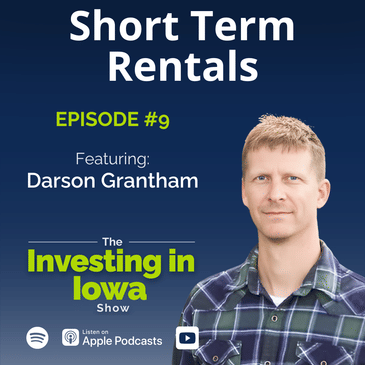
Discover the strategies Darson Grantham uses to navigate market changes, the importance of leveraging people and resources, and his insights into the short-term rental market in Des Moines. He also delves into his personal experiences with work ethic, mentorship, and the significance of understanding one's worth in business.
What you'll learn from this episode
-
The importance of leveraging time and resources in real estate
-
Why Iowa is a great place for real estate investment
-
How sports and small-town upbringing shaped Darson's work ethic
-
The impact of Dave Ramsey's principles on personal finance and real estate investment
-
Strategies for growing a real estate business and building a supportive community
Resources mentioned in this episode
-
Influence by Robert Cialdini | Paperback and Mass Market Paperback
-
The Total Money Makeover by Dave Ramsey | Paperback, Kindle, and Hardcover
-
The Millionaire Real Estate Agent by Gary Keller, Dave Jenks, and Jay Papasan | Paperback and Kindle
-
The Millionaire Real Estate Investor by Gary Keller, Dave Jenks, and Jay Papasan | Paperback and Kindle
About Darson Grantham
Darson Grantham is a licensed real estate agent and experienced multi-family investor, committed to helping individuals and families build lasting wealth through strategic real estate investments. With deep expertise in the Des Moines market, Darson provides comprehensive services in purchasing, selling, and investment strategies.
Darson is dedicated to empowering clients with the knowledge and support needed to achieve their real estate goals, ensuring a future of opportunities and financial growth.
Connect with Darson
-
Website: Darson Grantham
-
LinkedIn: Darson Grantham
-
Instagram: @darsongrantham
-
Facebook Group: DSM Real Estate Investing Group
Connect with Us
For more insights and updates, follow us on social media and visit our website: https://theinvestinginiowashow.com/.
[00:00:00] I'm fine with leveraging as long as I see the value. There's a lot of people that are just, they just want to hold their pennies so tight. They just won't leverage those. We see in the agent world any services business, like they just won't hire that admin.
[00:00:10] From cornfields to high rises, office to industrial, houses to hotels and every other asset class in real estate, we cover the people, the projects, and the profit. Welcome to The Investing in Iowa Show. This show is for go-doers, action takers, and business owners. It's for people
[00:00:28] like you who are sick of Uncle Sam taking a huge bite of your apple. If you're looking to get ahead of what's taking place in Iowa, learn who is doing what and how you can get in on the action.
[00:00:39] You're in the right place. Hosted by Neil Timmins, an Iowa native who has been involved in over $300 million in real estate right here in Iowa. Recording in studio from West Des Moines, here's your host Neil Timmins. Darson Grantham, welcome to the show.
[00:00:57] Yes. Happy to be here. Thanks for having me. It's good to have you here. St. For the audience to say, who are they? Where are you from? What do you do? Gosh, a lot of that can be answered in a long, long-winded answer. But I grew up in
[00:01:08] small town of Iowa. I've lived in Des Moines since 2006. I went to AIB Business College, the college that is no longer. I knew I wanted to do business early on, own lawnmower and own business stuff. And so basically tried to figure out what that meant through business
[00:01:21] college. So I cut go knives for a while during college. I was laughing my life when I started to become a realtor. I was like, if this doesn't work out, I can go sell knives because
[00:01:30] they're literally the easiest thing in the world to sell because they're so damn good. So I did that. That was 06, 789. Graduated by my wife in 2012 working as an account manager for an insurance company selling employee benefits. Actually, it was more than employee benefits.
[00:01:45] It wasn't, but the fun of it was meeting business owners around the state of Iowa. So I meet with all the widget manufacturers because we did all of them, but a lot of them. Employee benefits. You get to hear their story of how they grew their little business
[00:01:59] to be the most unknown business in Iowa. That was super fun. Travis McDonnell stated that. They actually let me go in 2017. They got fired. One of my clients called me and they said, hey, do you want to come do what you were doing for them just
[00:02:14] as in-house for us? So we're Kiva up in Ames, a billion dollar company in Iowa. I started up. They were clients of ours and they said, just come do what you're doing in-house for our employees. So I didn't really scratch my sales entrepreneurial itch because
[00:02:27] I was working for corporate America, but at least I wore shorts and sandals and backwards hat and they did not care about it at all. And so then they grew from 700 to 1300. And I got fired from them right at COVID when COVID happened. There's a theme here, right?
[00:02:43] And between that, I started investing in real estate, joined some masterminds, bigger pockets and just learned everything I could about real estate investing. And that came from, we did the day of Ramsey. My wife and I, Ramsey Payne, didn't love the,
[00:02:57] once we had a step four, you have to pay off your house and put more in the stock market. And I was like, I just feel like there's a better way. And so my wife was,
[00:03:06] she's still a stay on the, our finances and business. She's like, pretty much trust you blindly until you prove me not to. And I was like, okay, I got this. So she was supportive
[00:03:14] of that. And since then we have, well, that happened. I lost my job at work Eva and basically I owned rentals, but I had already been networking with real estate investors throughout the morning.
[00:03:25] And so flipping the switch to become a realtor or investors made a lot of sense. I just did that math and I was literally in March and I called all the brokerages. Only one that would meet me in person was Keller Williams. This was March during COVID.
[00:03:40] March during COVID. Yep. Yep. Literally in the smack of it. None of the offices were open. I was like, Hey, I want to become an agent. And everyone's like, no answer, no one's even, I mean,
[00:03:49] I didn't know down between two and I listened to Gary Keller a few times on YouTube. And I was like, I don't know who these people are. I don't know who, I don't know what, but
[00:03:57] that is who I want to be with. So I joined Keller Williams and had to make a decision whether it was going to be investing that I wanted to do or they want to be a real estate
[00:04:04] agent because I just a firm believer in it's two very separate business models. And I chose just after a year of doing agent work, I was like, I can not be an investor but I can help a lot of investors. So I owned some properties
[00:04:17] at the time I owned 15 doors. So I bought some stuff and became an agent. It's kind of well, I was with you the year first year, sold a bunch of business and have been pretty flat honestly. It's kind of been pisses me off a little bit.
[00:04:28] I'm like 50 houses a year. Yeah, it's good and all, but like I can't get over that hump of like 75 to 100. It's an XP. Yep. That's where we'll see. And then you do some things in the short term space, don't you?
[00:04:38] Yeah. So 2022 basically as an agent I work with a lot of folks that are out of state that are looking to buy in Des Moines. I'm big on bigger pockets, have YouTube channel
[00:04:49] and so 40% of my business is done without estate folks. Right. So that's either on the buying as residential or investors looking to buy here. So in doing that, investors wanted to buy short-term rentals in Des Moines. I was uncomfortable referring any of the management
[00:05:05] services that were in Des Moines to them. And so I was literally losing sales because I didn't have someone to manage their properties. And I'm not a manager. The visionary type person, I am not the operations. And so I knew I could not do it.
[00:05:18] And so I reached out to a couple of past clients and a fellow realtor and I said, Hey, you guys do all the operations. Let's start this business and let's see what work can go from here. And so I started that 22 test out on our own
[00:05:30] product for a year. And now we have 11, maybe even 15 under contract, I guess you could say is managing management. Yep. Just short-term, medium term to just because it ties in like in the winter stuff, no long-term. I refuse to do long-term rental stuff. I struggle with
[00:05:46] those businesses. It's the two businesses short-term. Well, let's call short and midterm. We'll bump that into a single category. Furnished and not furnished. Yeah. Furnished, not furnished. Totally. It's not in that. Totally for business. Totally for management. One is largely hospitality driven.
[00:05:58] Yeah. The short term, it's not real estate. Right. Like it is marketing. I say click bait. It's not click bait, but it's truly a click through rate. You can see all the testing of like,
[00:06:07] Hey, your first four photos are shown. These are the first four they stop after photo two. Yeah. Right. And you're like, Shit, no, we need a better photo for whatever. The short-term world and you know this, Neil, the data behind it is bonkers.
[00:06:20] You can see exactly what you need to do to be the best. Yes. The long-term world. You can't do that. No. Which I struggle with a lot. Even today. Yeah. Today. You can rent a meter. You can do all the things, but a house, two,
[00:06:32] two better, two ones on the same street can rent at least $300 or $400 of difference depending on their quality. And you can't track that anywhere because once it goes down, once it goes not listed anymore, there's no tracking source. I've tried to figure out how
[00:06:45] to fix that and I'm not quite there yet. Yeah. Where there's a lack of transparency, there's money that can be made. Yeah. Yeah. I mean, I just like to have a lot of investor
[00:06:53] clients. I know a lot of investors in the morning. If I could get every investor to input the data that needs to be inputted into a system, you could spit out the differences between
[00:07:01] having garage and not having garage in Beaverdale. Not there yet. That's a dream thing, but it's not even in the works. Yeah. Yeah. If someone wanted to do that, I would totally support them. It would
[00:07:11] be tremendous. It would be heavy left, but it would be heavy. Yeah. Talk to me about growing up in small town Iowa. Everybody has a different background, where they come from, how they grew up, what that was like. What were the benefits of growing up in small town?
[00:07:23] How has that come to serve you today? Good questions. My dad was a REC lineman, like an electrical lineman, not house electric, but big stuff. My mom was a beautician, slash stay-at-home mom. She had a beauty shop in our house for most of my childhood.
[00:07:40] Went to public school, played sports. I think I learned a ton of work ethic. I was telling someone last night, I learned so much word ethic from sports. Then I was like, but my parents worked hard. He was an alcoholic up until 10 years ago, like
[00:07:52] fit the velvet, fit the black velvet every night drunk for sure. Super nice guy, but just always drunk. Stopped 10 years ago. Thank goodness. Totally different guy now with the grandkids. It's so fun, but they both work hard. We sat around and watched the news maybe
[00:08:07] an hour a night. So we watched some TV, but dad was always gone. Mom was always working. So it has to be something with that on sports. So I was in high school, our basketball team was really good. I was not very good, but I worked hard.
[00:08:22] And so I had win the awards like Mr. Hussle or whatever. I mean, you can't shoot and you can't do anything else, but you can play hard. Okay, that's me in that shell. So we went on
[00:08:31] state my junior year and then one state my senior year. And I was six months off the bench and our basketball coach was insane work ethic guy. Just our practices to the minute were scheduled and like, you'll dribble the ball from here to here for this one minute
[00:08:46] of the evening. And we all make fun of him, but like he's so good. I think the difference is between watching parents work hard and then your sports is different between understanding and implementation. Yeah, because I didn't see my parents implement
[00:08:59] the working hard because I wasn't there right? But my basketball coach, I could see that you were the one who had to implement it. Yeah. Yeah. It wasn't me watching something. It was a combo.
[00:09:07] I mean, because at home, I would say my parents didn't make me work hard, but I had chores. I had a lawnmower in business. I don't ever remember them like really yelling
[00:09:14] me like, you need to go do these things. You need to get what was not drill sergeant. But I guess I knew where I stepped out of line. I get past you, but like you just knew where that
[00:09:23] line was. But in basketball, like you're just always intense. It was insane. When you were going around Iowa, it's all employee benefits, if you will, and talking to these small business owners, understanding and learning about them and
[00:09:35] their story, was there something that did it shock you in any capacity that you'd go into small town Iowa and talk to these business owners and you'd be like, this is like finding a little Corvette in the back of the box. Meaning they have a tremendous
[00:09:47] business and produce tons of money and you're like, is there? You'd never have a clue. Yeah. It was very surprising in how humble they all were. Very few of them were flashy. In small town, you can't be flashy. Otherwise, it won't work out well.
[00:10:02] Yeah. Culture clash if you were. Totally. Totally. I remember going to college and I bought an accurate TL and I was like, I don't know if it was my dad or someone who's like,
[00:10:10] you're going to drive that back home. I'm like, it's not that nice of a car. And they're like, it's almost like Alexis. I'm like, it's not. It's not that nice. But like it was just different. It wasn't a big truck. I used to drive a big truck. Yep.
[00:10:22] So yeah, the small town, it was their biggest, one thing I noticed about them is they all cared so much about their employees. That was their key to success or key to making the widget was they had to have workers. They'd pull from other towns and the towns
[00:10:35] would kind of not fight but try to draw in from other people. Like, how do we care about our employees? What do we have to do to our employees to make sure they come here and not the next town?
[00:10:45] And that's the majority of what I noticed. Well, to keep component business is the leverage, right? A leverage shows up in multiple places, multiple places, right? Through people, through finance, through operations and marketing, number wise, but people being a large one.
[00:10:57] I'm curious as to that leverage, especially plugging in Kelly Williams, Gary Keller, the millionaire real estate agent, both agent and the investor, the two series of books. How you've applied leverage in the study of business.
[00:11:09] Hi, it's Ava Bowcamp, the investment relations manager for Neal's firm, Legacy Impact Investors. I'm inviting you to join us for our next investor workshop, our monthly legacy briefings. In these tactical Zoom calls, we cover topics and case studies for subjects such as taxes
[00:11:25] and depreciation, navigating macroeconomic shifts and evaluating deals as a passive investor. At each virtual workshop, we are joined by an industry guest who covers their topic in 45 minutes or less. No fluff, no pitches, just education and conversation with an expert each
[00:11:42] month. Every workshop ends with live Q&A from Neal and our guest. All briefings happen on the last Tuesday of the month at 3 p.m. central. If you can't make it live, recordings are sent
[00:11:53] out exclusively to those who've registered in advance. To join us on the last Tuesday of this month, visit Legacy Briefing dot com. Go to Legacy Briefing dot com to register. If you're a first-time registrant, I'll send you a free resource at sign up.
[00:12:08] Head to Legacy Briefing dot com and I'll see you soon. Three months in, I hired my first. I never have done TC work myself. I got fired twice and it was mainly because I was not organized and not to the T, right?
[00:12:20] So I knew that real quick and then when I started selling, I was like, okay, I'm just going to price him $200 TC fee to help make sure that the transactions close on time and
[00:12:29] we hit deadlines. I'm okay with hitting deadlines. It's the sweeping up everything. And so I did that right away. I hired my first and be part-time admin three or four months into it and did not do
[00:12:41] any hiring, just as like some contractor said, hey, my wife doesn't have anything to do during COVID and I'm like, well, I'll hire her if she just wants to basically sweep up my messes.
[00:12:51] And it went well for a good year, year and a half. And then I realized like I need a true organizer. And so yeah, leverage to me as people, I've not bought leads much. It's not really something that
[00:13:04] I've built my business on. I have created content, created goodwill throughout the community. So I run investor meetups locally, bigger pockets. Before I was an agent, I was commenting on anyone who talked about Des Moines real estate on bigger pockets. And so besides Mitch Cluzzi,
[00:13:21] I had the most likes and comments of any agent. So when they flip, when bigger pockets flip the switch and said, hey, you know, you can now find an agent, I was like, yes, I will be that guy that
[00:13:31] helped build my business because all of the goodwill I created for the first two or three years before I became an agent. Yeah, through serving through comments, through writing values. Yeah. So like to me, that's form of leverage. It's an ongoing leverage. But yeah, the good color
[00:13:44] of the book, I mean, I could go on forever, like swim thing I love about colors. It's color, but it's really the real estate business in general. It's a model. I didn't realize that you
[00:13:52] could model that out before I became an agent. I was like, I just got to talk to a lot of people about real estate and surely they'll trust me at least enough of them will. And then I was like,
[00:14:00] the models came out and like, oh, so you just have to do these things, then you'll sell. Follow the model. That's the way we're saying is we'll run a business. That's what the
[00:14:08] model is, is the play by play about how to run a business, not how to be an agent. No, right? Yep. It's how to run a business. Yes. Right. Yep. You're not a base, what you need to do with them,
[00:14:18] the having that's and having not met. I mean, I still laugh at today and you probably get this too. I think if someone came to me and said, I want to make $100,000 next year, they're willing to work 40 hours a week, I would guarantee them $100,000 next year,
[00:14:30] but they have to do exactly what I say for 40 hours a week. But nobody wants to do that. It's hilarious. I mean, I've read the book and I've implemented it. Yeah, many years ago. Yeah, I understand it. The model is there. It's been proven. It's worked,
[00:14:43] and you can tweak it. Right? So I don't do the calls in text, like it says, every quarter day is supposed to talk to everybody on your database. I'm like, I don't like getting phone calls. I'm not going to do phone calls.
[00:14:53] Texts I can do, we can figure out how to do that. That you followed up the millionaire real estate agent with the millionaire real estate investor. It's a model for investors. Exactly. Yes. There's plenty of people out there who follow and execute. Yeah.
[00:15:07] Same thing. It's just not right. You don't have to recreate. It feels like as investors, was an investor before any of that. That was like, you don't have to create something new. Right. Just follow what other people are doing.
[00:15:20] Let's talk about that in the short term space, maybe defined for folks. Well, from Iowa, you know, sitting here and where we sit, you have an understanding. But if you're not here, you're like, why would anyone ever go to Iowa? The idea being,
[00:15:32] you know, the traditional short-term model is, you know, get expet home on a beach. And that's only a mere fraction of actually what that business, what Airbnb is built for lack of a better descriptor of really what short-term is,
[00:15:45] to mere fraction of what their business is built on. Yeah. Short term, I was laughing. People asked the same. It's the most common question. Who comes in the morning for the short term? Well, first of all,
[00:15:53] to point out, short term in Des Moines and probably most like any other small city is like, no one comes here to vacation. You don't need to be the vacation spot. There is some need
[00:16:03] for that, right? Bigger properties. That isn't the need. It's the things that Des Moines have going for it. And you don't know that until you start doing research. You don't hear about what
[00:16:11] all Des Moines has, but there is a boatload of events, of places, of venues that people come to Des Moines for. And if you think about it, it's not necessarily people from out of state.
[00:16:22] It's small town Iowa. They're like, they're two hours away and they're like, we're coming to a wedding. We don't, we don't drive home, grab your wedding for two hours. So let's just stay in an Airbnb where we have the hospital systems. And so those nurses come in
[00:16:35] and stand and using the short term or medium term rental capacity. So I was talking with yesterday and the day before about how to finish up big rental, right? So five, six bedroom at
[00:16:46] the pool and whatnot. And we just talked about if you deck it out, there's very few in Iowa that are decked out. But if you bought that same thing in Gulf Shores, Alabama, Florida, whatever,
[00:16:57] it's going to be decked out because that's what your competition is. You have to have that. It's not the standard here. So you can really get ahead. So until enough short term rental owners start meeting and catching up, there's a little bit of arbitrage there.
[00:17:10] It goes past just having a nice property because anybody can go in it. I know never people have gone, oh, I can go do that. I'm at construction in that trade where I can go in
[00:17:18] and I can make it look sexy. But it goes past that you have to execute on the hospitality center that otherwise is all for nothing. Yeah. And I was kind of on the front end of that.
[00:17:27] That was when you're pre-evaluating the actual day to day stuff. I mean, that's hospitality, not real estate. I know some agents though in their own Airbnbs and I'm like, you can't be maximizing that. One, you can't maximizing that. And plus,
[00:17:39] you're taking away from your agent business unless you really enjoy hospitality. And there's some people that do. It's not smart. Yeah. You just mentioned something that tripped the thought. I see a number of agents and I see it more in the agent business than I see it
[00:17:54] in doctors or lawyers. I'll draw a parallel in a second that I see a number of people. So I'm an agent and then I also invest. And the idea is, I'll invest, I'll buy these rentals,
[00:18:04] I'll buy the short term, whatever happens to be, and that will supplement my income. But what ends up happening just like if you were a doctor or a lawyer, if you were to apply the same thing
[00:18:13] as your billable hours in the law practice decrease. This is why I read a book a number of years ago, attorneys are the least likely of all professional trades to build their own house
[00:18:24] because they're the most likely to know exactly what they're compensated per hour. That means when they make a trade-off, they know what it costs them. And so I see that a lot on the agent side
[00:18:32] when if they just stayed in their own lane like an accountant or an attorney or a business owner of any nature and you can still invest, it just has to be done differently. So I'm wondering
[00:18:43] if you see the same thing where you see pitfalls, I just happen to see in the agent space probably more than any other. I see it in myself. I don't invest, I don't buy rentals as
[00:18:53] much as I really like, I feel the need to because I'm putting money into my real estate agent business. The operating business. Yeah. So like my long-term rentals, I drive my block away from them. I mean
[00:19:04] probably every day and I have someone else manage them. I just got to a point where it made no sense for me to even think about leasing up a unit. I mean, because of what I was able
[00:19:14] to sell as an agent. They're two different businesses. You can maximize your operating business and then invest separately without being the person who does the day-to-day, the grind, the whatever. And you have to pay for it. I'm fine with like the leverage thing.
[00:19:27] I'm fine with leveraging as long as I see the value. There's a lot of people that are just, they just want to hold their pennies so tight and like they just won't leverage those. We see in
[00:19:35] the agent world, any services business, like they just won't hire that admin. Correct. I'm like just hire the damn admin. Correct. If done correctly, it'll be maximized. Like there's a lot
[00:19:44] of proof. I saw that when I was in the insurance world. The agents that first hired the admin would blow up and the agent that was too cheap and was like, no, I don't want to spend it because I
[00:19:51] don't know. Right. It's a cost. Yeah. Not an investment. That's how they do it. Right. I see that all the time. In any industry, it's not definitely just not an agent. And it's another advocate or reason why you should invest out of your own city. Right? Because
[00:20:03] you can't work on it. If it's true. Yeah. You have a choice. Right. Now, there's obviously, I always say, invest locally. You'll know way more about it. You'll be able to study it unless
[00:20:12] you invest locally. But a reason to not would be to, if you're a hands-on person and you always want to fix everything yourself, you would take away from your work or your family. Yes. Correct.
[00:20:21] That brings me to why Iowa. I'm going to ask two questions. There's plenty of reasons to invest out of the state, if you will. There's plenty of states you would never invest in and they can, some of the coasts where there is no cash flow anyway or very
[00:20:31] little. That's the reason to leave, to invest in another state whether it be Iowa or someplace else. But for you, why Iowa? You have choices you could have gone anywhere. You could have done
[00:20:41] anything. Why here? Why do you stay here? One of the benefits of actually, as you see it, actually being here. Yeah. So we thought long, so it's a family thing for me. We're from here,
[00:20:50] from small town Iowa. My wife's from Marshalltown. I mean, we all have family here. During COVID, we considered where else would we have wanted to move and like the laws that Iowa came out with and how they handled that were huge freedom people. Like,
[00:21:03] I don't want to be told what to do. When we told what shots to get, you know, where to take my kids, we're not going to do that. And so there isn't another state that
[00:21:11] treated it better than what we thought we could get for what we get here, right? Secondly, Des Moines in general is massively underrated. I think if you look at all the, what they're doing, the city or getting people to move here, the size of it,
[00:21:24] not being over a million yet hasn't got big, big national attention, but still comes up on all the lists of best places to live, work, blah, blah, blah. Most people that visit here
[00:21:34] are surprised with how nice it is if they're here for the first time or like, how much they liked it. I help investors invest here and they'll come into town and they'll say, take me to the
[00:21:41] worst neighborhood, right? I'll take them to what I would consider the lowest income neighborhood. And they're like, this is it. This is the worst. And I walked out, I walked my kids down any street in Des Moines during the day and not blinked an eye. So
[00:21:54] the Y Iowa, it's a very safe bet. So the other thing is the median during COVID, 20 to 23, I believe the median household sale price, Iowa was the fifth lowest of all the states, right?
[00:22:08] So it didn't go up a ton, right? To me, that means, well, it's not going to go down a ton when we have a downturn, right? And we're kind of seeing that right now. We're up,
[00:22:16] March was 5% median set price year over year. And the other cities that are definitely flat or losing like massively still seem a increase on that single family side. It's the fastest growing, you know, Iowa, one of the fastest. Well, more specifically, Des Moines,
[00:22:33] one of the fastest growing cities inside the Midwest. Yeah, with a lot of populations specifically to the wine even from through Iowa. I think it's 26 people. It was 36. I think it's down to 26 people a day move here. Yeah. So it's family for us. I'm confident
[00:22:48] enough I could go start a business thing. I don't know what the business would be. I would figure out something if there was another state or another country that I thought was better.
[00:22:56] And my wife would be like, yep, let's do it. She usually has, she can get the core values for her family a little better. And I can say, okay, this place meets those. So right. Talk about
[00:23:05] looking forward through this year. Where's the business headed? Where are you headed? Things changing in your family? Where are you going? Yeah. Where am I going? Yeah. Business-wise. Yep. I'm basically where I was at last year at the same time. So I would say about a
[00:23:16] million dollars a volume a month is like what it pays the bills and it gives us a good cushion. I'm hiring my first full-time in-office admin on Monday. This is Friday. So literally,
[00:23:26] I'm leaving this podcast and we go clean the area that she's going to sit in and then just say, hey, please keep me organized. Let's do this. So other than that, I just see a huge need in the
[00:23:37] Des Moines market to start in a podcast, doing this podcast, right? I think there's one need for agents and not connected to a brokerage. More of a pretty shingastic. Yeah, like I believe that
[00:23:48] all the brokerages in Des Moines have a spot for somebody. I don't think it matters that much. It does matter though. And I think a lot of agents don't understand what all the brokerages offer,
[00:23:58] right? And how all the agents kind of work differently in them. So the site podcast doing that. But ultimately, it's onboarding my admin and growing my number of transactions. While you might get careless, I mean, just that will come on the investor side.
[00:24:13] I've ran a meetup monthly and then every Friday morning and they're very poorly organized. Admittedly so, I'm just like, hey, these are the dates. I'll figure it out. Ten plenty of dates. That wouldn't be as harsh with that criticism.
[00:24:25] Yes, they're not organized. I need to do a better and they need to be like just have bigger, not bigger names, but some other names, some out of state. I've got some guys from Omaha coming over in the future getting people a wider variety of options of mindset
[00:24:38] of motivation. I'm going to try to go that a little bit and just see where it goes. I mean, that's not business. We talked earlier. It's not a business. I'm not charging for,
[00:24:48] I'm not doing any of that. But I track all my leads very closely and I can tell like those events produce more income for me. So I might as well do them better. If you're a house flipper, execute the birth strategy or do double closings
[00:25:01] and are in need of money. Little Guy Lones is your go-to lender here in the Des Moines area. Time is money loan approvals in 24 hours, closings in five days. Little Guy Lones was founded
[00:25:14] by Neil Timmons, an investor just like you. Since he has been in over 10,000 homes in Des Moines, there's never an appraisal houses, multifamily and commercial property loans up to one million. Check out www.littleguylones.com.
[00:25:31] It sounds to me like you're very heavily focused on growing the broker side of the business. What about the short-term management side? Do you view that as separate or is it a component? I do. It's separate because it matters, but it's different product. So
[00:25:42] what we've done with that is I send emails to an investor list and an agent list every month and we send a monthly short-term rental report to me as an investor because I was thinking about this. You're going to sell the investors things like them.
[00:25:55] They want to know what's going on in the market and they want to know what properties fit a short-term rental product. Currently, I'll have anything set up to send out rental properties at an on-market because I think there's a way to help investors find the properties. If we've
[00:26:11] already vetted them and say this one would work quarterly, what's going on in the short-term market? You need to know what you're getting into. It's separate. It didn't grow as fast as
[00:26:22] it like to be candid did not grow as fast as we thought it would. We started it right when the short-term rental, so there were 600 units on-market in September of 22 when we started. In January, there's 1200. We were like, well, now it's not profitable. Not our business, but
[00:26:39] as an investor, you can't just buy any property and make it profitable. People caught on. Now people are, it's the most common question that I've heard is what agents get asked when they're, should we sell our 2% mortgage or should we make it an Airbnb? The challenge
[00:26:54] I see from the outside looking in is it looks a lot easier than what the reality is. Those who? The management side of it. Management? Well, just the conception of, I'm going to turn into an Airbnb because a lot of us have gone, we've stayed and you're like,
[00:27:07] okay, well that's easy, but it's an actual business. There's things to it. To say, we've got a couple of holdings in the Airbnb in the short-term space. We've got our toe in the water if you will. Management is critically important. It seems to mean
[00:27:21] like those who do well in their business do very well and the average don't do very well at all. You'd be better off changing your average Airbnb property into a long-term rental. Yes. Yeah, that's, I think it's 30%. I would guess 30% make more than what your long-term is.
[00:27:37] 30% make more than what the long-term is and it requires way more energy, time energy effort. Yep. And that's really, I mean, it doesn't mean they don't make money, right? Because if you're managing yourself in your onesie-toosie, you just have to make more than
[00:27:50] mortgage in your units, right? Most people don't value their time spending in it. And so that's what we see is, I mean, we have a lot of people saying, would you manage this for us? And we kind of go through it and like, hey,
[00:28:01] this is what you would make. And they're like, I mean, that's what I'm making now. You're grossing way more because you're paying yourself, paying our management kind of thing. And I'm like, yeah, but you're not spending any time on it. But most people don't,
[00:28:12] they just don't look at it that way. And I can't force everyone to be a business person. And it's just over time, they will stop. Like, I think that's proven. Like, over time you won't sustain that. People will either sell it or you will hire it out,
[00:28:24] most likely to sell it. You can come up the curve of success and wealth a lot faster by knowing your worth and whether that means it begins with one stop. All right, let's move on to the final segment. What I call the final three. Ready?
[00:28:36] If you had to give one piece of advice to your 20-year-old self, what would it be? Go work for free for the best person that you want to model. I don't know if I didn't do that. I feel like I worked for very smart people
[00:28:47] and I watched exactly what they did, but I didn't go work for free from the best person. Like, I still went and found the job that paid the best and I paid attention to what leadership did.
[00:28:56] I would go back and I would go try to find whoever I wanted to model in 20 years, 10 years, 5 years, and just say, hey, I'm literally yours for the next three months. And then find a way to make money elsewhere and just go work for them.
[00:29:08] I read a number of biographies. It's amazing when you go back in time and Edison comes to mind about the number of people who worked for Edison who then went on to own some piece of the
[00:29:18] business to start to pick up something that he'd let go or left off, whatever it may be. Just absolutely incredible to be a sponge on. I don't even think... I think it's more the mindset that you're willing to work for free
[00:29:31] and not more, but it's definitely willing to work for free. They'll probably pay you. You will probably get something because most people that are in that realm, they aren't just going to be like, yeah, I'm not going to pay him for six months and we'll
[00:29:42] just be gone. They'll give you something. But the mindset that I'm willing to do this for free is to be the other trigger. If you went to work and only got a paycheck, you didn't get it. Yeah. Top two books that changed your life.
[00:29:53] Influence by Robert Caldini. Very interesting book. And then it's got to be Dave Ramsey's Baby Steps even though I stopped at Step 4. I don't think many real estate people are Dave Ramsey fans, so it becomes interesting,
[00:30:06] but it seems like you utilized it for the personal finance side of things and then you took it to where the investments are instead of going down a high-fiving. What I like, which you propagate, you've gone down a different path.
[00:30:18] What I liked about it is it clear path. It's a model. It is a clear path. And I don't like black and white. If I'm doing something I want to know, hey, this is exactly what I need to do. I'm going to do it or I'm not.
[00:30:29] And so it helped my wife and I understand that finance is better. Pay attention to that before we just willy-nilly just spending here and there. And it just wasn't good. So probably that book is what just triggered us to have a set plan as a
[00:30:44] couple. We were early on in our marriage, so I helped build our relationship too. Question three, if you were cashed away on an island, you were there for a year, you can only get three pieces of data from your business each and every month.
[00:30:56] Only three pieces of data. What three things must you know every month to know how your business is operating? It's a community estate business. So I apologize to the investors out there, but as an agent, you need to know how many
[00:31:07] people you talk to, how many properties are under contract would be one for me. People you talk to under contract and then I would go YouTube, how many pieces of YouTube content I put out? Those three things. For you, it sounds like that the content leads to the
[00:31:20] conversations. Yes. My goal is to never have to call someone to get a deal and they just call me. And that sounds like the dream when people are like, oh yeah, that sounds awesome.
[00:31:29] It's a lot of work. And it is not what they teach in real estate school. It's what they teach in business school. Night and day. Yeah. I appreciate being there. This is a great conversation. I know we could have tons of these. We could talk forever.
[00:31:43] So for people, they want to find you. They want to follow you. They want to connect with you, work and they go, what should they do? Yeah. I mean, if you're an investor and you haven't
[00:31:51] heard of bigger pockets, like go jump on there. Obviously, I mean, I've got a profile on there, but that space is massively important. And then secondly, we have an adult owner that I moderated. It's a Facebook group called DSM Real Estate Investor Networking. I think it is,
[00:32:05] but it's just DSM. So not Des Moines. The only one that's DSM, they'll click on that, join that and just sponge on the other amazing investors that we have. Like continually amazed at how
[00:32:18] much other investors will give back to investors in this market. I don't know other markets, but I'm told that it's not quite the same in other markets. In Des Moines, whether it's Iowa NICE or for some reason, we just have super friendly investors. But if you
[00:32:31] need a plumber, that website has it. If you need an electrician, it's got everything. Hard money. Hard money. That's exactly right. The link will be, we'll stick the link in there. I don't know,
[00:32:40] it's bigger buddy. So you have it there. Long question and I'll give you the last word. Why did I not ask that I should have asked? I should know all these questions because it's common podcast questions. I listen to a noxious number up on the cast.
[00:32:52] But I'll say the most recent podcast that I listen to. I always want to hear someone else's recommendations on podcasts. And so I'll share mine. Patrick Betta-David is a podcast or YouTube channel that I've yet to find a value that he values that I don't.
[00:33:07] And so I'm trying to find out why, what that is and that's super fun. And then I started out on Bigger Pockets podcast. That's where I learned the majority of my real estate investing. So if anyone is just starting out,
[00:33:18] go listen to the very, very first 200 episodes of Bigger Pockets. And that will help you understand what type of real estate investing you want to do, whether it's single family flips, rentals, short term, all of the anything those two podcasts, two, three. Yeah.
[00:33:34] Go back to the beginning because what's taken place in the Bigger Pockets world and then the bells that run out has been tremendous over the years. But going back to the beginning
[00:33:44] takes you to the mentality and the conversations because it is so green if you go back from your person where they are now. And I echo what you're saying, if you're just starting, you can walk that journey with them by going back in time.
[00:33:56] Yep. I met with a customer service rep because at Bigger Pockets, you pay for some leads at Bigger Pockets as agents. And so I jumped on with that. We have customer success and she goes, Hey, would you want to come on our podcast and bring
[00:34:08] a client that has done a boring investment? I was like, what do you mean a boring one? She goes, yeah, we're getting too many crazy deals and no one likes those podcasts that they're not relatable. We just want the boring investor deal. And I was like, yeah, that's
[00:34:22] the morning. I've got a lot of those. So it's so true. And so those very early days, I mean, Brandon Turner had 30 properties for how many years, right? Dave Green wasn't even on
[00:34:32] there. So it was early. I do that with every podcast. I'm one of those that I go from the beginning. I want to know everything about what there is about the host and what they think like. Yeah, well, I appreciate you being here in this one.
[00:34:44] Yeah. Thank you. I appreciate it. Thanks for being here. Thanks for listening. If you're enjoying the show, may I ask a favor of you? Naturally, subscribe so you never miss an episode. But would you rate and leave an honest written review
[00:34:56] on Apple Podcasts? It does a lot for us here at the show. And I appreciate reading your thoughts. Great guests make for a great show. If you know of another island who would be a great guest
[00:35:07] or you yourself have interest in being a guest, well, get on our radar. Visit investing in Iowa to fill out an application or recommend a guest. And if you want to connect with me one-on-one,
[00:35:19] go legacyimpactinvestors.com. Click on the invest with us button in the top right corner. And there you can pick a time for the two of us to get on the calendar and connect. Until next time, keep investing in Iowa.