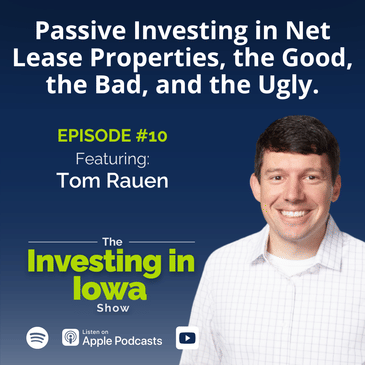
Ready to revolutionize your real estate game? Join us as Tom Rauen, a seasoned investor from Dubuque, Iowa, shares his incredible journey from humble residential beginnings to dominating the world of triple-net leases. Discover the strategies and lessons that shaped his success and get invaluable advice for making your mark in real estate.
What you'll learn from this episode
-
Early challenges in residential real estate
-
How to expand your real estate business and portfolio
-
Step-by-step process and benefits of real estate syndication
-
An effective way to navigate market changes
-
Tom's strategies for continued personal and business growth
Resources mentioned in this episode
-
Rich Dad Poor Dad by Robert T. Kiyosaki | Kindle, Paperback, and Mass Market Paperback
-
The 4-Hour Workweek by Timothy Ferriss | Kindle, and Hardcover
About Tom Rauen
Tom Rauen is the founder and CEO of 1800Tshirts.com, an Inc. 5000 company, and co-founder of both Shirt Lab and Dimensional Brewing Company. He has actively contributed to his community by serving on the boards of the Eastern Iowa Juvenile Diabetes Research Foundation, Dubuque Area Chamber of Commerce, Mercy Health Foundation, and several other organizations. Tom has received numerous accolades, including the Dubuque Rising Star award and the Chamber Member's Choice Award for Excellence in Social Media. Alongside his wife Amanda, he started the Rauen Family Foundation to support community initiatives. The couple enjoys traveling and embarking on new adventures, most recently navigating parenthood with their children, Thomas Jr. and Theodore.
Connect with Tom
-
Website: Rauen Capital | 1800tshirts
Connect with us
For more insights and updates, follow us on social media and visit our website: https://theinvestinginiowashow.com/.
[00:00:00] This triple net lease world with national tenants is a unique market. It's all in its own class and it's fascinating to watch, but it's also great because the prices haven't changed a lot. So unlike multi-family or other stuff, interest rates go up. That affects the price big time.
[00:00:17] From cornfields to high rises, office to industrial, houses to hotels, and every other asset class in real estate, we cover the people, the projects, and the profit. Welcome to the investing in Iowa
[00:00:30] show. This show is for go-doers, action takers, and business owners. It's for people like you who are sick of Uncle Sam taking a huge bite of your apple. If you're looking to get ahead of what's taking
[00:00:42] place in Iowa, learn who is doing what and how you can get in on the action. You're in the right place. Hosted by Neil Timmins, an Iowa native who has been involved in over $300 million
[00:00:54] dollars in real estate right here in Iowa. Recording in studio from West Des Moines, here's your host Neil Timmins. I've got Tom Rauen here. Tom, welcome to the show. Yes, glad to be here. I'm excited to be here. Say for the audience to say,
[00:01:08] who are you? Where are you from? What do you do? All right, live in Dubuque, Iowa, and pretty much been there my entire life. Went to the University of Dubuque, and CEO of 1800T-shirts.com and Round Capital. I'll tell you what, Dubuque is beautiful for those who
[00:01:27] haven't been there. I know what can attract you to that. It's just kind of rolling hills over looking the river. It is an incredible place, especially when you spend time in other sections
[00:01:36] of Iowa. A lot of it's flat, and Dubuque just doesn't look like Des Moines, so I know there's a lot to like there. Yeah, I love it. It's beautiful. It's gone through a lot of changes
[00:01:47] throughout my life, so it's fun to be part of those changes and see it all happen. Talk to me about your very first real estate investment. What was that? Yeah, it was a nightmare. I bought a Foreplex that also had some storage units behind it,
[00:02:08] so I believe it was roughly about 20 storage units and then the Foreplex. This was in a very rundown, I would say rough part of town. I bought it on contract. I think it was like three or $4,000 of inheritance money when my grandpa passed away,
[00:02:31] and so I used that as a down payment. I was in the game, and then we quickly realized one tenant was a pretty heavy drug dealer. Another tenant was a hoarder. Another tenant, I'm not sure what they
[00:02:51] did, but there was basically cops there a lot. Every possible scenario that could have happened, we went through in the first year and it was just absolute nightmare. Ended up evicting everybody, remodeling the entire place, and then selling it.
[00:03:10] And actually did pretty well on the sell of it. We got pretty fortunate on that part of it, learned a lot of lessons, and the biggest lesson I learned was I don't want to do a
[00:03:20] tenant anymore, so that forced us into the commercial side of things. When you say tenants more specifically, you mean people? Individuals? Rentals? Houses? Apartments? I don't want to deal with people and phone calls and all that sort of thing on the weekends and just all these issues.
[00:03:37] So that forced us into commercial, and then I learned about Triple Net Lease where the tenant covers all their maintenance. They cover the taxes and insurance and everything else. And with owning a company, that's my full-time job, that I didn't have time to be dealing with
[00:03:58] all the extra stuff. So I knew that if we wanted to keep growing this thing, we really had to focus on asset class that was very passive, very hands off. And that's how we landed in this Triple Net Lease world and focusing on that asset class.
[00:04:13] For a time reference, when did that foreplex? When was that first transaction? That was 2009. You've got a full-time job. You run a successful business. At some point, it sounds to me, and correct me if I'm wrong, that you've got dollars and cents to place like
[00:04:32] so many successful business owners. And your choice oftentimes becomes first, invest in your own business without a doubt. And then second, when you've got access capital, most people turn to the stock market, that quote unquote, the traditional avenue for
[00:04:45] investments. And for lots of folks, certainly business owners, those who are accustomed to being a little more hands-on and creating their own success, real estate becomes a very viable option for them. And as you go down a real estate path versus a stock market path,
[00:05:01] for example. Hi, it's Ava Bowkamp, the Investment Relations Manager for Neal's firm, Legacy Impact Investors. I'm inviting you to join us for our next investor workshop, our monthly Legacy Briefings. In these tactical Zoom calls, we cover topics and case studies
[00:05:16] for subjects such as taxes and depreciation, navigating macroeconomic shifts and evaluating deals as a passive investor. At each virtual workshop, we are joined by an industry guest who covers their topic in 45 minutes or less. No fluff, no pitches, just education and
[00:05:34] conversation with an expert each month. Every workshop ends with live Q&A from Neal and our guest. All briefings happen on the last Tuesday of the month at 3 p.m. central. If you can't make it live, recordings are sent out exclusively to those who've registered in advance.
[00:05:50] To join us on the last Tuesday of this month, visit Legacy Briefing.com. Go to Legacy Briefing.com to register. If you're a first-time registrant, I'll send you a free resource at signup. Head to Legacy Briefing.com and I'll see you soon. So I remember reading
[00:06:07] a lot about how a lot of wealthy people had built it up through real estate. I never really thought about now until you just pointed out, but 2009, 2010, basically, we started this journey. I remember seeing my parents then and then also in the late 90s when everything dipped.
[00:06:32] They're basically 401ks, their entire retirement savings. We had the financial advisor that come over to my parents' house, sit down at the kitchen table and tell them where basically their retirement was at. I remember the one time it basically got wiped out or more than half.
[00:06:53] How can this happen? I don't want that to ever happen to me or our family. And with real estate, I was looking and saying, all right, I can see the building there.
[00:07:03] It's physically there. Over time, it's always going to go up in value. At some point, you look at values 10 years ago or 20 years ago or 30 years ago. And I remember my grandpa telling me, he said,
[00:07:15] land, they won't make any more of it. Always invest in land and properties, whatever you can. Incredible. So you get eventually turned on to triple net leases. Tell me about the first
[00:07:27] property you acquired there. Yeah, so the first one actually was the building that we were looking to put the t-shirt company into. So that was the first commercial building and we basically house-hacked
[00:07:41] it. So I remember listening to podcasts or something and it was like, buy duplex, live in one side, rent out the other side and let that cover your bill. And so we found this building,
[00:07:54] commercial building. And at the current time, the t-shirt shop business was in 2,000 square feet. This building was 12,000 square feet. It was just way too big for us. So we'd actually, it had been on the market. It was a former Rex appliance store. And so it was dark for
[00:08:13] a couple of years. And I looked at it and then I was like, no, this is just, this way too much. It's too big of a project. There's no way. And the price was just too
[00:08:22] much at that time. It was like, this is not going to happen. And then I think it was like eight or 10 months later, looked at it again. And I kept thinking, all right,
[00:08:33] how can I make this happen? Or what can we do? And the more I looked at it, I thought, all right, if we don't need 12,000 square feet, that's a crazy jump from 2012,000 with our business.
[00:08:44] But I thought, all right, if we subdivide this, we take 7,000 and then we've got 5,000 left. We'll do that in the two store fronts of 2,500 or if we find a 10 at the 5,000, then we're good. And I calculated the mortgage payment was going to be about 5,000 a month.
[00:09:03] And so I thought, all right, this is it. This is the house hack. We just got to find a tenant and I have to find a bank to believe in the vision here of how we're going to take this building,
[00:09:13] redevelop it and make all this work. And then the idea was after maybe a five-year lease or something was up, if we were expanding, we would just expand into the entire building and
[00:09:27] not renew the tenant's lease at that point. So luckily we get the deal done and we're getting ready to move in, getting it subdivided and stuff like that. And local fitness place reached out and
[00:09:40] they want the entire 5,000 square feet. I was planning on a year process and it actually, this happened within a couple of months. And so they're still there today and covering that mortgage payment. And I was like, this is so great. It was perfect. So that was 2012
[00:10:05] and when we acquired that and then we just sold that property. And so we acquired that property for $650,000 in 2012 and we just sold it in 2021, actually 2020 right in the midst of the pandemic and we sold it for $1.65 million. Wow, that's incredible. And house hacked it the whole way.
[00:10:29] Yeah. I'm curious about your entry. How much money did you end up out of pocket when it came to the loan and any sort of reconstruction roughly? Yeah. So the down payment, we did an SBA loan
[00:10:45] so we did 10% down, 65,000. And at the time we scraped together, I'm talking everywhere we could find extra pennies to get the 65,000. We actually pushed the closing out. We extended it, I believe five different times. And looking back now, I'm like, wow,
[00:11:08] I cannot believe they kept extending for one and we're still able to get that deal done. But yeah, it was just kind of scratching together whatever resources we could to make it happen.
[00:11:22] And then the kind of redevelopment I believe was around $200,000. And so you guys done and then the tenant came in and they did all their own TI, which was great. So everything just kind of
[00:11:37] worked out well on that deal. When you're a small business owner and you're making things happen especially early in your career, early in the business, you got to get scrapped but you
[00:11:45] got to find grit. You got to find a way to get through it. Yeah. That's incredible. All right. So you move on from that talk to me about how the portfolio, what's been the focus since that?
[00:11:57] You learn how to do it, you execute it and then at some point you go, cool, let's go buy something. Let me bring in some investors. You're leveraging what you learn and the resources
[00:12:07] not just dollars but really the connections, the network that you have to go take down additional property. Yeah. So 2015 we got our first triple net lease and it was kind of the same thing we had
[00:12:23] outgrown the building pretty quickly. And instead of kicking the tenant out like initially the plan, I said, well let's just let them keep paying rent. We'll find a bigger building and then we'll lease this out and it'll be a producing property for us. And so I found a
[00:12:41] big warehouse in Industrial Park and the owner had sold to private equity, still on the building. Private equity didn't want the building because they wanted to be tied to the real estate. And so we acquired that and the idea and they had four years left on their lease.
[00:12:57] It's kind of a risk but the idea was if they move out in four years, they've paid it down four years of equity in it and then we moved the t-shirt shop there. So that was our hedge
[00:13:09] on this property. Well, two and a half years into it they re-signed another 10-year lease, extend it and then we looked at that hedge as okay now we have the cash flow from this property
[00:13:22] that we can then use to purchase another one and the equity built up in both of them to use towards the down payment in other properties. So then 2018 we purchased the current building that we're in with the 1,800 t-shirts 35,000 square foot building and largely paid with the equity from
[00:13:42] the first two properties and the cash flow from them for the first year just to cover that. So it was almost like an additional house hack in there where the tenants of the other
[00:13:52] properties were helping us grow the t-shirt business there. That same year we had a banker come to us, there was a local investor was having some health issues and they had a BioLife Plasma building,
[00:14:06] another triple net lease and acquired that one after that one and having the other industrial one it was like wow this triple net lease is really nice because it allowed us to still focus on the day-to-day business and be able to create this passive income besides that. So
[00:14:23] had those learned about dollar generals and Starbucks and Arby's and also start discovering that when you drive down the street all these corporations aren't owned by the real state, isn't owned by the actual corporation and I watched the movie The Founder and I'm like
[00:14:44] okay that's how McDonald's built their empire which now I think McDonald's owns maybe 40% of the real estate. And once I opened my eyes up to that COVID was like okay we see this here, there's a lot of opportunity here, a lot of people are going through different transitions
[00:15:01] and I think other people need to know about this. I mean everyone I talked to like wait you own a Starbucks and an Arby's like how does that happen? And I started explaining it to
[00:15:12] them so now it's after COVID I was like all right I have to not only explain this to other people and let them know about it, I should bring them in as investors as well because a lot of these
[00:15:22] properties are ranging from a million to five million each. And for typical person they just don't have you know a lot of money to take one of these down on their own but if we pull together
[00:15:34] you know five or ten people 25 to 75 thousand or 100 thousand each that's a little bit more digestible for people and then they can diversify across several properties. And so we started syndicating a few, bought some Starbucks and a few other you know properties like that
[00:15:52] and then everything kind of from there really started taking off. So I'd say 2021 2022 were some big years. I mean that's when it was like all right we're doing this we're putting the
[00:16:06] foot on the gas and going so yeah 2021 we acquired I think it was eight properties. We were up to almost one a month and then in 2022 we did seven, two big back-to-back years kind of just
[00:16:22] right out the gate and then we hit all the changes. We hit all the changes 2023. COVID was you know challenging a lot of regards but very positive in a number of regards in the business
[00:16:35] world and the ability to make some moves to strike. Interest rates were very favorable. There was a lot of positive things, a lot of opportunities presented themselves and then eventually that music stopped and interest rates moved very hard very fast the other
[00:16:51] direction and really choked a lot of that opportunity out of the marketplace. What has it been like and how have you, what's it been like since you know for the last two years I'd say since
[00:17:02] interest rates have really started to have really moved and what are you guys executing on now? Yeah so this triple net lease world with national tenants is a unique market. It's all in its own class and it's fascinating to watch but it's also great because the prices
[00:17:22] haven't changed a lot so unlike you know multifamily or other stuff interest rates go up that affects the price of big time. So on these we're competing with big hedge funds, private equity, people are doing 1031 exchanges, insurance companies whoever and they're paying all cash
[00:17:41] so they don't care if the interest rate is 3% or 10% when they're paying cash it's there so these are holding their value which is great for existing portfolios but at the same time there's an inverse on the cap rate versus the interest rate right now. So we can't
[00:17:59] said differently there you've got inverse, you've got negative leverage meaning you're borrowing at a higher rate which you can deploy the dollars and cents. Yeah okay so we can't leverage the way
[00:18:12] that you know we can't get that spread to have the cash flow and leverage the way that we used to so now it's all right how do we do this differently? So a few things we're looking at right now is
[00:18:23] value add so how do we go in? We've got the vision, the creativity and stuff to look at a building and say all right well there was an old owner here that is old and tired he
[00:18:35] doesn't want to put time into it or doesn't see it we can maybe see the vision of this is a great thing maybe it's cosmetic fix ups, maybe it's a different tenant mix and add that value to it
[00:18:50] some other options right now we're looking at is owner financing so how do we you know if an owner is stuck on a price and it's been sitting for a while because they don't want
[00:19:00] to lower their price especially on a multi-tenant building we can still get that deal done at their price however they've got to go at the turn they got to finance at the terms you name the price and in
[00:19:12] the terms yeah and so we've got a deal done last year you know where the seller carried at four and a half percent and we're able to still get them the price they want it and so worked
[00:19:23] out on a good deal for both sides and so we're just looking for those types of deals yet where we can you know still get that spread still get the cash flow that's going to have those returns
[00:19:33] and you know find nice properties like that what are you most excited about this year 2024 I think it's taken a lot of people out that are not willing to put in the work so 2021 2022
[00:19:46] it was just like deals coming left and right and competing on those deals I mean people just bidding on them and it was get I mean it was crazy and I think any novice investor could have just
[00:20:02] got in the game done some deals and it didn't matter now it's like there's more work to do it's like all right we got to analyze this a little differently we've got to look at
[00:20:11] differently we've got to create creativity and say all right what do we do to reposition this property how can we increase the rents how can we get different tenants in there how can get creative on the financing structure so it really just takes a lot more
[00:20:29] on the back end and some people aren't willing to put in that work so I think it just it changes the playing field a little bit when others aren't willing to do this work if you're a house flipper
[00:20:39] execute the birth strategy or do double closings and are in need of money little guy loans is your go-to lender here in the Des Moines area time is money loan approvals in 24 hours
[00:20:51] closings in five days little guy loans was founded by Neil Timmons an investor just like you since he has been in over 10,000 homes in Des Moines there's never an appraisal houses multifamily and commercial property loans up to one million check out www.littleguylones.com I'm wondering
[00:21:12] on a forward basis I saw this in a housing market in 2012 somewhere in that range or it's through that range is what you just said they're not willing to put it in the work the players a number of them just
[00:21:26] go away especially if you're on the acquisition side of this industry your comp is tied to acquisitions the number of acquisitions you're making is dramatically reduced you just find something else to do so where I'm going with this is I wonder what that looks
[00:21:40] like when we get through whatever it is we're going through right now we get to the other side and instead of year over year the velocity to deal flow falling that all of a sudden it comes back
[00:21:50] and when we're on an upswing again do people like you and the rest of the players who stick around who grind through it and work through it are they the benefactors of tremendous opportunities
[00:22:01] in the other side when it swings upward because you're here you're doing the work day and a day out yeah I mean so the the ones that either get out of the game or sitting on sidelines
[00:22:11] right now you know I foresee any deals that we're getting that people are getting done and we're getting done right now if they're cash flowing and they're you know we're making the numbers
[00:22:22] work right now that deals only going to get better in the future so whether rates go down or values increase or more people are coming in in a couple years when you know there's
[00:22:34] more favorable financing or whatever the case is those ones that we're locking up right now are going to look really good what do you see when you talk to banks what kind of feedback
[00:22:45] are you getting right now they're getting very stringent on what they're lending for so if there are no liquidity crunch and they've only got a certain number of dollars to lend out
[00:22:56] they need to make sure it's a grand slam they can't have any duds in there they can't have something fall through they're borrowing money at a higher rate than what a lot of our loans are at
[00:23:08] right there ones in the books yeah yeah and so they're looking and saying all right well is my money better just invest it and you know with the Fed right now right essentially keep it
[00:23:21] in bonds right and and having a safe return versus you know putting it out there so it's it's an interesting time to see that and I think you kind of learn where those relationships go
[00:23:33] right now also the banks got to put in the work right they've got to be able to see the vision they've got to be able to creatively see past their standard underwriting so sometimes it's
[00:23:46] you know a banker gets stuck in like here's our underwriting standards and they're going through and there's no leeway at all and I think right now you know to keep deals kind of going
[00:24:00] they've got to look at it and say all right well is there exceptions to the underwriting can can we see something beyond you know just what's black and white and I you know I think those are
[00:24:10] the banks that you know could end up with some nice you know properties assets in their portfolio and also create long-term relationships because right now you know it's the ones that are willing to maybe stick their neck out there a little bit work with you it's very meaningful
[00:24:27] for the investors you know for those clients to say all right these guys helped me out when all the other banks were closing their doors for us and that's you know going to be a long term
[00:24:37] you know kind of just reciprocity there. All right you're seeing the same thing I'm seeing is that a number of banks they have liquidity challenges they're unique spots and underwriting
[00:24:47] as far as I say has gotten tighter in a number of regards money from a bank standpoint is flowing less than what it did a couple years ago you're seeing that too. So going back to what you said
[00:24:57] earlier I agree with what exactly you said earlier which was if you're gonna deal done today and it works and it cash flows it pencils that it's going to be a much better deal at some point
[00:25:06] in the future so much of this industry the backbone of this industry is debt right 70 cents plus or minus of every deal is a debt dollar in one capacity or another so as things get tighter
[00:25:21] they get more challenging like they have been since rates have gone up there's you know ultimate prices should fall we're seeing that in some spots but as you said in other spots such as triple net
[00:25:33] they haven't but other asset classes they have and when dollars get looser lending loosens there's more dollars moving prices improve right prices rise it gets more competitive so a long term I agree with exactly what you said that's why it's the question what your experience is with the
[00:25:50] bank standpoint to echo what you're saying is that get it done today it gets better tomorrow. Yeah 100% for you why Iowa you you know born raised here but certainly you've got the choice freedom of flexibility with thriving t-shirt business you could locate this anywhere you
[00:26:06] choose to do so you choose to do it here why? I just like everything about Iowa you know I grew up here I'm familiar with it I like the people and I like everything that's happening and I think
[00:26:19] you know looking at whether it's trends in the t-shirt business or real estate business like whatever business it is we're kind of in our bubble and I call it the safe bubble because
[00:26:35] like on the coast if you look at you know 2009 2010 that the coast just got hit hard and then you look at big cities and major metropolitan areas and they're just getting crushed because they're
[00:26:49] just so much volatility and ups and downs and I feel like in Iowa we're just like we're in that space that by the time we realize there's this big catastrophic thing happening on the
[00:27:02] coast it's already done and over and it does and for us it's a minor speed bump instead of a big mountain that just happened and I like that you know for a lot of outside investors guys that are
[00:27:15] investing from California New York wherever it might not be sexy for them and I like that because it's our own little secret here you know so it's like all right we know and you know I'm
[00:27:27] familiar with it so especially stuff in Dubuque sure like all right I not only know that property and know the history of it and know the former owner or something but I also know all the tenants
[00:27:38] so I know the people that are running the business in there I know the guy that's running the pizza shop the nail salon and everything else and I'm familiar with them I'm comfortable with
[00:27:49] them and I know you know they're going to be great tenants things like that if they don't I also know Bob that has this business over here and he might like to be in that spot
[00:27:59] and so just having all that familiarity makes a lot simpler on the taxes you know whether it's property taxes or everything else it just keeps it simple I know when they're due I don't have to keep looking up different schedules and everything else and when everything is you
[00:28:16] know because I get brokers and they say well what if we had a property in Missouri or Indiana or somewhere else I'm like well that's fine but there's still so much opportunity here
[00:28:26] that I like to keep it simple and that's and that's like my main kind of model and focus with all this is I've got to dedicate a lot of time to one of her t-shirts and then I dedicate a lot of time
[00:28:39] to our family and kids and so I don't want real estate being like that first nightmare with the fourplex where it's sucking all my time and energy and so I look at what a lot of people
[00:28:53] probably don't view they always are just looking at ROI what is my return on this investment right and so I always look at ROH return on hassle and return on headache right like just keep it simple
[00:29:08] I don't want headaches I don't want a lot of hassle how can we simplify the whole thing and so that's where just the big focus and Iowa comes from that it's great I'm gonna add one
[00:29:17] I'm gonna add one more to your put it you can use this ROT because this is what I look at what's the return on the time right that's in that's in the same thing you know yeah ROH
[00:29:26] yeah takes a lot in some cases to get the to get that return yeah you ready for the final three questions Tom all right if you had one piece of advice for your 20 year old self
[00:29:39] what would it have been get in the game get off the sidelines you can read books you can listen podcasts you can do all the things but until you're in the game and you know actively doing it
[00:29:53] you might learn a few hard lessons but it's worth it because that's part of the education of it yeah but that education you can't learn in a book or on a podcast or something else until
[00:30:04] you're actually in the weeds making it happen and you know learning the real world you know what's happening as you're in it so I would say you know save up enough to get in early if you can't get
[00:30:17] in on a property on your own invest into a syndication with somebody else you know a good operator because then you're in the game you're not necessarily doing all the heavy lifting
[00:30:28] and the GP on that syndication can also be a great mentor and help you know navigate everything that's happening for a lot of folks that is the absolute best way to go yeah two books that
[00:30:40] changed your life Rich Dad Portette of course because that got me in the game it that was the kick in the butt of like you gotta do this you gotta get in there and the other four hour
[00:30:50] work week if you were cast away on an island for a year you could only get three pieces of data about your real estate business each month what three things do you need to know each month
[00:31:01] about your real estate business to know how it's running rent roll and I really don't need that much data I know Starbucks is paying rent every month cause it's a triple net yeah it's real simple
[00:31:12] so I don't have we don't have I don't have to worry about a lot of expenses coming through yep I trust our national tenants you know Starbucks Applebee's Arby's FedEx they're
[00:31:22] all paying rent and it's a CH is going into the bank account so you know a lot of times just watching the bank account and there's not much to manage so yeah I don't need a lot of data
[00:31:35] you know beyond that Tom I've asked a lot of questions I'm certain we could talk for hours but we will not but what's what's one question I did not ask that I should have asked um
[00:31:45] what's next oh let's hit it uh so what's next is we're gonna keep growing we're gonna keep looking for properties uh you know keep kind of just having fun with it and keep educating and bringing
[00:32:00] other people into the space as well I think triple net lease and commercial real estate is a great alternative to the stock market and traditional 401ks and things like that so I think getting people the opportunity to invest and you know getting them out of their at-race maybe
[00:32:18] to retirement a little bit quicker and getting the passive income opportunity that I didn't have when I was younger is a great thing that we can do for the industry it's been a great
[00:32:29] conversation Tom I appreciate you you came in from Dubuque drove to West of Mline here to be in our studio and I appreciate you making the journey taking the time it's been a great
[00:32:37] conversation for people who want to find you they want to follow you they want to connect with you where can they go what should they do uh you can follow me on instagram at fastfood landlord
[00:32:49] or on twitter at invest with Tom links are below in the show notes for everybody Tom thanks for being here all right thank you thanks for listening if you're enjoying the show may I
[00:32:59] ask a favor of you naturally subscribe so you never miss an episode but would you rate and leave an honest written review on apple podcasts does a lot for us here at the show and I appreciate
[00:33:11] reading your thoughts great guests make for a great show if you know of another island who would be a great guest or you yourself have interest in being a guest well get on our radar visit investing
[00:33:23] in Iowa to fill out an application or recommend a guest and if you want to connect with me one on one go legacy impact investors com click on the invest with us button in the top right corner
[00:33:36] and there you can pick a time for the two of us to get on the calendar and connect until next time keep investing in Iowa