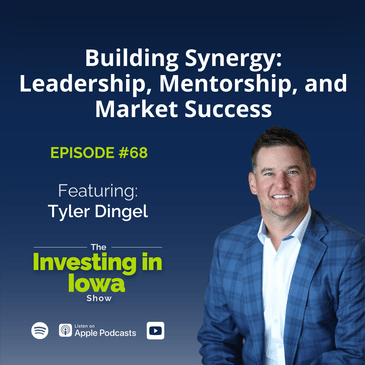
From a small-town upbringing in Iowa to making waves in the real estate industry, Tyler Dingel's journey is a testament to resilience, strategic thinking, and the power of mentorship. We dive into the lessons he learned from early career struggles as a new broker to multimillion-dollar deals, uncovering the mindset and strategies that have fueled his success.
Success is more than numbers—it's about relationships and long-term vision. As a real estate investor and broker, Tyler is committed to leading by example and giving back through mentorship. Whether you're a real estate enthusiast, an aspiring investor, or looking for career inspiration, this conversation is packed with valuable insights!
Key Takeaways
-
How early career mentorship played a crucial role in his professional growth.
-
Why synergy is core to Tyler's leadership philosophy & how he leads his team
-
How his experience as an investor has shaped his work as a broker and vice versa
-
His philosophy on managing risk as a real estate investor
-
Why nobody is really 'self-made' and the importance of relationships
Career Journey and Industry Insights
Tyler graduated from the University of Northern Iowa with a degree in Finance and Real Estate. During his studies, he completed internships at Principal Financial Group, Real Estate Research Corporation, and ultimately, CBRE. His experience at CBRE solidified his interest in real estate brokerage, leading to a full-time role after graduating in 2005.
One of the most rewarding aspects of Tyler's career is witnessing the tangible impact of his work on the community. As his children grow, he enjoys driving through the city and discussing new developments, sharing how his team played a role in transforming ideas into reality. From revitalizing historic buildings to contributing to the skyline with new structures, he takes pride in the lasting influence of his work.
Tyler attributes much of his professional growth to the mentorship he received early in his career, particularly from Todd Millang. Inspired by this experience, he has made it a priority to mentor younger brokers, fostering a culture of collaboration and knowledge-sharing within his team.
Approach to Real Estate and Investment
In brokerage, every day presents new challenges. Tyler emphasizes that success in the industry is not about persuasion but about demonstrating real value. Whether advising on a multimillion-dollar investment or structuring a long-term lease, he adopts an analytical approach to real estate decisions. His goal is to help clients understand how investments impact their business, whether in terms of operational efficiency, financial returns, or overall strategic growth.
A firm believer in relationship-building, Tyler acknowledges that the strongest influence on his career has been the people he has worked with. He recognizes that everyone has unique strengths and weaknesses, and finding the right business partners can lead to greater success for both professionals and their clients.
Personal Life and Interests
Beyond his career, Tyler and his wife are proud parents of three children, each with their own passions and personalities. He has cherished the opportunity to coach his daughter in basketball for seven years and his son in both basketball and football. His youngest is passionate about competitive cheerleading, where he happily supports from the sidelines.
When not engaged in their children's activities, the Dingel family enjoys spending time at the lake with friends. Watching his children trade screen time for fishing rods and water sports brings him immense joy. These moments, spent together as a family, reinforce the importance of balance between professional ambition and personal fulfillment.
Contact Info:
Website | CBRE.com
X / Twitter | https://x.com/TylerDingel
Facebook | https://www.facebook.com/tyler.dingel
LinkedIn | https://www.linkedin.com/in/tyler-dingel-ccim-1a78b77/
[00:00:00] I took that more as a challenge. I took that as a turning point to say, you know what, I am capable of doing this. I have the knowledge, I have the drive and desire and the want to make it happen, and I'm going to go out and prove them wrong. From cornfields to high-rises, office to industrial, houses to hotels, and every other asset class in real estate, we cover the people, the projects, and the profit.
[00:00:22] Welcome to the Investing in Iowa Show. This show is for go-doers, action-takers, and business owners. It's for people like you who are sick of Uncle Sam taking a huge bite of your apple. If you're looking to get ahead of what's taking place in Iowa, learn who is doing what and how you can get in on the action. You're in the right place. Hosted by Neil Timmins, an Iowa native who has been involved in over $300 million in real estate right here in Iowa.
[00:00:51] Recording in studio from West Des Moines, here's your host, Neil Timmins. I've got Tyler Dingle here on the show. Tyler, welcome. Thank you. Glad to be here. I'm excited you're here. Say, for the audience's sake, who are you? Where are you from? What do you do? So, Tyler Dingle. I am Executive Vice President at CBRE. I'm originally from a small town in North Central Iowa, Rockford. So, three small towns that make up our school district, which was Rudd Rockford, Marble Rock, or RMR.
[00:01:19] Kind of a mouthful there. But I grew up in a small town, ag-based community like so many across the state. Graduated with 38, 39 people, something like that. So, a small town. From there, went to the University of Northern Iowa. Originally went there thinking I wanted to get into the golf industry at some level, whether that be playing or course pro type of a deal. The more I played and saw the people that were on the golf course on a daily basis enjoying golf and enjoying the sport,
[00:01:47] it was not the people that were working in the industry. It was your business professionals, whether that be real estate or attorneys or all across the board. Those were the people that were actually enjoying the game versus the ones that were out there working it. So, I decided to pivot. I also realized I wasn't nearly as good at golf as I thought I was. So, I made a change and went into the College of Business. A friend of mine was part of a group called Real Epsilon, which is a real estate club across the country, but a very strong club at UNI.
[00:02:17] So, I went to a Real Epsilon meeting and it was certainly appealing. Job opportunity standpoint, investment standpoint, a number of different things. And gave me some good direction, decided to pursue a double major in finance and real estate through the university. So, they have a great program up there, great instructors over the years, just learned a lot. And a lot of what I learned, I think what's cool about my education at UNI is a lot of what I learned day in and day out, I still use today. Really?
[00:02:47] And I don't think, you know, there's a lot of people that say, hey, I don't hardly use anything. I learned the deal. And so, I use it, like I said, almost every day. I think that's one of the largest criticisms, you know, two large criticisms of college is largely the lack of direct applicability. Yeah. What you learn to the job and then probably as a result, yeah, that the value gap is challenging. Yes. What the cost of the input is today. Yeah. Okay. So, you get out of college, you've got this double major. What do you do?
[00:03:16] Yeah. So, it was interesting. I took, I had, you and I did a nice job of helping set up like internships and stuff through the program as well. So, I actually did three different internships to try and figure out what I wanted to be when I grew up. Right. So, my first one was with Principal Financial Group and I was on the underwriting debt side. That's a seven-month internship. They call it co-op. But basically, you take a semester off of school. You get college course credit for the time that you're working.
[00:03:42] But you get better than just a quick summer internship and just a real glance at what happens. You really kind of dig in a little bit and really learn the business and adds value to the employer as well. So, I did that for seven months. And then the following summer, I did an internship at a company called Real Estate Research Corporation or ERC. They're based out of Chicago but have an office in Waverly. That was close by. I was able to stay on campus and do that one.
[00:04:09] And then my senior year, I decided to do an internship with CBRE and figure out what brokerage is all about. If it was something that I wanted to pursue or something that I thought I could be successful in. And after sitting down and weighing the pros and cons of each decision, I had the opportunity either to go to principal or to go with CBRE. And I decided I used to be a broke college kid that didn't need much to survive. And if I was going to try and do brokerage, which a lot of people, when you start in brokerage, it's a tough road to hoe out of the gate.
[00:04:37] If I was going to do that, I wanted to do it while I was young and didn't have a wife and kids to support and things like that. So I took a leap and joined CBRE right out of college and here we are almost 20 years later. You had to be entrepreneurially inclined when coming out of college, right? Probably in your DNA somewhere in your background growing up. Or the option coming out of college to be go to work for principal with a paycheck. Or it's on your shoulders at the end of the day. There may be something on the front end.
[00:05:05] But at the end of the day, it's going to be feast or famine in the sales world. Is there something in your background, something growing up, something from that world that helped spark that confidence, the resilience that ultimately is required to be inside of the sales role in this business? Yeah, no, that's a great question. You know, looking back growing up, I mean, I've always said I've had two real jobs in my life. And that doesn't include all the farm jobs that I had growing up.
[00:05:32] You grew up in an ag community and it was whether it was working in the hog confinement or picking up rock or tasseling, all those fun ag jobs that come along with that. I did all of those. But the two industries that I have the most experience in are the restaurant industry and the real estate industry. When I was 14 years old, I hopped on my bike on my birthday, hopped on my bike and rode down to the local pizza corral and put in my job application. You had to be 14 to apply. And so on my birthday, I did that. That was my first real job, I guess, so to speak.
[00:06:01] And later that transitioned into a bartending serving role at a restaurant called Chandler's in Mason City, which is 15 miles from Rockford. And then into Pepper's Sports Bar in Sear Falls, where I was a bartender server all the way through college. Nothing on the sales side that leans to that.
[00:06:20] I can tell you, I was a heck of a salesman when it came to the local fundraisers where you went door to door with your paper pamphlet and you're selling popcorn or whatever it might be to raise money for a choir trip or for an athletic event or whatever. I looked forward to those and I always wanted to be the top producer when it came to those type of deals. But no, I think there's nothing that really ties directly back into taking that risk. I mean, I was involved in a lot of athletics growing up. You know, in a small town, you did everything.
[00:06:49] So I played football. I played basketball. I played golf in the spring and played baseball in the summer. And so I think there was a competitive edge that came along with that. I had a lot of great friends in my class that were, you know, we were fortunate enough to have some pretty good teams growing up. And we pushed each other. And I think that probably played into it a little bit as well. So you joined Seabury. You're in sales. Talk to me about the first one, two, three years. Not like very early on.
[00:07:19] You know, I should back up to the previous question as I think about it. I talked about, you know, some of my friends and that kind of nature. I'm the youngest of four boys. Okay. So I have three older brothers. So when you have to learn to become good at sales when you're the youngest of four boys, whether it's, you know, trying to get a new pair of shoes or you're trying to get time on the Nintendo or whatever it might be. You know, I was always competing with them for some of that time. So that could have played into it as well. That's interesting.
[00:07:48] I'm the eldest of four. Okay. Four boys. And so I understand everybody two years apart. I understand a very competitive household. Yeah. Yeah, absolutely. Yeah. So you joined CBRE. It's early on in your career. You know, what are those first few years like? Very tough. A lot of what I thought it would be. You mentioned Principal and they're a great company. And, you know, they have for a kid coming out of college, a great opportunity to have a salary and benefits and all that fun stuff. And you go into brokerage and you don't have any of that. And it's eat what you kill.
[00:08:18] And so it was really tough getting started. I didn't have any connections really in Des Moines. I didn't have any family or close friends or anything like that that was tying me or brought me to Des Moines. So I was really just kind of on my own to get out and start building relationships. And so it definitely took time to build up that business. And one of the fun things I like to do with some of the younger guys that come into the business and some of the younger brokers on my team is they'll come in and say, you know, how did you get started or where did you go?
[00:08:47] And at that time, Kyle Gamble, who was managing our office, you know, gave me a phone and a phone book. And, you know, you just picked out a market segment. It could be chiropractors. It could be laundromats or, you know, dry cleaners, whatever it is. And you just start going down the list and you have a space that might fit one of those. And you start calling and figure out who needs space. But I used to have a yellow legal pad like you have right there in front of you. And I would write down every business and the number, the person I was calling, whoever was running that business. And then I would take notes as I had that phone call.
[00:09:16] They might say, hey, we're doing just fine. We just signed a five-year renewal and we've got plenty of space. You know, that'd be great. How many square feet are you in? Well, we're in 2,500 feet. Fantastic. If you ever need more space or looking for a second location, please let me know. And then I'd make a note of that. They had five years left in their lease. So in three years, I was calling them again. I'd have a within my contacts database. I would put those notes into detail and it would pop up a reminder that XYZ company has a lease up in two years.
[00:09:45] And so that would prompt me to call them and just trying to build my personal brand that way that I was somebody that paid attention to details and cared about their business and how I could add value to their business. And I think that certainly helped out and been a benefit to my career over the years. What was your very first transaction? My first transaction was I actually did a deal during my internship with CBRE. It was a Gazali's Mediterranean Grill off 60th and Ashworth. I worked with Kent York on that deal.
[00:10:15] It was a small, little small restaurant space. And yeah, it was kind of cool. I got to, you know, I had an hourly base with CB during my internship and it wasn't a lot of money, but that wasn't the intent or the point of it, right? It's to learn, to learn that business and if it's something you want to do the rest of your life. But I got, Kent split that fee with me. And so I went back to college and I got my first commission check and I can't, I think it was like 1200 bucks or something like that.
[00:10:43] But at that time that was, that was a nice little bump. And I thought this, man, this brokerage thing is kind of cool. You can make some money doing this. So yeah, that was, that was our first, my first deal. Tell me about your most recent transaction. Then we're going to come to work in the middle. Tell me about the most recent one. Boy, size wise. I mean, yeah, just tell me whatever, whatever you can about the most recent one that closed. So you can tell me some details. Yeah. Size wise. What is it? Well, let's, so we're doing as, as we were talking a little bit, I have a, we have a seven person team at, at CBRE.
[00:11:13] So we have a lot of, a lot of mouths to feed, but we're doing, we're averaging a little over 100 transactions a year right now. So we're seeing, you know, 10 deals a month, roughly nine, 10 deals a month. So it's hard, you know, we probably had one closed this week that, that, you know, somebody on the team sure may have led that I, that I'm not thinking of. But I'll go back to one that closed with just within the last couple of months, because it was, it was a fun deal to work on.
[00:11:38] And I think a good example of where the, where the market and where the business can go, but Hubble Realty developed a industrial building up in Ankeny off a four mile. So it was 147,000 square foot IQ warehouse building. Another team, industrial team within CBRE, Chris Pendroy, Marty Herman, were able to get that fully leased to Amazon for a fulfillment center. And so Hubble came to us, we've sold deals like that for over the years.
[00:12:05] And even with Amazon specifically, so that was a, that was a deal we were able to take to market. It had a 10 year, 10 year triple net lease with a credit tenant of, of Amazon, you know, a double A minus credit and 10 years of term, which is pretty attractive to a lot of investors out there. And so we do, we do a global marketing pitch on, on an asset of that, of that caliber. And we were able to identify a company out of Sacramento, California called Buzz Oates. And they, they were fantastic to work with.
[00:12:34] We still remain, stay in contact with them. It's been a lot of fun to get to know those guys, but that was, that was a, that was a fun deal. It was a pretty good size care transaction. It was 18 and a half million dollar sale. It was, it was a nice return for, for Hubble and for their investors. And it was a nice asset for Buzz Oates to put in their portfolio. Let's, let's contrast that between where you started and where you're at today. There's a lot of things that had to happen over the year, you know, certainly in the industry and within yourself to, to get to the spot you're at today. So walk me through, maybe let's walk me through that first decade.
[00:13:02] When did, when did things really start to churn for you to feel like, all right, I got my legs. I feel like this is, this is a pretty good home. I know I'm in this business, you know, never have that thought of, maybe this isn't for me. As so many of us do in the first year. Oh yeah. When, when the check just doesn't commit. Yep. You know, I'll, I'll, I'll dive into a little story for you and then get, get to your core question. But you mentioned that, that early time in your career where you're not sure if you're going to make it or whatnot.
[00:13:31] I remember distinctly a trip that I, I made up to area in Iowa was selling a, I think it was a 14 or 16 plex apartment unit. And small deal up in small deal. And we were able to get the transaction done. And we were able to get the transaction done. It took a lot of time and, and, and effort and energy to get it done, but we were able to get it done. But I remember on, on the ride home, I had a, I had another broker in the car with me and we were talking a little bit.
[00:13:59] Um, this was probably, you know, nine months into the business. And, um, he looked over and he said, you know, I would tell you, this might not be the right business for you. If I was your dad, I would say, you know, that corporate real estate route may be the better path for you. And so at that point it was, you're, you're already questioning yourself. Can I do this? Can I make this work? And then you have somebody in the industry that's, that's successful and been there and done that. Tell you that, you know, put some additional doubt in there. I mean, I took that more as a challenge.
[00:14:29] I took that as a turning point to say, you know what? I am capable of doing this. I have the knowledge. I, I have the drive and, and, and the desire and the want to make it happen. And, and I'm going to go out and, and prove them wrong. And so it certainly wasn't immediately after that, that thing started to roll, but, um, it, that, that definitely lit, lit, lit a fire. I started to work with multiple brokers in our office. Heath Bullock, Tom, Tom DeWay, Jeff Spence, several of those guys started working with Todd Malang on a, on a handful of deals as well.
[00:14:58] And Todd and I worked very well together. Um, and he eventually offered me an opportunity to join him as a business partner. And that was certainly attractive to me. I, I had a lot of respect for Todd and he was very well respected in our industry overall. And I'd always said, you know, I, I didn't want to go work for somebody, but I would always, I would work with them if I could be a partner. And that partnership was certainly a large percentage that went to Todd and a very small percentage that went to me in the beginning.
[00:15:26] But I was okay with that because we were, we both had, we both had time and money and, and things at risk with each deal. And when he made money, I made money. And the more money I could bring in and make him, the more money I would make on the back end as well. And so we started to work together. That was probably the beginning of our partnership. And, um, we still work together today. Todd's been an incredible mentor for me. And that would, that's probably the, the, was a catalyst to, to building the team that we have today.
[00:15:53] Um, it was at that time it was Todd, myself, and then Michelle drummer, who is kind of Todd's right hand. And, uh, she still works with him today as well. But we've added several, several along the way and, and grown the team from there. What year was that? That would have been probably 2000, late 2006 when we officially partnered up. We had worked on some listings and things together. So for you a couple of years into the business. About two years into the business. Yeah, yeah. You know, a number of partnerships out there, two guys, two folks come together. One plus one equals three.
[00:16:21] For some, one plus one does not even equal two. Yeah. How is it that you guys are able to work together in such a, such a manner to create a synergistic relationship? I love that word synergistic because that's my team makes, probably makes fun of me. But I, I, I named our team, team synergy. We used to just be team malang, but we had to, we had to go away from that as we, as we grew and, um, and things. So I went with team synergy because exactly your point is the definition of synergy is the, the, some of the parts is greater than the whole.
[00:16:49] And so that's exactly it is, is trying to find somebody that complements what you do. Todd's, Todd and I have a lot of strengths that overlap each other, but we have some where he is, his weaknesses might be something where I'm very strong and vice versa. And that's where I think he and I were able to work so well together. We were alike in so many ways, how we grew up, small town families, things like that. But we were different enough that, that we could, we could balance each other out on, on certain things.
[00:17:18] And that's, that's really been the key driver, I think in our overall team, you know, whether it be Riley Hogan or Iden Nadarvich or Blake Bogan Reef, Ben Probst. All of those guys are very similar to, in a number of different ways, but very different in others. I look at a guy like Riley and I, the way that he and I do business is so different. He is very creative and, and very good at, at seeing, you know, as they say, working outside the box, sitting outside the box.
[00:17:45] Sometimes we say he's so far outside the box, he can't see where the box is at, but that helps because I don't have that, that aspect is, is not as strong for me. And I'm, I'm very much more, you know, I like to think things to be organized. I'm very analytical. You know, I love the spreadsheets and the numbers. And to me, that's a lot of deals that comes down to numbers and value and, and what is the real cost of the space? What does it do for our employees, for our companies? And how does that drive my bottom line? Those are the things I really like to dig into.
[00:18:11] And so for a guy like Riley and I to, to balance each other out, he's going to see things that I would never see or think of. And I do the same for him. So that's, that's, what's really been a lot of fun and growing our team and building our business and our team to where we're at today. Started with just, well, three of you, right? Yep. From, from the beginning and you, you evolved and grew over the years. That next addition to the team, what was like that like, when did that occur? And I guess how did, you know, how did you end up trying to figure out where does everybody fit?
[00:18:41] How do these, how does this puzzle ultimately come together and then allow you to add additional people into grow? Yeah. And that's, that's the hardest part of having the team structure is figuring out how those, how those pieces go together. We live in a world or in an industry where you're self-employed, right? You're, you're, you're your own boss. And you, you know, again, we talked about the eat what you kill mentality. And when you, when you join a team and form a team like that, you now have, you know, somebody that you're accountable to outside of just yourself.
[00:19:08] And that pie is only so big and you can only cut it up so many ways. So as that team grows, if you add a person, that's a piece of the pie that you have to split up and figuring out how to split that is challenging. Our team, we meet, you know, typically, obviously we meet on a weekly basis, but we meet, we try to sit down twice a year and look at our splits and say, okay, you know, how do we feel everybody is, is performing? How do we, what value is everybody bringing to the table?
[00:19:31] And you have to have some hard conversations to tell a guy like, like Todd, who really kind of started this thing and has been in real estate for a long time. And it's certainly very valuable to tell him that, Hey, we need to take your split down a little bit because, you know, you're not, you're not as active as you used to be. And we've got some young guys that we need to, that we need to include in that as well. So it's, it's hard conversations, but we have become very much like a family as, as cliche as that is to say, when you're talking about a team,
[00:19:57] it is every bit of that. There are times where we want to slam the door and yell at each other and fight each other. Like I did with my brothers growing up. And there's times that we kick back and laugh and joke and have a great time. But I think what's special about our team is that we, that everybody truly sees each other as family and we all want the best for each other. And that's helped us get through a lot of some of those harder conversations.
[00:20:20] And then, you know, as a, as a, as a senior guy, you know, Todd has got, has gone through this and I'm, I'm going through this now is, you know, I'm making an investment in our younger brokers where I'm, I'm giving up part of fees on deals that, you know, I may be leaving that money on the table today on a deal, but I'm, I'm investing in the future of our team and our, and our business by giving some of that fee to a younger broker on the team.
[00:20:46] And, you know, they certainly, the younger, the younger brokers certainly provide value, but it's, it's just trying to figure out how do you, how do you get them enough compensation so that they stay motivated or they stay hungry, but they also feel validated and they feel compensated, well appreciated for the value that they bring. And so, yeah, it's, I wish I, I wish I could say it. I can imagine. It's tough, but we make it work. Hey, Iowa investors.
[00:21:13] This is Ava Bowkamp, chief of staff at Legacy Impact Investors. Have you thought about adding real estate to your portfolio, but don't have the time or desire to play landlord? At Legacy Impact Investors, we do the heavy lifting. Our team finds the deals, manages the properties and handles all the day-to-day operations. Our select group of qualified investors co-invest with us, gaining ownership equity without opening a tenant email or responding to a maintenance call.
[00:21:40] They just share in the income, appreciation and tax benefits. These opportunities aren't for everyone. They are for qualified, accredited investors only. If you want to learn more, please visit LegacyImpactInvestors.com to apply. At some point in your career, you know, this whole business of being an agent, being a broker, you know, works out. You obviously make some dollars and cents. The dollar has got to go to work someplace. And you decide, I'm going to buy an investment property. I'm going to invest in what I go.
[00:22:08] Tell me about the very first property that you invested in. Yeah, that's a fun story. So the first deal I bought, and God bless Todd, he went along with me on this one. It was a small deal. We paid $100,000 for a fourplex off a 38th Street in Des Moines. A few years back, I imagine at those prices. Yes. Yep. Yep. $25,000 a unit. And it was Todd, myself, and then my brother actually invested in it. My oldest brother invested with us as well.
[00:22:34] But it wasn't investment so much to, hey, this is going to be a great return, and I want my first investment to be a great return. It was, I'm going to invest in this deal so I can learn what I don't know. And if I mess this thing up at $100,000, it's not going to hurt any of us too bad. And I'm going to learn from it and keep going. That's what we did. I managed the thing. I mean, I would take my mower and put it in the back of my truck, drive over to the place and mow it.
[00:23:04] Because I couldn't get my tenants. You know, hey, I'll give you $40 off your rent to mow the lawn. Nah, I don't want to do that. You know, so I wasn't going to pay somebody to do it. So I'd put the mower in the back of my truck. I'd go over there and mow the lawn and pick up the trash and do those things. And, you know, the number of calls I got to my sink is leaking to, you know, we had a broken pipe at one point. A lot of those hard lessons learned, you know, life you're paid with two coins.
[00:23:34] One is money and one is experience. And this was much more of the experience payment on this deal. And it turned out to be a decent investment. We made a decent return on it. But it was the value I got out of it from a learning standpoint was far more than anything I got from a financial perspective for it. And one thing I learned is if I'm ever going to own multifamily, I'm going to own 100 units and not four units because I do not want to manage it myself. That is tough work and something that I'd rather have somebody else handling that.
[00:24:04] Yeah, that's a fun takeaway from the investor hat on. Did you learn something through that experience that helped you become a better advisor in your role as a broker? Yeah, I think, you know, one thing that has changed for me over the years as a broker is, you know, I mentioned that I've always been analytical and I've always been digging into the numbers in the spreadsheets. And I was always looking at them from an outside view and what that owner might want to see or might be important to them.
[00:24:33] So I would say I've transitioned now to anytime I look at a deal, I look at it as if I own this deal, if I own this real estate, what would I do with it? And that's how I advise my clients now is I put myself in their shoes and I can relate to it. I've been there. I've had that experience. I can put myself in their shoes and relate to what the questions that they're asking themselves and the answers that they want to see.
[00:24:58] And so I do think that's been a big benefit, you know, knowing or seeing a deal both from a broker side and investor and owner side. I'm curious about what, you know, what that line is and or what asset class you invest in. A lot of people, you know, want to specialize in exact that, you know, I only own multifamily. A number of people, you know, want to really specialize in Des Moines. And what I mean by that is they want a multitude of asset classes because you can understand the players and the things that all are here.
[00:25:27] But you're going to really refine yourself and define yourself geographically speaking to go, I understand this market inside and out, know how to get things done. Where do you fall? Yeah, I'm a little over the board on that. You know, I always look at my investing on the real estate side. For me, I've always been much more conservative and which is odd because what I decided to do for a living is not a very conservative path. Right.
[00:25:51] But I figure I take enough risk with my job and not having a steady income or any of those things that I have to have some stability somewhere. But so I've been pretty conservative on the investment side and I try to stick to markets that I know and asset classes that I know. And if I don't know, then I rely heavily on somebody that I know personally, that I trust personally, that does know that asset class.
[00:26:17] So I've grown everything from office to retail, industrial, land. I've invested with an individual that's very strong on the farm side with Steve Brewer with People's Company. That's a segment where, you know, I knew the farm industry growing up, but I don't know the values of it. I don't know how that plays into what a piece of ag ground is worth, but that's his expertise. And I know Steve and I trust Steve.
[00:26:43] And so when he tells me, hey, there's a this is a good deal to look at, then that's certainly something I'll look at. But on the commercial side, it's really been markets that I have a good knowledge and understanding in. So, you know, Todd and I have partnered on a number of deals, but, you know, Roka downtown is one that we bought together that kind of blended in my two industries I work in. I worked in real estate and restaurant business, which is the restaurant business is not for the faint of heart, but it's gone well. We just hit our 10 year.
[00:27:11] Are you in both the real estate and the operating business? Yeah. Yeah. Yeah. So that was a real estate play with, you know, that was the backstop, right? We felt good about the real estate, the value of the real estate. And we looked at the restaurant saying, hey, we're going to give this a shot because we think we've got a chef that we really like. We have an idea that we really like. But my safety net on that, on the conservative side is if it doesn't work, if we can't make the restaurant work, we can lease this out to somebody. And it's still a good investment. It's still a good hold. So that was the idea there.
[00:27:40] We opened up Roka. It was a fun project that we got to work on. And we just hit our 10 year anniversary. So, so far, so good. So that deal, Todd and I bought social, the former social club, Niner Mulberry recently. It might've been two years ago that we bought that together. Industrial deal. I've done some retail development work. So yeah, just kind of all over the board, trying to stay diversified a little bit, not, not sink too much into one specific asset class.
[00:28:07] But majority of the, of the assets that I own are here in Des Moines, unless it's, unless it's the farm ground aspect. I've done a couple of deals both in the state and outside of the state. And then I also was able, very fortunate a few years back to buy my family farm, some ground that my, my grandparents purchased originally in the fifties. And my parents lived, well, that's actually where I was born. My parents lived on the ecoregion farm that my brothers and I were all born there.
[00:28:37] We were wiped out in the eighties with a lot of people during the farm crisis and we couldn't, we couldn't make, make it work. And so we had to leave the farm and dad went from there and got into agricultural lending. And so we had to, we had to leave Lake Park at that point. But my parents maintained ownership of the ground, my grandparents, excuse me, maintained ownership of the ground and rented it out over the years. And when grandma passed, there was an opportunity there for me to buy that, that original homestead and that, that original site.
[00:29:03] And so someday I will be at the state fair with my kids to celebrate our century farm. So that was, that was a fun opportunity for me and probably not the greatest return on investment of any of the deals I've done. But from a, you know, what matters perspective, it was, it was a fun deal to be involved with. From that very first floorplex, floorplex to today, how have you had change and how have you changed as an investor? Well, the deal sizes have definitely gotten, gotten larger.
[00:29:32] Has that made it easier? You know, it, it probably does make it a little bit easier. You know, it's never easy, but when you're dealing in a, in a smaller price range like that, there's just so many other, there's so many other players in that, in that market. And you're having to do the same level of work, right? You still have closing docs. You still have, you know, banking that has to be done. You still have inputs of this. Yeah.
[00:29:56] Everything's the same, but, but your returns are going to be a lot smaller just on a scale basis on a hundred thousand square foot floorplex. Then it would be on a $10 million, you know, apartment complex. You just, like you said, the inputs are going to be the inputs. And when you can spread that, it's that cost out over a larger investment than your returns certainly look a lot. So, you know, really, I think I still look at deals very much the same.
[00:30:22] I look at, when I look at deals, and this is probably a blessing and a curse, right? There's probably deals where I've really missed that were home runs with huge upside. But when I look at a deal, the first thing that I'm looking at is what's my worst case scenario. I'm laughing because you're not the same way. Yeah. Yeah. I didn't work for, you know, almost 20 years in brokerage to build my business and my portfolio to where it's at today to have a deal that could be a home run, wipe that all out. Correct. And so I'm looking at, you know, what's my, what's my worst case?
[00:30:51] What's my downside on this thing? And if the, if I'm comfortable that the downside isn't going to be something that, that is too painful for me and there's a decent upside, then it's a deal that I would certainly take a run at. I just, I just finished Sam Zell's autobiography. Yeah. And that it's right there. Exactly. As you just described laid out. I'm saying the exact same thing. Well, he's a lot smarter than I am. Always going to the risk first. What's my downside? Yeah.
[00:31:15] As an agent, as a broker, you know, coming in, working really for yourself as an individual today to becoming a team leader, somebody who's, as you said, you now are responsible and accountable to the balance of the team. How have you had to evolve? What skills or what traits have you had to acquire over the years to live in the role you live in today? Yeah. No, I think the biggest thing is the people management side of it.
[00:31:39] And, you know, we are a seven person broker's team is a very large broker from a broker standpoint, but it's very small in the world of if you had a, if you own a company and you had seven employees, it was a very small company. Right. So there's, there's a lot of people that have far more responsibility and people that they, that, that, whether that's report to them or people that they're, that they're responsible for or whatnot. So I, you know, I, I do take that into account.
[00:32:03] You know, I, I, I certainly don't have it too bad, but you know, just trying to look at whether it be a, you know, especially when we talk about splits and things like that, you're looking at our business and the value that each person provides that business and what their percentage of the, of the, of the fee should be on, on deals is trying to look at it from their perspective as well as outside of just of your own.
[00:32:25] And I think that's, that's very challenging to do, you know, as, as human nature is, we're going to look at what, what I bring to the table, what I, what value I drive to the team and what I'm able to, you know, what's my worth. That's, that's a lot easier for people to define because you know intrinsically the, the blood, sweat, tears, hours that you put into that business. And I might, even though I work with that person on a daily basis, I don't know everything that they're putting into the business. I mean, I have a sense, right. But everybody's in a different spot and a different scenario.
[00:32:54] Everybody has different circumstances and stuff that they're dealing with outside of, outside of work and outside of our business. Just trying to, to bring that human element in and, and, and be compassionate and be, and trying to be very understanding of, of everybody's scenarios. Something that I've, I've definitely had to build on, you know, when it was just Todd and I, and you know, Todd was, was the lead broker on it. I didn't have to worry about that stuff. All I had to do was motivate myself and make sure I was getting my stuff done and the rest of it kind of took care of itself.
[00:33:23] And I've had to definitely grow that, those people skills and, and some of those things that, that are important when you get into that type of a lead role. Yeah. Well, there's a lot of work and a lot of effort that goes into living in the role you live in. It is, it is a lot, as you said, it's a lot of, it's a lot of people work to be able to be able to put that whole thing together. Yeah. If you're a house flipper, execute the birth strategy or do double closings and are in need of money. Little Guy Loans is your go-to lender here in the Des Moines area.
[00:33:52] Time is money. Loan approvals in 24 hours, closings in five days. Little Guy Loans was founded by Neil Timmons, an investor just like you. Since he has been in over 10,000 homes in Des Moines, there's never an appraisal. Houses, multifamily and commercial property loans up to 1 million. Check out www.littleguyloans.com. Well, I understand. Congratulations, Aurora. You've just been named too recently to the Midwest Real Estate Hall of Fame. Yeah.
[00:34:22] Congratulations. Thank you. It makes me sound really old. I feel like, you know, you talk about Hall of Fame. Hey, it's not a lifetime achievement award. Yeah. Yes, that's a good point. No, it's great. You know, we've talked about it a lot today. But it's a recognition of what the team has been able to accomplish.
[00:34:46] And I'm very, very fortunate with the people that I've been able to surround myself with, you know, starting with Todd early in the career and the guys and gals that we've added over the years. It really is a team effort. It really is a team effort and something that I've been fortunate just to be a part of it. And I look forward to seeing what some of our younger brokers, where they take it from here. At some point, they're going to say, hey, you know, it's time for you to step aside and let us run with this thing.
[00:35:13] And you add what value you can from the sidelines and let them run. So we'll see. I don't know when that day will come. That's not coming anytime soon. But that's the other aspect of the team is, you know, at some point, my younger brokers want to be that team lead, too. You know, and I want that for them. And so I want to help guide them and give them as much advice and direction as I can to help them get into that spot.
[00:35:37] And that includes me at some point, you know, stepping away from that lead role and letting somebody else step into that role. Well, I think that's the pinnacle of success there is when a, you know, definition probably, when a good leader creates other leader. Yeah. Yeah. But it's great, Mike. Well, hats off to you, Frank. Congratulations for that award. Are you ready for the final three questions? Yes. If you had one piece of advice for your 20-year-old self. It's a good question.
[00:36:04] So we, and we've touched on this a little bit today, but I was just reminded, I was having a conversation just the other day over a cup of coffee with a young, with a young broker. And I was talking about a piece of art that I came across. I'm not a big art guy. I think art's cool. It's great, but I don't know much about it. Right. I don't own much art, but there was a piece that I saw one time that I thought was really, really cool. And it was the concept of a self-made man.
[00:36:27] And it's a bronze statue where the top half is just a statue of a man with a chisel and a hammer. And the bottom half is a solid block of bronze. And the idea is, is, is creating himself. He's becoming self-made. He's chiseling away and creating the person that he is. And I always thought that was so cool. And I thought, man, you know, I came to Des Moines and I didn't have any family or any ties or anything. So, you know, I'm going to become this self-made man.
[00:36:53] And I still think it's a cool piece of art, but it is, it is incorrect in some big ways. And if I could, if I could go back and recreate that same piece, you would, I would still, you'd still have the main person with a chisel and the hammer working away. But you'd have a dozen other people standing around chiseling away at it at the same time. And that's the biggest takeaway is the people that you surround yourself with are the people that make you who you are.
[00:37:17] I don't, there, there may be somebody out there that's, that's completely self-made, but I look at it as, you know, I, I may have not had a family member in the business, but Todd became that for me. I found mentors like Todd and Kyle Gamble and others, you know, my family, my parents, my brothers are all part of creating them. The person that I, that I am today, the person that I become. And that's, that's very important.
[00:37:40] I think for, for that younger person or somebody getting started into brokerages, surround yourself with great mentors and great people and learn from them. And it's going to make things so much easier for you. Two books that changed your life. Man, Master Key to Riches, Napoleon Hill, that you, you started to talk about the pinnacle of success. And, and, and he has a quote in that book that that's one of my favorites. And he says, those that reach the pinnacle of success, or it says the opulence of success, which is essentially the same thing.
[00:38:09] Those that reach the pinnacle of success do with two outstretched hands. One reaching up to those who already summited and one reaching down to those that help those still climbing behind them. That's one that's always stuck with me. I think it's fantastic. Another one I would say outside of the business world, I would say Fearless is another good one. Fearless is, is with Adam, by Adam Brown or about Adam Brown. And then another one would be Can't Hurt Me by David Goggins.
[00:38:32] Those are both Navy SEAL services related books that, again, a lot about setting goals and, and, and becoming something, making something more of yourself and then facing adversity and overcoming those challenges. And very inspirational from that standpoint. So I gave you three, sorry. Hey, listen, always delivering more value. If you were, if you were cast away on an island for one year, you could only get three pieces of data about your business each and every single month. What three things must you know every month to know how your business is running?
[00:39:02] First one I would say is my pipeline. I don't know if that qualifies in your question or something. Sure. I'm talking more like- You got a team, you got a pipeline? Yeah. Yeah. So we, we pay a lot of attention to the pipeline. My team probably gets annoyed as much as I, as I talk about it, but just trying to understand, you're trying to forecast revenues, just like any business, right? You've got revenues, you have expenses, you're trying to forecast revenues and know what's coming in. And so I, I spend a lot of time looking at our pipeline and trying to understand not only that, but having it in there, you help forecast it.
[00:39:31] But it also is a good check-in on where are we at with each deal. And it's a good reminder of, you know, Hey, XYZ lease is out for signature. We haven't heard back on that in a few days. Let's follow up. So it's a, it's a good point of reference for me on, on understanding where we're at with the deal. Um, you know, making sure that we're, we're guiding it along throughout, throughout the process. You know, I, I do get the, I do pay attention to the business record daily. You said monthly though? I'll let you roll it up. Okay. All right.
[00:39:59] So the business record, I, I do pay attention to that. I love the AM and PMs that they send out and, and the commercial real estate weekly, just, uh, just trying to keep a pulse on the market. And then if there's something in there that, that is specific to my industry, then I'm able to dig into it and find uncover some of the details. So just trying to keep in touch with that. Uh, and then lastly, I was thinking was my kids schedules.
[00:40:21] I don't know that it really doesn't have as much impact in the business, but my wife and I have three, three kids that are very active in both sports and cheer and, and all those things. And we're constantly running in different directions. It will keep you amazingly busy. I am certain. Yeah. I've asked lots of questions. What's one question I did not ask that I should have asked? Well, I think I just touched on, we didn't talk about family. No, we did.
[00:40:43] Um, I talked about my, my growing up and my, my parents and older brothers, but, uh, but yeah, so married to 2007. So, you know, 17 years, is that right? Yeah. 17 years. So I've been married for 17 years. I have a 14 year old daughter who's in eighth grade. She just finished her, her first season of eighth grade girls basketball. So that's, that's been a lot of fun seeing that. Much fun. Yeah. I was able to coach her for the first seven years during that time period. So that, that was great.
[00:41:09] She's, she's now moved on from, from dad's coaching to, to play for, um, Ohio attack at Aims there. Um, so it's been fun to see that transition as well. But, um, and I have a, an 11 year old son who is also in basketball, but loves football, basketball, trying to get in more into golf. He likes to go out and play with dad, but, uh, he doesn't really want to put the time or energy into getting, you know, making himself a better player. He just likes to go out and have fun, which, you know, there's nothing wrong with that, but, uh, you know, maybe, maybe I can get a little more competitive. Perhaps you've inspired it.
[00:41:38] The time do its thing. Yep. Yep. And then my, uh, youngest eight year old is, she is the opposite of sports. She, she said, she's told us, dad, I don't want to play sports because I don't want to sweat. She is a princess. She loves hair and nails and makeup and all that fun stuff. And she is into cheer. Miss her, it's her favorite, but she's, she's a lot of fun. All three kids are very different, but, uh, you know, just make, makes life enjoyable.
[00:42:05] You know, getting to see that, see them in their element and having fun and growing up. So there's certainly the reason to do all of it. Yes. During the day. Absolutely. Tell, I really appreciate you taking the time out of your schedule to connect up here to chat for people who want to, they want to find you. They want to follow you. They want to connect with you. Where can they go? What should they do? Yeah. Um, you know, cbra.com is our, is our website, our company website. I have a LinkedIn profile. I think it's Tyler Nash Dingle is, is my LinkedIn.
[00:42:35] I think I probably will share those. We'll have the links below in the show notes for everybody. I've got a, I've got a Twitter that I don't really post much on, but I try to keep up with what's, what's going on out there. And then, you know, I also have Facebook, which is seeing more friends and family and keeping up with, with where they're at. Thanks for being here. I really appreciate it. I've learned a lot. This is a, it's quite a story, quite a journey over 20 years to, to get to where you guys are at.
[00:42:59] And it's, I can't wait to have you back on and in a year or so, and let's talk about all the things that have, that have changed and evolved in, in, in the industry, but also inside your business and what you got going on. So I appreciate you being here, Tom. Well, thank you for having me. It's been a lot of fun. My pleasure. Thanks for listening. If you're enjoying the show, may I ask a favor of you naturally subscribe? So you never miss an episode, but would you rate and leave an honest written review on Apple podcast? Does a lot for us here at the show.
[00:43:28] And I appreciate reading your thoughts. Great guests make for a great show. If you know of another Island who would be a great guest, or you yourself have interest in being a guest, well, get on our radar, visit investing in Iowa to fill out an application. Or recommend a guest. And if you want to connect with me one-on-one, go legacyimpactinvestors.com. Click on the invest with us button in the top right corner.
[00:43:55] And there you can pick a time for the two of us to get on the calendar and connect. Until next time, keep investing in Iowa.