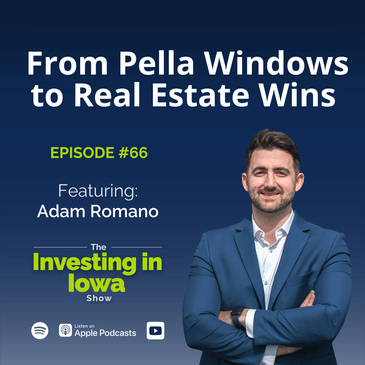
Ever wondered what it takes to transition from a steady 9-to-5 to full-time real estate investing?
Adam Romano made that leap after sharpening his sales skills at Pella Windows and Doors in Clive. Since then, he's rolled up his sleeves and gained hands-on experience in nearly every corner of residential real estate.
In this episode, Adam dives into the value of mentorship, the importance of learning by doing, and how to stay agile in today's fast-moving market. Packed with practical advice and real-life stories, Adam shares his experiences with creative financing, 'subject-to' deals, and growing his business in new markets across the country. Tune in for valuable insights that could inspire your own real estate journey!
Key Takeaways
• How a key mentorship helped Adam fast-track his way to success & avoid expensive errors
• Why reading real estate investing books can only get you so far
• Learning to navigate contractors & building business partnerships that last
• What it took to scale his business and flip properties in other states
• How Adam plans to grow his business for the future while mitigating risk
Adam's Real Estate Journey
My real estate journey began in 2016 while I was working at Pella Windows and Doors. After reading "Rich Dad Poor Dad by Robert Kiyosaki", I became fascinated with real estate and was determined to build a career in the industry.
By 2017, while still working full-time as a sales representative at Pella Windows and Doors in Clive, I began taking action. In 2019, after a pivotal conversation with my now-wife. I decided to fully commit to real estate. With her encouragement, I resigned from my job and officially launched my full-time real estate business in February 2020.
My introduction to real estate mentorship came through Mark Lane, a connection that shaped my career significantly. Mark remains both a mentor and a friend, playing a vital role in my success today.
Our first deal was a purchase from a local wholesaler, Jamie King. The property was in extreme distress—meth contamination, three failing foundation walls, a steep 15% grade driveway, and a tiny 692 sq. ft. footprint with no garage. To save costs and complete the project, I quite literally slept at the house while working on the renovations.
Fast forward to today, and we have completed dozens of deals across multiple real estate strategies, including wholesaling, flipping, owner financing, and rental investments. For several years, our primary focus was flipping homes, leveraging deep construction knowledge to maximize value. We even briefly ventured into high-end kitchen and basement remodeling as general contractors.
In June 2023, we shifted our focus to expand beyond Iowa. Currently, we market in 63 locations across 13 states, primarily in the Southeast and Midwest, acquiring 2–3 deals per month. Our strategy has evolved from heavy construction and fix-and-flips to wholetailing and owner financing, allowing us to scale efficiently while maintaining profitability.
Contact Info:
LinkedIn | https://www.linkedin.com/in/adam-romano-a6a1a893/
Facebook | https://www.facebook.com/adam.romano.33
[00:00:00] I feel like in life there's so much that we can't control. I gravitate towards the things that we can control. And then it was always about creating financial freedom and not the cliche guru sell the financial freedom, but like the freedom to, semicolon, to do whatever you want, to travel, to take time off, to spend with your kids.
[00:00:20] From cornfields to high rises, office to industrial, houses to hotels and every other asset class in real estate, we cover the people, the projects and the profit. Welcome to the Investing in Iowa Show. This show is for go-doers, action takers and business owners. It's for people like you who are sick of Uncle Sam taking a huge bite of your apple. If you're looking to get ahead of what's taking place in Iowa, learn who is doing what and how you can get in on the action.
[00:00:49] You're in the right place. Hosted by Neil Timmons, an Iowa native who has been involved in over $300 million in real estate right here in Iowa. Recording in studio from West Des Moines. Here's your host, Neil Timmons. I've got Adam Romano here on the show. Adam, welcome. Thank you, Neil. I'm excited to be here. I'm excited to be here. Say for the audience to say, who are you? Where are you from? What do you do?
[00:01:14] All right. So my name is Adam Romano. I've been in real estate eight years in November since I created my LLC. I am in the Des Moines area, originally from Grinnell. So about an hour east of here. I went to Iowa State. After Iowa State, I landed back in Des Moines. And yeah, been in real estate, like I said, about eight years. So growing up in Grinnell, small town, you've got a heck of a university or college there.
[00:01:44] Yeah. Right in the backyard. What took you to Iowa State? I, well, I knew I needed to go to a four year college at that time that was, you know, sort of indoctrinated, got to go to college. And I didn't particularly love Iowa City. So I actually started out, I went to DMACC. I did that whole two year at the community college and then kind of figure out what you want to do. And then two years later, go to a four year.
[00:02:07] I actually started out as a pre-med in DMACC. And then when I went to Iowa State, I started with a chemistry undergraduate pursuit of that. And I took a class called quantitative analysis. It sounds as bad as it is. And that made me realize if the medicine thing doesn't pan out, I'm not going to be in a lab.
[00:02:28] So it was one semester over Christmas break. I realized I don't want to do this. And I said, well, what, what do I want to do? And so I was like, okay, there is a college of business at Iowa State. You can do like a supply chain. Oh, gosh, what's not the I'm blanking on one of them, accounting, marketing. Logistics is probably in there.
[00:02:51] Yeah. So I said, okay, well, I'll figure something out. And most likely it'll be marketing. So I declared marketing my major and then switched to the college of business. Came back, did two more years, got my degree in marketing. And then the rest was history from there. So you left them, then what? So my junior year at Iowa State, I got connected to a Northwestern Mutual financial advisor internship here.
[00:03:21] And I did that, liked it, liked the guys a lot. So I was in the financial advising space as an intern for like half my junior year and then all my senior year. When I got out of Iowa State, I was still at the financial advisor capacity. And I did that for another like year-ish approximately. Okay. That, I really thought I was going to retire as a financial advisor. I really did. Because there's like this whole metric. If you're here five years, there's like a 90 or 95% chance.
[00:03:51] This is what you're going to do until you retire. I just, it turned up like it was a great opportunity. The sales training was amazing. Loved like the people I was around. I just couldn't help but like feel like I'm just selling people insurance. And, and, you know, we were compensated heavily. If I sold you a policy that cost you $20,000 a year in permanent life insurance, I made $10,000. In college, six years ago, seven years ago, however long ago, or sorry, that, that long ago, that was a lot of money.
[00:04:20] It's, it's, it's 10 grand is real money for any college kid at any age. Exactly. You know, that's like probably 25 grand now. Yeah. So it was like, I just, I don't know. I felt like I was just pushing insurance and, you know, you kind of get like connected to this like inner circle of people. And maybe this is me making excuses why I didn't end up doing it, but you've got to get referred out to people that have real money. So you start rolling over the IRAs and the pensions and managing the assets. That's how you really start building your reoccurring revenue and your cashflow. Right.
[00:04:50] And I just didn't make it there. I just kind of, one day, I think I got like three appointments in a row. They canceled on me. And I was like, I'm done. And I got a call from a recruiter. It's like, Hey, have you ever thought about working at Pella windows and doors as a trade rep? And I'm like, what? Hey, what a unique question. Cause who's thought about that? Right. And I'm like, you know, I specifically remember I was in the parking lot. I was like, you know what? You caught me on a great day.
[00:05:16] I just got no show by three appointments. I'm ready to hear of a new opportunity. So I had no expectations and I went into the interview and I was like, interesting. You don't need to know anything about building materials. You don't need to know anything about construction. This is funny, right? Hindsight after flipping how many dozens of houses now back then I knew nothing about any of that. And they're like, that's not what this is. You're to take off of blueprints of like houses and putting window packages together.
[00:05:42] And it was like a $40,000 draw against the commission. And so I just thought it was a great fit, you know, the opportunity to make six figures. What five years ago, again, that's five years ago, six figures, a lot more money than today. I'm like, cool. So I started out on the commercial side is what we call a trades rep. And then very quickly, whoever was in charge of the retail was like this guy, this guy should be working with with homeowners.
[00:06:11] So I switched from the commercial to retail. And and I did that for, I think, about four, four and a half years, roughly. Yeah. Did great. I loved it. But somewhere along the way, a good buddy of mine named Bennett, do you know Bennett? Well, I don't. OK, for some reason, I thought he knew you. Appreciate the future attraction. Yeah. So he went to school to be an attorney.
[00:06:36] And during his stint in law school, he started to get really involved with like real estate. And and his dad had some rental properties in a couple of apartment complexes in Grinnell. So I went to high school with Bennett. And long story short, he was in town one day and was like, hey, man, like haven't seen you for a while. Let's go grab and grab a drink, shoot some pool. And so like we met downtown and we were just talking. And he talked to me about this book that he read called Rich Dad, Poor Dad.
[00:07:03] Yep. And so I am an action taker. I literally was at the bar and I'm like on Amazon and I'm like, OK, order. It shows up. I get the abridged version that's literally this big. Like it is hilarious because looking back, I ordered the wrong book. But I just was like, OK, this guy's like telling me to order this book. I got the right copy. I read it and like I was hooked. Yeah. I had no knowledge of real estate, how it worked or anything. But like I read that and I was like there was just something that like transformed to me that I was like, this is what I want to pursue.
[00:07:33] I never had any like, OK, I'm going to quit my job and go do this now. But it was just like this was ignited. And then I started reading more books and more books and more books and more books to the point where eventually I started taking action. Do you think if you had read that book when you were in college that the outcome would be different?
[00:07:52] Do you think you had to have a certain life experience and and some level of wisdom about, OK, this is what life's like after college and giving thought to what are the next 20, 30, 50 years of my life look like? That's an amazing question. I have never thought about it.
[00:08:08] I think that. If you read something at one point in your life and you go back five years later or five years before that, it's totally different how it's going to impact you with your experiences, what you need to hear, what you didn't hear, what you have the ability to receive different because you've changed. Exactly. That's why I love reading books like Chris Voss has never split the difference. You can read that 100 times and you could probably gain exponentially more every time you read it. I think I would have had a different impact. I really do.
[00:08:36] Yeah. So you read the book. Mm hmm. It's it's life changing mentally. There's there's something that clicks. Mm hmm. And then what? So from there, I started figuring out. Like most people, I think the first thing you think of is not how do I find the deal, but I don't have money for this. Right. Like, how am I going to do this? The time I didn't have any connections.
[00:09:06] I didn't have any resources. I knew nobody in the investing community. But I did know of a gentleman at the time named Mark Lane. And I know you are familiar with him, Mark. Mark is very well. Yeah. And at that time, Mark actually was pursuing. I don't know what you call it, but but he had a thing where he had people get together where he was teaching them about. Yep.
[00:09:31] I think if I remember correctly, looking back, he was probably trying to educate to create wholesalers and bird dogs to go out, find deals and then, you know, do that sort of thing, which is it's a great it's a great idea. Yeah. So I went to that and nothing really came of that. But I actually had reached out to Mark a few months afterwards and was talking. That's so funny. I have the messages on Facebook Messenger. It's like, hey, if you find a deal, I'll give you a couple of thousand dollars. Yeah.
[00:10:00] And it's like, oh, Adam, that doesn't that's not the way that works. But you don't know that at the time. Sure. I'm trying to like present myself like, look, I'm somebody who's going to take action and I'll give you money. You know, little do we know that's not how the game is played. Right. And then Mark eloquently gave me some sort of response. It was like, yo, actually, you know, this is kind of how it works. And I didn't really say much more. But like a few months later, something had happened.
[00:10:27] And I was like, I think I read some more, probably watch some YouTube stuff. And I was like, Mark, I'm sure a lot of people come to you wanting something. What can I give you? What can I give you? I don't know what that is, but let me know. In exchange, I just want to learn. That's it. Brilliant. I just want to learn from you because I thought to myself, I mean, I remember starting to like kind of research more about Mark. And I mean, he was doing dozens of deals a month. And at that time, he was massive wholesaling.
[00:10:57] That's when he had the yellow truck driving around. Still, I was a branded truck. I talked to Mark today. It's not yellow, though. Yeah. No, it's not yellow. Blue now. Yeah, correct. But that, yeah, he was just chilling the wholesaling side. I think he was doing over 100 deals a year. And I knew that was the guy. Yeah. And so I reached out to him and I just kind of like, I'm ready. Fire. Aim. Like, that's my personality. And he was like, well, I don't really need anything.
[00:11:24] But I'm looking at starting like an educational type presence on YouTube. So I'd be looking for somebody that knows camera. And I knew nothing. I didn't own a camera. Guess what I did? I said, I am more than welcome to take on that role. Learn that. So I literally go to Best Buy, buy like a $2,000 camera, start like researching on YouTube how that works.
[00:11:52] Incredibly complicated with actually creating like some sort of quality. Quality production. Yeah, right. Right. Especially within your dim-lidded houses and there's no like white balance and all that stuff. So it's funny because like if we go on Mark's YouTube channel, you'll see all the videos I created for him. On all the thumbnails and everything. Yeah. So we did that for a few months and Mark just like slowly taught me the business. Like I remember going to houses that he bought at auction or a house that he was replacing the foundation or, you know, asking him questions. We'd meet up.
[00:12:22] I'd film him. I'd learn. And like I just absorbed. And in exchange, like I said, I was creating videos and no idea what I was doing. But I was creating the videos for him that he was teaching me and creating his educational content at the same time. Yeah. So it was like perfect for what he was trying to do. Um, one thing led to another, started to build some relationships, had Jamie King. I'm not familiar with that name. Um, he was a wholesaler at that time.
[00:12:48] He had a posted on Craigslist, this POS house, South side of Des Moines, 600 square feet on like a 20 degree slope driveway. Um, and I went out there because I've got all this knowledge from Mark and I'm like, Hey, I want to buy this house. I think we can flip this. It's going to be worth millions of dollars. Yeah. Mark connects me to Steve Lipovac. Yeah. And, um, we get the deal under contract and like, I'm out there doing the thing.
[00:13:15] Well, this house was so. So, you know, hoard it out and, and, and drugged and everything. There was four dumpsters in the basement alone of a 600 square. Oh my heavens. I'm talking to like, I'm six, two that in your toll. Yeah. That the trash was taller than you all. The whole, you couldn't see the foundation walls. So my surprise after the clean out, Hey, we get one, two, three foundation walls to replace
[00:13:42] that are so bad that like, I can not my feet, like I can stick my hand. They're blowing that through that. Yeah. So that was my first feet into the fire. Hey, here's the first house to flip. Oh, by the way, here's three foundation walls and every full gut on the inside, plumbing, HVAC, everything, everything. And I remember walking in with Mark and like, I have to send you the YouTube videos cause it's hilarious looking back. And we walked through it, did the video. And afterwards he's, I remember we're in the driveway.
[00:14:11] He goes, what are you thinking your rehab is? And back at the time, 30 grand on a rehab was like pretty heavy. Yeah. You know, 30 grand is probably like 60 today. 30 grand on a 600 square foot. Yeah. So do the square foot math on that. Yeah. Uh, he goes, yeah, you're, you're probably more like 45 or 50. And I remember like, that was my margin. I like that. My heart just like sank. Right. He, he was like 43, 45,000 like on the nose.
[00:14:38] And by the way, I literally slept at the house to do the labor to get the project cost down. Um, so he was spot on. Yeah. Thank God. During the interim of that project, I had a wholesale just happenstance from a buddy that was like, Hey man, can we sell this house? I got this lead. It was this roached out firehouse and we made like 20 grand. And now that got me enough to get the rehab done where I didn't have to go back to Steve and say, I need more money. Yeah. And we sold it.
[00:15:06] I listed it at, well, my wife listed it at like one, one E we sold it first off of 98,000. Yeah. That would, so that was my first introduction into real estate. Um, but we went on to do another one. Yeah. Well, a lot of people, a lot of people do that and go, cool. Yeah. Uh, I've had, I've had enough taste. Yeah. Yeah. The, I think the saving grace was, um, I like, I very quickly realized I had the proof
[00:15:36] of concept in front of me of Mark. What was possible? Yes. Right. It wasn't like I was reading about it. Like I see it. Yeah. Um, at that time, you know, my, my Mark's sharing with me, like, you know, the, the checks you had to make and the profitability and like the, the things that he was on track for, for his business this month. So it was like, I knew it was possible. I just knew that this was not something I'm ever going to repeat it yet. Yeah. How critical was that? The fact that you could see it, therefore you believed it. Massive. Yeah.
[00:16:03] I think the biggest thing that keeps people from the, I think that the vision between successful and unsuccessful people is just the tenacity to keep going when you can't see that and being tangible, like within reach. If it's always constantly not there, I feel like that's why people give up. Yeah. And, but I, but it was there every day for me when I was talking to them and like, you know, that mentor capacity, I knew it was possible. Incredible. All right. So you get a taste there.
[00:16:32] How much did you learn by going and doing that? Where, where I'm going with this is you could read an infinite number of books or you could, or, and, and, or I guess you could stack it, right? Or you can go do one deal. Yeah. Cause you can't, you're going to learn more by, by in that doing than you could from all, pretty much all the books that exist. At that point, I mean, I'm trying to kind of, I was on a reading kick, right? Cause I was just trying to take action after the rich dad or dad.
[00:16:59] And, you know, another book of like flipping houses for dummies and then contracting estimating. And like, I literally had a, a, a, a tote, um, two totes worth of books, uh, all on like business and real estate and, and, and all that stuff. So, I mean, I learned more on that one house than the two totes combined, but I think what that, I think what it does is it creates a momentum of taking action and, and that's what it was for me.
[00:17:24] Um, but yeah, the, the, the education, what Steve calls the seminars because you know, they, they cost more and they're, they take a lot longer to learn. So you moved on. What was the next one? I couldn't tell you what was the next house because we've done so much stuff at this point and that sounds crazy. Um, but it was profitable that much. I do remember. Did you, did you early, let's call it from that point forward. And that first, let's call it from there to a year forward, were you primarily focused
[00:17:52] on wholesaling or flipping, flipping, flipping. Why? I don't know. I, I be, well, at that time I, we were walking a lot of projects that Mark was flipping. So Mark was wholesaling a lot and wholesale the ones you don't want and keep the ones you do want. Sure. And so I guess I was, I didn't really think about like having buyers and all that whole process. And I mean, I didn't know how wholesaling worked. Right.
[00:18:19] Um, so really, uh, it was, it was more so just kind of like, okay, I, I have the resources for this and I think I should know how to do this. Where, where were you finding deals at that, at that juncture? I started getting deals from Mark. All right. So you were ultimately, you were buying from wholesale standpoint versus wholesaling is the business of wholesaling is it's a marketing machine with which I know we're going to talk about them. And it's a marketing machine, the way that works is you got to go direct to a homeowner.
[00:18:48] And I didn't know anything about. Yeah. I mean, it's a whole, it's a whole business, right? Versus buying a property from off the MLS through a realtor or from a wholesaler. And you're focused very heavily on how do I kill it on the flip, right? Produce a killer product, keep my cost center control and then move fast enough so that my estimated ARV that I projected today is actual reality by the time it goes to the market. Yeah. And I, it's a good, actually you sparked something, me thinking about that.
[00:19:18] I was almost like afraid because keep in mind, I would walk seller appointments with Mark or like signing appointment. Yeah. And like, he'd go to the appointment and I'm like, how does he know that this rehab is $40,000? Like I'm looking around. Yeah. You know, I remember one Southside house in particular and I'm like, how does he know how to do this? Like, I don't know how to do that, but I think I can figure out how to flip a house. Right. And so with that sort of symbiotic relationship, I think Mark saw somebody that's like, first
[00:19:48] of all, what, maybe 10% of people take action. And of those. I think that's heavy. Yeah. I was going to say, and how much of the 10% are still there six months later or 12 months? So I think I demonstrated to Mark, like, this is somebody that I want to pour into. So we developed that relationship and I was like, look, I just want to be your easiest buyer to work with. And he saw that I wanted to grow and, uh, and I was buying a lot from him, you know, and I was never, Hey Mark, can you, uh, can you come down? You know, I was like this price. All right, cool. Yeah.
[00:20:17] And, um, that's, yeah. I, so, so I think it was very much, I was afraid of what that looked like learning that side of things. That side of the business. Yeah. I just had to raise my hand and say, okay, I want that deal. Yeah. You know? Yeah. So how were you sourcing contractors? How did you manage that, that process? I don't know how many contractors I fired on that first house. Um, when the roofing guy is doing a drywall inside, you probably hired the wrong person.
[00:20:45] Um, like it was a process of elimination of just sorting through garbage. Yeah. And one house in particular, um, we had a really nice, it was one of the biggest and oldest houses in agony. Um, it's like probably 2,600 square feet. It was a big, big house. We had a, a contractor that was hired for, um, trim work, mill work doors, cabinets.
[00:21:13] And I'm a pretty good judge of character being in sales my whole life. I just like this guy presented himself very well. I saw his work. He cared about the job sites, like the questions he was asking me. And we like hit it off from there. Um, he was my right hand man and it's been my right hand. His name is Jeff Brooks and he's been in carpenter and construction for, I think almost 30 years now, 25, 30 years.
[00:21:38] Um, and, and just kind of like one thing led to another that you'd ask a referral for this or referral for this, or Hey Mark, do you know a guy for this? And I just sorted through the garbage to get, you know, where we're at today. Like dating. Yeah. Yeah. Only usually it's more expensive and more time consuming. You're right about that. Yeah. Yeah. Okay. So fast forward. Well, I want to be clear on from a timeframe standpoint too. Your work, this is a side hustle at this juncture.
[00:22:07] Right. And let me explain to you. You're still working. Well done. Pell and windows is not, Hey, um, you know, uh, Mr. Timmons. So here's our window package. Okay. Sign here. You're good with that. And then I just get to go on my way. Oh no, no, no. No, I had to oversee the ordering, the installation verification, the actual physical ordering, inputting of that product. The, um, the coordination of delivery. If there are any challenges with the install and customer service after I told people, um,
[00:22:34] you're basically hiring the person that's going to do everything but build and install your windows. Like that was kind of like my tagline and that's what we did. So every, I was probably working 60 hours a week at Pella easily. Yeah. And so we might have days where we wake up and have six appointments that I'd start at 8am and be in Ames and end up in Newton at, you know, seven at night. And in the busy season, which was like March to October. I mean, you were just go, go, go, go, go.
[00:23:03] Things slow down a little bit in November, December, but yeah, I mean, and so on top of that, like 60 hours a week, I mean, I was full-time visiting job sites. Um, at that time we were doing a little bit of marketing. So trying to like meet with sellers. I mean, I'm 34 now. And like, I look back, like, I don't know. I don't know how I did it. I seriously don't because it's just crazy if you would map it all out. Yeah. You know, now it's like you had a long day and it's like, I did 10% of what I used to do. What's the drive? What's the why? It's a good question for me.
[00:23:33] So for one, I love real estate. I, it's fun. It's, it's very like satisfying to take something that's just undesirable and doesn't have like, like to look at something and know what it can be and then have the direct impact to control of what you want it to be. I feel like in life, there's so much that we can't control. I gravitate towards the things that we can control. Um, I find myself being like interested in those sorts of things. So for me, I think that's what it was.
[00:24:01] And then it, it, it all, it was always about creating financial freedom and not the cliche guru sell the financial freedom, but like the freedom to, and, and that's like, you know, just semi-colon to do whatever you want to travel, to, to, to take time off to spend with your kids. Um, my whole life, I watched my, uh, father sacrifice his freedom to be home, to create, you know, the typical raise four kids, wife doesn't have to work, very nice house, but he's
[00:24:30] gone 90% of my life. So there's probably a little bit of that in there, but for me, it wasn't always like trying to prove something or trying to get rich. Um, it was just fun. And, and, and like I said, I, my mentor, I saw what was possible, you know? Except Lance? Uh, yeah. Three. Where do you fall in the age? Youngest. Youngest. How did that being youngest impact what you do in comparison to everybody else? I don't, I don't, I don't know the answer to that. I mean, my sister's a stay at home wife.
[00:24:59] Um, her husband's a manager of fairway. Um, my other brother is, has worked his way up from a, um, so he's college educated and all those things, but he's worked his way up from an interior door builder for like Jeldwin to basically vice president. And he's, um, of, uh, of a cabinet company and they've moved around like 10 times and he's on his way to become CEO basically. So he's, he's always had that drive as well. Yeah. My other brother has kind of had some like lost guidance here and there and some troubles,
[00:25:28] but like he's one of those guys, like I would equate to like, a Grant Cardone that had trouble in life. But once you find something like that's it, I don't, I would say I took the most untraditional route. Um, but I, I don't really think anything that they did impacted where I ended up. Yeah. So about four years working both, both, I'll call it both professions in parallel. Yeah. Cause right after I, I mean, like I'm still in training and I just started the real estate
[00:25:58] venture stuff. Yeah. Yeah. It's, it was, it was very early. How'd you get to a spot and ultimately make the decision to, to go real estate to it? Because I made enough money, um, at Pella and I basically acted like that income didn't exist that I was making from profits of flipping. And so I just was bankrolling. So my now wife, we had been dating for a couple of years, like maybe two and a half years before
[00:26:26] I, um, asked her to marry me. But it was starting to get to this point where like a good month at Pella might be like eight or $10,000 in like a great month. But you know, it's like, well, we've got like these three houses and we're projected to make 30 grand and 20 grand and you know, whatever. And we got this lead coming up. So it started to be this, like, not that I was losing money by staying at my job, but what's the, um, what's the sustainable path of what we're doing?
[00:26:56] And so I remember having a conversation with, with my wife now and she's like, well, why don't you just quit? And so I was always afraid to put her, put us in a position, you know? Um, and it was like, after she gave me that permission a few weeks later, I, I gave my, like, it wasn't my two weeks because I had a lot of respect for my boss who I also got into real estate by the way, before, before I left Pella, he got bit by the bug. Uh, and now he builds. So that's funny.
[00:27:25] Um, but I told him, I was like, Jordan, this is what's going on. He goes, I mean, I knew it was coming, man. I just asked for respect, you know, give me at least six months. And I did, it was like October and I ended in February. Wow. Yeah. Uh, so I, so I saved up, I don't know, maybe like 60 or 70 grand. And I was like, I have enough for like a year worth of living or more. I have some money marketing. Like I can give this a true shot. And I, there was just something about being young and in your twenties. Like I was like invincible. I was like, I'm just going to go for it. Yeah.
[00:27:56] Uh, the benefit of taking the risk at that time is your downside. It's not very far down. Yeah. I think our payment on our house was like a thousand bucks a month, which was a fixer upper that we've kind of like stayed in and flipped. No kids. Yeah. Um, super low car payments. Yeah. Like totally different, totally different when you're older and you have, I have a little girl now she's almost 15 months old. Correct. You know, I mean, it's just a whole different world. Whole different world. So at that point you are still focused on fixing and flipping.
[00:28:25] Yes. Yeah. Yep. That's all I knew. Um, now, and I'm trying to think I, it was probably 2021. We started to, I started to look at more of like the asset accumulation side and started to look at, okay, well maybe we should burr, buy them, refinance them, all that, rent them. Yep. So we started to keep and we did that about six times.
[00:28:53] Um, at the end of COVID, um, four of the properties just were wrecked and like the tenants destroyed them and everything. And we had a good bit of equity. So we just sold them off. Two of them are, um, uh, contract for deeds. Okay. And then we obviously can't sell off. So we still have those, but we started to switch more from fixing and flipping to try to actually generate cashflow and assets. Um, fast forward to today and I try to create, I try to do as little as possible in terms
[00:29:22] of creating the cash because I'm more focused on the asset side, creating cashflow. Hey, Iowa investors. This is Ava Bowkamp, chief of staff at Legacy Impact Investors. Have you thought about adding real estate to your portfolio, but don't have the time or desire to play landlord? At Legacy Impact Investors, we do the heavy lifting. Our team finds the deals, manages the properties and handles all the day-to-day operations.
[00:29:47] Our select group of qualified investors co-invest with us, gaining ownership equity without opening a tenant email or responding to a maintenance call. They just share in the income, appreciation and tax benefits. These opportunities aren't for everyone. They are for qualified, accredited investors only. If you want to learn more, please visit LegacyImpactInvestors.com to apply. So the last two years, you know, 21 was probably fantastic for flipping. Yep.
[00:30:17] And then the rates started to move and the world started to look a little different. And costs? And costs started to move and that one moved real fast. Yeah. Yeah. But both from a material standpoint and from a labor standpoint. Mm-hmm. What have the last two years, what has that been look like? How'd you navigate this? So, and I'm trying to think timeline here. So June of 23, we went remotely. So I'll kind of like come back to that.
[00:30:44] But about six months or so before that ish, we were, maybe it was about a year, we were doing more wholesaling. I was waiting for the bottom to fall out. You know, I was like, this doesn't make sense. Watching the market started to like, I started to go down like the rabbit trail that I knew nothing about and then making the mistake, well, I knew real estate so I can research this and know this. It's like, no, I've had like six years of this, right? Like you're not an expert in this. But I started to think like, this can't make sense. So I- What couldn't make sense?
[00:31:14] The cost of living where real estate prices were at. 21. Yeah. The fact that we are in still to this day, we are so far out. The pendulum has swung very hard one way as a result of interest rates moving up and prices continuing to rise. That if you look at what the Atlanta Fed produces, they produce the ultimate, you know, home affordability index. And almost everyone in this country, according to their statistic, it's on a form. Exactly.
[00:31:41] So the problem was I was too early and maybe it wasn't a problem, but it was, it was very conservative approach. So somewhere along the lines, we started to market a lot of direct mail and we started to wholesale more and more. So like all of like 22 was mostly wholesaling. Yeah. Your idea being let's de-risk. Yeah. Let me, don't have the exposure on the asset side to the market. Let's, let's just work at the marketing game, direct the seller and then straight off to a buyer who's going to flip it.
[00:32:11] The problem with that, everything was working great. I had a mail piece that nobody had ever used in this area. It was actually really cool. It was a, it was a check. This was, and I, nobody had this before me and how I know it because my response rate was insane. Yeah. And, and not only that, but the, the quality, the quality I was getting of people calling me, um, it was great. It worked for like six months. We got like 12 deals, you know, 15, 20 grand a pop on those wholesales.
[00:32:39] And then I spent $15,000 on marketing and got like 0.2% response in mail. Yeah. Yeah. In, in 21. Yeah. Mail moved hard in 21. And you know, it's funny. I leveraged up a bunch of mail credits to write off my taxes, to drop my taxable income through that year. And so I like, okay, let's just go gangbusters on mail. And I was so defeated.
[00:33:04] And so if you know my start, I've always had the marketing, I let's say I've never had to figure out the marketing machine because my marketing machine was Mark who had mastered the marketing machine. So anytime that I've marketed myself, it's always been this like, Hey, here's the money for this. Like, and just like, I hope this works. So something like happened and broken me where I was like, I can't do this. Like, what am I going to do? So for like six months, I didn't, I didn't do any real estate.
[00:33:32] Um, I watched like the market shifting, you know, um, we, we had done that mail. I had one flip fall in my lap through a, through a friend of a friend of a failed wholesaler that was trying to wholesale this firehouse for like 50 or 60 grand. We paid the seller 11,000. So that just shows to show you how off he was. Yes. And we put a hundred grand into the thing. Um, but that one kind of fell into my lap and that was the only deal I did in like 12 months other than the wholesale stuff.
[00:34:02] After that deal, uh, Luke Shelton, which is a guy that I'm going to highly recommend that you have on here. Do you know Luke? No. He's a silent operator, but he's been in this space for almost a decade. Okay. Um, he's a creative finance. I don't want to say guru, but he's very, very, very good at it. Um, so anyways, I know Luke really well. And I was like, what are you doing? Like, I never see you don't fix and flip. You don't wholesale. He goes, well, this is what I'm doing.
[00:34:30] And introduced me to creative financing, which is subject to, and you know, if for anybody that doesn't know, you're just taking over the payments that have existing lower interest rate, and then you're turning around and selling it on contract, or you're doing like a deed of trust if you're in a different state other than I am. Yeah. The sub two is you are taking that property over subject to the existing mortgage remaining in place. So I was like, well, how do I learn about that? Well, I was like, are you doing that Des Moines? He's like, yeah, but also outside.
[00:34:59] And I'm like, well, wait, wait, wait, how are you doing this outside of Des Moines? Are you like, how are you going on appointments? Why don't go on appointments? I was like, dude, what do you, what do you got going on? He's like, okay, so check out this guy and send some YouTube videos. And like, I kind of like saw like the model and I was like, okay, so the pay-per-click guy was like, okay, so I got connected with the pay-per-click guy. Yeah.
[00:35:27] Was like, okay, started sending out pay-per-click. And pay-per-click is amazing because it is an outbound or sorry, an inbound lead rather than an outbound lead, right? The seller is not calling you saying, why did you send mail? Right. You're, you're getting their information and say, oh, Hey Jane, this is Adam. Tell me about your house and what you got going on. Right now I'm qualifying them. That's right. Do I want their house? Do I want to take on their problem? Does it make sense for me? So the frame is totally different. And I loved that immediately.
[00:35:58] The second thing I found with the pay-per-click is it was real people. It wasn't like the person that's got 70% equity. That's you're trying to sell them on selling their house. It was like, Hey, I'm two months behind my payment or Hey, this house is a wreck. I inherited this house. Like these were people that's like, I have a problem, right? They're searching on Google. And so we started doing that and I always have a knack for like the steep learning curve that costs the most amount of money. First lead, first pay-per-click call.
[00:36:28] I thought I invented fire because there's a whole nother can of worms, but the deal structure that I had with this deal, we might lose some people here, but I'm gonna try to explain it to you. Okay. The mobile home should have been worth around. We thought like 125,000. Okay. That was going to be what we're going to flip it for. So she owned it free and clear. Okay. We agreed to purchase it from her for $60,000. Okay.
[00:36:56] $20,000 is due at closing. Okay. $40,000 is via a promissory note. We call this term some now, some later. I'm going to give you some at closing and some later. Now it's an unsecured promissory note. Okay. Okay. So what that means is we can sell the house and we have an obligation to pay her. Yep. That has nothing to do with tying it to the actual property. What was the answer straight on that note? Zippo.
[00:37:26] Would you like, would you like to know how many years? I want to know how many years. 360 months. Full 30 years. So how do we get that? She goes, well, how long would you need to pay off the other 40? I said, oh, how long would you give me? She said, well, how long are you thinking? I said, well, would you do like a bank? Would you do 30 years? Yeah, we could do that. I mean, I just, I just asked. Um, and so I had no idea what I was doing.
[00:37:52] This was my first out of state creative deal in rural West Virginia, Sissonville, West Virginia. It's about 40 minutes from Charleston in the sticks. Doesn't even have cell phone reception. He was double wide. I mean, just absolute looks like the Beverly hillbillies moved next door because there was a family member with land and they basically carved out a parcel. And that's where my piece of property was. They died. There's like a double wide. There's an outhouse. There's trailers. It's just like the Clampus.
[00:38:22] It was like, it was crazy. And so that was our, that was our deal. I mean, it sounds like an incredible deal going in because you're, I'm sitting here thinking, all right, cool. You got 20 grand into this and some payment schedule, but that payment schedule is, is really, is you getting a tremendous loan. I'll take all the 40 grand I can get to repay at 0% interest over 30 years. I'll take every dollar. Exactly. Cool. And so in my mind, I'm like, you got to get your 20 grand back and then a little, and this is fantastic. So let's fast forward.
[00:38:50] I own the property 11 months, 11 months. This wasn't a bird. This wasn't a buy and hold. This was, I couldn't sell it. The rehab was fine. The location was fine. But this neighbor's next door. I like, I wish we could show the people listening because you cannot imagine what I'm trying to articulate here. It was unsellable. And everybody that was interested liked the house, but then the neighbors. We finally got an offer. We dropped the price from like 120 to like, oh, and by the way, this was an interest rates were climbing up. Yeah.
[00:39:20] Right. So the wrong way. So going the wrong way, 3000 people in Sismville, West Virginia, which has had a declining population for the last decade. Nobody has money. Nobody has money for even a down payment. I tried to sell it on contract. I couldn't, couldn't get anybody that would do it. I funded the deal with my own money. So I've got my own money into it. So saving grace is I don't have a ton of interest. Right. But we finally sold it, dropped the price from like 120, sold it at 90,000.
[00:39:46] I had to put a $10,000 full HVAC system in that thing. So if on paper we paid 20 and put like 20 into it. And because of the way that structure works, I get a write off the full purchase price. So there's a tax savings and it costs me a hundred bucks a month basically. But that was my first deal on the remote side. Since then, you know, we've done dozens since then. Yeah. Much, much different, much different outcomes. You remodeled that from afar.
[00:40:15] I did. I had a mixture of local people and people that came from Des Moines that drove out there. You sent them from here to there. Yeah. We have done a few in South Dakota, but that's about as far as we've gotten. Because once I get about four, that's not true. I've sent the guys to Arkansas. So what's... Yeah, I got one in Arkansas right now. Occasionally I can get the guys to go. We've only done it maybe half a dozen times. So I can get them to go specifically in the winter. Yeah. Right.
[00:40:44] When it's slow and they need work. Yeah. But I'm impressed. God bless them. How far you've gotten them to go. God bless them on that one. Because I mean, that was like, you couldn't have cell phone reception until you left 10 minutes after you left the property. So let me tell you what that was like trying to communicate with change orders and like project scopes. And, you know, hey, we like did literally have to leave and then call me. And then Home Depot is 20 minutes away. And oh, by the way, my wife was pregnant for the first time with our first baby on the way during this whole process.
[00:41:13] And it was just, it was a lot of stress. But I, after this was all said and done, I said like, if I can get through this, I literally can do anything remotely. So sort of the same experience with that first flip. Correct. That's where my mind was. I ran the marathon with 50 pounds in a rucksack. Like I can do this and whistle without the weight on my back now. All right. So move before due, maybe not the next one, but a more standard one. Yeah. A day. So we cut out the heavy rehabs.
[00:41:43] We realized locally that is my bread and butter. I'm very comfortable with that. I know the numbers. I know the codes. I know inspections. I know the process for Iowa and said, okay, well, if I'm going to do this remotely, it's not going to look like that. So what is it going to look like? It's going to look like buying a property that is not in terrible shape, but good enough shape where it could need some fixing upping. And we can just put it on the market as is at a reduced discount.
[00:42:11] So if it's 200,000 for, remember, we're not comping at fully remodeled and updated. I'm comping at, okay, this is a decent comp for $200,000. I'm not in great shape. And here's some things that the buyer would have to put into it. I'm going to be 180. Or 160. So that's what we started to do. You're, you're, you're wholetailing. Wholetailing. You're buying it below as is value. You're selling it on the market and on the MLS at as is value. Correct. Okay.
[00:42:38] The first one we did, and this is where I, like, I was just, it was, it was a breath of fresh air, even though it was several deals after, but in Missouri, St. Joe, Missouri bought the house for $90,000. And we ended up, um, all of a sudden done, the closing statement was 190. And I never lifted a finger in that house, which was funny because that coincided when I finished the firehouse, which was a massive undertaking. Tearing off an addition, new trusses, a full nine yards. And I made like 95,000.
[00:43:07] So I literally came within like five to 10% of the biggest profit I've ever made. And I did nothing. At that point, I was like, there is a whole new world that we can get into. Yeah. So I want to walk through the business model mentally. So correct me as I, as I go through. Sure. Okay. Or add any color. The legion, the top of the funnel is pay-per-click. And that is, you have to have a professional. Yeah. I mean, you, you, you have to be an expert in that business.
[00:43:37] We manage our own campaign. What? Yeah. Um, that blows me away. I don't know how to describe pay-per-click. Pay-per-click is complicated and it's also simple. Um, it's, it's, you know how like the, the educational space, they have to sell you complexity because the simplicity doesn't sell. And it's not, you know, it's not sure you, you got to understand, Hey, they have the solution to my problem. Pay-per-click is kind of the same way, but at the same time, you have to know enough to know enough what you're doing. Yeah.
[00:44:05] I started with the management, but we, in, uh, the beginning of 23 at the end of no. Yeah. At the beginning of, of 24, the end of 23, we went to self-managing and my cost per lead went down and my cost per contract went down and, and I don't, I'm not paying $1,500 a month for the management management. Uh, third party management of pay-per-click to me is a lot like contractors. You may have to kiss a lot of frogs. You need to understand what's going on there though.
[00:44:33] And the thing about pay-per-click is there's a thousand different ways to run a campaign and, and how many ads they use and the keywords and there's just so much complexity. Fortunately, I got connected with somebody that's like, this is a campaign that works really well. Just use this. And we started to put that into ours and we just, it's like, like yesterday I got three leads cost per lead, not cost per click cost per lead was $43. Incredible. Average cost per contract? Uh, around 2,500. What a steal, man.
[00:45:03] Yeah. And then average, I'm going to ask average, average revenue per deal. Since we became more picky. So we started doing more of the holdings. So a lot of like the sub two stuff and wrapping, which obviously isn't the sexy big cash hits. Yeah. Um, but the whole tails, they've been like 80 ish thousand. Good heavens. Okay. So I want to walk through, keep it. All right. So top of the funnel is, uh, the pay-per-click. Then you bring these, everything's online.
[00:45:32] So you're buying everything over the phone and then, then you're running the business model. Ultimately is you got to get pictures, decide what you're doing from an exit at some, somewhere along the line. Correct. Right. If it's a, if it's a sub, you're going to retain this or if it's going to be a whole tail, um, and then, and then execute on that plan. Exactly. On the sub twos that you retain, you're going to take this thing down. Sometimes you've got some cash into this. Sometimes you don't. Are you buying many properties that are in arrears? Some of them. Okay.
[00:46:02] Yeah. So for the audience's sake, interrears means that they're, they're in some sort of foreclosure. They're behind on payments. So you got to catch these things up. Um, the benefit of the sub twos is the days of two and three and 4% of interest rates may be gone forever in our lifetime. And so that's what you're taking on. You're getting these things with 30 year mortgages or, you know, 25 years left of 30. Yep. That's right now for 4%.
[00:46:25] And, and it's even, it's even better than that because like it's, we try to pencil this so that let's say I got to give the seller five grand walk away. So that means regardless of what you owe on your mortgage, I'm going to give you $5,000 in your pocket. Yeah. Um, and let's say they're behind $5,000 as well. And, um, I have to reinstate that. So I'm out 10,000 out of pocket. Well, it's a $200,000 house. Okay.
[00:46:52] I know I should be able to get hopefully between well to 15 on the low end, maybe even 25 on the higher end if the market's doing okay. So I kind of am running my numbers on, I'm going to hold that property probably 60 days, 30 days to sell it, and then give the buyer 30 days before the new payment is due. And so as long as my calculus is close to what my downstroke is going to be from my owner finance buyer, we can do an infinite amount. Right.
[00:47:20] The problem becomes if you start getting too, uh, liberal with what you think you're going to get on your down payment and you have to lay out too much cash, right? Then you, then you start missing the mark and then you start leaving chunks of money into these deals. Correct. And that's not good. So fortunately we haven't had that. If you're a house flipper, execute the burst strategy or do double closings and are in need of money. Little guy loans is your go-to lender here in the Des Moines area. Time is money. Loan approvals in 24 hours.
[00:47:49] Closings in five days. Little guy loans was founded by Neil Timmons, an investor just like you. Since he has been in over 10,000 homes in Des Moines, there's never an appraisal. Houses, multifamily and commercial property loans up to 1 million. Check out www.littleguyloans.com. You're going off and finding buyers oftentimes through what, what mechanism, what marketing channel? So you find these buyers are going to buy it on these seller finance, this, this wrap piece.
[00:48:19] Facebook marketplace. Marketplace. Yep. And it's just as simple as, Hey, this is the owner finance property, you know, no banks. And we have a process for that too. Like I don't sit there and respond to every generic click. Is this still available? In fact, I don't respond to those. The only thing I'm going to respond to is anything having to do with you read the description because in my description, it specifically gives you instructions to go to the house and call me. So if you don't do that, I, am I going to trust you to make payments to me on a $200,000 asset?
[00:48:49] If you don't, can't read through a description and go to the house and call me. Funny thing is the people that do, those are the ones we ended up signing off the deals with. I mean, we, it's like a Darwinism process. We just had a going through application process. One of our, one of our, you know, after we do an initial screen, they've expressed interest, right? Provide the resume or whatever. And we reply back and it's going great. We'd love to interview you. First, first interview is it's, you know, it's on zoom, blah, blah, blah, blah, blah. Hey, email me back with two different days and on each day, two different times that would work for you. Yep.
[00:49:19] Don't do it. Just screen them. You're going to find out who can follow a simple instruction because you can't follow that there for us. You can't follow what I need. Exactly. Yeah. So like what I did the last three owner finance properties, um, because things are getting a little tougher. I found the people that I wanted to sell the house to that had probably about 40% of the down payment we were looking for and all three scenarios. What's the most you could put down today right now, $4,000, $6,000, whatever.
[00:49:46] If I get these 30 days, how close can you get to 10 or 15%? And you know, that, that, that time, you know, you're talking to 20 to 25 grand for these, for these properties. Sure. I'm saying that because one, I want to know, like, are you resourceful? Like how important is this property for you? Every single one of those people has came to be like, one of them was 17 grand. The other two got the full amount. They didn't have the money today, but in 30 days they did. One of them went to their, um, union pension and got released the money for a down payment program.
[00:50:17] One of them, I have no idea. They had five grand and now they have 17 and we closed a couple of weeks ago. One of them, uh, literally the husband and wife are a truck driver. They took more routes so they could come up with the other 10 grand. Like those are the people I want in my houses. Cause they had to, they have skin in the game and they showed that they can do what it takes. Yeah. And so we, I would rather just say no to a lot of people and find the perfect person. That's going to give me the most down because Luke, if you have the opportunity to talk with him, we'll tell you that the down payment is a massive determining factor.
[00:50:47] If you're going to get that house back or not. No doubt about that. Yeah. Yeah. Have you considered selling it with it on an option basis instead of with the, uh, funny that you mentioned. Yeah. Cause there's some benefits from a tax standpoint. Yes. Not only that, but Iowa, which is a beautiful forfeiture state and land contract. You miss it. You got 30 days to cure it. You're done. If you evict them, go to courts. Yep.
[00:51:14] Other states such as Kentucky, uh, is a judicial foreclosure. And so if, if you don't know what that means is you got to go through the court system, i.e. pay an attorney, i.e. a lot of money. You don't even get the house. It's forced sale. So once, once we started to really, cause we're in multiple state and, and, and they are so vastly different. Each state has its own stipulations and statutes and stuff like that. Um, once we started to really start, okay, like let's, let's, like, let's figure out how
[00:51:44] to mitigate this. Um, one, do we need to do a mortgage or do we need to do a land contract or contract for deed or deed of trust? What's the most expedient way to get the house back and protect our interest? And two, um, is there another way? And so the lease option is actually something I've been considering. Yeah. Um, because what I wanted to do was do a lease option with a clause in there that's within the legal statutes with rental that basically says, if you ask me to fix anything within
[00:52:09] 12 months, 24 months, I have to legally, but this will avoid your contract because you're getting ready for home ownership. Yeah. And so I thought about toying around with that because I know somebody that does that. And then after 12 months or 24, it actually switches to an installment sale or a deed of trust or something like that where you know, it's a much safer because you've got, you know, a year or two years of payment. Yeah. So we're always kicking around different ideas like that.
[00:52:35] There's tax benefit there on those, on the, you know, the contract for deed as you're going today, you know, it's, it's coming out of your name. It's going in there and you may be, you may be untitled, but it, you know, it's coming out off your tax return. Right. Right. You're into a contract receivership position. You cannot, you know, nothing's deductible from the asset standpoint. No depreciation. No, no depreciation. No, nothing. But on that, on the other side of the thing, the lease option, it's in your name. Depreciate, depreciate away. Yep. Right.
[00:53:02] And we've actually, so the boogeyman of sub two is, will the loan get called? Um, and I know a high amount of people that, I mean, I'm not talking hundreds, I'm talking with thousands of notes. Right. And it will count on single digit percentage on how many have gotten called. Right. So is sub two being called a possibility? Yes. Um, but I, and I, but I'm also, I'm also a risk averse person, which is funny because like you see some of the stuff I do and you would think it's like, where's your risk tolerance?
[00:53:32] But stuff like that, let's say I've got somebody in there for 12 months and they'll, Hey, um, we're actually calling this due not like a warning, but like, no, this is, this is like going to happen. Right. Um, I can just get out of the lease, you know, and, and, and get rid of the property. So as we've gotten more aggressive with our marketing, which is basically doubling in 25, that is something that I strongly have started to look into is the lease options.
[00:53:58] The only calculus we have to continue to figure out is how much can I give the payer so that my option contract is still reasonable? Yep. Cause I can't expect, I mean, I, I have no experience with lease options. So I mean, I wouldn't think I'm going to be getting 10% downstrokes like you could with a, with a contract for deed or a deed of trust. Yeah. They're my guess as well. But you know, it's like, I just, I just talked to a guy that was a great operator.
[00:54:25] Um, he's been doing it like seven years and about two years ago, they started really scaling up and about 12 months ago, they really started scaling and he went from 10 to $25,000 a month in Google ad spend from a team of just him to eight employees and eight months of start from starting that. He literally ran out of money. He's filing bankruptcy. The market's took him out. He grew too fast. So I'm always wanting to grow and I'm always wanting to push and, and, and like, you know,
[00:54:53] like a Toyota Kaizen philosophy, which is just continuous improvement, but so much in a way that is safe. Because if you just do our recipe of acquiring say five houses a year, a couple of cash pops, 10, 20 years, I have more money and financial freedom than I possibly know what to do it. So I have really started to try to look into things like those lease options and mitigate risk. Yeah. The story you just described, I mean, you, you have to identify the key metrics that are
[00:55:21] driving your business as you go, right? What's your cash conversion cycle? What's your, what's your return on marketing spend? Mm-hmm. You got to know those factors. There's only a handful of things that are really in, in, inside of the vertical in which you operate in. Right. That one needs to know, are we on the right path or do we need to make, do we need to come about base, if you will? What are the key, you know, what are the key things that you pay attention to? I'm a big proponent of, of having as much liquidity in my bank account as possible.
[00:55:50] Um, it makes me feel good. It's how I started. It's how I left Pella. The more cash on hand I have, the better of a position. I feel the better deals. I feel like I can buy the better negotiator I am. So you feel like because you're looking at a position, you can operate from a position of strength. Yeah. Because if I have three years of living expenses and marketing expenses in my bank account, you think I need that deal when I've got five of them under contract? No. So I'm going to negotiate. Like I don't need that deal rather than the guy that's like desperate for his first deal
[00:56:19] to get out of his nine to five job. Right. Right. So the, there's a, there's a mentor that I had that said the best deal you'll get is the one that you don't want. There you go. And that's so true. Yeah. The, the, it's like amazing. Like in, in November, in October we had like, I don't know if it's eight or nine, but eight or nine contracts that were even the process of being purchased, dispoed or on the market. And people were calling and it's like, I didn't even want to like, I'm paying money for these leads and I'm like, I don't even want to talk to you because I don't want another house right now.
[00:56:48] But obviously you do. Yeah. You do. Right. And then, you know, a couple of those fall out because that's just statistics, but it's, it's, it's the principle that the position of strength of having a large cash position, like a Berkshire Hathaway, you just do what you want and be choosy. So I would say my biggest position, I try to look for how much cash we have. Um, I also cost per, um, per lead and cost per contract.
[00:57:14] The ROI, in my opinion, yeah, it's important, but I think what's more in terms of it is like, um, sales funnel, sales cycle and like liquid cash position. I think that's probably the biggest thing we look at. But the ROI can get a little, it becomes differently skewed depending on your business model. When you're retaining the asset and all of a sudden you're clipping coupons, it looks different versus tops. Yeah. And how do you do an ROI on something that pays you $500 a month that you have $30,000 in equity?
[00:57:43] And it's like, it's hard, you know, because maybe that deal costs you five grand to get like, how do, how do you do that ROI? And cause at some point there's a break even where it's an infinite return. That's right. So I, I try to just focus on skip more deals, just get more deals. What does your team look like? What's that structure look like in order to run this operation? Me. I, I mean, I'm the general contractor. I'm the fulfillment marketing sales, um, disposition transaction, everything. It's just me.
[00:58:14] My wife lists a house if it's local. Um, and then I have my project management slash contractor. That's Jeff. But in terms of the remote side, it's, it's just me. You know, what's really crazy to me is it doesn't take that much work. This business is a business that's hard to scale because there's operational complexity and it's not like I'm selling this widget and all I have is this widget and this by itself is binary. I don't have all these things I have to worry about. Like real estate is this fluid amorphous.
[00:58:42] Like sometimes it's this, sometimes it's that. Um, but I think with our remote model in the systems that we have for it and I don't visit the house and I get a home inspection and then do I stick with my number that I said, I'm going to purchase the house on based off of what you told me the condition was. It's, it's a very like plug and play. And it's just a matter of how many deals do you have? We don't have to worry about money constraint because we have private lenders that we can
[00:59:11] borrow the money from it. I think our problem is going to be a fulfillment problem in 25 because I'm only so many hours in the day and we're going to be going from spending about four grand a month to nine grand a month in ad spend. So that's the thing I'm making sure the fulfillment side, but if I'm not doing huge rehabs, what's my fulfillment? It's not that big. Put a lockbox on the property. Yeah. I mean, you're right. Yes. Yes.
[00:59:38] If you can take, if you take hours out of one bucket and place them in the other. Yeah. And really dial it in. Yep. Um, you know, the fastest part of a river is where it's most narrow. Yeah. So you can concentrate and zero in on that, the pieces of our business, right? That, that really are the things that move the needle. Yeah. You can move pretty quick and get a lot of things done. And, and what you've said multiple times here today is simplify.
[01:00:06] Well, I think the other thing is being choosy with what you want to spend your time with. Um, I just, there's just some deals like I won't even call because it's not in my area. It's really rural and some people might be like, Oh, that's a waste of your money. But it's like, I don't know where that is. I don't know where that more. Cause this, again, this is national pay-per-click. Like I don't get leads that it's exactly where I want to be all the time. And so, but if I know I'm not going to do the deal and I know I don't know the numbers
[01:00:32] and it's a single wide for 70 grand in an area, it's like, it's not even worth it. So is it worth your time? And then what's the actual, does, does this deal make my life better? That's a litmus test that we use. Yeah. If it doesn't, I don't want a part of it. What are you most excited about in 2025? Consistency. Um, 24, half of 24 was turning the marketing machine on. My, my daughter was born and had a rocky start to life in the NICU.
[01:01:02] She's God bless. Everything's fine. But I shut the machine off. I mean, I was in there, you know, machines beeping and stuff. We're in there 24 hours a day. Like I can't take leads. So I turned that off and then we turn it back on. Like I said, like February, March. Um, so we, we haven't had a full year, but 25 is not even, not just a full year, but double what we're doing now. So I'm excited for that. Where can we get to ready for the final three questions? Ready? If you had one piece of advice for your 20 year old self, what would it be?
[01:01:33] Think in terms of not how much money you can make, but how, how little you can have in terms of debt and focus on creating like your first cement block wall of cashflow to meet your month, your, your, your cost of living. Cause once you do that, you're bulletproof. You can start building on that. I made the mistake kind of scaled up. This is our fifth house in seven years.
[01:02:03] So we, we, it's not like we overextended ourselves, but had I started out and been a little more conservative, I probably could have kept a lot more properties, but because I felt like I kept needing more money, I had to keep flipping. Yeah. So it wasn't until the last year and a half, I really started to throw in more assets. Why did you feel like you needed more money? I think like you just, you just always think the grass is greener on the other side, you know? And it's, it's like benign. It's like, Oh, well this house, this house is nicer.
[01:02:32] And then it starts to like, well, now you're looking at houses or like, you know, I got to get a new truck because I want to save 50 grand on my taxes. And it's like, well, but yeah, but your payment is $500 more a month now. Well, yeah, but I get to save the 50 grand. And the next thing, you know, you know, you're, I tore all that down in, uh, 20. 24 June ish. Um, yeah, 24 this year, we got a house in Ashworth. Um, and, uh, I was going to flip it, but, um, we sold our new construction and moved into that.
[01:03:01] And now there's a ton of equity and we basically have no mortgage. So I, I reversed time and I went back to simplifying new things. And now that's why I'm accumulating assets. Cause I'm in a position. I can do it again. Outside of Rich Dad, Poor Dad. Give me two books that changed your life. Chris Voss, Never Split the Difference. Have you read that one? An Iowa native. Um, I do not know who's from Iowa. Rich Dad, Poor Dad is a big one.
[01:03:29] Um, I'm, I'm really trying to think what else sticks out to me that I read. Cause I read so many books over time. I, I, I, I'm drawing a blank. I really am. I'm drawing a blank on what else I would put in there because it'll red pitch anything. I have. You mentioned frame or frame control early on, which made me pick up Warren Klaff. Yes. Yes. And that, that's exactly where that came from. So yeah. The Millionaire Next Door is a great book. Um, Tom Stanley. Yeah.
[01:03:57] That he wrote the, uh, the book that changed my life, the millionaire mind. Uh, it was, it was all not just the millionaire next door was wonderful. Like what do they look like? The millionaire mind is how do they think? How do they operate? What, what's their take on things? How do they, how do they raise their children? Um, 23 years old, right? That one did it. I'm going to have to get that. Cause I, I, I haven't heard of that. That one. Yeah.
[01:04:22] I, I would say the millionaire next door and, um, never split the difference aside from the Robert Kiyosaki. Yeah. If you were cast away at an Island for a year, you can only get three pieces of data about your business each and every month. What three things must you know every month to know how your business is running? Cash balance. Cost per deal. Average deal profit. I think that you don't need anything else other than those three. Adam, I love this conversation.
[01:04:51] I appreciate you being on here. Say for the, for the audience's sake, somebody wants to find you, follow you, connect with you. What, what can they do? Where should they go? Um, I'm on Facebook, although I took it off of my phone. I still, and I did that intentionally. I took Instagram off my phone. I took Facebook off my phone. I don't have Twitter. Um, but I'm on Facebook. Why? Uh, it's a distraction. I mean, even though you sit there, it's 30 minutes and like, I'd rather spend time with my daughter or talk to my wife.
[01:05:16] Um, I just feel like we are inundated with so many distractions, especially like a lead comes in. Uh, I have to stop what I'm doing. So I try to remove the distractions. I'm still on Facebook though. So you can find me on there. Yeah. Cool. I appreciate you being here. Thank you for having me. Uh, humbled that, uh, that you asked and, um, yeah, it was fun. Thanks for having me. Thanks for listening. If you're enjoying the show, may I ask a favor of you naturally subscribe.
[01:05:42] So you never miss an episode, but would you rate and leave an honest written review on Apple podcast? There's a lot for us here at the show. And I appreciate reading your thoughts. Great guests make for a great show. If you know of another Island who would be a great guest or you yourself have interest in being a guest, well, get on our radar, visit investing in Iowa to fill out an application or recommend a guest.
[01:06:07] And if you want to connect with me one-on-one go legacy impact investors.com. Click on the invest with us button in the top right corner. And there you can pick a time for the two of us to get on the calendar and connect until next time. Keep investing in Iowa.