
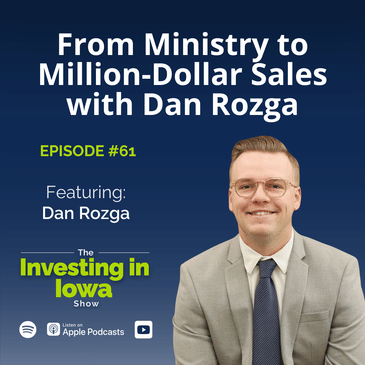
Dan Rozga was serving as a High School Student Pastor when he decided to launch his real estate career. In this conversation, Dan reflects on the motivation for his career change, the hurdles he faced during his first year, and the invaluable lessons he's gleaned from his investment journey. From the power of strategic financial planning to the importance of nurturing genuine client relationships, Dan shares the insights that have shaped his success.
He dives deep into what it takes to thrive in real estate, including why a long-term mindset and humility are essential to growing in a competitive industry.
What You'll Learn from this Episode
-
How Dan's desire to make a lasting impact led him to pivot from ministry to real estate.
-
Why building authentic, trust-driven relationships with clients is the key to long-term success.
-
The invaluable lessons Dan learned from experienced mentors and why staying humble is crucial.
-
How his background in ministry helps him connect with clients on a deeper level, bringing empathy and understanding to every deal.
About Dan Rozga
Four years ago, Dan made the leap from serving as a High School Student Pastor to launching his real estate career. Though he began on a supportive team, he quickly recognized his desire to build his own path, stepping out after just four months. Since then, he has found deep fulfillment in helping clients achieve their real estate dreams. Dan's work has earned him recognition in the DSM Area Real Producers 40 Under 40 and a recent induction into the RE/MAX Hall of Fame. Every morning, he wakes up excited to make a lasting, positive impact in the lives of his clients.
Connect with Dan
Phone | (515) 494-6241
Website | https://daniel-rozga.remax.com/
Instagram | https://www.instagram.com/danrozga/
Facebook | https://www.facebook.com/danrozgarealestate/
[00:00:00] But I don't want to do it because I have to. I want to do it because I'm like, I genuinely enjoy this and I'm not going to slow down. But if I wanted to slow down, I could because, you know, in my 20s or 30s, I chose to do things the right way. From cornfields to high-rises, office to industrial, houses to hotels, and every other asset class in real estate, we cover the people, the projects, and the profit. Welcome to the Investing in Iowa Show. This show is for go-doers, action-takers, and business owners.
[00:00:28] It's for people like you who are sick of Uncle Sam taking a huge bite of your apple. If you're looking to get ahead of what's taking place in Iowa, learn who is doing what and how you can get in on the action. You're in the right place. Hosted by Neil Timmins, an Iowa native who has been involved in over $300 million in real estate right here in Iowa. Recording in studio from West Des Moines, here's your host, Neil Timmins.
[00:00:56] I've got Dan Rosga here on the show. Dan, welcome. Yeah, thanks for having me, Neil. Appreciate it. Hey, see, for the audience's sake, who are you? Where are you from? What do you do? Yes, I am a realtor, work for Remax Concepts, also real estate investor a little bit, dabble in that, I suppose, from Indianola originally. So that's where I grew up. And my wife and I now live in Des Moines. Growing up in Indianola. So graduate high school there, then what do you do?
[00:01:20] Yeah, graduate high school. I went to school in the suburbs of Chicago. I was in vocational ministry. That was what I was studying, biblical studies. So I went to school, small private Christian school in suburbs of Chicago. And then I worked at a church in West Des Moines as a high school pastor for about three years before I got into real estate. How did you stumble into real estate? Yeah, it's a good question. You know, my father-in-law is a custom builder with Cornerstone Homes. He's been doing that for a few decades.
[00:01:51] And church was great. It was really just I kind of put all my eggs in one basket. I never really considered doing anything different. And I spoke to my parents about potentially going into real estate, to which my dad responded that when when people don't know what to do with their life, they either sell real estate or sell insurance, which touche. I suppose that's that's generally true. As you know, it's kind of a revolving door. But my uncle was a realtor in Breckenridge area of Colorado, and I was always interested in what he did.
[00:02:19] And I kind of just went for it. So my wife and I, we got married in August. I quit my job just before our wedding. We came back from our honeymoon. And that was right when I started in real estate. She had quit her job to get her master's degree. So by the time we were on our honeymoon, we were both unemployed and newly married. So just a great idea. But it worked out. What was the catalyst? What made you decide to make a change?
[00:02:45] Yeah, I really like working with my own ideas and sort of not being tethered by anybody else's. There's blessing and curse with that. Lance Hansen, who's one of our brokers at Concepts, always says the beauty of real estate is it's on you. So if you really think you're good, then great, go do it. But if you're bad at it, it's also on you.
[00:03:09] So I liked the idea of sort of gambling on myself. Admittedly, there was a little bit of an innocence to my shift into real estate, which I think was kind of good. Interestingly, I didn't really overthink it too much. I kind of just was like, all right, I got to do this thing and it needs to work. There's something about putting yourself in a situation where it has to work.
[00:03:30] You know, I'm newly married. I want to lead us well and I need to get paid. And so I think that helped me kind of have to come out and work hard. Well, there's nothing more motivated than knowing you might not eat tomorrow. Yeah, there's that. Right. Yeah. Yeah, that's true. Definitely. All right. So you get into real estate and decide to decide to be an agent, sell some homes. What was the first year like for you? It was great. You know, I started on a team right away and I did that sort of kind of as a security.
[00:04:00] You know, I didn't know much about it. I never knew about a team as a lot of people don't who aren't an agent. And so it was explained to me, you know, you can be on a team, you get the support, you can maybe get some leads and it can help you get business. So it sounded great. I definitely underestimated the amount of business I would bring in myself just from even being in the area. So it was only on the team for about four months. But the year ended up great. I ended my first year, I think, eight point eight million in volume.
[00:04:27] So it was far exceeded what I what I thought. And it's it's continued to grow from there. So, yeah, that's amazing. All right. So somewhere along the journey, you decided to buy a property to invest in yourself, if you will. Tell me about that. Yeah, I've been to the school of hard knocks on that one, to be honest with you. So there was a duplex in Indianola. I know Indianola. Well, obviously, I'm there. It was a situation where I had to move rather quickly.
[00:04:53] And I've always wanted to acquire rental properties because as a realtor, you know, we don't have retirement like like other people do. I mean, there's ways around that, I suppose. But my thought is, you know, when do I want to retire? And if I want to retire earlier than maybe some, what what am I going to have in place that's providing income for me in those years? And so that's where, you know, passive income through real estate came about. So there was a duplex in town. Bought it. It's it's I've learned a lot about the process.
[00:05:21] I moved rather quickly. I don't regret it, although my pocketbook regrets it over the first year. There are some unfortunate things that have happened, but that's part of learning it. And as lots of investors say, you know, you you learn from those moments in a bad property. I shouldn't call it a bad property because my theory is always, OK, it was a bad year, but you only lose money if you sell it. And I've not chosen to sell it. And so maybe it's going to take a you know, I'm set a year back from where I thought I would be with cash flow.
[00:05:48] But that's OK. I'm just going to hold it and it'll eventually make its money back. So that's the that's our first property. And our second property is an Ankeny townhome. That's been great. It's a newer unit. I never really had any issues with it. I have great tenants. I'm lucky with that. And all my units that we have, we have great tenants. And that's what I always tell people. They say, you know, is it hard to get a tenant? Getting a tenant's like the easiest thing in the world. It's getting the right tenant. You know, I have. You're right. I'll never have issues with vacancy.
[00:06:16] And it's funny. Investors, I know, say I love it when people get scared of vacancy because I know that it's not an issue. And I'm willing to move forward on an offer where someone who's maybe a little greener is a little worried about vacancy. But that Ankeny townhome is a different kind of investment with one, just a single family. But we we like it. You know, there's not oftentimes there's not much one can learn from winning. It's all those lessons come from the losses or the setbacks, the challenges.
[00:06:46] Right. Let's dive a little deeper into the duplex. What was challenging? What had you say what you said? Yeah, well, I think that it moves quickly. I mean, it was listed quickly. There were multiple offers. I had to move rather quickly. And so I didn't do a very thorough inspection of the property. There were some disclosure issues with some dishonesty from the past owner, which I've learned a lot about that process. And I've been able to go through that process rather.
[00:07:15] I'd say cleanly, I suppose there wasn't a lawsuit situation, thankfully, but I was able to approach that prior owner and work it out between us two. Do you end up in mediation for that? No. No, no, that was definitely I mean, it was pretty clear cut. I'd spoken to an attorney about, you know, what could I do? He said it's pretty obvious. Black and white. OK. Black and white. And I, you know, rather than just slapping a paper on his desk and saying, this is what we're going to do. I just called him and I said, here's where I'm coming from. Right. This happened. It wasn't communicated to me. And here's how I think you should make it right.
[00:07:44] Just so you know, this is what I'm prepared to do. And that's kind of my personality is just giving the guy a call and, you know, not that it was the funnest call for him, but there was certainly an admission of guilt. And, you know, everything's behind us now. Sure. Sure. OK. So outside of that component, so certainly disclosure issues, you know, it can be costly. Yeah.
[00:08:07] So outside of that, what I hear you saying is you had to move fast, probably reflecting probably wouldn't have paid what you paid. Yeah. I mean, some people ask me that. I guess, yes. Again, Mike, I try to think what's interesting to not backtrack too much. But when people talk to investors like, hey, is this a good investment? Is this a good property? It completely depends. What? You know, some investors say if it doesn't cash flow X amount, I don't want it. Some of those investors might be in their 50s.
[00:08:32] Some investors that are in their 20s are like, you know, if they have the discipline to see the long term, they maybe don't care quite as much about the cash flow. So I certainly paid a premium for it, but I also felt somewhat justified because there were four other people that were willing to do basically the same offer as me. So I don't regret it. I learned a lot. I probably would not be so eager to, you know, jump on the property, but I've got it. And here we are, I suppose. Yeah, you know, I like what you said.
[00:09:01] If you're in it for the long term, because if you went back in history and pretty much identified any top of any market, you go back to 07, 08, and you bought at the top of the market, if you will. It didn't take that many years from the top of the market, you know, and things went terrible pretty quick, right? 08, 09, 2010. It didn't take that many years, you know, moving forward for it to exceed what one would have paid in 2008.
[00:09:28] And if you certainly, if you went back to 2008 from today, it's incredible. Right. I would have bought anything at an 08 price. Yes. If you look at where we're at today. In fact, yeah, an investor told me, and this is kind of tongue in cheek, he's like, just buy anything. Just buy it. And that was sort of like, but, and obviously there's caveats to that, but his thing is like, don't overthink the deal. Correct. And again, for my tolerance, and again, every situation is different. Like, you know, we wouldn't have bought this property if what we experienced was going to like completely set us back.
[00:09:57] And it hasn't, it's not been fun, but it wasn't an investment that's like, oh my gosh, these, you know, these things we've had to experience are going to make us sell the property. I wouldn't have bought it from that, you know, if that would have happened. And I do know investors that leverage themselves pretty thin, you know, and they don't allow for any margin for something to happen. And so that's where it's just interesting when people analyze deals, it's so contingent upon what someone wants, what someone thinks is a lot of money, what someone needs. Just, it's just, there's not a, it's not, you can't just paint it with a broad brush.
[00:10:27] So for us, it's still a good investment because we do have a long-term approach to it. Based on what you learned there and all of a sudden you're, let's, let's say you're, you shift over, you got a client. So you have your realtor hat on. What three top tips are you giving that client when they're looking at an investment property? Yeah, that's a great question. Um, I would say the first one is, you know, are, are you prepared for unforeseen expenses? And, you know, how much money do you have?
[00:10:55] Do you have $10,000 that if something happens, you're able to, you know, act on those things? Um, that would be the first thing, maybe not 10,000, but, you know, just something. Do you have a margin of, of cash that you're able to use for, you know, to be conservative? Um, you know, the second thing I would say is, is sort of analyzing the financials, you know, what are they getting for rent? How much can you put down? This is something that I, again, sort of differentiates is me potentially from other investors is we put an aggressive amount down on the property, 40%. Okay.
[00:11:25] Um, and some people said, you know, it's stupid. You could buy another rental property with that. Uh, I wanted to be really conservative on this first property to where even with financing a portion of it, we were able to cashflow, you know, $1,200 a month because when something like this happened, it doesn't take that long to get that money back. So, um, that, that is also something that, you know, if the numbers don't make sense, my thing is, are you comfortable putting more down? Because if we keep seeing all these houses and the cashflow doesn't work, you can make the cashflow work.
[00:11:54] You just have to have more cash to put down, uh, which is my philosophy. Some would say, you know, I don't want to do that and I'll wait a year and then that property is worth more. And you're like, ah, crap, I guess maybe I should have. So those are the two, I guess to, those are the main two things, I guess, is how much money do you have if things go wrong? How much money are you prepared to put, to put down? Um, those would be the two things. I know you asked for three, but. Well, top two nuggets right there. No, that's fantastic.
[00:12:22] What are you most excited about in 2025? Yeah, that's a great question. I would say I'm excited about, this would be my fifth. Oh gosh, I think it's fifth full year or fourth full year. I kind of forget. Um, I'm excited to finally start seeing a little bit more relationships with some of my past clients. Cause in the beginning right now, I'm really just trying to serve people well and create a long-term relationship. However, a client sees fit or whatever is appropriate.
[00:12:50] Some people, you know, want to be your buddy and some people don't. And they still want you to be their realtor, but they don't want to go get a beer with you or anything, which is totally fine. Yeah. Um, some people, you don't want to get a beer. But they're a great client. Right. Yeah. There, there's just a, yeah, there, there's a little bit of, uh, kind of, uh, I guess, um, you meet them on there where they're at. Right. Yeah. So I, I'm looking forward to more of the, obviously for me, admittedly, I'm more of a people person. I really like helping clients and I like it when we both feel like things are going well.
[00:13:20] So I'm excited to start to get more years under my belt to where I'm starting to see more referrals from clients or their family, or, you know, they're looking to move again. And to me, that is such a good indicator that you're doing a good job in your business. Like I used this person once and I'm, I'm going to go out of my way to use them again. Uh, so I'm starting to see some of that in the business and hopefully that continues to happen in 2025. Hey, Iowa investors. This is Ava Bowkamp, chief of staff at Legacy Impact Investors.
[00:13:49] Have you thought about adding real estate to your portfolio, but don't have the time or desire to play landlord? At Legacy Impact Investors, we do the heavy lifting. Our team finds the deals, manages the properties and handles all the day-to-day operations. Our select group of qualified investors co-invest with us, gaining ownership equity without opening a tenant email or responding to a maintenance call. They just share in the income, appreciation, and tax benefits. These opportunities aren't for everyone.
[00:14:19] They are for qualified, accredited investors only. If you want to learn more, please visit LegacyImpactInvestors.com to apply. How did studying, doing biblical studies, having your role in the church, how did that serve you well, that background? How did it serve you well as a realtor? Yeah, that's a great question. I mean, there's a variety of things. Some of it just plainly.
[00:14:44] I'm not typically nervous talking in front of people or, you know, there'd be times the church that I was employed at was a rather big church. So, you know, weekly speaking to 100, 150 students or sometimes giving announcements to, you know, a couple thousand people on a weekend. Not that I'm ever having moments with my clients like that. But, you know, in that group of people, you have a variety of different personalities. And especially as, you know, if I'm teaching to high school students, I'm really having a relationship with their parents as well.
[00:15:13] So being able to navigate, you know, having a constructive conversation, connecting with a teenager and then also being able to communicate with their parent. You kind of have to be flexible in the way that you're able to communicate with people. And I think that served me well to where I feel like I get along with a wide variety of clients. Those that are sort of soft spoken, maybe those are a little a little hard. You know, they're a little they're a little driven. They're a little aggressive. You know, I like those people, too, in certain settings.
[00:15:41] So I think it's kind of helped me be able to talk to the client, find a common connection, like those sort of things. So I typically I'm not nervous to meet someone for the first time or anything like that. If they want to if they want to talk about something that's hard or we have to have a difficult conversation, I'm typically not. Well, just I'm just not I'm not I'm not I'm not nervous to have those sort of conversations. So, yeah, I like I like that. It taught me that. That was that was huge to.
[00:16:07] From what you learned there and maybe maybe being in that world, did that somehow serve you well as it relates to referrals? Yes, to an extent, not as much as you would think, not as much as I would have thought. I mean, certainly. And I'm very grateful for those that I was able to serve alongside and that have helped me, you know, in a big church like that. There's also a lot of realtors in that as well. But, you know, certainly I feel like I left on good terms.
[00:16:34] And that's, you know, people say they people want to work with people who they like, you know, and if somebody has a good reputation, I feel like as time goes on, that can't hurt you in any way. And even if somebody doesn't use you, if they if they think well of you is what I've always told myself. If somebody thinks well of me, not in an ego way or anything like that, if someone, you know, they I think that comes around in certain ways, whether they refer you or someone mentions you and they're like, oh, yeah, they're great. They do. They do a great job.
[00:17:04] I really like them. So, yeah, it's it's helped with some referrals. And again, hopefully that continues. If you're a house flipper, execute the birth strategy or do double closings and are in need of money. Little Guy Loans is your go to lender here in the Des Moines area. Time is money. Loan approvals in 24 hours. Closings in five days. Little Guy Loans was founded by Neil Timmons, an investor just like you.
[00:17:29] Since he has been in over 10,000 homes in Des Moines, there's never an appraisal. Houses, multifamily and commercial property loans up to one million. Check out www.littleguyloans.com. When you think about your investing business, what's the goal? When you look forward 10 years from me, when you look into that long term worth of wall, if you will, where do you want to go? Yeah, I'm still honestly thinking through that, honestly.
[00:17:58] I mean, sometimes you... Admittedly, it's pretty long term. Again, I kind of alluded to the fact that, you know, what can I do to where... I see a lot of agents and to each their own. And there's a point to this, I promise. But there's a lot of people in our industry who I don't think handle their money very well. And I think they're working longer than they probably had to. And some of that is due to, you know, maybe a lifestyle that they want to have, that they can't have long term. It's not sustainable.
[00:18:27] Some of it is, you know, teach their own. People can do whatever they want. Get paid on a 1099 for getting to save money for taxes. There's that. I've heard every story in the industry. There's that. Of course. You know, or just, you know, small things of, you know... Anyway, I won't go too much into that. But the point is that I see a lot of agents who they're working at a pace and at an age. And I look in the future, I'm like, I don't want to be doing that. Not that I don't love my job. I should clarify. I don't necessarily not want to do that, but I don't want to do it because I have to.
[00:18:57] Yes. I want to do it because I'm like, I genuinely enjoy this and I'm not going to slow down. But if I wanted to slow down, I could because, you know, in my 20s or 30s, I chose to do things the right way. Or my wife and I, as she's a part of the properties too. So when I look long-term, I more look at it as, and people, you know, don't always think about, you know, if I want to retire early, what is going to sustain my lifestyle? How am I going to be creating money that's going to be able to sustain that?
[00:19:23] And so that's the ultimate goal is that these properties would be able to provide, you know, income in those years. Yeah. You ready for the final three questions? Yeah. If you had one piece of advice for your 20-year-old self, what would it be? Oh, that's a great question. Um, my response would probably be, um, you know, you're really not that important. Um, and, uh, we, we talked about this kind of before we were recording, but to each their own.
[00:19:50] Again, that's the beauty of real estate that someone told me early on is there's lots of different ways you can skin a cat. If you want to handle your business this way, you can, you're in real estate, you can do whatever you want. In my generation, I see a lot of sort of like this rah-rah, like, let's go, we got to grind, we got to get this done. You know, um, and I can't stand that. I really try to, and maybe it's because it just conflicts with my personality.
[00:20:16] To me, it's, I feel much more appropriate being like, work hard, do your job. Like, don't get a ribbon for just doing your job. You're just doing your job. Um, and I feel like there can be a lot of added, um, things that can potentially come from ego, I suppose. And, and that certainly, you know, when you're 20, everyone's kind of got an ego or someone in 20 can maybe be a little too big for their britches. But, you know, I, I think I underestimated, and I don't mean you're not important enough, you know, that's maybe brash.
[00:20:46] But I just mean like, hey, like, just do your job, be a good friend, be a good person. You know, at that point, I wasn't married, I suppose. But, you know, if I was, you know, be a good husband. Uh, I would tell myself just to kind of chill out a little bit and, uh, try to see the big picture. Um, and yeah, I suppose that's how I would answer it. Two books to change your life. Oh man, you're talking to a guy who is not a reader, but, um, I've started a lot of books. Um, man, that's a great question.
[00:21:16] Um, two book covers that changed your life. Yeah, that's hilarious because that's totally true. But again, like I, I'm sort of different in the sense of, uh, I don't read a lot of leadership books. I don't read a lot of real estate books. I listen to podcasts and things like that. Um, I would say one book that was, man, it's so funny because I haven't read in a long time. There's a book called Scary Close by Donald Miller. Okay. Has nothing to do with business or real estate. Has a lot to do about yourself. It's pretty deep.
[00:21:42] It's, it's more about like coming close to who you actually are. And sometimes that's scary. Yeah. Uh, but you have to, you have to see that and it does bleed into business. It does change who you are, uh, for better or for worse. Sometimes people are a little bit afraid to, to really look at themselves closely because they might not like what they see in a sense of, um, you know, some adjustments could be made to potentially be a better person. Um, so that's, I haven't read that in a long time. Scary Close. That was a good one.
[00:22:09] Honestly, I've read a lot of like ministry related books, I suppose too. So, um, yeah, there was a book called, um, The Circle Maker by Mark Batterson and it's a book about prayer. And it's essentially about, you know, uh, dreaming big and, and praying prayers that might sound like are impossible. And obviously I'm a faith-based person. So that means a lot to me, but, um, seeing the big picture and, um, you know, praying big things that can feel scary and, and, uh, trusting in faith, I guess that they can happen.
[00:22:37] So not your typical, like Grant Cardone or, uh, I, uh, I don't typically read those things. Yeah. That's great. If you were cast away on an Island for one year, you could only get three pieces of data about your business each and every month. What three things must you know to know how your business is running? Oh, that's a great question. Um, okay.
[00:23:03] Well, three pieces. I would need my database, uh, which I use follow up boss. So I, my database is what tracks, you know, incoming clients, old clients responses to things that I'm sending out like the communication, which I have to work hard at. I'm not a naturally organized person and I could do a lot better in organization, but that helps my brain, uh, stay a little more sane. I suppose.
[00:23:29] Uh, definitely that, um, I would need my cell phone. Um, obviously just, you know, keeping up with clients and responding to clients, those sorts of things. And, uh, again, I alluded to this earlier, but it's, it's fun to, you know, I'm a green Bay Packers fan and, um, I'll meet with clients who are, you know, if they have an allegiance to a team and, and we text each other sometimes on Sundays and, uh, you know, if our teams are playing or something like that.
[00:23:57] And so, uh, my cell phone, because it's not just always business related. I try to do a good job of, if I'm reaching out to somebody, it's, it's hard to do, but trying to make it feel natural and not forced. And it has to be genuine. Like people can, you know, people can sniff out, maybe you say one thing that's not about real estate in one text, but your next text is like, well, anyway, I just wanted to see if you were looking to buy a house in three months. And it's kind of like, well, you probably really just wanted to text that. And so I, I try to do a good, this is a tangent, but I try to do a good job of what I'm communicating.
[00:24:24] Sometimes having, you know, conversations in the conversation that ends and we never say anything about real estate or anything about moving or anything about it. You know, I just genuinely, and hopefully that communicates to them. Like I actually do care about what I'm talking to you about. So my cell phone, um, let's see. My third thing would probably be like a coffee maker or like an energy drink or something. Uh, I'm not a good sleeper. We have an eight and a half month old at home, which is, that's wonderful. Yes. Challenge. Challenging.
[00:24:53] And that's, you know, I will say again, like the beauty of real estate is it has allowed me to be able to be present in ways. Still very busy, of course, but it's a different kind of busy where I'm in a little bit more control of, you know, my daughter's having a nap. Can we see the house an hour later than you want? And most of the time clients say, yeah, that works. Uh, it's, I, I, I selfishly enjoy that freedom as opposed to being in a position, you know, where a lot of people are, where, you know, you're not able to dip out of the house to do those sorts of things. Right.
[00:25:19] Uh, but certainly caffeine, uh, can fuel my business and in many ways. So those would be the three things, nothing too crazy, but I need all three of those. Yeah. I've asked lots of questions. What's one question I did not ask that I should have asked. Hmm. Good question. The question I ask myself often too, is what are the things that young realtors, cause I'm a young agent should be doing in their business. Let's do it. Yeah.
[00:25:44] I'd be curious to your response on it too, cause I know you've been in the industry, um, a while, but, um, I've got an answer and it's only four things. So, but I'm gonna let you go first. Yes. I mean, obviously there's a variety of things. Um, but one thing that's been huge to me is, um, finding agents that you want to be like in a lot of different ways, not just successful agents, because, you know, again, like there's a lot of agents in our market. There are certain agents that they do a great job, but respectfully, I don't want to handle my business like that.
[00:26:14] Um, you know, I don't want to arrive even at the success. I don't want to arrive, even if they're more successful, I don't want to arrive at success in that way. I'd rather be less successful. And, and some of that is, is due to, I'm not in this industry to, I'm in the industry to do a good job and just help people. And of course I want to be successful, but, uh, you know, uh, the bottom line of volume or home sold every year is not, I'm a human.
[00:26:38] Of course I want it to be good every year, but that's not the most important thing to me, but finding those agents that consistently do a good job. And I would recommend agents that, uh, don't go out of their way to tell you what to do. A little soapbox, uh, that I'll go on here as being a younger agent. It's not always well-received when a veteran agent kind of comes into a younger agent's business and starts just telling them what, what to do from kind of a level of superiority.
[00:27:04] I suppose, not that it's not been earned, but I, I, I guess personally, I tend to respond better to agents that are very successful, but they don't have to talk about it all the time. Those, those are the people where I'm like asking them questions. Like I'm trying to pull it out of them. Like, no, like, how are you doing this? Because I want to be like that. But I do that regularly with a handful of agents at our brokerage and either even other brokerages where I just ask questions of how they've arrived at their success.
[00:27:28] And you have to go into those conversations as a younger agent with a level of humility, understanding you're passionate. Yes. You want to do well. Yes. Maybe you even done pretty well in the beginning, but you've got 20 years or plus, you know, where you got to survive in this thing. So coming to those conversations humbly with veteran agents, I found that some people have, have even veteran agents that I've talked to. I think they enjoy it. I think they like it when younger people come and they just say, can you help me with this? I don't know what to do. Uh, they seem to really enjoy that, but it's helped my business tremendously.
[00:27:58] Yeah. You ready for the four? I'm ready. I'll do it. This is, this is, in my belief, I learned this early on and it attributed my success as an agent. I believe there's only four things one should be doing. Now, what you just said, I agree. And I take it one step further is once you learn and soak up that wisdom from an elder agent, from a successful agent, it is showing homes, it's writing contracts for buyers, it's writing listing appointments, and it's writing listing contracts. Yes.
[00:28:26] It boils down to those, those are the, those, you know, there's plenty of things that lead into that, but that's been 80% of your time there. You'll be a millionaire in no time. Yeah. Yeah. You're doing something right. If you're doing those things. Correct. Certainly. Yeah. Yeah. Yeah. This is great. I've enjoyed this conversation a lot for people who want to find you. They want to follow you. They want to connect with you. Where can they go? What should they do? Yeah. I have, uh, my Instagram is just Dan Rosga, my name. I used to have a business account.
[00:28:52] I kind of stayed away from that, uh, just cause I couldn't handle posting on multiple things. Uh, so my Instagram is Dan Rosga. My Facebook is Dan Rosga. I do have a Facebook, um, business account, I suppose. But, uh, yeah, I try to keep it light and try to keep it to where I'm not posting about real estate all the time. Uh, but I certainly like to sprinkle what I'm doing on those sites. Fantastic. Links below in the show notes, everybody. Dan, thank you for being. Yeah. Thanks so much, Neil. I appreciate it. Thanks for listening. If you're enjoying the show, may I ask a favor of you? Naturally subscribe.
[00:29:21] So you never miss an episode, but would you rate and leave an honest written review on Apple podcast? Does a lot for us here at the show. And I appreciate reading your thoughts. Great guests make for a great show. If you know of another Island who would be a great guest, or you yourself have interest in being a guest, well, get on our radar. Visit investing in Iowa to fill out an application or recommend a guest.
[00:29:47] And if you want to connect with me one-on-one, go legacyimpactinvestors.com. Click on the invest with us button in the top right corner. And there you can pick a time for the two of us to get on the calendar and connect. Until next time, keep investing in Iowa.