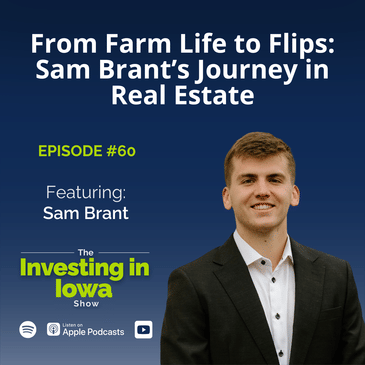
Listen in as Sam Brant takes you through his unique journey from growing up on a farm to becoming a successful real estate investor. With roots grounded in a strong work ethic and a hands-on approach, Sam shares the lessons he's learned along the way—from flipping properties to managing rental portfolios. He opens up about the challenges and rewards of building a business, how partnerships have played a pivotal role in his growth, and the importance of understanding the different dynamics between long-term rentals and short-term Airbnb investments.
Whether you're a seasoned investor or just starting out, Sam's down-to-earth approach and real-world insights make this episode a must-listen.
What You'll Learn from this Episode:
-
How Sam's farm upbringing shaped his work ethic and determination
-
Why you need to build systems to manage your time as a house flipper
-
Navigating the world of Airbnb versus traditional rentals—what's the best fit for your strategy?
-
Why forming solid partnerships with contractors is crucial for scaling a real estate business.
-
The importance of cash flow management to ensure long-term sustainability
About Sam Brant
As a Central Iowa native and a fourth-generation farmer, I bring a strong work ethic, deep local roots, and a passion for helping families realize their real estate goals. Growing up on a farm taught me the value of hard work, perseverance, and the importance of building lasting relationships—all qualities I carry into my real estate career.
I wear multiple hats in the industry: as a dedicated real estate agent for the Fett Real Estate Team in Ames and as an active investor with a substantial personal stake in the local market. Currently, I manage a portfolio of 25 rental units, including three Airbnb properties, and am working on 18 flip projects in various stages—whether under contract, in escrow, or undergoing renovations. Since starting in real estate, I've sold just under 30 flips of my own, and I've helped clients buy and sell over 100 properties.
This combination of real estate agent and investment experience gives me a unique, firsthand perspective that I bring to every client relationship. Whether you're a first-time buyer, a seasoned investor, or someone looking to sell, I'm equipped to provide guidance tailored to your unique goals.
My journey into real estate began with a desire to create financial security and opportunity for families and individuals in my community. Outside of work, you'll find me training for my next Ironman, cheering on Iowa State at home games, or helping out on my family farm.
Connect with Sam:
Email | Sam@FettRealty.com
Phone | (712) 210-3025
Facebook | Sam Brant
Instagram | Sam Brant
[00:00:00] Doing the ordinary thing every single day over consistent time produces amazing results. If you show up every single day with the right intent, you're going to push the needle forward. From cornfields to high-rises, office to industrial, houses to hotels, and every other asset class in real estate, we cover the people, the projects, and the profit.
[00:00:22] Welcome to the Investing in Iowa Show. This show is for go-doers, action takers, and business owners. It's for people like you who are sick of Uncle Sam taking a huge bite of your apple. If you're looking to get ahead of what's taking place in Iowa, learn who is doing what and how you can get in on the action. You're in the right place. Hosted by Neil Timmins, an Iowa native who has been involved in over $300 million in real estate right here in Iowa.
[00:00:51] Recording in studio from West Des Moines, here's your host, Neil Timmins. I've got Sam Brant here on the show. Sam, welcome. Thanks for having me, Neil. I really appreciate it. I'm excited you're safe with the audience to say, who are you, where are you from, what do you do? Yeah, so my name is Sam Brant. I live right now in Ames, Iowa, originally from West Central Iowa. I'm kind of a hybrid. Do some real estate agent stuff right now still representing some clients, buyers, and sellers.
[00:01:19] I have some multifamily investment properties, still have a few single family stuff, duplexes. Three Airbnbs and do quite a few flips. So a little bit of everything, Neil, to tell you the truth. Tell me, take me back to the beginning. Talk to me about how you got into the business of or the investing world, whichever of those two came first, the brokerage or the investor.
[00:01:44] Yeah, for sure. So I probably got to start back probably before even high school, school, just kind of telling you about my background. Kind of that works into the work ethic and just what I came from. So I grew up in West Central Iowa on a cow-calf row crop operation. So since I've been 12 years old, I've been working, driving a tractor, literally scooping shit out of the horse lots or cattle lots or whatever. So hard work, manual labor was just a thing you did.
[00:02:14] You know, come home from school, you do chores. Weekends after football, you do, you got to work on Saturdays. So that transitioned really nice after school because this business, it's nothing fancy. It's pretty simple, honestly. Just a lot of hard work. So then from there, obviously went to school at Iowa State for an agricultural degree.
[00:02:35] In between there, kind of sales background, I was working at a Chevy GM dealership selling cars and that helped me pay my way through school and build up some capital. So same thing there. I was working weekends, working 10, 12 hours a day at the dealership, getting there at 8 in the morning, not leaving until 730, just helping out clients there. And then COVID hit and you can't sell any cars on an empty shelf. And so I was really thinking of transitioning.
[00:03:03] I've been listening a lot to Bigger Pockets. Actually bought three single family houses in one month there in 21. I had no idea what I was doing. I was like, hey, they say this is passive income. Let's see what it's about. And I found a $100,000 house in Ames, which there's not any more of anymore. Right. And acquired that one. And then there was a house right next to it that came for sale.
[00:03:30] I was like, sure, let's buy that one too with some of the funds I had from the car sales gig. And then bought a house that I lived in. All closed that June, I think, in 21. So it was like, we're in it. Yep. We're in it. So then that transitioned. I was still working at dealership then. Transitioned right around then to come back to Ames. Didn't really know anything about real estate besides the three houses I bought. They were managed by someone else.
[00:03:58] They seemed to be cash flowing a few hundred bucks. Seemed to be working out good. And then really dove deep in with Colin Fett at Fett Realty. He's been huge. He's been probably a good mentor to me 10 years ahead. Fantastic. Has over 100 units. Management company. All that kind of fun stuff. So I've been able to learn underneath him the last three years. And then that next year, did some more burrs. Flipped the house in 22. Did Airbnb arbitrage.
[00:04:28] So that was like hot during COVID. And I was like, let's just try that out too. Yeah. Made some money on that. And then really transitioned the last year probably. And doing a lot of flips now. Being really active in that. Still represent some clients. But not nearly as many as I did two years ago. Yeah. So it's been a wild ride. You've done just about everything inside that family space. Yeah. Yes. Dabbling in a little bit of everything. And it's not complicated.
[00:04:58] You just got to show up and do the work. So you enjoy holding these properties it sounds like. What got you into the flip side of the business? Flip side of the business. Just kind of build up more capital. Same thing. That was kind of my thought process through actually being an active agent too. You can work your way and build up good capital through that too. But as a flipper. You can actually build it out as a business. Compared to an agent. If you're not there to pick up the phone call personally.
[00:05:28] You're not going to get the business. Whereas if you're actively have a flipping business. It doesn't matter if it's me or you or Joe Schmo giving them an offer. If it makes sense for that seller. They're going to go ahead and work with you. So you can really kind of start putting people in the right places to take that over for you. Yeah. Talk to me when flipping. How do you underwrite a deal? Just at a fairly high level. High level. So it's pretty straightforward.
[00:05:56] You got to have some feel for the market. But you start out by assessing the property itself. What it might need for repairs. What condition it is currently. Get an idea of what those repairs might be. And then from there you're looking at comparables. So things that have sold within the last year or two. Similar square footage. Size. All that kind of stuff. At. What I do is I look at what it would be worth. Completely fixed up.
[00:06:26] Get that aftermarket repair value. And then what it is currently. You know like. Even in the shape it's in. There are comparables for that as well. Sure. So. Both the ARB and the as is value. Yep. Okay. Yep. I'm just doing it. Well how do you decide if you're going to fix it or if you're going to hold it? Location plays a big part. Yeah. So honestly from the. We've sold about 30 deals this year for flips.
[00:06:55] We'll probably in total we'll probably buy around 45 this year. Mainly it's price. And if. How fast we can sell it. And then location. I think out of all those 45s we're only holding one. That's true. It's a really cool location right around campus in Ames. Yeah. And I think that's a great area to invest in for the future. So. How do you find these deals? Without giving me the total secrets. Yeah. No. It's nothing fancy.
[00:07:25] Cold call. Texting. Direct marketing. Yeah. And you just got to do a lot of it. You know. If you're. You think you're going to get a deal and you're going to call 10 people. It's not going to work. Sure. But if you do a lot of volume you can get a lot of results. You know like anything. You want to be big in the gym. You got to do a lot of reps in the gym man. Yeah. So. Yeah. That's pretty much it. It's in a nutshell. That's incredible. All right. You mentioned apartments.
[00:07:53] Tell me a little about where you're at and what that apartment world looks like for you. Yeah. So I was really grateful this year. I had the opportunity to buy 12plex off market in Ames built in 2000. Okay. So pretty new. Yeah. Was able to get most of that down payment. I sold off one single family home in East Des Moines and then just from the capital from the flips coming in. So that's been a lot of fun.
[00:08:20] It's like this is almost like my gem property now. Like you have all these single families. Yep. Moving. And it's hard to really scale with those. Yep. So this it's been the same thing as buying a single family. Just a few more tenants, a few more water heaters, a few more windows. I like it. Sam, you're just playing Monopoly, man. Just for those houses for hotels. Yeah. Right? Yeah. That's the goal. How'd you finance that deal? Finance that deal. Commercial loan.
[00:08:50] Local lender. United Bank of Iowa. So been able to build a relationship with him for the last four years. And came back. He's got a few of my other things. If I would have asked him three years ago to finance that, he would have said, hell no. But he was we've kind of built that relationship up. So he was able to 25 year, five year AM. Yeah. Six percent interest, I think.
[00:09:18] Six and a quarter, three quarters or whatever it was. How do you manage it? So I don't manage any of my properties myself. I hire out management for all of them. Either Colin Fett. He's got a management company or that one's unique apartments in Ames. Hey, Iowa investors, this is Ava Bauckamp, chief of staff at Legacy Impact Investors. Have you thought about adding real estate to your portfolio, but don't have the time or desire to play landlord?
[00:09:45] At Legacy Impact Investors, we do the heavy lifting. Our team finds the deals, manages the properties and handles all the day to day operations. Our select group of qualified investors co-invest with us, gaining ownership equity without opening a tenant email or responding to a maintenance call. They just share in the income, appreciation and tax benefits. These opportunities are for everyone. They are for qualified, accredited investors only.
[00:10:13] If you want to learn more, please visit LegacyImpactInvestors.com to apply. I got a couple of jobs already, Neil. I don't need a third or four. You know? All right. With that, then I'm going to transition to the Airbnbs because then a question that will come is how do you manage those? Talking about the Airbnbs, how you decided on the particular ones that you have chosen to keep and retain and turn them into Airbnbs?
[00:10:39] And maybe why turn anything into an Airbnb in the first place? For sure. That's a great question. Yeah. So my first Airbnb was Airbnb arbitrage. So for people that don't know what that is, you're pretty much the tenant. I leased it from a landlord, a single family house, and then furnished it all and re-put it back on Airbnb. You're just trying to make the difference there. And that worked out great.
[00:11:06] The landlord figured out after two years that I was making too much money. And so he wanted it back. But AirDNA is great. It's just a thing online. Same thing as comping out rentals, you know? Just so you got to find what other properties in the area might be bringing in. And then hopefully you can do a better job staging it, managing it, you know, responding to the guests better than anyone else who would get those five-star reviews. So that was the first one.
[00:11:35] Sold that off actually first of this year back to him, my furniture and my bookings. I sold that business, I guess, back to him. And then the three I have now, location plays a big part. And then updates. So two of them are close to campus, which really helps walking distance almost to stadium. And then the other ones on West Ames, that house was built in like 2004. Large home.
[00:12:06] Decor helps quite a bit with that. You know, I'm terrible at that. My girlfriend's great at decorating. So if I didn't have her, I'd be paying someone to decorate it, which just adds to the bottom line. Sure. How do you manage them? Manage them. I use a called Guesty. I don't know if you've ever heard of that. No. It's great. It really brings in all the bookings across everything into one platform.
[00:12:31] And there's stuff to do the work of communicating with some of the guests, but you can build out automated messages. And then I have a dynamic pricing tool called Price Labs. And they're great. Otherwise, I'd be probably working every single day just pricing these properties. Because like a game day or graduation could be $1,000 a night. Yeah.
[00:12:53] You know, so you got to really take advantage of those Iowa State games or the graduation, you know, just big events in Ames have been a big help. So. Wow. Well, those, it's, I always get an interest in the Airbnbs and what turns into an Airbnb. Yeah. Tell me from a, I'm interested from a net standpoint, net income standpoint. Yeah.
[00:13:19] If these were long-term rentals versus Airbnbs, how much more are you netting? Give me a dollar a percent. Yeah. I don't care which one. How much more are you netting as a result of turning them into Airbnbs? So all these properties are pretty highly leveraged, like probably 80% loan to value because I just purchased them. Sure. So with that, counting the mortgage, you're probably as a long-term rental, a couple hundred bucks, you know, after maintenance and management.
[00:13:49] As an Airbnb, you also have that capital of furniture. So you're talking 10, 20 grand in place. But a net standpoint on those, some months are nothing, some months are $2,000 net. So you really got to make your gravy in the summer. There's no doubt about it. Yeah. In the winter, do you transition to medium or long-term? I call it medium term. Yeah. I don't right now.
[00:14:15] Maybe that's something I get better at, but I have them booked out for a year in advance. So you'll get one of those people that do a February in there, a weekend for a game day or something. And then you can't tell them, no, you can't stay there. So then it's hard to get maybe those midterm nurses or business people in there. When you see you're booked out a year in advance, what I understand you to say is that you have the calendar open a year in advance. Yeah. Okay. Yeah. Got it. What are you most excited about in 2025?
[00:14:45] 2025, I think for me personally, is just scaling this flipping business. I think we've finally put some good people in the right seats to be able to grow that, to potentially double what we're at now. I think that's a space where the market overall, I think it's going to be, it's not going to be a COVID market, you know, multiple offers on everything, but I think it's still going to be pretty good.
[00:15:14] You know, if you price it right, if it looks good, you're still going to get really good activity in that first 30 days. What does a scale flipping business look like? I mean, I really, what I'm asking, what's the org chart look like? So for a team perspective, it's me and my partner, Beau. He takes care of most of the marketing sales aspect.
[00:15:33] And in that, we have probably three, maybe four internal salespeople, acquisitions, cold collars, a marketing assistant, all taking care of that on the front side. And then once we get that deal closed up, then it transfers to me. And we probably have three or four people on that backside too, closing deals, doing TC stuff with sellers.
[00:16:02] Right now I'm listing all the properties here locally. So adding another agent or two that can handle that flow. Because you think a hundred properties, that's 50 for two agents. That's a ton of houses to list. And then just some additional admin, people running around, helping with the properties. Outside vendors, contractors have a couple of good contacts there. So. So.
[00:16:27] Are most of your contractors external, I mean, the general contractors running a project? Yep. Yeah. Yep. So been able to find some really good crews. And once you build that relationship, you know, they figure out what you like, what you don't like, how you want it. And then it's really just handed them over to them, you know, and letting them do their thing. So. And repeat. Yeah. On your tip, your average deal from the day you buy it to the day it goes back on the market for a sale.
[00:16:56] Yep. How many days? Less than 30. Yeah. Amazing. Yeah. The speed is imperative. You have to. That cash, what is that cash cycle? Cash conversion. Cash conversion cycle. You have to have that quick. Because like, if we tried to scale this business from zero to 45 again, and you're waiting nine months and doing really deep, deep rehabs on everything, we would have done five this year probably. Or maybe 10. Yeah. Like you, you got to flip them quick.
[00:17:26] The only way deep rehabs work, and this is coming from my experience. Okay. Actually doing this. Yeah. You make ridiculous checks. Yeah. Right? Yeah. I mean, that's the only way you can justify it is the checks have to be enormous. Yes. And the likelihood of that, how many, there just aren't that many projects out there where you can go do a deep rehab. No.
[00:17:49] And make a check so sizable that it makes sense to go down that business path versus what you're doing. Especially in this market. Correct. You know, it's not like we're on. We're not in LA. No, we're not in LA. We're not in Florida. Right. We're not on the East Coast where they have a thousand square foot house that's worth two million. Correct. You know, where you buy that for 25% of market value, you're making a killing. Correct. So, yeah, you really got to do volume here.
[00:18:19] But the thing with volume that I like here is there's not much risk. Yeah. If you buy them right. You know, if a $100,000 house goes down 10%, you're losing 10 grand. Right. Where you do that in Florida, you're losing 100, 200,000. Right. Puts you under pretty quick. Yes. But. How have you had to change and evolve over the course of the last, you know, your entry to this industry? Yeah. To live, operate and lead in the position you're in today. Yeah.
[00:18:48] Great question. Really comes back. Just kind of adding one block onto the next. You know, first we talked about before. It was just like, I feel like I'm in that stage of like trying to learn how to evaluate a deal again. Of like, that was like the baby steps for me of just like figuring out what is real estate and what are the nuances in it. And now when you build yourself from there, you then have to add people underneath you to add that scale because you can't, you can't do everything.
[00:19:18] You know, you will never be able to. Otherwise, you're not going to sleep and you're not going to have any type of social life or. So then kind of positioning now, which the stage I'm in now is figuring out how to lead, how to manage people, how to put together a team. What onboarding looks like, what pay scales look like, all that really fun stuff, Neil, that everyone talks about. The whole business operations.
[00:19:42] Yes, it's the management is, has been the thing I'm really trying to key on. And that just comes back from reading books, listening to other people in the space, meeting with other business owners, trying to surround yourself with like minded people. So outside of hard work that was instilled in you at an early age from growing up on the farm. What else have you drawn from those, those early days?
[00:20:10] What else was in your upbringing that has allowed you to become successful today? Yeah. Just continuing to do. One thing I wrote down was doing the ordinary thing every single day over consistent time produces amazing results. So it seems like to me, like there, obviously there's been some things changing the business, but if you show up every single day with the right intent. You're going to, you're going to push the needle forward.
[00:20:39] If you're a house flipper, execute the burst strategy or do double closings and are in need of money. Little Guy Loans is your go-to lender here in the Des Moines area. Time is money. Loan approvals in 24 hours. Closings in five days. Little Guy Loans was founded by Neil Timmons, an investor just like you. Since he has been in over 10,000 homes in Des Moines, there's never an appraisal. Houses, multifamily and commercial property loans up to 1 million.
[00:21:09] Check out www.littleguyloans.com. That's really what I've tried to do. Some other things in those early days when I was 18, 19 years old, which really wasn't that long ago. I'm 25 now. Was just communicating with people that sales aspect. You know, the car business isn't fancy or fun and it gets a pretty bad rap, but you're dealing with every type of people.
[00:21:34] You might deal with a guy that comes in and buys a $3,000 car or you might deal with a guy that owns five high country pickups and is worth 50 million bucks. You know, so just those people skills early on were huge. You ready for the final three questions? Yeah, I'd love to. All right. If you had one piece of advice for your 20-year-old self, I know we're not going back that far. Yeah. But one piece of advice for your 20-year-old self, what would it be? I'd say get more involved in everything.
[00:22:05] I wasn't that involved in stuff. You know, I had a good group of friends. Give me a couple examples. What would you be more involved in? Like clubs. Okay. Clubs, social events, going to those things that, you know, you might think are cool or might not even think are cool, but you just being able to meet those people and then take in, especially in college, I tell people this is like, go for that leadership, maybe position. You wouldn't think you wanted to. I never did that.
[00:22:32] I wish I would have now because it would have put me more in the right group of people and you would have, you know, had more of those skills to come out of that. So that's probably one of the big things. Two books that changed your life. Classic. A classic, I would say, is Rich Dad, Poor Dad. I read that back from COVID on a study abroad. 48-hour trip back from Greece here to Iowa.
[00:23:00] Read it all in one plane ride, which I'm a slow reader. So it took me all 48 hours. And then the second book, I think, is probably, what is it? Seven Ways to Influence People. Who's that by? Oh, okay. That's not the title of it. How to Win Friends in a Full of SP. Yeah. The one that comes to mind, unless there's a Stephen Covey book. He writes seven habits of highly effective people.
[00:23:30] I think he's done probably a number of things. Yeah. The number seven. It's, I think it's that one. Just, there's a few things in there that I've taken away that I still use today. So. If you were cast away on an island for one year, you're going to get three pieces of data about your business each and every month. Okay. What three things, we're going to relate this to the flipping business. What three things must you know every month to know how your business is running? Cash reports. Cash is king.
[00:23:59] That's something I've really tried to dive into today. You don't focus on it. It's not going to be relevant. It sounds so simple, but you got to do it. That's, I would say, offers made. And because without the offers, without that volume, you're not going to get a deal. Yeah. And then probably return on investment.
[00:24:30] How do you measure a return on investment? I asked that, I know it could be a silly question, but I'll put some context to it. If you paid $100,000 for a home you paid in cash, you go do the flip, whatever it may be, you got a $20,000 return. Let's just call it your $100 all in. You got a 20% return. But if you leverage that $100,000 and all of a sudden you find yourself $20,000 into the deal in cash and you doubled up, if you will, or came close to it, you may have had a 75% return.
[00:25:00] So I'm curious as to what you're paying attention to on the return on investment in the flipping space when leveraging. Yep. Marketing costs compared to net profit. Okay. Yep. Yep. So. And that's largely because outside of the cost of fixed labor, so I'll put variable labor in the category of cost of goods sold. Okay. Flip. Yep.
[00:25:25] So your fixed labor being your fixed overhead cost, the largest single cost lying out of me in that business is marketing. Yeah. Yeah. Yeah. Yeah. Which still, we're really not spending that much on marketing still. That's impressive for the... All right. Well, then I'm going to ask the next question. You can pause if you so choose. Average your cost of marketing, how much he's spending per acquisition. Per acquisition. Per acquisition.
[00:25:54] Now you're making me think, you know, under $1,000. Yeah. You got to spend more. I know. I'm talking... You're talking... I mean, you know this. You know, there was a time in our business where we flipped almost 100 a year. Yeah. And you can buy them at that, and I got a pretty good sense of what your return is. Home run. Yeah. Yeah. More. More. More better now. More. Yeah. Mm-hmm. Don't got to recreate anything. Just do more of it.
[00:26:22] You've got a tremendous runaway for... Well, I'm excited to have you back on because I have a really good inclination that tremendous things are coming in the next... In short order. But let's say in the next 12 months, it's going to be fun to watch it grow. And that was similar to your story too, right? Yeah. I know a little piece of your story, but you were a rock star agent per se when you're 20s. Yeah. Kind of transitioned to doing a ton of flips and then commercial, right? Or am I missing something? Yeah. No. You're exactly right. Yeah. Yeah. It's a great way to do it.
[00:26:52] Yes. Yeah. And then lending. Yeah. But yes, you're on it and you've got this business tied up then. Doing the... Like Darren Hardy. Incremental gains. How can you improve 1% a day because they compound? And so you're doing all the right things day in and day out of what it sounds like. I've asked lots of questions. What's one question I did not ask that I should have asked? I don't know. You kind of hit... We were a lot of real estate there.
[00:27:22] So I did it really quick. I don't know if I have... Oh, one thing I was going to talk... Partnerships. I think that's been big this year. This is probably the first really true year I've done more partnerships. Not just on the flipping business, but some acquisitions too. I have probably two or three partners outside of my main flipping business that we partnered on deals this year. And one thing I wrote down was one plus one equals more than two.
[00:27:51] And I really came to appreciate that this year. I'll play devil's advocate. Sometimes one plus one does not even equal two. So I'm curious about how you vet those partnerships to make sure that you do have that synergistic relationship so that it does equal greater than two. Yeah. The one thing I think I have been really good with those relationships is there's a lot of expectations up front from each side.
[00:28:18] If one side's just bringing the capital and you're doing all the work, being really clear about that. Because the last thing you want is the guy that thinks he's doing all the work and the other guy that's bringing all the money. They flip-flop or interchange or one wants to get more involved than the other. Just kind of relating those goals from the beginning. And then talking about what it might look like five, 10 years down the road too. Because if one guy wants to sell in year two and the other wants to sell in year 10, well, you got a problem right off the bat.
[00:28:47] And you probably shouldn't do that. Yeah. So be forward thinking and that kind of stuff too. Talking about those buy-sell agreements. Yeah. I was told this is huge having that all in writing too. Are these largely related to properties that you retain as rentals? They're not flips. Yeah. Most of them are retained. Yeah. Yeah. Because my experience on the flipping world is if one brings a capital, one does all the work.
[00:29:15] As soon as the guy who gets all the work gets a really strong skill set, it's over. Because they just call a guy like me because we don't charge 50%. Yeah. If the capital is only good for capital, that's it. Yeah. They just call it. There's other options out there. But oftentimes it can work when you're doing these bigger deals, when you're doing an apartment deal. Yeah. Or doing some other things.
[00:29:40] And sometimes you might lead a guy in and let him be on one of your flip deals because it's going to lead to a lot more down the road. Whereas with a bank, if this deal doesn't fit in their box, you're not getting funding on it. Correct. But if Jimmy down the road really trusts you and wants to bring that million bucks, he'll do it. Correct. On a deal the bank might not. So you're also maybe not getting all the margin that you would if you would have just got
[00:30:08] bank financing on that flip, but you're building the longer relationship too, which I think about on a few guys. And can pay dividends and healthy rewards are real long-term. Yeah. That's what it's long-term business. Sam, this has been great. We've been having you back on in years because I don't want to hear the update. So we're going to timestamp this. Yeah. Say for people, they want to find you, they want to follow you, they want to connect with you. Where can they go? What should they do? Yeah. My phone numbers, I'll just start out now, 712-210-3025.
[00:30:36] And then just look me up on Instagram, Facebook, send me a text is probably the best way to get ahold of me. So love to chat, reach out to people, connect, get coffee or whatever it is if you have questions. Details are below in the show notes. Sam, thanks for being here. Yeah. Thanks for having me, Neil. Thanks for listening. If you're enjoying the show, may I ask a favor of you? Naturally, subscribe so you never miss an episode. But would you rate and leave an honest written review on Apple Podcasts?
[00:31:04] Does a lot for us here at the show and I appreciate reading your thoughts. Great guests make for a great show. If you know of another island who would be a great guest or you yourself have interest in being a guest, well, get on our radar. Visit Investing in Iowa to fill out an application or recommend a guest. And if you want to connect with me one-on-one, go LegacyImpactInvestors.com. Click on the Invest With Us button in the top right corner.
[00:31:32] And there, you can pick a time for the two of us to get on the calendar and connect. Until next time, keep investing in Iowa.