
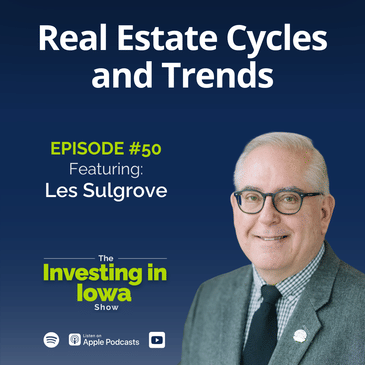
How do you make data work for you in real estate? In this episode, Les Sulgrove takes us through the metrics that matter most. From navigating "golden handcuffs" created by low interest rates to reading market cycles, he provides actionable insights on building long-term success in real estate. If you're looking to make data-driven decisions, this conversation is for you.
What you'll learn from this episode
-
Understanding the 10-year market cycle and how COVID-19 altered typical market patterns
-
How low-interest rate loans from previous years impact current inventory
-
An outlook on the 2025 real estate market
-
Key metrics in real estate for a clearer market view
-
Les' vision for more accessible statewide data through No Coast MLS
Resources mentioned in this episode
About Les Sulgrove
Les is an Iowa native born in Des Moines and raised in the southwest Iowa town of Bridgewater. He has been a resident of Des Moines since 1982 and has been married to his wife, Linda, for over 35 years. Together, they have three grown children 7 grandchildren and make their home on Des Moines' south side.
He has been a licensed REALTOR® since 1990 and is Vice President at VIA Group, REALTORS®. Les is the 2011 Past President of the Des Moines Area Association of REALTORS® (DMAAR) and received the award of Salesperson of the Year by DMAAR in 2007 for his involvement and service to the Association.
Additionally, he is active at the Iowa Association of REALTORS® and National Association of REALTORS®, currently serving on NAR Research Committee and NAR FPC to Iowa 3rd Congressional District US Representative Cindy Axne. He also owns and operates a national technology networking group called CyberProfessionals. This group of real estate professionals meets twice annually across the United States to learn from each other and share new marketing ideas with heavy emphasis on current and future technologies and their use in the real estate business.
Connect with Les
Connect with us
For more insights and updates, follow us on social media and visit our website: https://theinvestinginiowashow.com/.
[00:00:00] When inventory starts to grow and prices start to rise, the peak, which is obviously when the market's as hot as it's going to be, this downturn period where inventory starts to drop and prices start to drop and days on market stays a little longer. And then we hit this bottom. And that's the natural ebb and flow of a 10 year cycle.
[00:00:16] From cornfields to high rises, office to industrial, houses to hotels, and every other asset class in real estate, we cover the people, the projects, and the profit. Welcome to the Investing in Iowa Show.
[00:00:29] This show is for go doers, action takers, and business owners. It's for people like you who are sick of Uncle Sam taking a huge bite of your apple. If you're looking to get ahead of what's taking place in Iowa, learn who is doing what and how you can get in on the action. You're in the right place.
[00:00:47] Hosted by Neil Timmins, an Iowa native who has been involved in over $300 million in real estate right here in Iowa. Recording in studio from West Des Moines. Here's your host, Neil Timmins.
[00:01:01] I've got Les Solgrove here with me. Les, welcome to the show.
[00:01:04] Hey, thanks for having me.
[00:01:05] I'm excited you're here.
[00:01:06] Say, for the audience to say, who are you? Where are you from? What do you do?
[00:01:09] How far back do you want to go?
[00:01:12] As far back as you want to take us.
[00:01:13] I was born in Southwest Iowa. We're born in Des Moines. Grew up in Southwest Iowa, a small town. So I got a lot of those small town values in my blood. Moved to Des Moines in 1980 and started real estate in 1990. And from there, this is my real estate career.
[00:01:27] So what brought you to town?
[00:01:29] My wife and I got married in 1980 and she went to AIB and I started at South Ridge Mall. I was a little mall rat for four or five years.
[00:01:37] Yeah. How'd you stumble into real estate in 1990?
[00:01:40] It's interesting. A good friend of mine, Larry Sly, got to know him in the early eighties with Jaycees. And Larry was a realtor, still is a realtor. And I said, I'm looking for a house. And Larry's just like a dog and a bone. And he sold me the house next door to him and then told me. So we've become fast friends for years on that.
[00:01:57] You've got to remind Larry, he's required to disclose material adverse defects.
[00:02:01] That's right. Yes, absolutely.
[00:02:04] I think he was on the other side of my second personal home. So I've known Larry now. It's been years.
[00:02:09] Yeah.
[00:02:09] Is it about that one?
[00:02:10] Yeah. He's been in the business since the seventies.
[00:02:13] Okay.
[00:02:13] So yeah, it was the early eighties, but then 1990 looking for something different. And he said, real estate, Kogel Banker, Stambrough & Associates is where I started.
[00:02:22] So you got in and felt your way and figured your way out through the industry early on?
[00:02:26] Absolutely. Yeah.
[00:02:27] Like most agents, some agents either land and stay and others land and then they bump around. I was a bumper. I spent about 17, 18 years at the Remax franchises.
[00:02:38] Yeah.
[00:02:38] So that was my home for years. And then last few years before I took this other job, which I'm sure we'll talk about, I was with Ken Clark at Via Realtors.
[00:02:46] Yeah.
[00:02:47] Yeah.
[00:02:47] That's where you and I got to know each other the first time was back in the Remax system.
[00:02:52] Back in the Remax.
[00:02:53] Almost 20 years ago, we were reminiscing before we came on and go, oh my gosh, it has been that long.
[00:02:57] A lot of good people there. A lot of good people still there.
[00:03:00] No doubt.
[00:03:01] Yeah.
[00:03:01] Tremendous.
[00:03:02] Absolutely.
[00:03:02] What drew you into real estate? And I guess what kept you in real estate? I'm going to fast forward. We'll get to what keeps you in real estate in just a moment.
[00:03:10] Got me into real estate. I was working in the paper industry at the time, selling paper products. And then I was in the pre-press department at a printing press. And it's just, I love the sales side, but I wanted to get out and see people and get to know people. And yeah, you say this is a people job. It really is.
[00:03:26] And that's what really made me happy and scared to death to start out 100% commission and seem to do okay with it. I wasn't a major top end producer, but I wasn't a slacker. I was just making my living and meeting needs and having fun.
[00:03:42] Yeah.
[00:03:42] That's terrific. Now your career has really morphed over the years. You've always been a stat guy. You've always seemed to be drawn to that.
[00:03:51] It was because I got licensed in 90. We were just coming off of books. We were still using the books in early 1990s. And then I was involved in the early MLS computers businesses and the platforms. And so that's where a lot of that came from. And then, so numbers really hit me around 2000. And then 2006, of course, the mortgage meltdown and stuff. So that's when I really started to pay attention.
[00:04:15] It seems like that was the genesis. Yeah. All right. So you seem to pay attention. And where did that take you early on? What were you looking at? What'd you sink your teeth into?
[00:04:22] On the stat side?
[00:04:23] Yeah.
[00:04:24] Basically just inventory. Just how many homes are there for sale? How much are they selling for? Just the stuff that was hard to pull off of the MLS system. I'm just trying to make myself a more informed realtor. And the brokers that I work for love that information. Dabbled with trying to do some back end stuff and thought, you know what? No, this is for me and for agents. And it's been that way ever since.
[00:04:45] Yeah. You've always been a huge giver, a big sharer of information. And I know that's why so many agents, you resonate so well with so many agents because you are so collaborative in what it is that you do.
[00:04:57] A lot of several agents said, you should charge for what you do. We'd pay. I have yet to collect $1 for doing, this is a labor of love. And over time, I decided that if I'm not their competition, even though at the time I was selling houses, but if I'm not their competition, I'm providing them.
[00:05:15] Good information. They're going to do a better job in pricing homes and talking with their clients and I'll do a better job. So it was just my way of giving to the community and giving to the industry.
[00:05:26] You've evolved, significantly evolved well past just what do things price for and how long do they take to sell?
[00:05:34] Yeah.
[00:05:35] Talk to me about some of the more popular stats, the things that you get feedback on, and then maybe some of the more interesting and unique ones that you might pay attention to.
[00:05:44] So to set this up, I really had two mentors when I got into this as far as stat goes. Steve Harney from Keeping Current Matters. And Steve has recently passed away. He was a great man. Got me a better interest in kind of what to collect.
[00:05:56] And then, of course, NAR, Dr. Lawrence Hune. And we just had him here in October to the Iowa Association of Realtors Convention.
[00:06:03] And he was one of our guest speakers. And both of those individuals, I started to look at what they produce.
[00:06:08] And I said, OK, how can I relate what I'm seeing nationally or even statewide and bring it down to a local level?
[00:06:17] I'd say, OK, this is how many homes we have for sale in the nation or in the state. But how does that compare to the local market?
[00:06:25] And that's where I started to draw my stats from. And so your question was, what are some of the odd stats I pull that make me make this unique?
[00:06:33] I went beyond the number of homes for sale, the pricing, because that information is always good.
[00:06:38] But at the early stages, it didn't mean anything to say at the time we had 6,000 homes for sale back in 2008 or 2005 or 2006, whatever.
[00:06:48] It wasn't until I had about five years of data behind me. And I was doing this every single day.
[00:06:53] I'm an Excel spreadsheet junkie. I bring back to my Southwest Iowa roots where everybody down there was farmers and they had chores.
[00:07:00] This was what I considered a chore, my daily chores. And I didn't look at it as work.
[00:07:04] It was more of, let's collect this information. And then as time goes, I can look at those trends.
[00:07:10] So that's when a lot of the data I started to collect became more valuable because then we could start to project and see what's going to happen, the cycles, the spring, summer, fall, winter cycles over the years.
[00:07:22] So let's talk about cycles a little bit. Over the last handful of years and maybe coming out of COVID, have you been able to identify some of the cycles that are taking place?
[00:07:31] I'm wondering, a home buyer can identify when to strike? When is the best time period of the year to buy? A home seller, best time period of the year to sell?
[00:07:40] Instinctively, there's probably some answers there. And then maybe the last one, how investors can take advantage of the ebbs and flows.
[00:07:46] Some of that data should be able to better project what's taking place and instill greater confidence in the actions they're taking.
[00:07:52] Great question, because real estate goes through what we consider about a 10-year cycle. That's a buildup when inventory starts to grow and prices start to rise.
[00:08:01] The peak, which was obviously when the market's as hot as it's going to be, then there's this period of downturn period where inventory starts to drop and prices start to drop and days on market stays a little longer.
[00:08:12] Then we hit this bottom. And that's the natural ebb and flow of a 10-year cycle. Now, I say 10 years because we were in 2019, we were right at the edge.
[00:08:21] We were at a peak market.
[00:08:22] Right.
[00:08:22] And we had the most inventory we'd probably seen in a while. And we started to see pricing start to drop. And then, of course, COVID hit.
[00:08:29] And instead of the market bottoming out, instead, it just got its second wind.
[00:08:34] And we all know what happened in 2020 and 2022, those couple of years there where prices just went through the roof.
[00:08:41] Inventory, while inventory didn't rise, sell pendings.
[00:08:44] We put the most number of homes into contract in 2021, I think it was, at one time that we've ever seen.
[00:08:51] And that was-
[00:08:51] In history.
[00:08:52] At least one of, it has to be in history.
[00:08:53] Yeah, of the IOMs.
[00:08:55] Right.
[00:08:55] Correct.
[00:08:56] And those were the days, obviously, as well, when they were doing closings out on the hoods of cards because of masking and distancing.
[00:09:03] And closers were, escrow companies were hiring extra people because they were so busy.
[00:09:07] Those were valuable times because I learned about that we're not really in control of the real estate market sometimes.
[00:09:14] And as a realtor, you need to be flexible and follow along with what's taking you down the path.
[00:09:19] I've always said you never compete against the market. You only compete against other agents.
[00:09:24] Absolutely.
[00:09:24] So you take what the market gives you, and then you've got to figure it out.
[00:09:27] Absolutely. Yeah.
[00:09:28] So besides the standard stuff, one of the stats that's very popular is months of inventory.
[00:09:33] I was an old mentor from my first broker. His name was Harry Lewis, and he came from the grocery industry.
[00:09:39] And I was in the business maybe a year, and as a brand new agent, you go to open houses with these experienced agents.
[00:09:46] I won't call him older, but these experienced agents.
[00:09:48] And he tells you how you do business.
[00:09:50] And he described the real estate market as a grocery store and your home for sale are Kansas soup on the shelf.
[00:09:58] And depending on how many homes you have for sale, it's like how many cans of soup do you have and how long does it take you to sell out that inventory?
[00:10:06] And it was just one of those things that just stuck with me.
[00:10:09] And so months of inventory has been very interesting.
[00:10:12] Of course, that then defines whether we're in a buyer's market, which benefits a buyer, which is more than six months of inventory, a balanced market, which is that in-between number.
[00:10:21] And then the seller's market, which we're all familiar with the seller's market the last several years, because that's all we've really been in.
[00:10:28] But that's less than four months.
[00:10:29] So if no new listings come on the market today, in about 3.2 months right now, we'd be out of homes for sale.
[00:10:37] Right.
[00:10:38] Of course, that never happens because we're bringing inventory on.
[00:10:41] So that's a valuable number that agents really seem to love to see.
[00:10:44] Hey, Iowa investors.
[00:10:45] This is Ava Bauckamp, chief of staff at Legacy Impact Investors.
[00:10:49] Have you thought about adding real estate to your portfolio, but don't have the time or desire to play landlord?
[00:10:55] At Legacy Impact Investors, we do the heavy lifting.
[00:10:58] Our team finds the deals, manages the properties and handles all the day-to-day operations.
[00:11:03] Our select group of qualified investors co-invest with us, gaining ownership equity without opening a tenant email or responding to a maintenance call.
[00:11:11] They just share in the income, appreciation and tax benefits.
[00:11:14] These opportunities aren't for everyone.
[00:11:16] They are for qualified, accredited investors only.
[00:11:20] If you want to learn more, please visit LegacyImpactInvestors.com to apply.
[00:11:25] You take it one step further.
[00:11:26] You break that down by?
[00:11:28] By segments and also categories.
[00:11:31] Yeah.
[00:11:31] Categories you're calling single families.
[00:11:33] Single family versus condo townhomes.
[00:11:35] Yes.
[00:11:35] Or overall.
[00:11:36] So within the single family, I also break it down by new construction versus resale or existing homes.
[00:11:42] Because you really can't compare days on market unless you take the new construction out.
[00:11:48] You can't compare pricing unless you take the new construction out.
[00:11:51] And I don't want to ignore that.
[00:11:53] So I really have these five categories.
[00:11:56] Entire market, new existing, single family, and condo townhome.
[00:12:00] One of the ways that we utilize your data a few years back was exactly what you just said.
[00:12:04] What's a month of inventory?
[00:12:06] And then broken down by price segments in the single family space when we were doing a lot of flipping.
[00:12:11] So that we could identify what segment the price point is going to sell the fastest.
[00:12:16] So that we could target a list when we're buying direct.
[00:12:18] Absolutely.
[00:12:19] From home sellers, where do we actually want to place our bets?
[00:12:22] Yeah.
[00:12:22] I've basically helped you become good at analyzing predictive analytics, essentially.
[00:12:26] And that's true with any of them.
[00:12:28] Interestingly, the pricing or the breakdown by the price point, I do that on a monthly basis versus weekly because of just the amount of time it takes to crunch that.
[00:12:36] But that makes that end of month report very popular.
[00:12:39] And I always get it out within a day of the end of the month.
[00:12:42] That's another frustration I had when I started this was.
[00:12:44] In fact, I have an association of realtors right now.
[00:12:47] They release market stats.
[00:12:49] We're just now talking about September numbers and we're near the end of October.
[00:12:54] We're fixing that.
[00:12:55] Let me talk about that later.
[00:12:56] We're fixing that.
[00:12:57] But I was able to produce current numbers that are relevant to the market today, not 30 days ago or six months ago.
[00:13:05] Yeah, that's incredible.
[00:13:06] I can imagine that takes some significant labor to execute on that.
[00:13:10] It did in the early days.
[00:13:11] I've got it pretty well automated now.
[00:13:13] So AI comes to mind.
[00:13:15] Are you using it?
[00:13:16] How is it working in your world?
[00:13:18] Have you touched it at all?
[00:13:19] As far as producing the market stats, I have not.
[00:13:22] That or influencing anything on the statistical side?
[00:13:26] The only place I'm really using AI is because I record a weekly YouTube show and I'll take the transcript of my show and I'll dump it into chat GPT.
[00:13:35] I'll say summarize this and give me a three to four sentence promo and a good title because that's the area that I would say great week in real estate this week.
[00:13:46] And you say that four weeks in a row or a month in a row, it doesn't last.
[00:13:49] So the titles and AI comes in helps me a lot with that.
[00:13:52] As far as creating new graphics, I resisted that only because I don't think AI is there yet for what I want to do with it.
[00:14:00] I want your take on interest rates and the housing market.
[00:14:05] There is a tremendous segment of the population out there who have locked long-term fixed interest rates 15 or 30 years in at sub 4%.
[00:14:15] And I keep hearing, I read various articles and people talk about, hey, we have locked essentially a generation of home buyers out of the marketplace because unless interest rates fall and probably falls dramatically, a bunch of us's out there are never going to move.
[00:14:32] Not only have prices risen, interest rates have risen.
[00:14:36] Yeah.
[00:14:36] Right?
[00:14:37] Yeah.
[00:14:37] So you got a double whammy if you're ever going to go sell your house and you got a 2.5% interest rate and it's going to get replaced by whatever, a 6% plus interest rate today.
[00:14:47] Right.
[00:14:47] What do you think that looks like?
[00:14:49] I know we're going to a crystal ball here a little bit.
[00:14:51] What do you think that looks like on a forward basis?
[00:14:53] Do you think we're going to have significant lack of inventory at below the average cost of construction home?
[00:14:59] Construction will just build below that average cost.
[00:15:02] Yeah.
[00:15:02] Yeah.
[00:15:02] So what you described with the low interest rates and being a homeowner, I'm one of them myself right now.
[00:15:07] We call that in the industry having the golden handcuffs on.
[00:15:10] Sure.
[00:15:10] Because it doesn't make sense for me.
[00:15:12] I've got a four bedroom, two story.
[00:15:13] I'd love to sell that and downsize, but I'm going to have to pay more for a smaller house at a higher interest rate.
[00:15:20] So yeah, those are the handicaps.
[00:15:21] How are they affecting the market?
[00:15:22] I would say that you alluded to that a little bit about the lower price points underneath the new construction line.
[00:15:28] Right now we need entry level homes for sale to come onto the market.
[00:15:33] I think the last month, I think under a hundred thousand dollar price point, there were less than 75 or 60 houses in the metro for sale.
[00:15:41] And for somebody who got in the business in 1990, that was a hundred thousand dollar house sale for me back then was like a million dollars house sale for most agents.
[00:15:50] Man, I sold the house for over a hundred thousand dollars.
[00:15:52] That was a nice house.
[00:15:53] So today, a hundred thousand dollar house is barely a starter.
[00:15:57] It's a one to two bedroom, one bath, fixture upper and the investor side.
[00:16:04] What we need help with is we need probably the cost of borrowing money to come down to a point where some of these people like myself with the golden handcuffs feel like, okay, it's worth it now because I've got the equity in my current home.
[00:16:18] I can either buy down that rate to help offset that payment shock, but there has to be something for me to buy.
[00:16:24] And even though we're seeing inventory rise, we're almost at that magical 4,000 homes for sale.
[00:16:30] We're just bubbling underneath that.
[00:16:32] And we think, wow, 4,000, that's a lot of houses.
[00:16:35] But back in 2009, we had 6,000 houses for sale.
[00:16:37] I recall.
[00:16:39] And prior to that, days on market were, when I started, it was like 90 days on market was average.
[00:16:45] Today, if something's on the market for more than three weeks, they're firing you as an agent because you're not doing your job.
[00:16:51] And two weeks in, they're going, what's wrong with our house?
[00:16:53] And one weekend, they're going, how come we don't have multiple offers?
[00:16:56] Because they remember.
[00:16:57] Not so long ago.
[00:16:58] Short-term memory, but yeah.
[00:16:59] Correct.
[00:17:00] Talk to me about your work at Iowa Realtors.
[00:17:03] I was approached two and a half years ago by Gavin Blair.
[00:17:08] Gavin said, hey, I want to talk to you about coming to work with us at the Iowa Association.
[00:17:13] The Iowa Association of Realtors manages an MLS system of six different local boards around the state.
[00:17:20] And at the time, these were some of these local boards that were consolidated because back in the, about 10 or 15 years ago, there was a huge consolidation.
[00:17:29] There was like, I want to say 30 some boards around the state.
[00:17:32] We're down to 17 now.
[00:17:34] And a lot of these local boards, especially in the rural communities, didn't have the money or the efforts or the access to get into an MLS system.
[00:17:44] They were still running from books even while 15 years ago.
[00:17:48] And so the Iowa Association brought on this MLS service through Rapitone MLS at the time.
[00:17:55] And about five years ago, they switched over to a different platform and they incorporated the MLS side of the piece of the business and called it No Coast MLS.
[00:18:05] And they were looking for somebody to run No Coast MLS.
[00:18:08] And at one point, I don't know if they caught me at a moment of weakness or whatever.
[00:18:12] I said, okay, I'll talk to you.
[00:18:13] And so they hired me as the MLS director.
[00:18:16] I still have a real estate license.
[00:18:18] It hangs as active, but I don't sell.
[00:18:20] I can't sell on my position.
[00:18:22] So I am now truly not your competition.
[00:18:24] I said to him, I still have to be able to do the stats for Des Moines.
[00:18:28] I provide this.
[00:18:28] I have a following.
[00:18:29] It might seem like a little small following if you're a social media person.
[00:18:32] But for me, this is my passion.
[00:18:34] He says, absolutely keep going on that.
[00:18:36] I basically took on the duty of MLS director for this No Coast MLS.
[00:18:40] We have 1,200 agents in 47 counties, all of them predominantly rural.
[00:18:45] Many of them still don't use lockboxes.
[00:18:47] I hesitate to say if they still use the key bowl at the office, they come by and pick the key.
[00:18:52] But I know it happens.
[00:18:54] And I took that on.
[00:18:55] And the first year, I basically said, here, run the MLS.
[00:19:00] And I knew computers.
[00:19:01] I knew MLS and stuff.
[00:19:03] But I spent the time learning that particular system.
[00:19:06] This past year now, I have other things going on in our industry right now.
[00:19:09] I'm building great rapport.
[00:19:11] And the goal with No Coast MLS right now is to offer a data share solution.
[00:19:17] So I have a local board of realtors that basically it's called West Central.
[00:19:22] It covers all of Western Iowa and part of the southern Southwest Iowa with the exception of the Council Bluffs markets.
[00:19:29] And so my goal is to create what's called a data share between, for example, Des Moines and Southwest Iowa Board of Realtors.
[00:19:38] So we share our listings so that if you're a West Central board member, you log into your MLS that we provide.
[00:19:44] And you'll see all the data from both those different boards and vice versa.
[00:19:48] And that just opens up the markets to all these other brokers and agents.
[00:19:53] And currently, you can do that on your own.
[00:19:56] But you have to join two different MLS editors, maintain two different databases, make sure when you make a change in one, you're making it in both.
[00:20:02] And it just doesn't make a lot of sense to do that.
[00:20:05] We've done that.
[00:20:06] And so we're working on this data share program.
[00:20:09] And it's taken some time and a little bit of money.
[00:20:12] And we're working on rolling that out here.
[00:20:14] And it'll roll out where?
[00:20:15] Even beyond Iowa, we've got an interested party in Illinois that wants to data share.
[00:20:20] Now, we're not licensed in Illinois.
[00:20:22] We understand that.
[00:20:23] And they're not licensed in Iowa.
[00:20:24] But there's some value in having access to just the metrics of saying, okay, I'm going to refer an agent over to DeKalb, Illinois, for example.
[00:20:34] And if I'm an agent, I can then go on and I can look at the inventory that's over there and advise my client who the best agent is based on the sales that they're doing.
[00:20:44] Correct.
[00:20:44] And the brokerage.
[00:20:45] And so it's a service that's going to help you do a better job with your client referrals.
[00:20:49] Real estate's local.
[00:20:50] And more specifically, it's hyper-local.
[00:20:53] In your example, who's doing the best job over there?
[00:20:55] That can get hyper-local.
[00:20:57] In this price range, in this type of neighborhood, in this zip code, however granular one wants to get to go, that's my agent in this area that I'm looking for.
[00:21:05] Yeah.
[00:21:06] Or even within the state, the big concern is, Des Moines agents, I don't want somebody from Carroll to come over and sell a house in my market.
[00:21:12] They know nothing about our market.
[00:21:13] And the Des Moines agent knows nothing about the Carroll market.
[00:21:16] But you can build those referral relationships out there.
[00:21:19] And as the market gets tighter, agents do tend to sell a little bit farther.
[00:21:24] We're licensed across the state.
[00:21:25] Right.
[00:21:25] But I know agents that won't go from the south side to Ankeny.
[00:21:28] About the same respect.
[00:21:30] It's because it used to be 20 minutes.
[00:21:31] Now it's 45.
[00:21:32] That's right.
[00:21:32] That's right.
[00:21:33] So it keeps going.
[00:21:35] It's going to be near Ames before you know it.
[00:21:37] Yeah.
[00:21:38] Yeah, absolutely.
[00:21:39] If you're a house clipper, execute the birth strategy or do double closings and are in need of money.
[00:21:45] Little Guy Loans is your go-to lender here in the Des Moines area.
[00:21:49] Time is money.
[00:21:50] Loan approvals in 24 hours.
[00:21:52] Closings in five days.
[00:21:54] Little Guy Loans was founded by Neil Timmons, an investor just like you.
[00:21:59] Since he has been in over 10,000 homes in Des Moines, there's never an appraisal.
[00:22:04] Houses, multifamily, and commercial property loans up to $1 million.
[00:22:08] Check out www.littleguyloans.com.
[00:22:12] What are you most excited about looking forward to 2025?
[00:22:16] 2025 is going to be a better year.
[00:22:19] Remember I talked about cycles earlier.
[00:22:21] Yes.
[00:22:21] And I feel like we are at that bottom of that real estate cycle.
[00:22:25] We're basically on the point where we're going to start to pick up.
[00:22:27] I think we're going to see inventory.
[00:22:28] There's going to be some challenges because of the affordability of money.
[00:22:32] But I think we're on the point where we're going to start to see some people like myself with the golden handcuffs start to let go and say, but it makes sense now.
[00:22:41] I've enjoyed the equity buildup.
[00:22:43] I'm going to buy that smaller downsize home, which if I can find it, and I think I'll be able to find it.
[00:22:49] But that's also going to open up the markets up above.
[00:22:52] And another thing I'm excited about for 2025 is the Iowa Association is rolling out a brand new stats program that I've been working with.
[00:23:00] Because the stats we currently have around the state are great, but they don't tell the full picture.
[00:23:05] Because, again, the data sharing thing where you have two boards that are next to each other.
[00:23:10] One agent can't get on that system and the other one can't get in the other system.
[00:23:13] So they double enter the listing.
[00:23:15] So they get their quote unquote volume.
[00:23:17] When's the last time you went to a bank or to the grocery store and paid your groceries with volume?
[00:23:21] But they want their volume.
[00:23:22] That ends up with two properties in the MLS and it doubles up the stats.
[00:23:26] And our current provider doesn't have a mechanism to change that.
[00:23:29] So we're moving out to a statewide stats program that will be able to take it by local board, county, city, zip code, neighborhood.
[00:23:37] And agents across the state will be able to use this.
[00:23:40] And it's going to go hand in hand really with our data sharing options.
[00:23:43] So do you think that maybe as a result of some of the recent challenges in the NAR world, do you see things becoming flatter?
[00:23:51] What I mean by that is more data sharing, more collaboration inside of perhaps the associations, perhaps the MLS side of the business?
[00:24:00] I'd like to think so.
[00:24:01] I would say if this was 20 years ago, everybody at that point in time just said, this is my market.
[00:24:07] Show me your ID to get in.
[00:24:08] We're beyond that with the internet and with everybody being more mobile.
[00:24:12] And homebuyers, especially after COVID, they're moving out into the rural communities.
[00:24:16] They're crossing outside of the different boundaries that NAR has set.
[00:24:21] They're also better educated.
[00:24:23] Absolutely.
[00:24:24] I think back to the days when I started this business compared to the last handful of years when you converse with somebody.
[00:24:30] It doesn't matter what level, whether it's first-time homebuyer or 10-time homebuyer.
[00:24:34] There is the internet and all the resources, of course, that evolved over a period of time.
[00:24:37] I still remember when Zillow rolled out in its existence.
[00:24:40] Yeah.
[00:24:41] They're sharper.
[00:24:42] Zillow and Trulia at the time, which is now owned by Zillow.
[00:24:45] That was one of those factors as well.
[00:24:47] They come up with their Zestimates.
[00:24:48] And that's fine.
[00:24:49] It's an automated valuation model, an AVM.
[00:24:52] So I try to do something similar in our marketplace and compare that because some people say Zillow is accurate, the letter A in their name.
[00:25:00] And other people go, it's what I rely on because there's no other resources out there.
[00:25:04] So if we can provide good data, again, bringing better education to the clients and to the agents.
[00:25:10] You bring the best education to the agents.
[00:25:12] The agents are the ones who know those values best.
[00:25:14] And then ultimately the market's going to dictate what it's worth.
[00:25:16] Yep.
[00:25:17] Absolutely.
[00:25:17] So are you ready for the final three questions?
[00:25:19] Bring it.
[00:25:20] Good.
[00:25:21] All right.
[00:25:21] If you had one piece of advice for your 20-year-old self, what would it be?
[00:25:25] Real estate related?
[00:25:26] No, just in general.
[00:25:27] Any which way.
[00:25:28] However you choose to answer.
[00:25:29] Number one, because I'm getting up there closer to thinking about retirement would be sock away the best and sock away money.
[00:25:36] But make those relationships early and really find what you love and hone that as a passion and become an expert in that area.
[00:25:44] Two books that changed your life.
[00:25:46] This is funny because I've been asked this question before.
[00:25:48] And I used to brag that the only book I ever read was Charlotte's Web because I had my third grade.
[00:25:54] But Seth Godin is a guru out there, a motivational speaker.
[00:25:59] And he probably has both of the books.
[00:26:01] But the one that really comes to mind is The Dip that he wrote.
[00:26:04] And it's a great book because it talks about how if things aren't changing the way you want it to, you're stuck in a cul-de-sac.
[00:26:11] You need to get out and get up over that dip.
[00:26:13] And I love the analogy of that.
[00:26:15] I heard him live in San Francisco years and years ago, I think it was.
[00:26:20] And basically I've read all of his books.
[00:26:22] And when I say read, I'm an audiobooker.
[00:26:23] I don't know if I've got a dyslexia problem, but I can listen to books all day long.
[00:26:27] He's my best fan out there.
[00:26:28] His books are easy to consume too.
[00:26:30] They are.
[00:26:30] Yeah.
[00:26:30] I think it was Meatball Sunday.
[00:26:32] It was another one that was really good.
[00:26:33] And so those are probably industry books, marketing and that.
[00:26:37] Yeah.
[00:26:38] All right.
[00:26:38] If you were, I'm going to change this as I normally ask a guest just for you.
[00:26:43] If you were cast away on an island, you could only get three pieces of real estate data each and every month.
[00:26:48] Three pieces out of your report that you produce.
[00:26:51] What three things must you know to know how the market is here in, I'm going to call it central island?
[00:26:58] So I would focus on the trends of all these pieces of data.
[00:27:03] Okay.
[00:27:04] Because it's important to not just see the number today.
[00:27:06] These are trends.
[00:27:07] The number of homes per sale, the number of homes that are selling in a 30-day period, and the pricing, the sold pricing.
[00:27:17] If you knew the number of homes for sale, the number of homes sold in a 30-day period, could you predict pricing?
[00:27:24] The trajectory of pricing?
[00:27:26] I could predict the market activity.
[00:27:28] Mm-hmm.
[00:27:28] If you know the numbers, then you know where the activity is.
[00:27:32] If you start to see a rise in inventory, then my mind would go, then that probably is going to mean that pricing is going to go up.
[00:27:38] Or if it slows down, it's going to go down.
[00:27:40] Plus, this has been fantastic.
[00:27:42] I asked lots of questions.
[00:27:44] What's one question I did not ask that I should have asked?
[00:27:47] I can't think of anything.
[00:27:49] I got two dogs at home.
[00:27:51] That's how thorough you were.
[00:27:52] I have to revert to my dogs from six grandkids.
[00:27:56] For people, they want to find you, they want to follow you, they want to get the stat report and make sure they're on the monthly distribution list.
[00:28:02] Where can they go?
[00:28:03] What should they do?
[00:28:04] Best place to send them to is Des MoinesMarketValues.com.
[00:28:07] That's a fantastic website that I've created that basically when I produce these weekly market videos on YouTube, the YouTube videos stay out there on a history page.
[00:28:17] And you can go back.
[00:28:17] And, of course, you can subscribe from there to the YouTube channel.
[00:28:20] But I also, every time I do a show or if I come out with special market statistics, I put all the graphics out there on another page.
[00:28:28] And you're able to go back and take those stats and incorporate them into your marketing or into your decision making if you're a consumer.
[00:28:37] Again, I tell everybody frequently on my show, I am not your competition.
[00:28:42] Please take this information as you use it.
[00:28:44] Just don't alter it.
[00:28:45] Leave the attribution stuff around so that the MLS is happy with me, but use this and benefit from it.
[00:28:51] No cost.
[00:28:52] It's what I do.
[00:28:53] Links below in the show notes for everybody.
[00:28:55] Les, I sincerely appreciate you taking the time to connect.
[00:28:58] I appreciate the time.
[00:28:59] This is fun.
[00:28:59] I need to do more of these.
[00:29:00] You're always welcome back.
[00:29:17] Great guests make for a great show.
[00:29:19] If you know of another Iowan who would be a great guest or you yourself have interest in being a guest, well, get on our radar.
[00:29:26] Visit Investing in Iowa to fill out an application or recommend a guest.
[00:29:32] And if you want to connect with me one-on-one, go LegacyImpactInvestors.com.
[00:29:38] Click on the Invest With Us button in the top right corner.
[00:29:41] And there, you can pick a time for the two of us to get on the calendar and connect.
[00:29:45] Until next time, keep investing in Iowa.