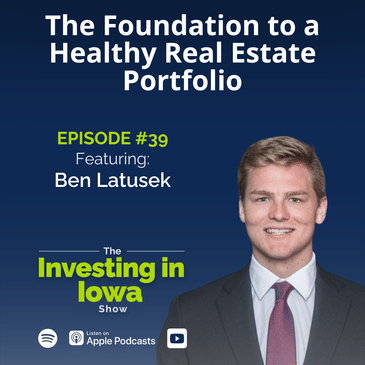
How do you turn a single duplex into a thriving real estate empire? Join Ben Latusek, a seasoned investor who's done just that. Learn the ins and outs of property management, value-add strategies, and crafting effective business plans. Discover practical tips on tenant relations, utility billing systems (RUBS), and maximizing property management software for greater efficiency, all from Ben's extensive experience.
What you'll learn from this episode
-
Why it's critical to have a clear business plan for each property
-
Commercial vs. residential property management
-
Ben's future outlook and market dynamics
-
An expert's personal advice for young investors
-
The value of community and networking in real estate
Resources mentioned in this episode
About Ben Latusek
Ben Latusek, owner of Synergy Property Management, is an EDP Engineer at John Deere, specializing in data analytics for the Integrated Technology team. A graduate of Iowa State University with a B.S. in Mechanical Engineering and an MBA in Finance, Ben was also a student-athlete in football, gaining leadership and teamwork skills. In 2022, he founded Latus Capital, a real estate investment company where he handles property management, financial analysis, and project management, offering investment opportunities for friends, family, and himself.
Connect with Ben
-
Website: Synergy Property Management
-
LinkedIn: Benjamin Latusek
-
Email: ben@synergypropmgmt.com
Connect with us
For more insights and updates, follow us on social media and visit our website: https://theinvestinginiowashow.com/.
[00:00:00] Patience. It's a virtue in this business. It's very easy to want to take down everything at once. But from my experience, slowing down, being patient, mapping out your investment or business goals and putting them into bite-sized chunks is the way to execute.
[00:00:16] From cornfields to high-rises, office to industrial, houses to hotels, and every other asset class in real estate, we cover the people, the projects, and the profit. Welcome to the Investing in Iowa Show.
[00:00:30] This show is for go-doers, action-takers, and business owners. It's for people like you who are sick of Uncle Sam taking a huge bite of your apple.
[00:00:39] If you're looking to get ahead of what's taking place in Iowa, learn who is doing what and how you can get in on the action. You're in the right place.
[00:00:47] Hosted by Neil Timmins, an Iowa native who has been involved in over $300 million in real estate right here in Iowa.
[00:00:55] Recording in studio from West Des Moines, here's your host, Neil Timmins.
[00:01:01] I've got Ben Latusik here on the show. Ben, welcome.
[00:01:04] Thank you.
[00:01:04] Thank you.
[00:01:05] I'm excited you're here. Say, for the audience's sake, who are you? Where are you from? What do you do?
[00:01:08] Yeah. My name is Ben Latusik, investor and property management business owner here in Des Moines.
[00:01:14] Started out investing in real estate here in Des Moines. Found a huge need and demand for good property
[00:01:20] management, not only on our own portfolio, but for investors in the market. Something I was
[00:01:26] passionate about. Started synergy property management, and that's what we're doing now.
[00:01:30] Nice. Tell me, what was your first property you were involved in?
[00:01:34] Yeah. Full circle. I started out, my initial exposure to real estate and investing actually came
[00:01:42] from my dad. He grew up on a farming family, but since then owned the farmland, managed the farmland.
[00:01:49] And so that really instilled in me the value of investing, what passive income, we all know it's
[00:01:55] not truly passive, but what the passive income and wealth generation can do for you. And during my
[00:02:02] college experience, I got the opportunity to start learning more about commercial real estate and
[00:02:07] things like that. And that led me to say, really interested in real estate and I know the value
[00:02:11] of investing and working alongside my dad. We started off with a duplex on the south side of Des Moines
[00:02:17] and grew into a couple other multifamily properties in Des Moines and now most recently office and
[00:02:23] retail in Adel and stuff like that. So we've expanded a little bit.
[00:02:27] What did you learn? The first couple of properties that you did, the duplex and then moving forward,
[00:02:31] what did you learn from doing that from either the remodeling side or the management side of
[00:02:37] the real estate? Yeah, I think the biggest thing I realized is in real estate, there's always a great
[00:02:47] opportunity to generate wealth through a business plan. And that can look very different depending on
[00:02:54] your property or depending on the asset class or can really alter very widely. And that first one we got
[00:03:01] was a duplex. That one was pretty much stabilized, pretty easy to step into. But the multifamily
[00:03:07] property, there's a lot of value add, it could say there. Not a huge lift, not like it was overly
[00:03:13] vacant or anything like that. But the opportunity to implement operational things like rubs and
[00:03:19] reducing vacancy and things like that, but also opportunity to improve the units physically with
[00:03:27] renovations and improvements. And to just bring that full circle to the business plan and real estate
[00:03:33] being a great asset is those net improvements in revenue or in income create incredible value. And
[00:03:41] especially as the numbers get bigger, that value increase gets bigger. And so I would say that's the
[00:03:47] biggest like aha moment for me as a young investor. Also just a ton of learning opportunities
[00:03:55] opportunities as I look at those properties. And like a lot of people say rubs as like a potential
[00:04:02] value add opportunity. But sometimes you go into these properties and you have a business plan
[00:04:07] and you're not 100% sure that business plan is going to work.
[00:04:11] Sure.
[00:04:11] And I've had opportunities like that where you go into it and it's a calculated risk with that
[00:04:18] kind of entrepreneurial spirit and it's worked out in our favor on that multifamily property.
[00:04:24] And so that's just taught me like the value of coming up with those business plans. And you don't
[00:04:32] always know 100% with surety that's going to work out, but there's a great opportunity there.
[00:04:38] I've always said the best operators are like Tom Brady. You go in, you practice these plays all week
[00:04:43] long. You have a business plan. And then sometimes you need to call an audible.
[00:04:47] Yep.
[00:04:47] Sometimes it's just for whatever reason, whatever it may be, but the winners know how to call an audible,
[00:04:53] shift, and ultimately find another strategy that gets them over the finish line, gets them to the
[00:04:57] end there if you will. Basically for the audience's sake, rubs in case those in the audience listening
[00:05:02] don't happen to know what rubs is. Elaborate on that for us.
[00:05:05] Yeah. So rubs, ratio utility billing system. It's a great opportunity to add value to a property
[00:05:14] where you have utilities that you have, for example, one meter, a shared utility payment process,
[00:05:23] whether it be one water meter, one electrical panel, and then multiple tenants are pulling
[00:05:28] their resources from that. There's many ways to go about it. You can do it manually. There's property
[00:05:34] management softwares that'll do it for you at this point. But essentially what happens there is you
[00:05:41] receive a bill and then you distribute it how you most see fit among tenants. And so the standard
[00:05:48] ways to do that are square footage on properties that are very alike. Number of occupants is another
[00:05:55] popular way to do it. When you get to like mixed use properties, there becomes a bit more nuanced
[00:06:00] based on usage of a commercial tenant versus a residential or a data center and just a retail store.
[00:06:07] So there's more nuance in those situations. But I would say it's low hanging fruit if it's not
[00:06:15] been implemented on a property. And I've not only done it on my own portfolio, but also as a property
[00:06:22] management business owner, I've worked to implement that on a portfolio that's over 100 units. And
[00:06:28] obviously there, that's a much larger, it becomes a true project. And there's a ton of teamwork and
[00:06:33] collaboration and things that go into it, but it's amazing. It also depends on the property,
[00:06:38] does it not? What comes to mind is a duplex where there's one water meter, one bill, and you got a
[00:06:43] duplex and each unit's identical. Oftentimes it's pretty easy to make a decision there. I'm thinking
[00:06:49] about the mobile home park, which we acquired just a few months back where we have 60 some odd
[00:06:56] occupied pads. We have one water meter, which we get billed for at the park level. And then there are
[00:07:02] 60, right? Each individual has their own water meter. So it requires us to actually go read those
[00:07:07] because it's not the city water meters, they're private water meters that we ultimately own the
[00:07:11] property. Therefore, we own the water meters. And we go back, read the meters, we bottle process for
[00:07:16] this and then bill them back. Hey, Iowa investors, this is Ava Bowkamp,
[00:07:19] chief of staff at Legacy Impact Investors. Have you thought about adding real estate to your
[00:07:24] portfolio but don't have the time or desire to play landlord? At Legacy Impact Investors,
[00:07:29] we do the heavy lifting. Our team finds the deals, manages the properties and handles all
[00:07:34] the day-to-day operations. Our select group of qualified investors co-invest with us, gaining
[00:07:39] ownership equity without opening a tenant email or responding to a maintenance call. They just share
[00:07:44] in the income, appreciation and tax benefits. These opportunities aren't for everyone. They are
[00:07:49] for qualified, accredited investors only. If you want to learn more, please visit LegacyImpactInvestors.com
[00:07:56] to apply. And that's a great, when you have the infrastructure there, it's a resource for you
[00:08:02] also to track and identify leaks or larger issues, which I think is obviously something you always
[00:08:12] need to be diligent with as you're managing property is utility bills. But that's a great example of an
[00:08:17] opportunity where you can monitor as well what, where something might be going wrong as well.
[00:08:22] There's no doubt. We're going through that process and I think we're about halfway through that
[00:08:26] project because when we bought it, we knew there were leaks. We need to monitor what's the usage
[00:08:30] and what's the bill and what's the delta between those two, right? And then the whole process unfolds
[00:08:34] about how do you identify those leaks? What do you do? What's the cure? Because you figuratively,
[00:08:39] you've got money just bleeding in the ground.
[00:08:42] Exactly. Yeah. Yeah. And you've got to, it probably takes a couple months to identify what's a good
[00:08:47] benchmark from there. You've got to identify how much is worth raising that red flag and saying,
[00:08:53] hey, this is worth more investigation and things like that. But that's all of what goes into that
[00:08:59] effective management and reducing those expenses to increase the bottom line for you.
[00:09:03] Your first property, a duplex, did you flip that or did you retain it as a rental?
[00:09:06] That one was in place for tenants. Great. Just stabilized. Got it in 22 when rates were low and
[00:09:14] everything cash flowed, honestly. And it was our first step into real estate from other investments.
[00:09:21] And so that was great. I personally purchased the one next door. I'm a house hacker as they call it.
[00:09:27] Another thing I can't recommend enough to young people who want to get involved in real estate is
[00:09:32] house hacking one to four units. You have that opportunity to get a lower interest rate from
[00:09:38] the bank, but also you can get fixed term debt and just a great opportunity. We've since moved out of
[00:09:44] that, filled it up, got great debt and moved to the next one where we're doing the same thing all over
[00:09:49] again. Now, at some point you have the bug for property management, which not a lot of people do.
[00:09:54] Yeah. Tell us a little about that.
[00:09:57] Yeah. Like I said, I started out investing. We decided we were going to self-manage our properties.
[00:10:03] Sure.
[00:10:04] And that was just a no-brainer for us. I come from an engineering background. I have a very can-do
[00:10:12] attitude. And so it was never like, let's just get a property management. Let's figure it out. Let's do
[00:10:17] it. And it's that mindset. And along that journey, I just truly started enjoying it. And I started
[00:10:23] identifying that there's a business here that I've implemented systems that are valuable within my
[00:10:30] own property management and portfolio that are beneficial for others and people hadn't really
[00:10:38] identified or thought of. And really the moment in my head was, I was working on looking at a potential
[00:10:45] syndicated deal with some other investors and just the property management fees. And when you get to
[00:10:52] those larger properties, not only the fees, but knowing that you have a trusted partner there
[00:10:57] that you can execute on a deal with other people's money. You have to be 100% confident when you're
[00:11:04] going to move forward and the abilities of a manager to work in that aspect. And I knew I had that ability
[00:11:11] from my prior experiences. And it became like a no-brainer to me from that perspective.
[00:11:16] And the other aspect of that is I have a long-term mindset in the Des Moines metro market as well.
[00:11:24] And property management probably isn't the get rich quick scheme in the real estate world.
[00:11:30] That's right.
[00:11:30] And I knew I loved the Des Moines metro. I know I'll be here for a long time. I know I'll be investing
[00:11:37] here in a long time. And I know I'll generate relationships with other real estate investors
[00:11:41] in this market as well that want to stay here and want to hold assets long-term. And all of that
[00:11:47] requires great property management. And so for me, that was the light bulb moment. I started Synergy
[00:11:55] Property Management. Now we're about six months in. Obviously manage my own portfolio and then have a few
[00:12:02] other clients. We're about 130 units that I'm managing, whether it's full stack property management,
[00:12:09] accounting, leasing, tenant relations, or also have clients where they have employees in place.
[00:12:17] And it's filling that role of manager of employees as well and taking on that aspect as well.
[00:12:23] Yeah. It sounds like fair to say you'd often see that in an apartment situation.
[00:12:27] Very much so. Especially large multifamily. There's opportunity to just hire an onsite
[00:12:33] maintenance guy or an onsite leasing manager. So that's where you see it a lot.
[00:12:38] This has been a unique model though, that we took from large multifamily and extrapolated to a large
[00:12:45] portfolio. And it's worked really well. And it's been a great opportunity for me. And it's improved
[00:12:51] that portfolio as well. So what makes a property manager a great property?
[00:12:55] Yeah. I think the way I would lay it out is, first off, you have to be very operationally and
[00:13:03] systems focused. So like I said, my background was engineering, data analytics. And so naturally,
[00:13:11] my mindset worked really well in the world of property management. And so from that perspective,
[00:13:19] I think that's very important. There has to be methods of tracking everything you're doing as a
[00:13:24] property manager. Because I've been on the other side as an investor. And if I'm going to trust someone
[00:13:31] to operate my asset, I need to know that those things are being tracked. And there's a why behind
[00:13:40] the action. And that can be explained. And that just can't happen without efficient processes and
[00:13:46] ways of collecting the information that goes through an operation. So I think that's a huge aspect.
[00:13:53] Communication will always be huge in the world of property management, whether it's
[00:13:58] tenant relations or with owners. You have to be able to navigate not only just financials with owners,
[00:14:06] but emotions, not owners and tenants alike. There's a ton of emotions within it. You have to
[00:14:13] be able to have those tough conversations and to speak in very different situations. You speak
[00:14:19] differently to a tenant than you do a vendor. You speak different to a vendor than you do an owner
[00:14:24] and all of those things. And I think this is like a value of synergy property management. And
[00:14:29] I call it grit. It's not something you measure, but in property management, there becomes a time where
[00:14:36] you're like, if we're going to go execute what needs to be executed within a business plan or within this
[00:14:43] month, we just have to commit to it. We've got to bring the team together, develop that camaraderie
[00:14:50] and go tackle it. And so that's the third one, in my opinion.
[00:14:54] What separates a good property owner? So I'm talking about investor from a bad one.
[00:14:59] Property owner and investor from a bad one.
[00:15:02] I think it starts from the very beginning when you're underwriting a property, when you're looking
[00:15:06] at a property.
[00:15:09] I'll be more specific. What separates those two, a good or bad one, as it relates to the
[00:15:14] interaction on the property management side?
[00:15:16] Yeah. I think there's very different ways to be a good owner in relation to their property
[00:15:24] management company. I think a good owner from a property manager's eyes, if they're going to be
[00:15:31] active, which certainly want an active owner, they also need to, as we look at bringing on clients,
[00:15:38] they have to be committed to the property management company and know that not everything's always going
[00:15:45] to go maybe the right way, but you can rely on the effort we're putting in and the systems that
[00:15:52] we're implementing are with intentions of maximizing the benefits of your property.
[00:15:59] And I think it's, I think I look at it as a partnership. There's got to be that understanding
[00:16:05] and willingness that when something goes wrong, we're together. We're not against each other.
[00:16:10] We're trying to raise the waters together. So I think that's a big part. And then you've got
[00:16:15] investors that they're not as active. They don't want to be as active. They are pursuing a profitable
[00:16:21] job. That's great for them pursuing their own business. And they want to put money into real
[00:16:25] estate. And those owners are good owners, but we just communicate differently. And it's sending them
[00:16:33] the report, making sure that upfront, we're aligning on like a business plan that this is maybe a buy and
[00:16:39] hold, and it's a place to put money for tax benefits and things like that. And that's different from an
[00:16:44] active investor who might be looking for positive cash flow and executing a business plan quickly and
[00:16:50] things like that. And I think what I'm saying there is that there's many ways to go about real estate
[00:16:56] investing. And so just as many ways as there are about going about real estate investing, there's as
[00:17:02] many ways to be a good owner and it depends on what you're trying to accomplish.
[00:17:07] You mentioned earlier about, you recently bought a commercial property.
[00:17:10] Yeah.
[00:17:11] If you're a house clipper, execute the burst strategy or do double closings and are in need of
[00:17:16] money. Little Guy Loans is your go-to lender here in the Des Moines area. Time is money. Loan approvals
[00:17:23] in 24 hours, closings in five days. Little Guy Loans was founded by Neil Timmons, an investor just like
[00:17:30] you. Since he has been in over 10,000 homes in Des Moines, there's never an appraisal. Houses,
[00:17:37] multifamily and commercial property loans up to 1 million. Check out www.littleguyloans.com.
[00:17:45] Yeah. So great opportunity. I love Adel within the Des Moines metro, smaller suburb,
[00:17:51] growing like crazy. My family recently moved there. My mom opened a business there.
[00:17:57] And so it's where we've put our roots within the Des Moines metro. And as an investor,
[00:18:02] I spent a lot of time going to brokers looking for deals. And this was my mom's running her
[00:18:07] business. And the owner says, Hey, I'm ready to sell. And I'm ready to do it on seller financing
[00:18:12] with great terms. And so one, I think that shows the value of relationships and strong relationships,
[00:18:19] even if it's not me, but my family with the owner and the landlord there. And so we got 10,000 square
[00:18:27] foot, four tenant strip mall in Adel right off of highway six, 10 year term, three, 3%.
[00:18:35] That great. You can't turn down those types of terms. It was our first dip into retail,
[00:18:41] commercial retail. We've found our core values. They translate between asset classes. And that one
[00:18:48] is, I'd say about 20 to 30% below market rent. And so we've got some fixed term leases there
[00:18:54] that are hopefully going to be coming up and we'll be able to do that lease to market. And that would be
[00:19:00] great for us from there. And then we came to the closing table on that one. And he said, Hey, I think
[00:19:05] I'm ready to sell my other one. And so we got another 5,000 square feet of office on that one.
[00:19:13] Little different seller finance terms, but nonetheless still great. And that one, we were actually able to
[00:19:19] pretty close to market, but we had about an extra 800 square feet that wasn't being utilized.
[00:19:25] We worked with the city. We worked with contractors. We're adding an extra 800 square foot that was just
[00:19:33] inhibited based on the previous leases there to make it another leasable space. So we leased that up
[00:19:39] and added the address, added the unit, that whole business execution there. And so those have been
[00:19:46] great. And just to go back to Adel from the chamber of commerce there, from what I, from what they said,
[00:19:52] they're bringing in 30 new households per month. So when you talk about key demographics that make
[00:20:01] you excited about somewhere to invest, population growth, job growth, that population one is growing
[00:20:08] rapidly as the metro expands in that direction. So we're super excited about that.
[00:20:14] How's property management been different for you on the commercial side versus the residential?
[00:20:18] I've actually had a broker joke to me. Watch out. Once you move to commercial property management,
[00:20:24] you're not going to want to go back to residential. And every time I'm put on my commercial property
[00:20:32] management hat, I think of that and I just smile because it's so true. It's business tenants.
[00:20:39] It's, I don't want to call it transactional. It's not transactional, but it's a numbers game.
[00:20:45] It's a, it's always logical and you're able to have those, those type of conversations with commercial
[00:20:53] tenants. And so that part from a tenant relations perspective comes a lot easier to someone who
[00:21:01] understands real estate and things like that. The other aspect though, that is a little bit more
[00:21:07] complex. You've got commercial leasing is if, if residential is just a small boat, you can turn it
[00:21:15] quickly. You can lease it up really fast. There's tons of demand. Everyone needs a place to live.
[00:21:20] Commercial leasing, not the same specifically in the past. Since COVID really office has taken a huge
[00:21:26] dip. It's rebounding a little bit. Retails, you know, they're those general high scale things,
[00:21:33] but as long as you stick to your ability to lease at high levels, keeping that up really well.
[00:21:39] And then handling those tenant relations when it comes to modifications, that's another huge aspect
[00:21:44] of leasing in the commercial space is giving the business owner what they want. And between you and
[00:21:51] the owner, the business owner and the building owner, that's another aspect of leasing is that
[00:21:57] negotiation of modifications and things like that as you come into a lease. But I look at it as a lot
[00:22:04] more work in your leasing cycle, but then you secure a three, a five, a 10 year lease. And then it's like
[00:22:12] hands off. And that's the biggest difference I think I've identified.
[00:22:17] As you look forward to next year, 2025, what do you want us to excite her about?
[00:22:21] First off from a market perspective, I think everyone's been waiting for what's going to happen
[00:22:27] with the 2020 dead and the low rates and see some of that here and there. I'm excited to see where that
[00:22:33] continues into 2025. I think Des Moines is a hot market. There never really was much of a drop,
[00:22:40] but just to continue to see how some of those dynamics fare. Very excited about that from an
[00:22:46] investment perspective. From a property management perspective, like I said, I love this business.
[00:22:52] Most people don't. I'm passionate about it and I'm excited just to continue to connect with investors,
[00:22:59] build my business and take that to the next level and continue to grow my skillset as the
[00:23:04] business evolves as well. Now, for you, why Iowa? You could do what you do anywhere,
[00:23:09] choose to be here, chose to put your roots down in Adele. Why Iowa?
[00:23:14] Yeah. If you would have asked me that a couple of years ago, I would have said, yeah, why?
[00:23:18] I originally, growing up, never thought I would stay in Iowa. I was born and raised here.
[00:23:24] But really, the real estate market, specifically in the Des Moines metro, is fantastic. We talked about
[00:23:32] those demographics that are very important, such as population growth and job growth. They're both
[00:23:38] incredible in the Des Moines metro. I think it's the largest growing metro over 500,000 in the Midwest.
[00:23:45] And so that's very positive. You still have sub markets even within Des Moines that are very cash
[00:23:52] flow friendly. And then you've also got the appreciation markets, which I think is really
[00:23:57] unique and exciting about Iowa. And you're starting to see a lot more of these national
[00:24:06] companies and retail tenants come to Des Moines. And it's just further proof that what's going on here
[00:24:14] is drawing attention from other investors. And when those large scale companies are doing that,
[00:24:20] it can make the small investor rest assured that what they're doing is correct too.
[00:24:24] A lot of exciting things taking place here in the state.
[00:24:28] Yeah, absolutely. Ben, you ready for the final three questions?
[00:24:31] Yeah, let's do it. If you had one piece of advice for your 20-year-old self, what would it be?
[00:24:38] I'd say patience. I think it's a virtue in this business. It's very easy to want to take down
[00:24:46] everything at once. But from my experience up to this point, slowing down, being patient,
[00:24:53] mapping out your investment or business goals, and putting them into bite-sized chunks
[00:24:57] is the way to execute. And if you're not patient, you're going to want to get ahead of yourself and
[00:25:02] try to do too many different things. And patience, absolutely for me. And then also,
[00:25:07] real estate is a patience game, right? You're never going to, at least up to this point,
[00:25:11] you've never seen lack of success as long as you can sit down and hold it for a long enough time.
[00:25:16] So patience for sure.
[00:25:18] Two books that changed your life.
[00:25:20] Big one for me, like I said, as that analytical can-do attitude was who not,
[00:25:26] how can.
[00:25:26] Sullivan.
[00:25:27] Yep, Dan Sullivan. Delegation is key, especially as you become a business owner and you want to
[00:25:32] focus on those highest value activities. And so who not, how has been a huge one.
[00:25:37] Another one I'm reading now, stress to success. His last name's Paul. He's a property management
[00:25:43] business owner in the UK. And he talks, he's just very taking systems and processes, which I think
[00:25:50] a lot of people understand, but a lot of people don't understand how do you take that from a system
[00:25:56] and process on a board or in a computer and apply it to human resources and really just bringing
[00:26:03] together and creating a heartbeat for your company. And so that's one I definitely recommend that I
[00:26:09] haven't heard of other people talk about, but I'm just loving that right now.
[00:26:13] Fantastic. Great recommendation.
[00:26:16] All right. If you were cast away on an Island for a year, you can only get three pieces of data
[00:26:20] about your business each and every month. What three things must you know?
[00:26:24] I would say occupancy is the big one. I think that's very standard. If I was on that Island for
[00:26:33] a long time, I'd want to know leases coming due. I think that's a big one for my, if you're operating
[00:26:39] in fixed term leases, which not everyone does, but you can start to see when things are coming up.
[00:26:44] And then the next month I'll see how did we do on leasing it up or lack thereof.
[00:26:48] And then from the bottom line perspective, I like profit per unit. So I think that's when I
[00:26:53] really like to look at it makes it takes away the highs and the lows and almost an average
[00:26:59] perspective profit per unit. It's a big one. And that's one I took from Logan Rankin. He's a huge
[00:27:04] investor based out of Green Bay and he owns like 4,000 units himself. And it's crazy and he's great.
[00:27:10] And that's his core metric. Yeah. That's a great one.
[00:27:15] Ben, I've asked lots of questions. What's one question I did not ask that I should have asked?
[00:27:19] I think you got it. I think you got it all. There's nothing that comes to my mind right now.
[00:27:24] I appreciate this conversation and this podcast has been great as I've listened to some of them too.
[00:27:30] There's a lot of great people who you've been able to bring into this and
[00:27:35] really prop up investing in Iowa, which is awesome. There's a, there's a true,
[00:27:39] we live in a fantastic state and we've got tons of great people that are here, tons of great
[00:27:44] operators. I appreciate it if you took the time to come in here and chat a little bit.
[00:27:49] Yeah. Really appreciate it.
[00:27:51] For people that want to find you, they want to follow you, they want to connect with you,
[00:27:53] where can they go? What should they do?
[00:27:55] Yep. So Synergy Property Management, our website is synergypropmgmt.com.
[00:28:01] If you're interested in our property management services, you can reach us there. You can find
[00:28:07] me personally on LinkedIn. That's just my personal name, Ben Latusik. That's where I would say I'm the
[00:28:13] most accessible. My email is ben at synergypropmgmt.com. And always happy to talk real estate, whether it's
[00:28:22] situations like this, grabbing coffee, meetups and things like that. I love it. I love the networking
[00:28:28] aspect of this industry. All the links are below in the show notes for everybody. Ben,
[00:28:33] thanks for being here. Thanks, Neil.
[00:28:34] Thanks for listening.
[00:28:36] If you're enjoying the show, may I ask a favor of you? Naturally, subscribe so you never miss an
[00:28:40] episode. But would you rate and leave an honest written review on Apple Podcasts? It does a lot
[00:28:46] for us here at the show and I appreciate reading your thoughts. Great guests make for a great show.
[00:28:52] If you know of another island who would be a great guest or you yourself have interest in being a
[00:28:57] guest, well, get on our radar. Visit Investing in Iowa to fill out an application or recommend a guest.
[00:29:04] And if you want to connect with me one-on-one, go LegacyImpactInvestors.com. Click on the Invest
[00:29:11] With Us button in the top right corner. And there you can pick a time for the two of us to get on
[00:29:16] the calendar and connect. Until next time, keep investing in Iowa.