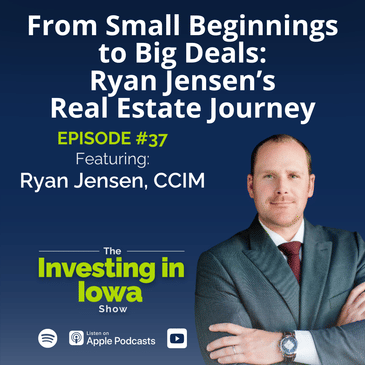
From small-town beginnings to leading real estate investments, Ryan Jensen, CCIM's journey is nothing short of inspiring. Join us as he shares how he overcame the 2008 recession and financial setbacks to thrive in the multifamily, industrial, and hospitality sectors. Get ready for deep insights into syndication, creative financing, and finding deals in blue-collar markets!
What you'll learn from this episode
-
An overview of Compounding Capital's syndication strategy
-
Major upsides of industrial and hospitality investments
-
The main complexities of financing hotels
-
How Ryan's modest upbringing shaped his approach to investing
-
Expert tips and tricks for young entrepreneurs
Resources mentioned in this episode
About Ryan Jensen, CCIM
Ryan Jensen, CCIM, began his commercial real estate career in 2007 with Hubbell Realty and joined CBRE in 2008, providing tailored real estate solutions for clients. As a top producer at CBRE, Ryan has been involved in over a billion dollars in transactions and consistently ranks among the top five for production volume. In response to growing interest from his network, Ryan co-founded Compounding Capital with Ted Oswald in 2020, offering accredited investors access to a portfolio of hospitality, industrial, and NNN properties. Compounding Capital allows investors to benefit from real estate ownership without the operational complexities.
Connect with Ryan
-
Website: Compounding Capital Holdings | CBRE
-
LinkedIn: Ryan J. Jensen, CCIM
Connect with us
For more insights and updates, follow us on social media and visit our website: https://theinvestinginiowashow.com/.
[00:00:00] The numbers sell themselves. Every investor on the brokerage side has their own thresholds for whether it's a cash on cash return, a global ROI over the whole period, whatever it is, right? They try to mitigate the risk and every profile is a little bit different.
[00:00:12] From cornfields to high rises, office to industrial, houses to hotels, and every other asset class in real estate, we cover the people, the projects, and the profit. Welcome to the Investing in Iowa Show. This show is for go-doers, action takers, and business owners.
[00:00:29] It's for people like you who are sick of Uncle Sam taking a huge bite of your apple. If you're looking to get ahead of what's taking place in Iowa, learn who is doing what and how you can get in on the action, you're in the right place.
[00:00:43] Hosted by Neil Timmins, an Iowa native who has been involved in over $300 million in real estate right here in Iowa. Recording in studio from West Des Moines, here's your host, Neil Timmins.
[00:00:56] I've got Ryan Jensen here on the show. Ryan, welcome.
[00:00:59] Hey, thank you, Neil. Great to be here.
[00:01:00] I appreciate you being here. Say, for the audience's sake, who are you? Where are you from? What do you do?
[00:01:04] Yeah, Ryan Jensen grew up in Indianola, Iowa, just south of the metro here, Warren County kid.
[00:01:10] Went to a small school in Northeast Iowa, Upper Iowa University in Fayette, which is a great school for me, kept me out of trouble.
[00:01:18] And pretty much live in Des Moines since then. I work, I've been Senior Vice President at CBRE, been at CBRE Broker for since 2008.
[00:01:27] So a long time, selling investment properties, primarily multifamily.
[00:01:31] And then I own a company with a partner, Ted Oswalt, called Compounding Capital Holdings.
[00:01:37] And we are a real estate syndication company that works with accredited investors to buy real estate here across the state.
[00:01:43] You have been around for some time.
[00:01:46] Yeah, I feel like I've been around a long time, but I still learn something every day.
[00:01:50] So it tells me I haven't been around long enough.
[00:01:52] Isn't that the truth?
[00:01:53] Yeah.
[00:01:54] That's the nature of the business. How did you end up in this business in the first place?
[00:01:58] That's an interesting story. The only time I haven't lived in Iowa, I lived in Colorado.
[00:02:02] And I got an internship in Colorado Springs working for the Major League Baseball Players Alumni Association.
[00:02:08] So my dream, I played baseball, Division III, I wasn't that good.
[00:02:11] But my dream was to always work for a Major League Baseball team. I just love baseball.
[00:02:15] So I had a degree in marketing, got this internship, which I was very lucky to get.
[00:02:19] Moved to Colorado Springs, got to meet a ton of Hall of Famers.
[00:02:23] Toured NORAD with Fergie Jenkins and Bob Feller.
[00:02:26] It was just a super cool experience.
[00:02:29] I grew up pretty poor.
[00:02:31] And so I worked as a bartender at night to pay my rent and all that kind of stuff out there because I just didn't have any money.
[00:02:36] So I just didn't work two jobs, whatever.
[00:02:37] I moved back to Iowa because I needed to go do this training in Oregon, which cost $5,000.
[00:02:42] So I moved back to Indianola where I grew up and I walked into Aspen Athletic Club and said, hey, I need a job for three months to save five grand so I can go do this training.
[00:02:51] And they're like, sweet, you're hired to sell memberships.
[00:02:54] And that was when the health club business was just kicking off.
[00:02:56] Yeah.
[00:02:56] It was like early 2000, 2002 probably.
[00:02:59] And anyways, long story short, I was making really good money selling memberships.
[00:03:04] And I was like, thought to myself, okay, I'm going to go do this training.
[00:03:08] And it might take to make the money I'm making now.
[00:03:10] I'll be 10 years into my marketing position at whatever major league baseball team is.
[00:03:14] And so I just made the decision to stay in the fitness business.
[00:03:18] Fitness business is awesome.
[00:03:19] I met Rod Sears, who used to own Aspen.
[00:03:21] Sure.
[00:03:21] Still a very good friend of mine to this day.
[00:03:24] And actually, yeah, talk to him all the time.
[00:03:26] But working at Aspen, I grew up, ended up running the Southside Club, then ran the Hickman Club for a long time.
[00:03:32] While I was at the Hickman Club, it's amazing how many successful people go to the gym.
[00:03:37] Sure.
[00:03:37] Doctors, lawyers, real estate brokers, real estate developers.
[00:03:41] I got to meet the Marcus Pitts, Eric Grubb, Jeff Stambrose of the world back then.
[00:03:47] And I saw these guys wearing Rolexes and prepaying for memberships.
[00:03:51] I'm like, holy smokes, they must be doing pretty good in this real estate business.
[00:03:55] And so at the time, I was getting divorced.
[00:03:57] Or my wife, I shouldn't say, I hadn't been divorced yet.
[00:03:59] My wife at the time said, hey, you're working too many hours.
[00:04:02] You need to get a new career.
[00:04:03] We're going to get divorced.
[00:04:04] I said, okay.
[00:04:05] So I got a job working at Iowa Carpet One selling flooring.
[00:04:09] So before I took that job, I called Stambrose and Grubbs.
[00:04:12] Hey guys, if I go sell flooring, will you guys buy flooring from me?
[00:04:16] I just need a built-in client.
[00:04:17] He goes, yours?
[00:04:17] No, yeah, we'll try to work with you.
[00:04:19] I'm like, okay, cool.
[00:04:20] So I went over there, sold a little bit of flooring.
[00:04:22] I actually sold the Marsh job, which is the biggest job company ever sold.
[00:04:25] But I just did not like the industry.
[00:04:27] So I hired a recruiter to find me a job in real estate.
[00:04:30] They did.
[00:04:31] They found me a job at Hubble.
[00:04:32] Started at Hubble in 2007, working with Dan Dutcher, who went on to be the academic development director
[00:04:38] in Waukee for a long time, but he had been in the business forever.
[00:04:41] Awesome guy.
[00:04:42] And I was managing their commercial land portfolio, basically trying to sell their commercial land
[00:04:45] around all their residential developments, right?
[00:04:48] So that was 2007, like late 2007.
[00:04:50] So it should happen in 2008, right?
[00:04:52] About nine months later, my boss gets fired and I just see the writing on the wall.
[00:04:56] Yeah.
[00:04:57] And Kyle Gamble, I had built a relationship with him.
[00:04:59] He was the main director of CBR Hubbell at the time and came down and said, listen,
[00:05:03] do you want to get to work?
[00:05:04] We'd love to have you join the team.
[00:05:06] And at that time, I was getting divorced.
[00:05:08] I literally was moving into my buddy's basement in Norwalk with my daughter who lived in a walk-in
[00:05:13] closet that was about eight by eight.
[00:05:15] I mean, we did this for five years, but I met with the power brokers, the Dingles, the
[00:05:19] Melangs and all those groups, Kurt Mom and all those guys.
[00:05:22] Should I be doing this?
[00:05:23] They're like, no, you're an idiot to do this.
[00:05:25] It is the worst possible time ever to get into brokerage.
[00:05:28] But I said, I just made the decision.
[00:05:30] I wasn't going to go work at Wells Fargo.
[00:05:31] I wasn't going to be a corporate guy.
[00:05:32] My mind does not work that way.
[00:05:34] I take direction.
[00:05:35] We don't take orders very well.
[00:05:36] Anyway, so I said, I'm going to be a broker.
[00:05:38] Moved in my buddy's basement and the rest is kind of history.
[00:05:41] How did you, so 2008, you decided to become a broker.
[00:05:44] How did you survive?
[00:05:46] Because a lot of people didn't.
[00:05:47] I didn't.
[00:05:48] Hell, I truly, my success is not because I'm super smart.
[00:05:52] It's because of the people that I've had in my life that have been placed in my life.
[00:05:57] Some have come in and out and some have been in my life forever.
[00:06:00] I had a good friend who basically let me live rent-free in his house.
[00:06:05] Now, I was racking up an IOU that was pretty substantial.
[00:06:09] But man, he bought me groceries.
[00:06:10] He took me to the bar and bought drinks.
[00:06:13] I made five grand my first, six grand my first year in real estate.
[00:06:17] First year, six grand.
[00:06:18] I think I made 15 the second year.
[00:06:20] And it was like 30 something the third year.
[00:06:22] Dude, how do you not quit?
[00:06:24] Because everybody's listening is going, how do you not quit?
[00:06:26] I mentioned I grew up core.
[00:06:27] My entire life mantra is break the cycle.
[00:06:30] And I was the first person in my lineage to ever go to college on either side.
[00:06:34] I would just say that I grew up, I would say just pretty white trash, right?
[00:06:37] Just my mom's amazing.
[00:06:39] Never really said, hey, you should go to college.
[00:06:40] Going to college, I got a letter from Upper Iowa one day.
[00:06:43] The night after I had a dream I was going to be a townie.
[00:06:46] And this is no joke.
[00:06:47] I had a dream I was a townie, jumping ditches and drinking natural ice, doing the same dumb
[00:06:52] shit I was doing in high school.
[00:06:53] And I got a letter from Upper Iowa that next day.
[00:06:55] I went and signed up that weekend.
[00:06:56] And it was like a week before college.
[00:06:57] You just got a marketing letter in the mail.
[00:06:58] Yeah.
[00:06:59] That was a seed.
[00:07:00] And you're like, okay.
[00:07:01] Yep.
[00:07:01] Yeah.
[00:07:01] That was it.
[00:07:02] So break the cycle.
[00:07:04] It's getting my mantra, create generational wealth.
[00:07:05] I just truly believed in myself, I think.
[00:07:07] And when everyone was telling me to quit, to stop, just go get a job at Wells Fargo or
[00:07:13] wherever, it just fueled the fire more just to say, I'm going to prove to you I can do
[00:07:19] this.
[00:07:19] And the hard work pays off.
[00:07:21] And yeah, it's been a wonderful ride.
[00:07:24] I learned a lot during that time about myself, about the people I surround myself with and
[00:07:30] a lot about real estate because when there weren't really deals happening, I wasn't doing
[00:07:34] deals.
[00:07:35] I was spending every dollar I had in gas, driving the market, learning the market, building
[00:07:38] databases, trying to build relationships.
[00:07:41] And I was driving a 1993 Nissan Altima that had a leaky manifold.
[00:07:45] So that fucking thing smoked, right?
[00:07:47] So I feed a stop sign and I've got a suit on, right?
[00:07:50] And I just smell like smoke because there's smoke coming in.
[00:07:52] And I'd park behind a building, walk around to meet a client or whatever.
[00:07:55] But yeah, just perseverance and really having the belief that if you're doing what you think
[00:08:01] are the right things to get where you want to go and having a long-term vision, right?
[00:08:05] If you're, a lot of people are short-term, they want quick money, they want quick-
[00:08:08] Today.
[00:08:09] Today.
[00:08:09] And I, for whatever reason, I've always had a long-term prospect on everything I've ever
[00:08:14] done, whether it's marriage or whether it's raising children or whether it's real estate.
[00:08:18] Yes, you look at the today, but you have to have an entry strategy, but you also have
[00:08:23] to have an exit strategy.
[00:08:23] An exit strategy often is a long proposition, right?
[00:08:26] Yeah.
[00:08:26] So I've always been able to think that way.
[00:08:29] Oftentimes in real estate, it's you do the work today to get paid a different day.
[00:08:33] Hey, Iowa investors.
[00:08:34] This is Ava Bauckamp, chief of staff at Legacy Impact Investors.
[00:08:38] Have you thought about adding real estate to your portfolio, but don't have the time or
[00:08:42] desire to play landlord?
[00:08:43] At Legacy Impact Investors, we do the heavy lifting.
[00:08:47] Our team finds the deals, manages the properties, and handles all the day-to-day operations.
[00:08:52] Our select group of qualified investors co-invest with us, gaining ownership equity without opening
[00:08:57] a tenant email or responding to a maintenance call.
[00:09:00] They just share in the income, appreciation, and tax benefits.
[00:09:03] These opportunities aren't for everyone.
[00:09:06] They are for qualified, accredited investors only.
[00:09:09] If you want to learn more, please visit LegacyImpactInvestors.com to apply.
[00:09:14] Or never get paid.
[00:09:15] Or never.
[00:09:15] Yeah, correct.
[00:09:16] In brokerage, CBRE, there's deals that'll take two or three years put together that are
[00:09:20] very fruitful.
[00:09:21] There's deals you work on for two years that just die, that you never get paid on.
[00:09:25] It's the nature of the beast.
[00:09:26] And that's what makes it so fun.
[00:09:29] Was there something that clicked at one point?
[00:09:31] You get three years in.
[00:09:32] Is there a catalyst?
[00:09:33] Did the market chose?
[00:09:34] Did you chose?
[00:09:36] What happened to the point where you're like, okay, now I'm using success in quotes, right?
[00:09:42] Yeah.
[00:09:42] I feel like, okay, I've got my legs under me, if you will.
[00:09:45] And then you've obviously positioned on the backside of that to thrive.
[00:09:50] Yeah.
[00:09:50] Yeah.
[00:09:50] I mean, there really was a catalyst.
[00:09:52] And the catalyst was my first investment deal.
[00:09:55] It was a mini storage deal I did on my own.
[00:09:58] And when I was putting the financials together and doing the underwriting for that, I'd never
[00:10:02] really done it before.
[00:10:03] I'd done some leasing and just really anything I'd get my hands on early in my brokerage
[00:10:06] career.
[00:10:07] And I did that deal and I just thought to myself, wow, I truly want to enjoy that process.
[00:10:14] And secondly, I really understood it.
[00:10:16] My mind, it just clicked.
[00:10:19] So I went to some brokers in the office that were very successful in the capital markets
[00:10:24] investment lane and said, hey, listen, I just did my first investment deal.
[00:10:28] It really, something clicked with me on this.
[00:10:30] And I'd like you guys to work with you guys and help you guys grow your investment team.
[00:10:34] And so that created a five-year partnership with that group.
[00:10:38] And I learned a lot working with those guys, Tim Sharpe and Linda Gibbs, both what to do,
[00:10:43] how to manage transactions, how to manage attorneys, how to manage bankers, because that's really
[00:10:47] what we are as glorified babysitters.
[00:10:49] And you're just managing higher level people who don't really give a shit about what you
[00:10:53] think.
[00:10:54] And anyway, so I learned how to manage a transaction successfully.
[00:10:57] That's the key to a broker.
[00:10:58] You got to control your client and you got to understand how to move the pieces of the
[00:11:02] puzzle into the right place.
[00:11:03] And that is oftentimes the lender, the appraiser, the attorney, and sometimes the other broker
[00:11:08] because although we have a lot of really excellent brokers in this market, they're not all.
[00:11:12] I totally understand that.
[00:11:14] The investment piece, I've been managing it.
[00:11:16] It's different than selling something else.
[00:11:18] And an owner is a building, for example.
[00:11:20] Investments are largely unemotional, largely, or they should be.
[00:11:24] How about that?
[00:11:25] Yeah.
[00:11:25] Largely numbers and data driven.
[00:11:28] And as long as you can get a velocity to deal flow, it's about being there and being a strong
[00:11:32] communicator and managing transaction to get it through because inevitably there are bumps
[00:11:37] along the way.
[00:11:38] Yeah.
[00:11:39] And I've always said, I don't sell real estate.
[00:11:41] The numbers sell themselves.
[00:11:42] Every investor on the brokerage side has their own thresholds for whether it's a cash on cash
[00:11:48] return, a global ROI over the whole period, whatever it is, right?
[00:11:52] They try to mitigate the risk and every profile is a little bit different.
[00:11:54] What we do, what we try to do on the brokerage side is put together real numbers, not selling
[00:11:59] on Performa, not selling on Blue Sky.
[00:12:01] These are the real numbers.
[00:12:03] Here's the true condition of the asset.
[00:12:04] And then when you can educate someone on what that asset is, they buy it or they don't buy
[00:12:10] it, right?
[00:12:10] It works or doesn't work.
[00:12:11] And we found that's been a very, that's been my philosophy brokerage is you don't really
[00:12:15] sell real estate.
[00:12:16] You help people understand the financials and then the property condition, and then they
[00:12:20] buy real estate.
[00:12:20] And then hopefully you help them buy more real estate.
[00:12:23] Yeah.
[00:12:23] And that's the benefit of the investment world, isn't it?
[00:12:26] Is that everybody's looking for the next deal.
[00:12:28] There's so much capital out there, it's chasing your return.
[00:12:31] So as long as you can be in the middle of that path, if you will, quality investment properties,
[00:12:37] you can work forever.
[00:12:39] Everybody's chasing you.
[00:12:39] Yeah.
[00:12:40] And you have the relationships with the owners and that's where you focus.
[00:12:44] And then when they're ready to transact, hopefully they trust you to help them maximize the
[00:12:48] value of that asset in the market.
[00:12:49] Compounding capital.
[00:12:50] So you don't just broker stuff, you obviously, but sooner or later you acquire dollars of your
[00:12:54] own and it's got to replace someplace.
[00:12:56] Yeah, yeah, yeah.
[00:12:56] What do you, tell me a little about that and tell me the types of things you guys invest
[00:12:59] in.
[00:12:59] Yeah.
[00:13:00] Yeah.
[00:13:00] So compounding capital, my partner, Ted Oswald and I, who owns TNL properties started
[00:13:04] in, I want to say our first deal was in 2020.
[00:13:07] And it came out of a catalyst where I had a lot of folks that I knew that were very successful
[00:13:12] in other industries and said, Hey, Ryan, can we invest in real estate with you?
[00:13:17] And I had never really invested in real estate.
[00:13:19] I always truly just tried to be a fiduciary broker.
[00:13:21] And so when it came time to investing, starting compounding capital, our first deal wasn't even
[00:13:25] compounding capital.
[00:13:26] There was a Fairfield Marriott 207 Crocker in downtown Des Moines.
[00:13:30] That was my very first real estate deal.
[00:13:32] And I always believed that I didn't want to do, and there's nothing wrong with this.
[00:13:35] I didn't want to flip a house.
[00:13:36] I didn't want to do a small deal.
[00:13:39] A lot of that was because I saw what happened with people in rental housing when they owned
[00:13:44] one house or two house and they hired a manager because I didn't have time to do that.
[00:13:47] It just, all the margins are sucked away.
[00:13:49] So I just stockpiled money where I could go do a big boy deal on my first deal.
[00:13:54] So that was our first deal.
[00:13:55] And from there, Ted and I built this business.
[00:13:58] We acquired a couple of daycares in 2020 and 2021, like absolute net deals at pretty good
[00:14:04] cap rates, obviously attractive rates.
[00:14:06] And then we acquired 110,000 square foot industrial, vacant industrial building, actually, the home
[00:14:11] run deal down in Burlington.
[00:14:13] I like industrial a lot too on the investment side.
[00:14:15] I like industrial and really solid blue collar labor markets.
[00:14:19] I love Burlington, Cedar Rapids, Waterloo, Cedar Falls, those markets.
[00:14:23] Always demand.
[00:14:24] There's always labor.
[00:14:25] You can't build a meatpacking plant in Des Moines and get the staff to work there.
[00:14:29] And so I try to look at those metrics when we're looking at deals.
[00:14:32] And that was a vacant deal we bought before we ever closed.
[00:14:35] We had a tenant in hand.
[00:14:36] They put 20 million bucks into a building we paid three and a half million for.
[00:14:39] That's a big tenant.
[00:14:41] That'd be a pretty good deal for us there.
[00:14:43] We still own that one.
[00:14:44] And then we just did our first ground up, true ground up Marriott in Norwalk.
[00:14:48] They just opened last week.
[00:14:50] Congratulations on that.
[00:14:51] Yeah.
[00:14:52] Why would tell us?
[00:14:52] What attracted you to that space?
[00:14:54] Yeah.
[00:14:55] Two things.
[00:14:55] One, it's very similar to operating an apartment complex.
[00:14:58] And I really, I have a cell apartments for a living.
[00:15:01] I understand the day-to-day operations of and fundamentals of that.
[00:15:04] And it's not much different outside the corporate piece of Marriott or whatever that flag is.
[00:15:10] You just turn a unit daily instead of once a year or whatever that is.
[00:15:14] But fiduciarily, I didn't want to be in the multifamily investment world because I sell
[00:15:19] apartments for a living.
[00:15:20] I just always thought that would contradict what I'm trying to do on the brokerage side.
[00:15:23] So that was the initial piece.
[00:15:25] But also my chance when we, I called Ted when we bought that downtown building.
[00:15:29] It was a Mercy office building.
[00:15:31] And I called Ted and I said, hey, Ted, we're going to buy this building downtown.
[00:15:34] He said, what the fuck are we going to do with it?
[00:15:36] Right.
[00:15:37] I was like, I said, I don't know yet, but we're going to go buy it.
[00:15:40] So we went down to-
[00:15:40] It's a good basis.
[00:15:41] That's what it sounds like.
[00:15:42] Yeah.
[00:15:42] It was a good basis.
[00:15:43] Yeah.
[00:15:43] I think we paid two and a half million for it.
[00:15:45] Okay.
[00:15:45] Make an office building downtown.
[00:15:46] Yeah.
[00:15:47] It was a pretty good buy itself.
[00:15:48] Yeah.
[00:15:49] And what was awesome on that deal was Mercy was building their campus with Frank Levy further
[00:15:55] down the street on Crocker, right?
[00:15:57] That brand new Mercy, their seat facility and housing and all that.
[00:16:00] And they were moving their offices there.
[00:16:02] So we had 18 months of due diligence.
[00:16:04] And so I said, we're just going to put under contract.
[00:16:06] And we have literally forever.
[00:16:08] If we lose 50 grand or whatever, because we give the deal up, because we have to have
[00:16:11] some hard money along the way.
[00:16:12] So be it.
[00:16:13] It's just too good of a deal to not try to take down.
[00:16:16] And so we figured that multifamily with that time was getting starting to get a little
[00:16:19] overbuilt downtown.
[00:16:21] Multifamily wasn't the right play.
[00:16:22] And we just thought, hey, let's a hotel would make a lot of sense here with the event center
[00:16:26] that there's multiple economic drivers.
[00:16:27] Right.
[00:16:28] And so that's what we did.
[00:16:30] So that's how I got into the hospitality business.
[00:16:32] So I'd say by chance, but also by design a little bit.
[00:16:36] So that required a conversion from an office to a hotel.
[00:16:41] What did you learn in that process?
[00:16:43] Conversions are cool.
[00:16:44] If the bones of the building are good and the bones of that building, tilt up concrete,
[00:16:49] steel frame, the really good column spacing for what we needed the building for.
[00:16:53] Sure.
[00:16:54] It creates a really cool hotel or apartment or whatever it is you're converting it to because
[00:16:59] it's not your typical prototype, right?
[00:17:01] Correct.
[00:17:01] So what I learned in that is that you can do something really cool with an old building.
[00:17:04] I can't say I learned anything drastically new about real estate.
[00:17:07] I learned a lot about the Marriott process as well, which helped in our Norwalk deal.
[00:17:12] But just learn that you don't be afraid of an adaptive reuse project because that's carrying
[00:17:16] force at the time.
[00:17:17] Sure.
[00:17:17] Yeah.
[00:17:17] All right.
[00:17:18] So you go to Norwalk and do a ground up deal.
[00:17:20] What did you learn there that was different?
[00:17:23] Because those are very different construction processes.
[00:17:25] Yeah.
[00:17:25] Yeah.
[00:17:26] And so on that one, I was really hand in hand with Marriott and our GC and our operator
[00:17:31] that was involved with some of that process.
[00:17:33] But learned a lot about the FF&E component of a hotel, which you go into a hotel room and
[00:17:40] you think, oh, there's, you got a coffee filter.
[00:17:42] You got your little cups that hold the coffee.
[00:17:44] I mean, you got, there's a million moving pieces to the FF&E component.
[00:17:49] And there's real money.
[00:17:50] And there's real money.
[00:17:50] Yeah.
[00:17:51] I think our FF&E package in Norwalk was like 1.6, 1.7 million.
[00:17:56] How many doors?
[00:17:57] Or 79 keys.
[00:17:58] Keys.
[00:17:58] Okay.
[00:17:58] So it's a lot per key.
[00:18:00] Yep.
[00:18:00] And that includes bedding and all the furniture and lamps and whatever.
[00:18:03] Everything.
[00:18:04] And the order for all the coffee and all the sugars and all the little holders for all
[00:18:08] that stuff was like 150 grand.
[00:18:10] Yeah.
[00:18:10] It just adds up pretty quickly.
[00:18:12] And so I learned a lot about that process and also learned a lot about the Marriott process
[00:18:15] because we weren't as involved in the construction of our downtown one as we were in the Norwalk
[00:18:20] one.
[00:18:20] And yeah, just overall learned a lot about the hospitality business and how to build a hotel
[00:18:26] ground up.
[00:18:26] How's financing for a hotel different than financing for multifamily is not a fair?
[00:18:32] That's not fair.
[00:18:32] You got Fannie Freddie.
[00:18:34] You got the best finance commercial financing that exists probably on the planet situated
[00:18:38] in multifamily housing.
[00:18:39] But let's say against a traditional commercial loan.
[00:18:42] It's difficult because hospitality is not like the darling investment class.
[00:18:47] And it's purely difficult in markets like Des Moines where we don't have a largely diverse
[00:18:53] economic drivers, right?
[00:18:54] We don't have 50 economic drivers to a hotel in this market.
[00:18:57] So you really have to, one, it's relationship-based lending truly is.
[00:19:02] And South Story Bank did this deal in the Norwalk for us and they were absolutely amazing
[00:19:05] to work with.
[00:19:06] And they understood our vision, why we're doing it there, why we thought that the market
[00:19:11] needed it, et cetera.
[00:19:12] So they bought into our story and then they helped us achieve it, right?
[00:19:16] But it's very difficult.
[00:19:17] And when we were doing that deal, we were in a rapidly rising rate environment.
[00:19:21] Sure.
[00:19:21] That's when rates went from three and a half to four and a half.
[00:19:23] And then they were five and five and a half, then to six.
[00:19:26] And we were locking our financing for this deal.
[00:19:28] We're supposed to sign loan docs closing on land on a Monday.
[00:19:32] Maybe it's a Tuesday, can't remember.
[00:19:33] Then there's a Fed meeting that next day.
[00:19:35] And I was talking to my lender.
[00:19:36] I'm like, listen, I think the Fed's going to do something that might benefit us.
[00:19:40] Let's wait 24 hours and see what happens.
[00:19:42] I think rates were like 625, something like that.
[00:19:45] Next day, next morning, 8 a.m.
[00:19:47] Rates drop.
[00:19:48] So we locked in 585 on that deal for construction perm.
[00:19:52] So we got a little bit lucky kind of playing the Fed.
[00:19:55] It was just tough.
[00:19:56] We talked to a lot of lenders.
[00:19:57] A deal that size is tough for local lenders because you're looking at a $10 million loan.
[00:20:01] And some banks have a capacity of 5 million.
[00:20:04] Then you got a participator, you know, 6 million.
[00:20:06] So find this single source financing mechanism that buys in, that trusts you, that trusts you can actually complete the deal.
[00:20:14] First ground up deal.
[00:20:15] How does Ryan Jensen know how to do this?
[00:20:16] You just don't know.
[00:20:18] You're taking a little bit of a gamble.
[00:20:18] So they just, they believed in us.
[00:20:20] And we have a good track record with other assets and whatever.
[00:20:23] And so it was difficult.
[00:20:23] We talked to probably 15 lenders and we had literally two proposals.
[00:20:27] Maybe three.
[00:20:29] Your favorite asset class.
[00:20:31] If you're a house clipper, execute the burst strategy or do double closings and are in need of money.
[00:20:37] Little Guy Loans is your go-to lender here in the Des Moines area.
[00:20:41] Time is money.
[00:20:42] Loan approvals in 24 hours.
[00:20:44] Closings in 5 days.
[00:20:46] Little Guy Loans was founded by Neil Timmons, an investor just like you.
[00:20:50] Since he has been in over 10,000 homes in Des Moines, there's never an appraisal.
[00:20:55] Houses, multifamily and commercial property loans up to 1 million.
[00:21:01] Check out www.littleguyloans.com.
[00:21:04] My favorite asset class is to own a home.
[00:21:06] Yeah.
[00:21:08] We're going to stick on the ownership side because inside the ownership side, you mentioned hotels, you mentioned industrial, you mentioned straight triple net deals on the kids side of things, right?
[00:21:19] Yeah.
[00:21:20] I like industrial a lot and I like hospitality.
[00:21:24] I truly do.
[00:21:25] I think the hospitality market's gone through bloodbath the last five years.
[00:21:30] There hasn't been a lot of capital.
[00:21:32] The big replayers haven't bought anything.
[00:21:35] They haven't really developed anything that's starting to come back, obviously, because we have ADRs that are going through the roof.
[00:21:40] We have occupancies going to the roof.
[00:21:42] And so I think the next five years is going to be really strong value growth in that sector of the markets.
[00:21:47] I'd like to build another hotel or two.
[00:21:49] I like industrial because I only like industrial in literally blue collar markets.
[00:21:54] Smaller town industrial where I can get a good basis, whether I'm building it or buying it.
[00:21:58] And I'm in a place where it's got to be a functionally, not a functionally obsolete building.
[00:22:01] There's a lot of industrial out there that you can buy that's 15 foot clear.
[00:22:04] I wouldn't touch it.
[00:22:05] Right.
[00:22:05] I don't care how cheap it is, whatever, because it's functionally obsolete today and it's going to be even worse in 10 years.
[00:22:11] So we want 20 plus foot clear.
[00:22:13] If we can get 25, 26 foot clear, great.
[00:22:16] 30 foot clear, even better because there's so many different industrial markets change a lot from the developer perspective and also the occupier perspective.
[00:22:23] 10 years ago, you had two or three types of industrial users, right?
[00:22:27] Correct.
[00:22:28] Warehousing, manufacturing, and an owner user basically, right?
[00:22:32] And today there are hundreds.
[00:22:35] Far more versatile.
[00:22:36] Of different occupiers for that space.
[00:22:38] And so that's one of the things I really like about industrial.
[00:22:40] How does Airbnb compete with you?
[00:22:45] The short-term rentals and also do you find that it's market specific, right?
[00:22:50] I can imagine if you're in Manhattan, that applies very differently than you're in Des Moines.
[00:22:56] Yeah.
[00:22:56] I don't see Airbnb hasn't really, hasn't created a problem for us or a real challenge for us in this market because there's not a lot of them.
[00:23:02] Sure.
[00:23:03] And hotels are a lot like retail.
[00:23:05] So when you think about when you travel and where you stay, generally it's right next to an attraction or where you're going to spend most of your time on that particular trip, right?
[00:23:13] Or in a central located where you can get to where you need to go easily.
[00:23:16] So how Airbnb has changed the hotel industry is pretty dramatic.
[00:23:20] It's changed a lot.
[00:23:21] And a lot of it comes down to compared to multifamily because what was being built 10 years ago, multifamily was pretty basic generic boxes, right?
[00:23:29] And today you have office space within that apartment complex.
[00:23:33] You have all these crazy amenities and the hotel market is changing like that so it can compete with the Airbnbs.
[00:23:39] And that's primarily in larger markets, right?
[00:23:41] Where there's not a lot of, there's my brother lives in Laguna Beach, for example.
[00:23:44] I'd love to build a hotel in Laguna.
[00:23:46] It would take me 20 years to do it because of all the bureaucracy to do it.
[00:23:50] But there's only three hotels in Laguna.
[00:23:51] It's the most expensive place I've ever stayed in the entire world.
[00:23:54] And I've traveled a lot.
[00:23:55] If I get in that's renting a house or a hotel or whatever, it's crazy.
[00:23:59] So markets like that, Airbnbs do really well.
[00:24:01] Markets like Iowa, Airbnbs I think are attractive for someone who's here on a long-term stay.
[00:24:07] Yeah.
[00:24:07] But for someone who's here for a week or a weekend or whatever, they're going to stay at the hotel that's closest to whatever it is they're doing.
[00:24:12] What's the average length of a stay at a hotel?
[00:24:15] Boy, I honestly don't even know that number for our hotels.
[00:24:18] I think most of our guests are probably two nights on average.
[00:24:21] And we do have people that are here for a week, like they're in a state fair.
[00:24:23] Sure.
[00:24:24] Like during the political cycle events with all the new stations and that kind of stuff that are here longer.
[00:24:29] But I'd say probably two nights.
[00:24:30] How did growing up the way you did impact who you've become and what you do today?
[00:24:35] Yeah, no, that's a really good question.
[00:24:36] Growing up with very little means and let's just say a very little insight to what the real world really was.
[00:24:43] I grew up in this little bubble where that's all I knew.
[00:24:46] And so how that impacted me was it's made me a very conservative investor.
[00:24:50] It's made me one of my greatest fears is being poor again.
[00:24:54] Right.
[00:24:54] And so I really am very cautious when I'm doing deals, even if it's a smaller deal.
[00:25:00] I just want to make sure that all the metrics work and all the data supports my decision to acquire that asset or build that asset.
[00:25:07] It's made me very conservative.
[00:25:09] It's made me very humble.
[00:25:10] I feel very fortunate to be where I'm at today from where I started.
[00:25:15] And it's made me very appreciative of the opportunity and actually of the people in Iowa.
[00:25:19] Iowa is a great place to be an entrepreneur because there are people here that truly care about your success and want to help you succeed.
[00:25:29] And as I mentioned earlier, when I was living in a basement, I didn't get through that just because my own mental toughness or my own will.
[00:25:35] It was the support that I had from my mom, my close friends, and even my daughter as she was getting older, like six and eight.
[00:25:42] It's just, it's made me a really, I think a really logical thinker.
[00:25:46] Yeah.
[00:25:47] I think it just, it's given me a good backbone to build a business on.
[00:25:50] Yeah.
[00:25:51] You ready for the final three questions?
[00:25:52] Sure.
[00:25:52] Yeah.
[00:25:53] If you're ready.
[00:25:53] If you had one piece of advice for your 20 year old self, what would it be?
[00:25:58] It would probably be not to be scared of doing, taking risk because I didn't have a lot.
[00:26:06] I think I could have taken some risk earlier in my career and been a little bit farther ahead than what I am at now.
[00:26:10] And I think I had a lot of fear.
[00:26:12] I want to start company capital was an idea I had in 2000 and I don't know, 12, pretty early high brokerage career.
[00:26:19] And I should have started it then.
[00:26:20] We'd probably be a billion dollar company.
[00:26:22] I didn't because I was scared.
[00:26:23] And so I think if I could eliminate the fear that I had as a 20 year old kid to go do deals and I had the knowledge, but I was fearful.
[00:26:31] People didn't think I had the knowledge, right?
[00:26:33] Cause I was so young.
[00:26:34] So that's what I would do.
[00:26:35] That's the.
[00:26:36] You're saying, I want to quantify what you just said.
[00:26:38] You said taking risks, right?
[00:26:40] And what I hear you saying is with dollars, putting deals together.
[00:26:42] Cause I would argue then 2008 to join the brokerage industry and make six grand and then make double that.
[00:26:50] The next year was tremendous risk.
[00:26:52] It was, but I think I, when I wanted to start a syndication company again, and there were, we could have bought a lot of multifamily or whatever in that 2012 to 2015, 16 timeline before cap rates really decompressed and all that kind of stuff.
[00:27:06] So I think, and that's the risk of going out and saying, Hey, I'm going to start compounding capital now.
[00:27:11] I'm going to go get, even though I didn't have all the resources I have now, I'm going to go find those resources with people that know me and trust me and go start buying these assets.
[00:27:19] And that's the risk which I would have taken sooner.
[00:27:21] Yeah.
[00:27:21] Because you, in that scenario, you deliver resources to the deal that aren't dollars, right?
[00:27:27] That are the expertise to be able to put the deal together.
[00:27:30] Correct.
[00:27:30] Which oftentimes is way more challenging, way more difficult than just finding the money.
[00:27:34] Correct.
[00:27:35] The finding the money is not very hard.
[00:27:37] Finding the deal and then executing the deal are two different things.
[00:27:40] Yeah.
[00:27:40] Two books to change your life.
[00:27:41] Yeah.
[00:27:42] Neil, I'm not a huge reader.
[00:27:44] I've read half of a lot of books, half of a lot of books.
[00:27:47] So there's two things that one book I'd say that really did change my life.
[00:27:51] And then it's not the Bible, but it's a book called the story.
[00:27:54] The Bible is very confusing to me.
[00:27:56] My faith has been very, one of the backbones of my strength is to get through some of the adversity I've gone through.
[00:28:01] It's been my faith.
[00:28:02] And the story, and I can't remember who wrote it, but it's a book that basically there's no Bible verses in it, but it takes the Bible and puts it in chronological order.
[00:28:11] So a dumb guy like me can read it and understand what the Bible actually means.
[00:28:15] So that book was really impactful for me and my faith because I had a hard time reading the Bible.
[00:28:20] And that was a great book.
[00:28:21] Outside of that, again, I've read half of every book you probably read.
[00:28:25] I've read half of.
[00:28:26] I just get bored reading books.
[00:28:28] I read a lot foreign affairs.
[00:28:30] I read a lot of political stuff.
[00:28:31] I read a lot on other markets.
[00:28:34] My reading is more like research data stuff.
[00:28:36] And that's where when I'm sitting at night watching TV or whatever, I'm reading market data.
[00:28:41] I'm scrolling through what's going on in China.
[00:28:42] What's the oil market look like?
[00:28:43] What's crypto doing?
[00:28:44] Sure.
[00:28:44] So that's the reading I do.
[00:28:47] If you were cast away on an island for a year, you can only get three pieces of data about your business each and every month.
[00:28:54] Yeah.
[00:28:54] I'll let you define your business however you want to.
[00:28:56] Sure.
[00:28:57] Yeah.
[00:28:57] All right.
[00:28:57] What three things must you know each and every month?
[00:28:59] Yeah.
[00:29:00] I'll stick to the ownership side just because on the broker side, that's a long list of things I need.
[00:29:04] Sure.
[00:29:05] On the ownership side of things, I need our financials.
[00:29:09] Obviously, in the hotel business, we have forecasts of what the next 30 days looks like.
[00:29:15] I'd want to see that on a regular basis.
[00:29:17] And then probably star reports for our hotels just because those are really strong indicators of how you're performing in the market.
[00:29:23] And that gives you all good info.
[00:29:25] Brian, I've asked tons of questions.
[00:29:26] We could talk all day.
[00:29:27] I am certain.
[00:29:28] But what's one question I did not ask that I should have asked?
[00:29:31] You didn't ask me about my wife and kid.
[00:29:33] All right.
[00:29:34] Let's do it.
[00:29:35] Tell me.
[00:29:35] Yeah.
[00:29:36] So I have a beautiful wife.
[00:29:37] Her name's Carson, and she's a residential realtor.
[00:29:40] Okay.
[00:29:40] And she's a banking man.
[00:29:42] I met her, but she's amazing.
[00:29:43] I have three children.
[00:29:44] My oldest, Mariah, just moved her to college here a few weeks ago to Iowa.
[00:29:48] Okay.
[00:29:48] Pre-med, wants to be a plastic surgeon.
[00:29:50] Correct.
[00:29:51] Crazy to watch her grow up.
[00:29:52] And then I have a five-year-old girl and a four-year-old boy.
[00:29:57] Okay.
[00:29:57] So I got my hands full there, and they are what keeps me, my family is what keeps me motivated to stay at it.
[00:30:02] You're busy, my friend.
[00:30:04] Yeah.
[00:30:05] This has been a fantastic conversation.
[00:30:06] Yeah, I enjoyed it.
[00:30:07] Learned a ton on both the professional side, but certainly the personal side.
[00:30:11] And you've got a wonderful story and an amazing journey to get from where you're starting to where you're at now.
[00:30:16] Yeah.
[00:30:17] It's going to be fun to continue this dialogue in coming years because I can't wait to see what you put together.
[00:30:22] Yeah, I appreciate that, Neil.
[00:30:23] That's really great.
[00:30:24] For people who want to find you, they want to follow you, they want to connect with you, where can they go?
[00:30:28] What should they do?
[00:30:28] Yeah.
[00:30:29] CBRE website, good place.
[00:30:31] CompoundingCapital.Holdings is our compounding capital website.
[00:30:34] Google is a great place.
[00:30:35] I don't have Facebook.
[00:30:36] I have LinkedIn.
[00:30:37] So you look me up on LinkedIn.
[00:30:38] And I do have Instagram, but I think I've made three posts my entire life.
[00:30:42] So.
[00:30:44] Yeah.
[00:30:45] That's something I wish I was better at is social media.
[00:30:47] Yeah.
[00:30:47] It takes time.
[00:30:48] Yeah, that's right.
[00:30:49] Yeah.
[00:30:50] Links are below in the show notes, everybody.
[00:30:51] Ryan, I sincerely appreciate you being here.
[00:30:53] Neil, thank you so much.
[00:30:54] Thanks for listening.
[00:30:55] If you're enjoying the show, may I ask a favor of you?
[00:30:57] Naturally, subscribe so you never miss an episode.
[00:31:00] But would you rate and leave an honest written review on Apple Podcasts?
[00:31:05] It does a lot for us here at the show, and I appreciate reading your thoughts.
[00:31:09] Great guests make for a great show.
[00:31:11] If you know of another Iowan who would be a great guest or you yourself have interest in being a guest,
[00:31:17] well, get on our radar.
[00:31:18] Visit Investing in Iowa to fill out an application or recommend a guest.
[00:31:24] And if you want to connect with me one-on-one, go LegacyImpactInvestors.com.
[00:31:30] Click on the Invest With Us button in the top right corner.
[00:31:33] And there, you can pick a time for the two of us to get on the calendar and connect.
[00:31:37] Until next time, keep investing in Iowa.