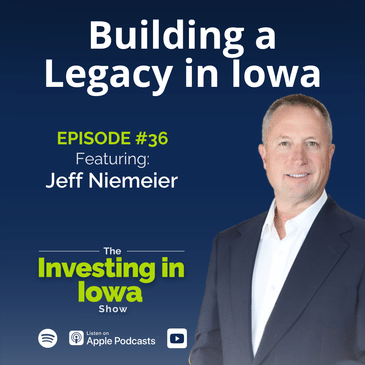
Discover the secrets behind one investor's transition from student housing to built-to-rent townhomes in this can't-miss episode. Join us as we sit down with Jeff Niemeier, founder of JB Capital, to explore his strategic shift in the evolving real estate landscape and the innovative strategies fueling his success. Listen now to uncover the insights that could revolutionize your own real estate investing approach.
What you'll learn from this episode
-
Key differences between syndication and fund models in real estate
-
Creative financing strategies to bring landowners as partners
-
Benefits and challenges of the build-to-rent model in Iowa
-
Important skills for successful real estate investors
-
Why Jeff chose to focus on long-term investments and rarely sell his properties
Resources mentioned in this episode
-
Rich Dad Poor Dad by Robert T. Kiyosaki | Paperback and Kindle
-
Rich Dad's CASHFLOW Quadrant by Robert T. Kiyosaki | Paperback, Hardcover, and Kindle
-
Raising Capital for Real Estate by Hunter Thompson | Paperback and Kindle
About Jeff Niemeier
Jeff Niemeier is a serial entrepreneur, fund manager, real estate developer/investor, and coach. With a successful career in Information Technology and consulting, Jeff transitioned into entrepreneurship in 2002 by starting his first business as a Wireless Internet Service Provider (WISP) and Private Cable Operator (PCO). After building and selling this business to venture capital, he moved into real estate investing, focusing on single-family, multi-family, and student housing properties. Jeff sponsored his first real estate syndication in 2011 and launched his first private real estate fund in 2019. He now hosts the Student of Money podcast, where he teaches financial principles to achieve financial freedom through passive income.
Connect with Jeff
-
Website: JB Capital Fund | Student of Money
-
Podcasts: Student of Money | Apple Podcasts
Connect with us
For more insights and updates, follow us on social media and visit our website: https://theinvestinginiowashow.com/.
[00:00:00] Taxes is your number one expense. And the other thing that happens, the other reason people buy real estate is they want to depreciation.
[00:00:07] So there's a thing called recapture of the depreciation when you sell an asset and that can get pre-cosm.
[00:00:14] From cornfields to high-risis, office to industrial houses, do hotels and every other asset class in real estate,
[00:00:21] we covered the people, the projects and the profit. Welcome to The Investing in Iowa Show.
[00:00:27] This show is for go-doers, action-takers and business owners. It's for people like you who are sick of Uncle Sam taking a huge bite in your apple.
[00:00:36] But you're looking to get ahead of what's taking place in Iowa. Learn who is doing what and how you can get in on the action.
[00:00:43] You're in the right place. Posted by Neil Timmins and Iowa native who has been involved in over $300 million in real estate, right here in Iowa.
[00:00:53] Recording in studio from West of Boy.
[00:00:56] Here's your host, Neil Timmins.
[00:00:59] I've got Jeff Neamyer here on the show, Jeff. Welcome.
[00:01:02] Hi Neil. Thanks.
[00:01:03] I'm excited to hear your say-for-the-Ideens to say, who are you from? What do you do?
[00:01:07] Yeah, my name is Jeff Neamyer from Cedar Rapids Iowa. I am the founder and I'm the Managing Principle of J.B. Capital.
[00:01:13] J.B. Capital is a private equity real estate firm.
[00:01:16] Our current fund is called the Iowa Legacy Fund.
[00:01:19] It's for Bill Turent Townhouses and the Cedar Rapids Iowa City corridor.
[00:01:24] And I'm also the host of the Student Money podcast where we talk about entrepreneurship, investing in real estate and personal development.
[00:01:31] Now the podcast, so I absolutely love it.
[00:01:34] Say you've certainly had a long career, very successful career doing a lot of things in real estate to get you to this current fund.
[00:01:41] Take me back to some of the big games.
[00:01:43] Where how do you get into real estate industry?
[00:01:45] So I'm going to take you back to the entrepreneurial bug that hit me about the world.
[00:01:49] I've turned 2000. Somebody actually introduced me to the Robert Kiesaki books and started reading Rich Dead Poor Dead, Robert Kiesaki.
[00:01:58] Seeing him at a couple events and said, I really wanted to be an entrepreneur. I really want to start my own business.
[00:02:04] So in 2002, I left the company I was working for.
[00:02:07] Started a technology business because I'm an IT guy, engineering background.
[00:02:11] And ran that for a few years and was doing cable television, high speed internet to apartment complexes and commercial headends and hotels, things of that sort.
[00:02:22] And one of the owners said to me who actually lived here in Des Moines.
[00:02:26] Hey, we can sign this contract for this bulk cable television, but if we sell you have to renegotiate with the new owner.
[00:02:33] And I said, oh, you're interested in selling it would it be okay if I gave you an offer and he said yes.
[00:02:38] So we ended up doing that deal. He actually did seller financing for me.
[00:02:43] So I went out to my friends and family network. I raised $65,000 of friends and family money.
[00:02:50] And I bought about $880,000 dollars. I bought it apartment complex in two single family houses with what year is that?
[00:02:58] That was 2006 and 2007. How to manage it?
[00:03:04] Well, I managed to properties myself and it was a learning curve just like everything else.
[00:03:13] And it's the same thing with my business too. When I went out and started my business, I used cookbooks accounting.
[00:03:19] And I tell this story that for four years I never filed my income taxes because I didn't know what I was doing.
[00:03:25] I didn't know accounting. I didn't know books. And finally, I came to a point in time where my CPA told me that no,
[00:03:33] No, I was going to give you a loan for anything or nobody's going to do anything because you don't filed any taxes.
[00:03:37] My wife's freaking out and she says they're going to come after us and I said, they technically they actually owe us money.
[00:03:44] So they don't really care that we haven't paid.
[00:03:46] And what really got me off the seat was my CPA says after three years they're not required to pay you any money that they owed you.
[00:03:55] So I said, okay, so I sit down on my CPA and we finally got together my books, filed my taxes and I got like a $20,000 refund check for all four years.
[00:04:06] And just for me, and now today I'm like an accounting guru because I've been doing it for 20 plus years.
[00:04:13] And it's the same thing with property management. I was fun alone. I joined landlords at Lank County. I did join landlords of Iowa.
[00:04:20] I went to other networking events. I went to other monthly meetups. I asked a lot of questions.
[00:04:25] And I got just you just dive straight into it and just from bumps and bruises. I cut my teeth on student housing and which is a very intensive because it's a constant turnover heavy lift heavy lift.
[00:04:41] And I was also doing rag dry. I've done 25 years of rag dry in a row and in rag dry hits at the worst possible time because it's right at turn for all the.
[00:04:50] Yeah, yeah. It's right in the middle of turn. So basically I would come back from rag dry and I would work nonstop through the middle of September and trying to get in students said and then coming back and doing repairs and doing all of that.
[00:05:05] I finally started moved away from student housing, but really the answer to question is just trial by fire. Seeker swim. I call it the burned boats. Yes, burn the boats. Absolutely.
[00:05:18] You see how you move out of this or a dance on if you will from your first acquisition. How do you eventually stumble in to student house.
[00:05:25] Student housing actually was the very first deal. So the apartment complex and that and the two houses I bought were all student housing.
[00:05:33] So the 16 plaques was all student housing and it was actually called Kirkwood dorms, it was dorms.
[00:05:41] So this is a Cookwood community college and see their app is Kirkwood owns none of their own housing. So they're pretty much rely on all private housing institutions.
[00:05:51] So I was going to Friday with the call T. J. for the bring the students on campus doing open houses doing all of that stuff.
[00:05:59] And then the hot, the actual the first house I bought was as an empty lot it was developer that had a call to sack and I bought the lot from the guy built in it.
[00:06:10] And I took the plans and I locked up four tenants. This is a great story. I locked up four tenants took their deposits took their first month rent promised them that the thing would be built and done August 1 so they can move in.
[00:06:25] And then I told the developer we got a close like July 30th early in the first because I've already rented it went to the bank with the purchase agreement and the signed leases and their security deposits in first month rent as down payment.
[00:06:39] And at that time in 2007 I was able to get 80% first position loan, a 10% second position loan. I had a couple thousand dollars of one of the moms says can I pay for the entire year all up front.
[00:06:52] So I had their security deposits, I had an entire year's rent all up front so I think I put $2,000 on a credit card and that is how I bought that first property. And then the second one to the third one was friends and family money.
[00:07:07] So it's a little net house today and cash flows great and I own like I own six houses on that little cold to sack now. So that's how I got started because the number one question I always get is I don't have any money. I want to do real estate but I don't have any money.
[00:07:21] It's got to get creative creative financing. Yeah. So you continue to acquire more student housing, right? How would you end up with it your peak?
[00:07:33] So student housing is by beds, by beds. So we had about a thousand beds and I was providing cable television and internet to about 2000 students in the Kirkwood area because I did once I put in my cable TV and head in an internet.
[00:07:49] I just started going down the street and just hook in everybody up. Yep. And I finally sold that business to venture capital in 2005.
[00:07:59] I saw high definition streaming services coming on board people were switching over from standard definition to high definition television. So I either had to upgrade all my equipment where I had to get out of that space.
[00:08:10] So I sold that company and then dove head first into just completely in the real estate. And then I and then I figured out that my friends and family money was technically a syndication.
[00:08:23] Oh, a security. And so I'm like, oh, I've got to learn about this. What's the security? How do you do? How do you raise money and people always start out with their friends and family network?
[00:08:35] Right. But eventually in 2011 I did my first official syndication where I raised money to buy a 16plex and still from my friends and family network but some of the more wealthier friends I guess.
[00:08:51] And I still owe that property today actually too because I never sell. I say that, but then I sold a bunch of properties in 2020 and then had to redeploy that money to avoid taxes.
[00:09:02] All right. So let's talk about that. Why the properties that you never sell? Why do you never sell them and the properties that you did sell? Why did you sell them?
[00:09:11] Because I hate given the government taxes as your number one expense. Right. And the other thing that happens, the other reason people buy real estate is they want depreciation.
[00:09:23] So there's a thing called recapture of the depreciation when you sell an asset and that can get pretty costly. So by the time you pay capital gains tax long-term capital gains and then you pay you recapture the depreciation.
[00:09:37] There's a big chunk of that profit that's gone. So you have to redeploy that money as an active investor. I can redeploy that and then start the depreciation cycle over again.
[00:09:48] And so I just do it to avoid taxes. And by doing that, you're able to that money you would normally pay in starts to compound and you start to be able to buy more and more.
[00:09:59] So what I talk about my podcast is getting to that financial freedom where you have more money coming in than you have going out every month.
[00:10:08] And then really then you can really start to now invest even more and more.
[00:10:14] So it starts to get into that snowball effect or it really starts to snowball. You sold some of the portfolio in 2020, but not largely for financial reasons right largely for
[00:10:25] I did that to get out of the student housing to focus on what I'm currently doing today. Yeah, what's next.
[00:10:35] So what's next is going from a syndication to a fund model and then going from buying pre-existing maybe distressed properties to building class A properties specifically right now or I will legacy fund we're building townhouses.
[00:10:54] Yeah, and to build the rent model build the rent model where are they being built where where where you're targeting so fund one is Cedar Rapids Iowa City corridor.
[00:11:03] So we're looking at North Liberty, Tiffen, the south side of Cedar Rapids we've got some already have some acres locked up it's not one big it's actually four different parcels for a total combination of about 226 units.
[00:11:18] I can imagine there's some unique and challenging circumstances at a window construction but at the same time tremendous benefits by constructing versus going and buying existing things and re-haven it.
[00:11:34] Yeah, one you get to pick the location which a lot of times if I'm looking at the MLS or I'm looking at what's for sale out there I don't necessarily like their locations.
[00:11:42] They're not people aren't selling because they're great cash flowing properties typically there's a problem so when I was looking for properties I was always looking for train racks that I knew I could fix and then you got to take a look at what part of town are they in and is that something that because you can't you can fix the property but you can't fix the neighborhood.
[00:12:01] So you've got to be able to know that one I want to look for that let's Aladdin say do you want to look for that jump and so you can't fix the neighborhoods but I can fix the property.
[00:12:14] But you typically buy in class be minus C properties and you really don't know what you're getting into until you have managed it for six months to a year.
[00:12:26] And there's brand new construction when you walk that has headaches and problems and at least when I build it I know exactly and then trying to build to a class and it's everything's brand new so the maintenance is going to be all out lower.
[00:12:39] It just seems like I can build it the other thing is to is I'm not building to sell because when you build a sell and you build a long-term hold is completely too different build the right right there's some houses that I look at that I wouldn't never buy that are built.
[00:12:54] Absolutely and I don't want to name any builders but there are there's different qualities and there's things that I'm going to put into I'm going to put in the plumbing different clean out and so I can run snake lines and things of that sort I'm going to do certain things that are going to be.
[00:13:11] I'm going to be there long term and I know that I'm just not going to flip it.
[00:13:16] Hey Iowa investors this is Avabau Camp chief of staff at Legacy Impact Investors have you thought about adding real estate to your portfolio but don't have the time or desire to play landlord at Legacy Impact Investors we do the heavy lifting our team finds the deals manages the properties and handles all the day-to-day operations are select group of qualified investors
[00:13:37] co-invest with us gaining ownership equity without opening a tenant email or responding to a maintenance call they just share an income appreciation and tax benefits.
[00:13:47] These opportunities are for everyone there for qualified accredited investors only if you want to learn more please visit Legacy Impact Investors dot com to apply.
[00:13:57] When I think of some of the unique challenges that go into the new construction side the very first one comes to mind is ground the ability to get ground to get it where you wanted to get it at an appropriate price or an economic situation that gets it to pencil.
[00:14:13] What are you doing for the ground side standpoint to put deals together?
[00:14:17] Yeah so I split the deal up into two things. I split the deal into what I call the pre-IPO which is the ground deal to get it to acquire the ground and then to get it entitled for development.
[00:14:30] And then once it's shovel ready then it transfers over to the fund for the long term construction and development.
[00:14:36] But one of the things that I think is very little utilized at a lot of people don't even know about it everyone is full air with a 10-31 exchange.
[00:14:45] You buy a property, sell a property and then to keep a tax free you roll it into the next one.
[00:14:51] There's also something called a 721 exchange which is instead of people bringing money into a deal they can actually bring the deed to the land and they can exchange the deed for partnership interests.
[00:15:05] And that also is a non-taxable IRS code 721. You have everybody can look it up.
[00:15:12] You can do a light kind exchange or then that business. It's you can exchange it into either an LLC or into a limited partnership which is what I use.
[00:15:22] So I'm able to and we could price this property at whatever the seller is long as you can justify it from a market standpoint.
[00:15:29] So in the current market that I'm in farmland is going for development land that where they have development actively going on and around they're listing everything about 95 to 100,000 dollars in acre.
[00:15:44] And a developer isn't going to want to pay that right because they have to put in all the streets, the water, all of that stuff, all that infrastructure.
[00:15:53] I'm able to go to that owner, typically before it's even listed with an agent and say hey I'm going to give you a full price offer of a hundred thousand dollars per acre.
[00:16:04] But here's the deal. You're going to dictate the price. I'm going to dictate the terms what I want to do is a 721 exchange.
[00:16:10] You're going to do a non-taxable event. We're going to put it on the books at a hundred thousand dollars in acre.
[00:16:15] We're going to bring that in as your capital account and then typically I'll give them some money upfront, but that's non-taxable too because that's not a sale.
[00:16:24] That is a return of capital from what they brought into the deal.
[00:16:29] Okay. So it's not taxable, right? So they get some money upfront.
[00:16:32] But then there the owner is also the perfect partner to bring that land in.
[00:16:37] Same thing with I would say with the vendors and the contractors, you're the perfect partner.
[00:16:41] Hey, what's your equity on this deal or what's your profit? You need to bring that profit into the deal too.
[00:16:47] I'd be an owner in the property. So I do that with a land.
[00:16:50] Bring them into the deal, get it up and belt and stabilize, and then and then we'll once it's stabilized, we'll refinance.
[00:16:58] Give them back the remainder of their capital.
[00:17:01] And again, that's all tax free because that is a return of their initial capital.
[00:17:05] Plus they'll carry 5% into the construction. So they'll be a long-term owner of it when at 5% typically equates to about another $100,000 per acre.
[00:17:16] So not only am I giving them a full price offer, I'm actually giving them potentially twice what they're asking for on their farmland.
[00:17:25] What do you need in creative way to be able to grasp it?
[00:17:28] Really a challenger, what could be a roadblock to give you to or at the very same amount of profit?
[00:17:32] I have to educate them. Yes, I can imagine you have to do a lot of educating there.
[00:17:37] Yeah, yeah. So my first the first deal we locked up for this.
[00:17:42] I kept sending, I sent him a letter of intent.
[00:17:45] I gave him my pitch deck. He did all my due diligence. He called all my references. He called my commercial banker.
[00:17:51] He checked on everything on me and he kept sending the documents over to his attorney.
[00:17:56] And his attorney kept sending me purchase agreements.
[00:18:00] And then he would modify the purchase agreement and send it over to me.
[00:18:03] And I keep sending him LPAs, limited partnership agreements, letter of intent.
[00:18:08] And then they kept changing all of that and says, no, we just want to.
[00:18:11] And then finally he comes to me and he says, hey, my attorney just figured out we're not doing a real estate transaction.
[00:18:17] We're doing a security transaction.
[00:18:19] And I says, ah, the light bulb just came on didn't it?
[00:18:23] And I says, you're right. This is a securities deal.
[00:18:28] And then he says, my attorney isn't familiar enough with, we have to find another attorney because he doesn't know securities laws.
[00:18:36] Yeah, right. Maybe a tad maybe a CPA or a tax attorney or something that would do it actually.
[00:18:43] So he actually had to go get advice from someone else because his family attorney,
[00:18:47] and we went up by this head.
[00:18:49] If I was beggining, whatever he was like, oh, yeah.
[00:18:51] So the education piece on that and how it worked. But once he got it,
[00:18:56] it was like I said, like a light bulb coming on.
[00:18:58] So we closed he did get some money up front.
[00:19:01] And then he we've got payments that are scheduled that we're making as we progress to get entitled.
[00:19:08] So now we've got the architects working on it. We got the civil engineers.
[00:19:11] We've already submitted our proposals to the city of Cedar Rapids.
[00:19:15] They've already done a preliminary report back on it.
[00:19:19] So everything is getting towards that entitlement.
[00:19:23] And then the best part about that deal is there's another developer that's building 200 homes around me.
[00:19:31] And he is bringing me all of the new brand new streets, brand new water lines, brand new sewer.
[00:19:37] So I'm technically doing infill development because I'm not putting in a city street.
[00:19:44] All the infrastructure is his deal. He's bringing it to me and grow it.
[00:19:49] And I just got a piece of the land in the middle because the seller was pricing it too high
[00:19:57] that the developers like, I'm not going to pay you that.
[00:20:00] So he walked away. I came in and was able to make a private deal with him.
[00:20:05] Picked it up, put it in my pocket. And now I get to take advantage of the 200 units that this developers putting in around me.
[00:20:13] Well, that's incredible. What a unique way to be able to do that.
[00:20:16] What do you most excited about next year?
[00:20:18] If you're a house clipper, execute the birth strategy or do double closings and are in need of money.
[00:20:24] Little guy loans is your go-to lender here in the Des Moines area.
[00:20:28] Time is money. Loan approvals in 24 hours.
[00:20:31] Closing's in five days, blue-to-guide loans was founded by Neil Timmins and in Buster just like you.
[00:20:38] Since he has been in over 10,000 homes in Des Moines there's never an appraisal.
[00:20:43] Houses, multifamily and commercial property loans up to 1 million.
[00:20:48] Check out www.littleguilones.com.
[00:20:52] Billy.
[00:20:53] When's the go-to-chir? I'm going to go vertical.
[00:20:55] The general contractor was a friend of mine. He's talking March, April as pretty aggressive.
[00:21:04] The architect says he's going to have the big thing is we're trying to get plans in our hands so that he can take it out to his network to get two three bids on everything.
[00:21:13] So that we can get it done.
[00:21:15] So you never know with weather construction.
[00:21:17] That's construction right.
[00:21:19] But we want to go first thing in the spring.
[00:21:23] And right now we're negotiating all of our ass with the city of Cedar Rapids, not on what we want.
[00:21:32] Anyway, it's good to be interested in the CIO comes together and goes vertical next year.
[00:21:36] Yeah, yeah, I'm really excited about building.
[00:21:39] I'm actually shocked that I haven't built before now.
[00:21:42] And what happened was, when I sold one of my student housing complexes in 2020,
[00:21:47] I actually sold it to a developer from Iowa City.
[00:21:50] And there was an empty lot on that property that I had sold.
[00:21:54] And for student housing, I was thinking, I'm going to put an amenity out there.
[00:21:57] I'm going to put in half court basketball court.
[00:21:59] I'm going to put in a picnic, bench, grill, whatever I like that is.
[00:22:04] And he built on it.
[00:22:06] He built a brand new nine more units, four bedrooms and other nine times,
[00:22:10] four 32 units with three floors up instead of two.
[00:22:14] And he instantly increased the value of that property by a million dollars.
[00:22:19] And so after I sold it to him and he overpaid me too, he overpaid me on and because he had 1031 money that he had to play her.
[00:22:28] So he bought that property from me and I thought and then COVID hit and I thought, this guy's not going to do very well.
[00:22:34] So he's going to do the student housing, COVID overpaid for it.
[00:22:39] But he had to because of 1031, I go there and explain, he's breaking ground and build more buildings because why?
[00:22:45] Because he's a builder.
[00:22:47] That's his mindset.
[00:22:48] I wasn't a builder so I didn't even think about the possibility of building a building on that site.
[00:22:56] But he saw the value.
[00:22:57] The fact that he overpaid a hundred thousand dollars for the property,
[00:23:01] he's going to get that back on building that building.
[00:23:04] It's unique when you bring your perspective, some else brings there because we all have a different lens in which we view these deals through it.
[00:23:10] And they talk about it on the appraisals.
[00:23:11] The appraisers will usually put in there best purpose for this land.
[00:23:15] I used to most use.
[00:23:16] Highest of best use.
[00:23:18] And sometimes it's just changing it for one tenant to another.
[00:23:23] So when I went from students to workforce, rents went lower.
[00:23:27] It wasn't as profitable because student housing is actually one of the most profitable.
[00:23:34] So what I ended up doing is I moved towards corporate leasing.
[00:23:41] So now a lot of my single family houses, I have corporate leases where they put the clients in.
[00:23:49] And I don't have to worry about the tenants, they take care of the maintenance and my rents jump right back up to where they were with student housing.
[00:23:56] But without the headaches.
[00:23:59] So as one of these deals where you have to shift your mindset and think about who's my tenants.
[00:24:05] Like a lot of people now say, I go by the 1% rule.
[00:24:09] Rent should be 1% of what the valuations are but nothing pencils out now.
[00:24:13] By changing the uses they do.
[00:24:16] They do.
[00:24:18] You get to think outside the box in order to make it work,
[00:24:21] especially during times where things are not so easy, things are challenging.
[00:24:26] When interest rates were 3% you could make a lot of things work that you just might make work today.
[00:24:33] Yeah, so you need to be doing things like looking at properties that are off market and you need to be out there in networking.
[00:24:40] So I rarely use a realtor.
[00:24:43] I always typically buy properties that are off market and do private deals.
[00:24:48] And throughout there you just have to, you got to work a little harder at it.
[00:24:53] Jeff, why?
[00:24:54] Iowa for you.
[00:24:55] You could do what you do anywhere you could own anywhere but you choose to do it here at why.
[00:25:00] Yeah, obviously the easiest and obvious answer is when I first started out I was at Do It Yourself or so I was doing everything.
[00:25:06] So the properties had to be within a driveable region, right?
[00:25:11] Because I was doing all the maintenance I was doing all of the property management.
[00:25:14] And I was doing everything.
[00:25:15] But when I started the fund model and the very first week I joined a master class in the master class,
[00:25:21] for the first week you got to pitch them your deal.
[00:25:24] And they'll tell you whether or not your thesis is correct.
[00:25:27] Your investment thesis.
[00:25:29] So I spent, that was kind of like, oh boy, I need to think about my investment thesis.
[00:25:35] And immediately it was like, oh, wow, Florida and Texas and down the sunshine belt or the hot market.
[00:25:42] Right?
[00:25:42] So I wrote a thesis saying, I'm going to go down in an invest in Texas or maybe I was going to do a fund of funds and raise money to invest in someone else's syndication and doing all of this fancy stuff.
[00:25:57] And then I thought to myself the problem with Dallas and Florida and not only is the property taxes insurance hurricanes, all of these other issues.
[00:26:07] The other fact is, I just don't know that market.
[00:26:09] Yeah, I've been a landlord in Iowa for 15 years or more.
[00:26:14] And I know the market and my competitive advantage is right here in Iowa.
[00:26:20] And Iowa is a business and landlord in friendly state.
[00:26:24] So when I took a look at why am I looking at taking money and trying to, because then I'd have to partner with somebody else.
[00:26:32] Because I'm not from those areas.
[00:26:34] You need an operator there.
[00:26:35] You need an operator or you if you do the fun to funds there.
[00:26:39] I just think you just double gouging your investors because they're getting, they're having to pay one waterfall at the syndication level and they have to pay another waterfall at the fund model.
[00:26:49] And that's just not aligning your values with your partner with your LPs.
[00:26:55] So I says, what do I know best? I know Iowa.
[00:26:58] So where can I find value?
[00:27:01] When then I did an interview with Darrell High from high properties and Cedar Rapids.
[00:27:06] And he said the same thing. He said Cedar Rapids, Iowa City Court or where it happened.
[00:27:11] Million in population were right on the threshold.
[00:27:14] The coins are great markets. So I'm just concentrating on two markets concentrating on the Iowa City City Rappets court or because of the growth and the boom that's going on.
[00:27:22] And I'm concentrating in the demoing.
[00:27:24] There's so much like here. No, that's fantastic.
[00:27:27] You ready for the final three questions? Sure.
[00:27:29] If you had one piece of advice for your 20 year old self, what would it be?
[00:27:34] Ooh. Work on your business.
[00:27:38] Not in your business.
[00:27:40] That's a great piece.
[00:27:42] Because that's my problem.
[00:27:44] Correct.
[00:27:45] Two books that change your life.
[00:27:47] Cash flow quadrant. Robert Kiesaki.
[00:27:50] Fantastic book.
[00:27:50] And 100 Tom Sins, capital raising for real estate.
[00:27:57] If you were cast away at an island for a year, you can only get three pieces of data about your business each and every month.
[00:28:02] What three things must you know?
[00:28:05] Oh, let's got to be rent role income statement balance sheet.
[00:28:10] Fantastic. Fantastic.
[00:28:12] From where?
[00:28:12] There you go.
[00:28:16] This has been a great conversation.
[00:28:17] I can tell you, I've learned some things.
[00:28:19] It's a 720 one exchange. What a fantastic little nugget you've brought today.
[00:28:23] That has been great.
[00:28:24] Jeff, I asked lots of questions.
[00:28:26] What's one question I did not ask that I should have asked?
[00:28:30] Wow. A real estate is a business.
[00:28:33] So the people want to thank all real estate's real estate and the reality is real estate is still a business.
[00:28:37] So I think on some of those questions there,
[00:28:40] people need to treat real estate investing as a business.
[00:28:43] And then you got to learn how to scale it and run it as a business.
[00:28:48] So I think that's to me.
[00:28:50] That's key element as opposed to the whole mom and pop people.
[00:28:55] Like, I don't want to invest in real estate.
[00:28:57] I don't want to fix toilets. I don't want you property management.
[00:28:59] But if you treat it as a business,
[00:29:01] the thing is that you're doing today.
[00:29:03] If you're working as an employer, you have issues.
[00:29:06] You've got problems. You've got all of those.
[00:29:08] But you got the exact same thing on real estate.
[00:29:10] But if you're doing it and treating it as a business,
[00:29:13] you can overcome them.
[00:29:14] Work on it not in it.
[00:29:15] Because on and on.
[00:29:18] Right. Real estate is not a hobby.
[00:29:19] Treat it as the business that will supplant your income
[00:29:23] and get you to financial freedom.
[00:29:25] For people who want to find you, they want to follow you.
[00:29:27] They want to connect with you.
[00:29:28] Work and they go what should they do?
[00:29:30] You've got two main websites.
[00:29:33] JBCapitalfund.com
[00:29:34] is for real estate fund.
[00:29:36] If you're a potential investor or a poor role,
[00:29:38] pitch decks, all of the paperwork, all that fun stuff there.
[00:29:40] If you're a buddy and real estate guy,
[00:29:44] and just want to learn more,
[00:29:45] then you're going to go to studentofmoney.org
[00:29:48] where we've got our podcast.
[00:29:50] We've got our YouTube channels.
[00:29:52] We've got all their information out there.
[00:29:55] Links below in the show notes for everybody.
[00:29:57] Jeff, I appreciate you being here.
[00:29:58] All right. Thank you very much.
[00:29:59] Thanks for listening.
[00:30:00] If you're enjoying the show,
[00:30:01] man, ask a favor of you.
[00:30:03] Naturally, subscribe so you never miss an episode.
[00:30:06] But would you rate and leave an honest, written review on Apple Podcasts?
[00:30:09] It does a lot for us here at the show,
[00:30:12] and I appreciate reading your thoughts.
[00:30:15] Great guests make for a great show.
[00:30:17] If you know of another island,
[00:30:18] would be a great guest or you yourself have interest
[00:30:21] in being a guest.
[00:30:22] Well, get on our radar.
[00:30:24] Does it invest in Iowa to fill out an application
[00:30:27] or recommend a guest?
[00:30:29] And if you want to connect with me in one of them,
[00:30:32] go legacy, impact, investors,
[00:30:35] dot com, click on the invest with us button
[00:30:37] in the top right corner.
[00:30:38] And there, you can pick a time for the two
[00:30:40] lest to get on the calendar and connect.
[00:30:42] Until next time, keep investing in Iowa.