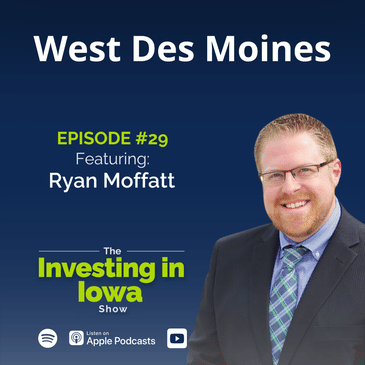
Dial in as we chat with Ryan Moffatt, the Community and Economic Development Director for West Des Moines. With over two decades of experience, he dives into affordable housing initiatives, strategic growth plans, and insights on the success of attracting data centers and the ambitious Grand Experience project. Don't miss this in-depth look at the exciting developments shaping the city's future!
What you'll learn from this episode
-
Challenges in the office market in West Des Moines
-
Affordable housing through multifamily developments
-
Growth and annexation plans of West Des Moines
-
The Grand Experience Project: What it is and what it aims to achieve
-
Importance of local partnerships in supporting the data center industry
Resources mentioned in this episode
About Ryan Moffatt
Ryan Moffatt is the Community and Economic Development Director for West Des Moines, where he oversees affordable housing, business retention, and city expansion projects. With over 20 years of experience in government work, including 11 years as a city planner in Des Moines, Ryan plays a key role in major initiatives like the redevelopment of Valley West Mall and attracting high-profile developments such as data centers. His strategic planning and practical solutions are focused on ensuring sustainable growth and improving the quality of life in West Des Moines.
Connect with Ryan
-
Website: urbanDSM.com
Connect with us
For more insights and updates, follow us on social media and visit our website: https://theinvestinginiowashow.com/.
[00:00:00] Industrial is a hot market segment, so we want to become more active in that sector and make sure that we can do some things to put our sites out there.
[00:00:06] Again, a lot of the infrastructure is already in. So now it's just doing the due diligence to maybe get these privately owned sites out of the point where they're more shovel ready.
[00:00:13] From cornfields to high rises, office to industrial, houses to hotels and every other asset class in real estate. We cover the people, the projects and the profit.
[00:00:23] Welcome to The Investing in Iowa Show. This show is for go doers, action takers and business owners. It's for people like you who are sick of Uncle Sam taking a huge bite of your apple.
[00:00:35] If you're looking to get ahead of what's taking place in Iowa, learn who is doing what and how you can get in on the action. You're in the right place.
[00:00:44] Hosted by Neil Timmins, an Iowa native who has been involved in over $300 million in real estate right here in Iowa.
[00:00:52] Recording in studio from West Des Moines. Here's your host, Neil Timmins.
[00:00:58] I've got Ryan Moffatt here on the show. Ryan, welcome.
[00:01:00] Thank you very much. Appreciate you having me.
[00:01:02] I'm excited you're here. Say for the audience to say, who are you? Where are you from? What do you do?
[00:01:05] Yeah, I am the Community and Economic Development Director for the city of West Des Moines. I've been there for one year now.
[00:01:11] So our department oversees housing efforts for the city when it comes to affordable housing,
[00:01:16] improving the quality of the housing stock that we've got. And then also on the economic development side, of course, we
[00:01:21] do a lot of business retention and attraction for the city. We work on development agreements to gap finance projects.
[00:01:28] And then a whole host of things in between. We market the community. We work on annexation for the city.
[00:01:33] You get into a whole bunch of things. Tell me, let's take me back to the very beginning.
[00:01:38] What did you study? How'd you get into this line of work?
[00:01:40] Yeah, I am fortunate to be doing what I call my realistic dream job. So I've always wanted to be a city planner ever
[00:01:45] since I was a kid. I'm one of the few people that I know that actually went into that program right out of high school.
[00:01:51] What was the genesis of that? You always wanted to be one?
[00:01:53] Always wanted to be one because I started with SimCity, basically video games.
[00:01:57] That got me hooked down. And then I remember just as a kid too,
[00:02:01] like when I had a train set, I got rid of the trains and just built all the buildings out.
[00:02:05] So I had a giant town set up in my basement. But that was definitely the roots. And I was
[00:02:08] fortunate enough to pursue that both with my undergrad and grad degree. And I've been doing
[00:02:13] government work since 2003 now. Started out after graduating from Iowa State, working for a
[00:02:18] regional council of governments up in Fort Dodge. So kind of regional planning economic
[00:02:22] development work then came home from the Des Moines area originally. So City of Des Moines
[00:02:26] hired me as a city planner back in 2005. Did that for probably 11 years before I made the shift over
[00:02:33] to economic development and haven't looked back since. So last year, Clyde Evans, who had been
[00:02:38] working for the city of West Des Moines for 32 years, very well respected in his field. He was
[00:02:43] kind of a rock star locally in the economic development circles. He brought me in and
[00:02:47] just asked if I'd consider applying for the position. Now it's perfectly happy doing what
[00:02:51] I did in City of Des Moines. Loved what I did there. But this was just a great opportunity
[00:02:54] like the direction the community was going in. So I was fortunate enough through a very
[00:02:58] rigorous interview process to get the position. Well, it's terrific. I can imagine there's a lot
[00:03:03] of responsibility, especially with West Des Moines being as high profile as it has been for
[00:03:07] as many years as it has been. And certainly, Clyde, fantastic job over the years. We interact
[00:03:11] with him a number of times in some of the years we have here in West Des Moines.
[00:03:14] Yeah, always big shoes to fill out here that quite a bit. Clyde was gracious enough to say,
[00:03:18] you know what? You're going to do this your own way. You're going to just find you're
[00:03:21] ways your own course. And he's not far away. So if I do need to use him as a resource,
[00:03:25] I still give him a call. But you're absolutely right. I mean, I think West Des Moines has been
[00:03:28] in a great position through a lot of the decisions that have been made over the years
[00:03:32] and being aggressive and proactive with economic development. I think the results
[00:03:35] show for themselves. Yeah, there's not a lot of places that have two malls. Maybe what will
[00:03:40] have been two malls. So let's talk about Valley West Mall and what's taking place there.
[00:03:45] Yeah. When I go around the community, for better or worse, I mentioned that we've got
[00:03:47] one and a half malls left. So, you know, Valley West Mall is one of the things that really intrigued
[00:03:51] me about the job too. I had really kind of a legacy in my work in Des Moines working with
[00:03:56] redevelopment. Of course, our team worked with Southridge Mall, Royal Hay Mall over the years too
[00:04:01] and certainly all the stuff that we've done downtown and on corridors over the years.
[00:04:05] As this community in West Des Moines matures, I think that those are some of the skills that
[00:04:09] we can deploy here too because we want to make sure we don't have a donut hole
[00:04:12] in the middle of the community. So Valley West Mall, I think as most people know,
[00:04:16] it's in receivership. So we're working with the bank, the court appointed receiver,
[00:04:19] and then the mall leasing agent to really kind of reposition the property in the future.
[00:04:24] And I have meetings with those folks basically, I mean, they're telling me everything that I want
[00:04:27] to hear that they feel that there's way too much commercial space there. It stays as a mall,
[00:04:32] are numbered, and that they're probably going to take a haircut on the value of the loan
[00:04:35] that's outstanding as your property. So my role right now is to continue to drum up interest
[00:04:39] and get developers, take a look at that property. So when the time is right to position
[00:04:44] that property for sale, we've got good interest lined up to do really what we want to do at the
[00:04:49] city is create kind of a mixed use more urban type development there. And that's not unlike
[00:04:53] what's happening all over the country. I mean, every city at this point has a mall that's probably
[00:04:57] in a similar state if not worse condition than Valley West Mall. And so this is a new formula,
[00:05:02] but it's something that we talk about quite a bit where there'd still be a retail component
[00:05:05] there. But we think that certainly a lot of rooftops in the area, maybe an entertainment
[00:05:09] function, limited office. And then one of the things we're really striving for right now too is
[00:05:14] to make sure that we end up with a public component to what happens there. So
[00:05:18] an outdoor gathering space or a festival space that the public can utilize to.
[00:05:22] Well, it's where its position is a fantastic location, right? By the middle of this town.
[00:05:28] There's just tremendous opportunity. Yeah, when I've met with both local and national
[00:05:32] developers, I think I'm on five or six different developers now just in a year that I've
[00:05:36] met with about the property. All of them have said this is still a good piece of real estate.
[00:05:40] For all purposes, Valley West Mall is the geographic population center of the metro as
[00:05:44] things have moved west. And with a position right off the interstate and the great infrastructure
[00:05:48] around it, it's still got good bones to be able to transfer into something hopefully a lot
[00:05:53] more dynamic in the future that will get some activity back there again.
[00:05:56] You mentioned office very briefly. I'm going to take it from there. What are you seeing
[00:06:00] in the office space? There are a lot of mixed opinions on what's taking place here that
[00:06:04] we read nationally. It's problematic and downtown Des Moines has tremendous exposure to
[00:06:10] office. Therefore, it's a little more challenged, I suspect. And you see that show up at the
[00:06:14] vacancy reports. But what are you seeing in West Des Moines?
[00:06:17] Yeah, that's another challenge that we're really working through. I won't sugarcoat that
[00:06:20] without question. It's an issue that we're going to be facing for quite a while, I think.
[00:06:24] But really depending on whose vacancy report you read, our vacancy rate in Western suburbs
[00:06:29] isn't all that much different from downtown Des Moines. Give it a point or two difference.
[00:06:32] So we've got our work cut out for us there too. And I can just say that it's going to be a slow
[00:06:38] grind, I think, to chip away at some of the vacant office space that's out there. We still say
[00:06:42] is what the brokers would call a good amount of deal velocity happening in the Western suburbs.
[00:06:47] But a lot of it's kind of the smaller tenants, the people that need 5,000 or 8,000 square foot.
[00:06:53] And sometimes you get building owners that have 25, 35, 45,000 square feet of space sitting
[00:06:57] out there at the moment trying not to demise down for these smaller tenants. And so that's
[00:07:03] the challenge right now is finding the bigger tenants to fill these office spaces. We have
[00:07:07] a lot of conversations about what the future of this looks like way down the road. Luckily,
[00:07:10] we're not in a position yet where people are throwing the keys to their office buildings
[00:07:14] back to the bank yet. But we've had discussions where if there is obsolete office product
[00:07:18] near belly west mall, for example, or we do have some older office stock, what can you do
[00:07:22] with that? You know, I think in downtown, just with the floor plates of the building,
[00:07:26] the views that you've got, those are probably more conducive targets to be able to convert to a
[00:07:30] different use like residential. I think again, with a larger floor plate and efficient use of space,
[00:07:35] that makes it tougher in the suburbs to look at a conversion. And even if you did, you know,
[00:07:39] what are you going to overlook parking lot or another office building? So we're not there
[00:07:43] yet. But you know, an idea would be if a building doesn't have any other economic use as an
[00:07:46] office, scrape it, redevelop it would be one idea lay down the road.
[00:07:50] Yep. Are you mentioned affordable housing and that has, at any time I hear that it's
[00:07:55] like a little tongue in cheek, because there's nothing anytime you got to go vertical on anything.
[00:07:59] It's just not particularly affordable for the average person. But maybe when we're talking
[00:08:04] about West Humoen, the economic scale does look a little different than Iowa's average,
[00:08:08] if you will. So what does that mean in your world? Well, I think the first thing we have
[00:08:12] to talk about is how we define affordability. Yes. And because that means a lot of things to
[00:08:15] a lot of different people. And you know, I mean, it's a big spectrum, right? And so we
[00:08:20] could talk about affordability with entry level starter homes, new construction.
[00:08:24] That's one thing when it comes to multifamily, for example, which is right now where we're
[00:08:28] focusing a lot of our affordable housing efforts with. It's everything from very low income,
[00:08:34] it's kind of almost a subsidization type thing for rents all the way up to various area
[00:08:39] median income levels and just making sure that we've got housing provided for all. So
[00:08:43] a lot of what we're doing are pointing developers towards the right resources that
[00:08:47] the state may have through the housing tax credit programs or the workforce housing tax credit
[00:08:52] program, even still with those programs right now with the way that interest rates are if you're
[00:08:56] financing a project and construction costs, which luckily are coming down a little bit right now.
[00:09:00] Yes. But still remain high. That's something where we're still needing to gap finance
[00:09:04] affordable housing projects because from a return on investment standpoint,
[00:09:08] affordable housing developers really can't build this without these tax credits and other
[00:09:11] sources out there. You know, we work a lot with the home builders as well. In fact,
[00:09:16] we just had a forum yesterday with the home builders association in Des Moines
[00:09:20] about how to get more rooftops going in West Des Moines. We've always been fortunate that we've
[00:09:24] been growing, but what's starting to see happen now is a little bit of getting outpaced by
[00:09:29] communities like Waquie and Ankeny. And there's a host of reasons why that might be, but
[00:09:33] one of them does come down to affordability and that a lot of what's getting built in
[00:09:37] Des Moines right now, West Des Moines for single family is on the higher spectrum,
[00:09:41] price range-wise. Got some beautiful estate lots being created, but
[00:09:45] there's not a whole lot of more affordable kind of entry-level housing product out there getting
[00:09:49] built in West Des Moines right now. And that's maybe why you're seeing Ankeny and Waquie grow
[00:09:53] faster right now is because that product is going to those markets. And so that's something
[00:09:57] that we've got our eye on, you know, again, you talk about what's affordable from a single
[00:10:00] family product now. And when we talk with builders, I mean, they're saying in West Des
[00:10:04] Moines, 330 to 340 would be the absolute minimum, sure that someone could build a house for,
[00:10:10] still make a profit. So, and that's not for everyone either. So I think that if people
[00:10:14] can't afford necessarily that new single family home, lends itself to the town homes and apartments
[00:10:19] still being pretty prevalent out there for the foreseeable future.
[00:10:22] Yeah. Let's talk about land and land growth. You know, when you mentioned Waquie and you
[00:10:26] mentioned Ankeny. Ankeny can grow as far north just about as they want, almost all the way to
[00:10:30] Ames and chew up everything. They're jumping the interstate. Now, the third high school is
[00:10:34] going to go on the other side of the interstate. They got a lot of room to run from there
[00:10:37] to Bondurant. And there's still seven miles between Waquie and Adele's. There's a
[00:10:42] lot of ground there. West Des Moines has grown almost as far west, is that fair to say? I mean,
[00:10:47] it's grown into Waquie and it's probably helped spur what's taking place with Waquie.
[00:10:52] But so talking about the growth of West Des Moines in the annexation, what does that look like?
[00:10:57] Hey, Iowa investors, this is Ava Bowcamp, Chief of Staff at Legacy Impact Investors.
[00:11:02] Have you thought about adding real estate to your portfolio but don't have the time
[00:11:05] or desire to play landlord? At Legacy Impact Investors, we do the heavy lifting.
[00:11:10] Our team finds the deals, manages the properties and handles all the day-to-day operations.
[00:11:16] Our select group of qualified investors co-invest with us, gaining ownership equity without opening
[00:11:21] a tenant email or responding to a maintenance call. They just share in the income appreciation
[00:11:26] and tax benefits. These opportunities aren't for everyone. They are for qualified, accredited
[00:11:31] investors only. If you want to learn more, please visit LegacyImpactInvestors.com to apply.
[00:11:38] That's something I maybe didn't appreciate when I took the job, how much of this role
[00:11:42] is defined by how much we annex and can grow our city boundaries in the future too.
[00:11:46] So we are working on annexation right now that would grow us up into the Waquie
[00:11:50] boundary. So kind of the Reuben Steakhouse exit, did think of Reuben off of I-80 there.
[00:11:55] West side of that road would be Waquie. Basically, the east side of that would
[00:11:58] be West Des Moines territory to grow into. That's one area. And so that's got its
[00:12:03] challenges. There's some subdivisions there that have been around for many decades that,
[00:12:06] you know, like the lower taxes and the ability to do some things that maybe you can't within city
[00:12:10] limits when it comes to parking your RV outside or burning your trash, whatever it may be. But
[00:12:15] we are a city, and I think to my knowledge, we're the only city that's in the state of Iowa
[00:12:19] that is in four different counties. And so it's not just Dallas County. Obviously,
[00:12:23] that's where the most growth is happening at. But we've got territory, we've got room
[00:12:27] to grow into areas in Warren County and Madison County as well. And thanks to all the public
[00:12:32] improvements that the city has made to support some of the growth that we've seen on the fringe of
[00:12:36] the city, it's allowed us to open up about 4,500 acres for development. And so now we've got a
[00:12:42] kind of right size. The other elements to the equation to get sewer and water mains and natural
[00:12:46] gas, these areas they can grow in the future. But one of the other things too from a land
[00:12:50] perspective that we're faced with is most of the easily developable flat cornfield property
[00:12:55] in West Des Moines has already been developed. And so as we go further west, we've got a lot
[00:13:00] more topography that we've got to deal with. And what that makes it more expensive to develop.
[00:13:04] So that's something too, when we talk about Ankeny and Wauke. I mean, they've got a lot of that flat
[00:13:09] easier developed grounds when we're kind of running a little bit more short on that.
[00:13:13] So going down into Madison County, not only are you dealing with city boundaries,
[00:13:18] you're dealing with school boundaries. And so you run into some of the school
[00:13:21] boundaries as you go that direction in which you just cross the county line. And let's say
[00:13:27] Dallas, it's West Des Moines schools. You go one block the other way and it's Madison County
[00:13:32] schools. And all of a sudden is the 30 to 40-minute drive, whatever happens to be, 30-some-minute
[00:13:37] drive let's say, to get down to winter set where the school actually exists. How much is that
[00:13:43] ultimately challenge what's taking place when it comes to rooftops specifically? How much is
[00:13:48] that going to challenge the growth of rooftops as you look to annex one?
[00:13:52] We have six school district boundaries within the city of West Des Moines. So obviously,
[00:13:56] West Des Moines community and Wauke's schools are the two big ones. And Wauke's seeing the most
[00:14:01] growth right now, but we also dip into Norwalk a little bit of Des Moines Independent School District
[00:14:05] van meter and winter set schools. And you know, I think when it comes to winter set,
[00:14:10] you're absolutely right. I mean, the growth in the Northern portion of the county is 20 to 25
[00:14:14] minutes away from winter set where the schools are at. But that school district had
[00:14:17] the foresight knowing the land's not going to get any cheaper. You know, to go ahead
[00:14:20] and buy a school site that's approximate. It's not in the city of West Des Moines,
[00:14:23] but certainly would be within our path of growth in the future to go ahead and just kind of lock
[00:14:27] that down for when the growth does hit that area. So hats off to them for being proactive.
[00:14:32] Same thing with Wauke's schools, they've been very proactive in terms of
[00:14:35] making sure that they're ahead of the growth curve. And it's a rapid pace.
[00:14:38] It is. But you know, we're working with them constantly on identifying those next sites too.
[00:14:43] You talked about, you know, attracting businesses and then retaining businesses.
[00:14:47] What does that typically look like? You know, businesses have a lot of places to go
[00:14:53] to. But what does that look like from you? If you're a house flipper, execute the birth
[00:14:57] strategy or do double closings and are in need of money. Little Guy loans is your go-to lender
[00:15:02] here in the Des Moines area. Time is money. Loan approvals in 24 hours. Closings in five days.
[00:15:10] Little Guy loans was founded by Neil Timmons, an investor just like you.
[00:15:15] Since he has been in over 10,000 homes in Des Moines, there's never an appraisal.
[00:15:20] Houses, multifamily and commercial property loans up to $1 million. Check out www.littleguylones.com.
[00:15:28] Yeah. And I kind of divide economic development definition into thirds. And the third of that
[00:15:32] really is the retaining the existing businesses that you have and go in recruiting new ones.
[00:15:36] Third of it really is kind of the project management and incentive negotiation
[00:15:40] projects that come through. And then another third, which is really kind of marketing the
[00:15:44] community a little bit. So, you know, I think for us, we've got a pretty robust program
[00:15:48] that we call business retention visit program. And so, we're out there meeting with a whole host
[00:15:52] of industries and it's everything from manufacturing to small business to the big insurance companies
[00:15:57] that are based here and just kind of build in relationship with them, seeing what their needs
[00:16:01] are if they're growing, if they're contracting, how we can help them. If something did happen,
[00:16:06] they've got a face to the name basically. So, that's something that we do,
[00:16:09] kind of stay out of the curve and make sure that you always hear the adage about,
[00:16:13] do you want to grow your economy? The best way to do that is with who you've got in
[00:16:15] your backyard right now. So, we take that seriously. But on the attraction front,
[00:16:19] I think that we're unique as a community participate in what's called the site selectors guild.
[00:16:24] And I've only done this twice since I've come with CityNow, but we go to a conference basically
[00:16:28] and work with the national site selectors. And these are the folks that really are charged
[00:16:33] with if you have an Amazon HQ2 or a semiconductor manufacturing plan, they're weeding through
[00:16:38] hundreds and thousands of sites across the country to find the right one for their client.
[00:16:42] And so, we like to get them familiar with West Des Moines and the Des Moines metro area.
[00:16:46] So, in conjunction with the Greater Des Moines partnership, we actually just two weeks ago did
[00:16:50] we call a familiarization tour. So, we brought up two nationally renowned site selectors,
[00:16:55] gave them a helicopter tour of the metro, certainly drove around West Des Moines quite a bit.
[00:16:59] And you know, just really wind and dynam to show the great quality of life that we have here
[00:17:02] and certainly the sites that we have too. So, that's one of those unique things I think
[00:17:06] we do in West Des Moines that'll put us on the radar, let them know what we've got
[00:17:10] and certainly open up their eyes to the sites that we have available.
[00:17:13] Yeah, one of the things you guys have been wildly successful at is attracting data centers.
[00:17:17] There were things that how did that come to be from the get go perhaps? And then,
[00:17:21] you know, how's that impact that West Des Moines?
[00:17:24] Yeah, you know, I think the reason as to why it's not just West Des Moines, right? Like,
[00:17:27] we've been very fortunate with working on what is our sixth data center, right? What's
[00:17:30] Des Moines with the Microsoft Corporation. But obviously, Apple's got a campus in Waquie,
[00:17:35] Meta Facebook is about built out and it really comes down to as far as elements in the equation,
[00:17:41] reliable, low cost energy, and then available in abundant land. And a lot of these large tech
[00:17:46] companies like to tout that they're powered by renewable or now non carbon energy sources.
[00:17:52] And so if you paid attention, you know, when all these data centers were getting going,
[00:17:55] there'd be a large wind farm announcement in about six months to a year later,
[00:17:59] that's when the data center would hit. So that was kind of done in tandem basically.
[00:18:03] But that's kind of the story as to how it got here. And I think, you know, our story with
[00:18:07] Microsoft originally was this was all cloud based storage for the stuff that we keep on our devices.
[00:18:12] And now it's transitioned into AI supercomputing. And so the software that Microsoft uses to
[00:18:18] power chat GPT from a data center perspective started right here in West Des Moines.
[00:18:23] And we visited with company officials with Microsoft. I mean, they showed us the growth
[00:18:27] trajectory that they're on from a data center perspective. You know, in 0809,
[00:18:31] we first landed our Microsoft data center in the original one, you know, it was ticking up.
[00:18:36] But then in 2021 when chat GPT hit, it's a straight B line in terms of the need to find
[00:18:41] available sites all over the country right now. And there are some challenges out there
[00:18:46] with the electrical loads, you know, we have a lot of discussions about water consumption
[00:18:50] that's needed to evaporably cool these facilities. So a lot of these are things
[00:18:54] that I think technology will solve long term, but the need for data centers is speeding up.
[00:18:59] And so really what this has meant for West Des Moines, having six facilities, each one
[00:19:04] is basically a billion dollar capital investment. And you know, if you've seen these get built,
[00:19:09] I mean they finish one bill and they roll on to the next one and the next one. And so,
[00:19:13] you know, it spikes our permit valuation. But these things for us,
[00:19:16] a great name behind the companies that are investing here and the significant investment,
[00:19:20] you know, they've generated about 350 to 400 jobs permanent full time jobs here in West
[00:19:24] Des Moines. They've brought 3000 construction jobs. And again, this is only Microsoft's.
[00:19:29] But I think they are property tax cash cows for us too. And they assess very highly. We don't
[00:19:34] really do a whole lot of incentives in terms of grants or tax abatements or things like that.
[00:19:39] One of the things we strive to do in West Des Moines really is lead with infrastructure.
[00:19:43] And so that has been our primary incentive that we've given to these data centers is
[00:19:47] oftentimes because they're light industrial use as they go on the fringe of the community,
[00:19:51] not a lot of infrastructure that are serve them. So we'll go bond for the infrastructure to get all
[00:19:56] of it put in, create a tax increment finance in district and then use the increment that comes
[00:20:00] off the data center to pay down our bonds. And the nice thing about that is we've got something
[00:20:04] to show for it at the end of the day. We all know these tech companies probably don't need
[00:20:08] a lot of grants and subsidies. But now again, with the investment that's been made with
[00:20:12] all this infrastructure, we've really opened up $200 million worth of public improvements
[00:20:16] that have allowed us to have almost 5,000 acres of developable property that's served by
[00:20:21] the infrastructure that Microsoft's helped us pay for.
[00:20:24] Yeah. You get out ahead of it and get to put some things in place that make it easier to go
[00:20:28] for a developer, for a builder, for anybody to go get something done.
[00:20:32] Yeah. And I like to tout this statistic too, but we're the third,
[00:20:35] we're the seventh largest city in the state of Iowa population wise. We have the third
[00:20:38] highest assessed value after only Des Moines and Cedar Rapids. And $2 billion of our $7
[00:20:43] billion property tax valuation comes from the data centers. So they're a major part of our economy,
[00:20:49] you know, they're a major, they're our largest property taxpayer,
[00:20:52] done a lot of things for the community otherwise too. They've contributed to the construction
[00:20:56] of the Jamie Hurte Ampitheater. They've self put Wi-Fi district wide in the Valley Junction
[00:21:00] neighborhood. They've contributed almost $30 million to water system improvements here.
[00:21:05] So just a phenomenal community partner.
[00:21:08] It's always interesting. Oftentimes you don't know how good you have it until you don't
[00:21:12] for reliable energy and affordable energy. So all those energy bills, you're like, it's too high.
[00:21:19] But you don't know how good you have it until you don't. You go visit somebody else in a different
[00:21:23] part of this country. It's not quite the same. Well, yeah, Mid-American Energy is a great
[00:21:27] partner as well, utility partner. I mean, they're renowned in the economic development
[00:21:31] circles nationwide as to be able to provide great customer service. This sounds like a commercial
[00:21:36] for them, but it's honest to God truth. Our site selectors that just visited the community
[00:21:40] said much the same thing that they are held in high regard. And so that's part of the
[00:21:44] elements to the equation of economic development, our great utility partners.
[00:21:48] I've known their CEO Adam Wright. We played football together at University of
[00:21:50] Nebraska. We both graduated from there. So he's doing a heck of a good job over there
[00:21:53] for what's taking place here. You just gave me, I think what might be the best
[00:21:57] little known fact that I get to walk away with is that two sevenths of the valuation
[00:22:01] is all derived from data centers. Yeah. Yeah. You know, I'll stat.
[00:22:06] That is. And you know, I think we want to be mindful too of making sure we diversify
[00:22:09] our revenue streams long term. We don't want too many eggs in one basket. Certainly we won't
[00:22:13] say no to more data centers because they are lucrative for us, but without question. I mean,
[00:22:18] we've got our eyes on industrial is a hot market segment right now. And so we want to
[00:22:21] become more active in that sector and make sure that we can do some things to put our sites out
[00:22:26] there. Again, a lot of the infrastructure is already in. So now it's just doing the due
[00:22:30] diligence to maybe get these privately owned sites out of the point where they're more
[00:22:33] shovel ready. Why Iowa? What keeps you here? You could do this anywhere, but what keeps
[00:22:37] you grounded here? Yeah, I grew up on the south side of Des Moines. I'm a native. I'm a local.
[00:22:41] We're invested in the community. Recently we just sold a business, but my wife and I,
[00:22:45] we had a business in Des Moines. You know, there's family here. So you're right. We
[00:22:49] probably could go elsewhere, but you know, I think it's just the people that keeps us here
[00:22:53] quite honestly. So, Brian, you ready for the final three questions? Sure. If you had one
[00:22:58] piece of advice for your 20 year old self, what would it be? I would say,
[00:23:02] you know, coming out of school, planning school especially, they teach you a lot about
[00:23:05] theory and principles and practices, but they don't really teach you a whole lot about
[00:23:09] the realities of politics and the realities of economy. So, you know, I think it's basically to
[00:23:14] you can still have your principles, but don't get too roiled by things that come at you that are
[00:23:19] out of your control when it comes to politics, when you work in government. It's
[00:23:22] fascinating and frustrating at the same time. But that would be a good lesson for
[00:23:26] anyone coming out of school that wants to get in this field basically is there are factors
[00:23:30] outside of your control that are going to affect how you do your job.
[00:23:33] Two books that change your life. To be honest, I'm not a huge book reader. I immersed in, you know,
[00:23:39] business record and business articles and things like that. But I think with this role
[00:23:43] especially, I mean, it's got me pressed for time and unfortunately, I don't have a whole
[00:23:47] lot of time to commit to books. But one of the other things I also do in my spare time is
[00:23:50] I administer a website called urbanDSM.com. And I've had this since 2004. But this is
[00:23:55] basically a discussion about Des Moines area development. And so there's a discussion
[00:24:00] forum on there. Used to be able to go out and get updates on project pictures and things like
[00:24:04] that a little bit more often. But that's something I do in my spare time now. Fill up what could
[00:24:09] have been reading a book. Yeah, there you go. Yeah. All right. If you were cast away on
[00:24:13] an island for one year, you can only get three pieces of data about your business. So
[00:24:17] however you wanted to find that by your role, what three things must you know every month
[00:24:22] to know how your role, how the job, how the business is going?
[00:24:26] Yeah, I would say just the state of the market and it depends on whatever sector it may be.
[00:24:30] Office, residential, industrial definitely wanting to keep up with the trends. I would say
[00:24:35] keeping up with the politics and we have to follow what the state legislature does often
[00:24:39] because that impacts what we do as well. And then just overall tax climate and business
[00:24:43] climate too. That's certainly a big part of economic development that maybe when I was
[00:24:47] a city planner, I did depreciate. You know, then it was more about
[00:24:50] aesthetics and you know how things look and how they're going to interact with
[00:24:53] the community. Now it's more about the business aspect of how they're going to fit in and
[00:24:57] you know, how they're going to contribute to our economy.
[00:24:59] Okay, so I've asked you lots of questions. What's one question I did not ask that I should
[00:25:04] have asked? Well, I think I just touched a little bit on the Grand Experience Project,
[00:25:08] which is another big thing that our department's working on really many departments at the
[00:25:11] city. But for those not familiar with this, this is basically a large indoor water park,
[00:25:17] a conference center. This is being proposed on basically any cornfield
[00:25:20] in any direction from the Reckplex complex on Grand Avenue. There's a master developer that's
[00:25:25] got an option on all that property. And so this water park and the conference center is kind of
[00:25:30] what gets a lot of the acclaim and the press. But as a component of this large master plan
[00:25:34] project is also six to 800 units of housing, some of which are intended to be affordable.
[00:25:39] And we have a large service sector economy with the creation of the water park and
[00:25:43] shopping and things like that that would support it. We want to make sure that we've
[00:25:46] got a housing proximate to where the workforce needs to be. Yeah. But then it opens up a
[00:25:50] lot of ancillary commercial development. So pad sites for restaurants and breweries and
[00:25:55] coffee shops, things of that nature. So that's something that would be our mayor calls it the
[00:26:00] big pizza because it's got everything included there basically. And if we can get that off
[00:26:04] the grounds, you know, I think they're kind of affected by what a lot of projects are
[00:26:08] right now with high construction cost and interest rates. But if this happens,
[00:26:11] it's another feather in the cap between what we've got going at the Reckplex DMU and DMAC
[00:26:16] already on that corridor. And it's only a mile away from Jordan Creek Town Center and
[00:26:20] Topgolf and all the great things for that area too. So we've really cemented ourselves as kind of a
[00:26:25] destination for family friendly entertainment options. That would certainly be another
[00:26:30] attribute to the community forward to seeing that one come along. Ryan, for people who want
[00:26:34] to find you, they want to follow you, they want to connect with you, they want to learn
[00:26:37] about war about West Des Moines, where can they go? What should they do? Yep. We've got our
[00:26:40] website, wdm.iowa.gov. You'd have to go to the economic development section,
[00:26:45] community and economic development. That'll tell you more about our department, who our staff are,
[00:26:49] you know, what resources might be available if you're starting businesses. And just really
[00:26:53] give you some good statistics and information about the community that we use to market the
[00:26:56] community. Fantastic. Thanks for blowing the show on us, everybody. Ryan, I appreciate being here.
[00:27:01] Thank you very much. Appreciate it. Thanks for listening. If you're enjoying the show,
[00:27:04] may I ask a favor of you? Naturally, subscribe so you never miss an episode. But would you
[00:27:09] rate and leave an honest written review on Apple Podcasts? It does a lot for us here at the show,
[00:27:15] and I appreciate reading your thoughts. Great guests make for a great show. If you know of
[00:27:20] another island who would be a great guest or you yourself have interest in being a guest, well,
[00:27:25] get on our radar. Visit investing in Iowa to fill out an application or recommend a guest.
[00:27:32] And if you want to connect with me one-on-one, go legacyimpactinvestors.com,
[00:27:38] click on the invest with us button in the top right corner. And there you can pick a time for
[00:27:43] the two of us to get on the calendar and connect. Until next time, keep investing in Iowa.