
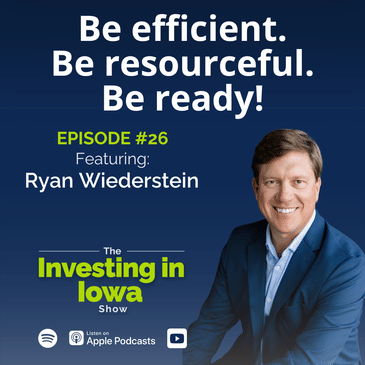
Discover how Ryan Wiederstein thrives on defying expectations as he shares his secret for turning agricultural and commercial properties into profitable ventures. From his lightning-fast acquisition of the Wells Fargo building to his long-term strategy in Iowa, he reveals the mindset and methods that set him apart. Tune in for a masterclass in outsmarting the market!
What you'll learn from this episode
-
What it's like to invest in agricultural and commercial assets during the recession
-
Challenges and strategies behind Ryan's acquisition and development of a Wells Fargo building
-
Benefits of having a contrarian mindset as an investor
-
The value of maintaining tight financial oversight
-
Why it's necessary to have multiple lending relationships
Resources mentioned in this episode
-
N/A
About Ryan Wiederstein
Ryan is the owner and broker of WB Realty Co., bringing over 23 years of real estate experience. He founded WB Realty Co. in 2010 and has since overseen the development of many successful residential and commercial projects. Ryan's passion has evolved from home renovations to property management and now encompasses commercial real estate, development, and land/agriculture sales. He consistently delivers quality property management services to investors and partners, taking great pride in his service standards for both commercial and residential clients. Ryan's commitment isn't limited to real estate alone—he is also an active participant in Iowa's agriculture programs, further exemplifying his dedication to rural Iowa's future through his engagement in ranching and farming activities. His versatile background has laid the foundation for the wide array of brokerage services offered at WB Realty. His vision is to continue growing the company as a leading real estate brokerage in Central Iowa.
Connect with Ryan
-
Website: WB Realty Co.
Connect with us
For more insights and updates, follow us on social media and visit our website: https://theinvestinginiowashow.com/.
[00:00:00] I got golden rules. I'm always the manager and I'm always the majority owner. And so
[00:00:04] I was controlled my deals. So I'd never mind anything. I know what's going on in this market
[00:00:08] very well, and you don't have to spend a lot of brain damage to figure out what the
[00:00:13] market is from cornfields to high rises office to industrial houses to hotels and every
[00:00:19] other asset class in real estate. We cover the people, the projects and the profit.
[00:00:24] Welcome to The Investing in Iowa Show. This show is for go doers, action takers and business owners.
[00:00:31] It's for people like you who are sick of Uncle Sam taking a huge bite of your apple.
[00:00:36] If you're looking to get ahead of what's taking place in Iowa, learn who is doing what and how
[00:00:41] you can get in on the action. You're in the right place. Hosted by Neil Timmins, an Iowa
[00:00:47] native who has been involved in over 300 million dollars in real estate right here in Iowa.
[00:00:53] Recording in studio from West Des Moines. Here's your host Neil Timmins.
[00:00:59] I've got Ryan Wiedersdien here on the show. Ryan, welcome.
[00:01:02] Hey, thanks for having me.
[00:01:03] I'm excited you're here.
[00:01:04] Save for the audience's sake. Who are you? Where are you from? What do you do?
[00:01:07] Yeah, Ryan Wiedersdien with WB Realty. I'm the broker owner of WB Iowa native.
[00:01:13] I grew up in Audubon. I went to Drake. I ended in a state in Des Moines after graduating
[00:01:19] and been in real estate for 23 years. How'd you get into real estate?
[00:01:24] I actually started working at R&R in 2001. I was an IT guy and I stayed there through 2014
[00:01:32] and then left the day before my 40th birthday and went out on my own. So eight years ago.
[00:01:39] Would most people in the IT world identify themselves as real estate people if they
[00:01:44] happened to work in a real estate firm? Yeah, probably not. Yeah.
[00:01:46] Yeah, but I mean, I had my license and I did a lot of data center work for them.
[00:01:51] And then I was in management there. So I was one of the directors on
[00:01:54] and Ryan won other subsidiaries. So I mean, I was involved in
[00:01:58] day-to-day real estate, non real estate activities, I mean,
[00:02:02] county, anything. So it was pretty wide base of knowledge coming out of there.
[00:02:07] Yeah. Yeah. You got a tremendous amount of exposure.
[00:02:09] Yeah. Great place to get educated.
[00:02:11] Yeah. Yeah. We went off on our own and did what?
[00:02:13] So yeah, went off on my own. I had started my own brokerage and I mean, obviously,
[00:02:18] as you know, we started with residential properties back in the day.
[00:02:21] Right. And you know what I mean? Residential properties are fine and I bought a lot of
[00:02:25] houses through the recession and that was great. Had the stomach to buy things when
[00:02:29] nobody else was. And that was probably the biggest key to what kind of propelled us
[00:02:34] to where we are today. Ultimately, we got into commercial and needed to diversify.
[00:02:39] We got into ag and so now we're in ag commercially and residential. Residential
[00:02:44] being basically the least of the portfolio, majority of it's commercial and then ag.
[00:02:50] So I'm going to skip residential for today about that.
[00:02:52] Yeah. Well, let's talk about ag and talk about commercial. Pick one. Just tell me
[00:02:56] what it is that you do inside those asset classes.
[00:02:58] Right. So ag, we basically in 2015-16, I mean, I'm always looking for
[00:03:05] the soft spot in any market. I don't care what it is. It's an industrial, ag, housing,
[00:03:11] whatever it is. I mean, that's as you know, as an investor, I mean, I'm not buying things
[00:03:15] when they're at the top. Ag, I felt was at the bottom at that point, at least on the
[00:03:19] cycle. Ag was in a downward trend at that time. So we bought, well, ended up accumulating
[00:03:25] almost 3000 acres of ground in southern Iowa, ran a cattle operation.
[00:03:30] Part of this was for tax purposes too. So that was the benefit on the side was a lot of these
[00:03:36] operations were nice offsets. So we picked that up and pretty much hit that right on the money.
[00:03:42] We acquired almost all of it with options in October of 2018, which if you look
[00:03:47] at the last cycle, that month literally was the low. So that was good timing.
[00:03:52] And now like a lot of that ground weight purchase has tripled, at least tripled.
[00:03:57] And now we're starting to unload that. So we've got closings about every other week on portions
[00:04:02] of that Ag portfolio. So that's what we went after there and we're not married to anything. So
[00:04:08] whatever is there can go. I mean, we like the buy low sell high. Yeah. So yeah.
[00:04:14] Before we get into commercial, I mean, it sounds to me like you're a contrarian of some danger.
[00:04:17] Where did that start? Where did that begin? What's the genesis of that? Because a lot of
[00:04:21] people, they say we want to buy low sell high, but when the days are darkest,
[00:04:25] nobody takes the action. Yeah. I mean, I always tell people, and I mean,
[00:04:28] I have a lot of people that ask me about it, obviously, especially with the purchase of that
[00:04:31] Wells Fargo building. It's all about if you can sleep at night. I mean, that's really what it
[00:04:36] comes down to. Not everybody has a stomach for risk. And guys like you and I were
[00:04:40] entrepreneurs, regardless of what it is of its real estate or anything else,
[00:04:43] you're always thinking about doing whatever. But if you can't sleep at night,
[00:04:47] none of it's worth it, right? And everybody's got a risk tolerance. And entrepreneurs typically
[00:04:53] have a higher risk tolerance. And what are you willing to lose? This is the other question.
[00:04:58] And how do you get there? I don't really set goals for myself either. I'm just like,
[00:05:02] hey, look, I'm just looking for deals. I've got a really high risk tolerance.
[00:05:07] But it's thought out and it's not like I'm making bad decisions. It's like,
[00:05:10] I don't want risk just to have a risk. That's just where I feel like the deals are.
[00:05:14] And it's hard to make big moves without having a risk tolerance too.
[00:05:18] It's hard to get further ahead quicker without that risk tolerance. So we did foreclosures back in
[00:05:25] the day and those came with a lot of risk. And I mean, I was buying properties in the
[00:05:29] middle of the recession when there wasn't a sole buying. Correct. And I couldn't buy enough.
[00:05:34] But that was an easier time because we entered about that time into the residential market.
[00:05:40] So it's not like I had 300 homes that I had paid market value for.
[00:05:44] And then I'm coming in and then buying more at low prices. I didn't really have any.
[00:05:50] And then I was buying it low. So my entry point into that segment was at the bottom.
[00:05:54] And that's basically where I'm at on office right now is I'm buying in at the bottom,
[00:05:58] not at the top. There's a lot of developers out there that got millions of square feet of
[00:06:02] office. They're never going to be a buyer on a vacant office building.
[00:06:05] So they have enough vacancy. They don't need more.
[00:06:08] They have enough vacancy and they have other headwinds coming against them
[00:06:11] where I'm basically buying at the low. If I wanted to, I could just basically win every deal in the
[00:06:17] market because I have so much room in it. So it's just an easier way to get there,
[00:06:23] in my opinion. But again, it's all back to risk tolerance.
[00:06:26] Talking about some of your commercial side and about some of the things you have done,
[00:06:30] including some of the actual land development, which you've done,
[00:06:33] and then on the back side of it, the end of that will go to the most frequent, recent
[00:06:37] and highly published acquisition to Wells Fargo Billard.
[00:06:40] Yeah, close on.
[00:06:41] Sure. So we did some residential developments. That's kind of what we started into kind of
[00:06:45] figuring out where the money's at and how to do it wasn't very difficult for us. I mean,
[00:06:50] you don't have a lot of background in development working for a developer. So
[00:06:53] it wasn't terribly challenging. Again, development is all about timing,
[00:06:59] especially residential. You don't know about the time you're done developing a residential
[00:07:02] neighborhood. What's the market going to be like? You're sitting on a bunch of non-income
[00:07:05] producing assets or land that's just costing them, bleeding you. And that's probably where
[00:07:10] some people feel themselves today in some residential developments. Then we bought
[00:07:15] some commercial ground down on the Highway 5, South Branch business.
[00:07:19] Yeah, I'm still upset about that. We talked about that a few years ago when it was a piece
[00:07:22] that I wanted. You wisely got it done. Yeah, a terrific piece and then gone vertical on that
[00:07:29] too. Yep. Got a warehouse on that for marketing and seeing out space in that as we speak.
[00:07:34] I've got some additional ground down there. Looked at doing some storage actually, got through a
[00:07:39] whole process on that. Interest rates killed it though. Like a lot of deals, the interest rate's
[00:07:44] just really hammer on deals and it makes it really hard to do something. But we got the
[00:07:50] warehouse up and it should be... I think they're doing concrete out there today on the drives.
[00:07:55] And we're maybe a couple of three weeks away from completion on that warehouse.
[00:07:58] That should be good. And then we bought some buildings up in Johnston that were actually
[00:08:04] foreclosed on years ago. Local bank took them back and then sold them. They were vacant.
[00:08:11] Yeah, I guess I wasn't super hot on Johnston, but I mean, Johnston's a nice community. It's not
[00:08:16] known for its office market, but the price was right. I don't know, kind of verdicts still
[00:08:21] out on that one if that works out or not. I mean, I'll be fine on it. It's just taken
[00:08:26] longer than I thought. Trying to attract users, I mean, this is kind of part of that learning
[00:08:32] easy to take some people from some municipalities into others like West Des Moines. You can take
[00:08:36] somebody from any other municipality into West Des Moines. Some other cities are a little harder
[00:08:40] to attract people to. Again, nothing wrong with Johnston. It's just proximity to workers
[00:08:46] and some of these other things. Maybe it makes it a little bit challenging at the moment. But
[00:08:50] Johnston has been super supportive and has been helpful on everything on that project.
[00:08:54] But then we've got string of assets along the university. We had other buildings on the university
[00:09:00] in Clive that got pretty much the... Yeah, just they're already occupied type buildings. Our office
[00:09:07] building, 100% occupied. Went in, bought it. Rates were low. Same deal. Just rework leases,
[00:09:13] get the rates up and valuations come with that. It's funny when so many people want to shy
[00:09:19] away from office. You walked into my office. We bought this two years ago at 60% fake
[00:09:24] agency. Tremendous need of some level of physical repair. Then took a small percent of the square
[00:09:29] feet and today we're at 10% vacancy. That's great. Another thing looks a lot better.
[00:09:33] Yeah, it looks great. So there's opportunity when people want to shy away from it.
[00:09:37] Yeah. And you saw that when Wells Fargo decided to vacate their mortgage building on university
[00:09:42] and put it up for sale, 400-ish. 425,000 since change probably. Yeah, a lot of square feet.
[00:09:50] Tremendous amount of square feet. And you put a deal together and took this down just before
[00:09:55] the New Year rolled in. Yep, December 28th. Tell us about that. And I'm curious about the time frame
[00:10:01] too because the auditor, I think would find that interesting. The whole story is how quickly it
[00:10:05] had to come together. Yeah, we've been looking at that. Well, we were looking for opportunities
[00:10:09] all the way in earlier in the year in 23. And yeah, just that building kind of popped up.
[00:10:16] I'm like, all right, let me just take a look at it. We went and looked at the building.
[00:10:19] Wells Fargo took another. We didn't actually offer at that point. Somebody else came in,
[00:10:24] had it under contract, fell apart very quickly. We took another look, put an offer in.
[00:10:29] Our offer is actually probably weren't even being really taken serious because Wells Fargo
[00:10:32] wanted, I think their perception was, we want to ensure that those closes,
[00:10:38] they took another offer. Our offer wasn't accepted. I think we were actually,
[00:10:41] maybe I don't even know higher. I'm not really sure. That deal went all the way through due diligence
[00:10:47] and fell apart at the very end right before Thanksgiving. So I got the call, hey, this deal
[00:10:53] fell apart. This is back in play. And but one of the stipulations was they wanted to close
[00:11:00] by the end of the year. So at that point, I'm going into Thanksgiving and it's like,
[00:11:05] all right, we got a month to do this deal. Yep. Number one, I don't want to start this
[00:11:10] if I don't think I can finish it. And there was a number of moves that we had to make on the back
[00:11:15] and to make cash available and stack the capital to get it done because it was going to be an all
[00:11:18] cash deal. And so obviously had to make a few phone calls. We had a lot of cash sitting on the
[00:11:25] sidelines at the moment anyway. So that made it a lot easier. It's not like we're going out
[00:11:29] and borrowing the whole thing. We brought a minor part of it, but we still need to chase down
[00:11:33] some cash. We didn't want to bring in equity partners on it. So we didn't, we didn't
[00:11:38] have to go out and sell off, sell our souls on equity to get the deal done. And on top of that,
[00:11:44] we had to be a little careful who we talked to because if anybody found out what that price was
[00:11:47] going to be, it was going to go away real fast. And that was really the hardest part was trying
[00:11:52] to get it there without actually telling anybody because it's not like I could go to any bank.
[00:11:57] I wasn't going to get financing from a bank in that period. So we definitely had to go
[00:12:01] and find somebody that could step in for the small amount of cash we needed on it. It was
[00:12:06] small when I said, I mean, we're still like looking at millions of dollars in a short period of time.
[00:12:11] Found that money. Found a guy who was like, hey, I'll step up. I'll give you the cash.
[00:12:15] We actually just financed him out here two weeks ago. So that hard money guy was gone.
[00:12:19] And now we're back to bank financing, which is obviously with the preference.
[00:12:24] So going into that last 20 days from the time we signed the purchase agreement to the time of
[00:12:29] close was exactly 20 days. So Wells Fargo had just impeccable records,
[00:12:38] never deferred maintenance, had a record for every single thing, every warranty, any vendor,
[00:12:43] everything was well documented. So it made the due diligence release.
[00:12:46] He's credible.
[00:12:47] If it wasn't for that, that deal doesn't get done. So we went through, did that,
[00:12:52] did whatever due diligence we could. We knew we were going to miss some things.
[00:12:55] There's just some things we just weren't going to catch, but we had that factored in
[00:12:58] and got the deal done and closed. And I mean, to be honest with you, it was like
[00:13:03] that Friday before Christmas, we were still working through stuff.
[00:13:07] And it was like, man, I was like really hoping I was done that Friday before the holiday weekend.
[00:13:13] It was like five o'clock and all the lawyers and everybody were like basically leaving for
[00:13:17] the weekend. And I'm like, all right, I'm going to have to sit through the holiday
[00:13:20] weekend thinking about this. That was probably like three days in my life.
[00:13:24] I did not really sleep that well. Again, I was just worried about not getting the
[00:13:28] building. It wasn't getting the building and having 425,000 square feet of make-and-see.
[00:13:32] Right. It was just not getting the deal. Right? And then once the deal closed,
[00:13:35] I was like relieved. Yeah. So it was good. Yeah. Yeah, it was fun.
[00:13:40] Hey, Iowa investors, this is Ava Bowcamp, Chief of Staff at Legacy Impact Investors.
[00:13:45] Have you thought about adding real estate to your portfolio but don't have the time
[00:13:48] or desire to play landlord? At Legacy Impact Investors, we do the heavy lifting.
[00:13:53] Our team finds the deals, manages the properties and handles all the day-to-day operations.
[00:13:59] Our select group of qualified investors co-invest with us, gaining ownership equity without
[00:14:04] opening a tenant email or responding to a maintenance call. They just share in the
[00:14:08] income appreciation and tax benefits. These opportunities aren't for everyone.
[00:14:12] They are for qualified accredited investors only. If you want to learn more,
[00:14:17] please visit LegacyImpactInvestors.com to apply.
[00:14:20] All right. So how does one go about filling 425,000 square feet of make-and-see?
[00:14:24] So we're smaller brokerage, which we're super resourceful in what we do, but I mean,
[00:14:29] this is a bigger project obviously. So we partner with Jones Lang LaCelle on marketing the space.
[00:14:34] So we have seasoned commercial professionals in our office too, but we needed more bodies
[00:14:39] after the horse power. We need more horsepower. So Justin Lossner and his team at JLL
[00:14:45] market that building with us. So that's been productive and generating a lot of activity
[00:14:50] and proposals and space planning. We're going through all those things and got a lot of prospects.
[00:14:56] Yeah. I mean, if people think there's nobody in the office market looking right now,
[00:14:59] they are delusional. I mean, there's a lot of office prospects out there. Now,
[00:15:03] great. A lot of them are probably making moves because they think there's maybe
[00:15:05] some soft spot here where they can get a better deal. And that's true.
[00:15:09] Yeah. I mean, and it is you're going to get a better deal on this building on lease rates
[00:15:12] than you would have. If I mean, that building built today, you wouldn't even be a double the
[00:15:17] current lease. Correct. I mean, it'd be way more. You'd be like in that 35 to $40 per foot range.
[00:15:22] So there are deals there where you can be in a class A office building with a restaurant and
[00:15:27] event space and catering and everything built into it with a ton of parking for a rate that
[00:15:32] you would have never seen otherwise. Dude, it's a beautiful building. Thanks.
[00:15:37] It's a standout building in the parking place. Yeah, thank you.
[00:15:39] So it will not shock me given when somebody goes out and shops in the West side.
[00:15:43] Yeah, this is the cream to crop. Yeah. I mean, my opinion is the best
[00:15:47] class A office building in the Western suburbs. I would agree with that.
[00:15:50] Yeah. What are you most excited about this year?
[00:15:53] That building's taken a lot of my time obviously. You know, that's the focus is we're going
[00:15:58] through a lot of design. We're working with the restaurant user right now going
[00:16:01] through all their architectural design elements, what we're doing at the outside.
[00:16:06] We're going to have some retail in that building too, like on the lower level.
[00:16:09] Oh, yeah. Some of these things, it's a domino effect. You got to have one deal
[00:16:13] that goes before we can kind of decide what to do with the rest of the space.
[00:16:16] I mean, that's the fun part of it, right? It's a strategy.
[00:16:20] You're solving a puzzle.
[00:16:20] Yeah, you're solving a puzzle and I mean, if you don't solve them puzzles like that,
[00:16:24] you're not a real estate guy. You got to figure out how to get there and what's the
[00:16:27] right way. Ultimately, you can look back and be like, oh, we should have done this.
[00:16:30] You do that every time, but it's like you're trying to make the best decision you can
[00:16:34] at the time. Right now, we're really dialed in on getting this restaurant user in established,
[00:16:41] get their stuff figured out and then we're going to kind of populate out the rest of what we have.
[00:16:47] Then I think that building will be that user and the building and the amenities in that building
[00:16:52] will be really good. Looking forward to that. That's the big, yeah. Looking forward to seeing
[00:16:56] interest rates lower too, I guess. What's your prediction there?
[00:17:01] I don't know. Obviously, you got rates election year. I mean, I wouldn't think
[00:17:08] rates will even drop once this year. Maybe next year, it doesn't matter who's elected after
[00:17:13] November, those rates are going to probably move one way or another. They might go up.
[00:17:18] The question is, can you get rid of inflation without a recession?
[00:17:22] I would say most people will say that's probably unlikely. You can end inflation
[00:17:26] without a recession. In order to put the country into a recession, you'd have to raise interest rates.
[00:17:32] I guess if I was betting one way or another, I would actually bet more on there'd be a rate
[00:17:37] increase than there would be a decrease, but more than likely stays flat through 25.
[00:17:42] However, you do have a lot of banks that are going to be pretty liquid in the middle of 25
[00:17:48] because all that PPP money that they took back in 01 starts coming back. They had all
[00:17:53] that windfall money dumped into treasuries. All those treasuries are getting cashed out next year.
[00:17:59] Banks should be in a much better position where they're not begging for deposits, but they're like,
[00:18:03] hey, we got money for loans now. There might be some softening just on that because they may end up
[00:18:07] with enough cash that they're like, hey, now's the time to attract some customers. Some of the
[00:18:12] banks are already seeing that. They'll step up and they'll do a deal where other banks
[00:18:16] are like, hey, we're just pumping the brakes. We're not doing anything. They're going to lose
[00:18:20] customers. They're going to lose customers. Banks with liquidity right now have the long-term
[00:18:23] advantage of acquiring customers and probably acquiring banks at the same time. They're in
[00:18:29] tremendous opportunity for them to strike. Yes, I mean, what a great time. If you're a bank that
[00:18:34] was well-structured and you didn't have that heavy treasury exposure, then yeah, you're probably
[00:18:39] in a really good spot. We talked about soft spots. You mentioned more than once.
[00:18:44] You look for soft spots in the market. Clearly, office is a soft spot. I'm wondering in your
[00:18:48] mind today, are there other soft spots that exist out there? Are there other places, avenues,
[00:18:53] asset classes you're looking at? You know what? I think office will hold that
[00:18:59] position of being the soft spot for probably a good time. Yeah. The opportunity is big enough
[00:19:04] and it's long enough. It's big enough and it's long enough. It's going to be like
[00:19:07] housing in the recession. That wasn't a one-year deal. No.
[00:19:11] Now, the risk there was way less because with housing, it's small purchase price.
[00:19:16] You got multiple exits. You can rent it. You can sell it. You've got people have to have a place
[00:19:20] to live. There's other factors in office. Value is not just determined in housing by
[00:19:25] which you can rent a force. That's all it is in office. Yep. So, it's a little different.
[00:19:29] I think this runs out quite a ways. Now, does that necessarily mean that it's here?
[00:19:34] Probably not as much. I mean, downtown has got a different deal, but those city leaders
[00:19:38] down there have always seemed to find a way to rectify office issues in downtown and they
[00:19:44] probably will again. Yeah. It'll get figured out and space will be consumed and things come and move
[00:19:50] from downtown to the west and to the suburbs that's happened several times even since I've been in
[00:19:56] rural estate. So, you just watch it happen and just know that it's happening. I mean,
[00:20:02] I'm still probably big on office, to be honest with you. Yep. Yeah.
[00:20:06] And I will be for a while. Now, I'm not saying I'm going to buy anymore office.
[00:20:10] I've obviously bought all the office I think I really want to take,
[00:20:12] but if I'm an investor out there, I don't know that you're going to find a good office building
[00:20:16] to buy because number one, this market is controlled by very few developers.
[00:20:22] Correct. And those developers are well capitalized, which is great because that actually makes the
[00:20:28] market super stable. Yep. You're not going to see R&R going under. Correct. I mean,
[00:20:33] if there's somebody I would not bet against it would be them. Yep.
[00:20:36] And you have those guys who will they aren't going anywhere. So, you're not going to see
[00:20:41] that portfolio just vanishing into lender land and foreclosure. It's not going to happen.
[00:20:46] And then you look at the rest of the market in the Western suburbs, it's almost all owner occupied.
[00:20:50] Correct. So, I don't think there's a ton of risk in the Western suburbs. If there is risk
[00:20:56] in the Western suburbs, it's outside pressures. It's a company that is located in Des Moines
[00:21:02] that may have five or six other cities around the US that they have businesses in
[00:21:07] where maybe it's Boston where rents are 25% of what they were and they can relocate their companies
[00:21:13] to Boston. Yeah, labor might be more but their office space just got a lot cheaper.
[00:21:18] Correct. Or that building in St. Louis that sold for $3 a foot. Right.
[00:21:21] It's like, are you going to be in St. Louis? Well, the right company might be and does that
[00:21:26] pressure all of a sudden it's like, well, we're not talking about Western suburbs versus
[00:21:30] downtown or it might be, hey, we're actually just talking about the market versus this market
[00:21:34] because all of a sudden rates moved enough in those other markets that now that's impacted.
[00:21:39] That's actually probably the bigger thing. It's interesting. Yeah. I mean, I can see that actually
[00:21:44] having some impact. There's enough Midwestern cities, Midwestern values in other cities where
[00:21:50] Des Moines is probably fortunate that it's in the position it's in. Yes. The Des Moines metro
[00:21:54] where you have other cities St. Louis for instance. It's not the case. Not the case.
[00:21:59] So somebody might be like, hey, look, we can track somebody down here real easy
[00:22:02] because this space is super cheap. Right. But you got to have companies want to make that move too.
[00:22:06] For you, why Iowa? What keeps you here? What has you invest here?
[00:22:11] Yeah, you're someplace long enough and I don't buy anywhere else because
[00:22:15] number one, I got golden rules. I'm always the manager and I'm always the majority owner.
[00:22:19] And so I always control my deals and I'm always the manager and it's hard to manage
[00:22:24] things if you're not there. So I'd never buy anything. I just wouldn't do it.
[00:22:30] It's too hard. I mean, I know what's going on in this market very well as you do.
[00:22:36] And you don't have to spend a lot of brain damage to figure out what the market is.
[00:22:41] If you're a house flipper, execute the birth strategy or do double closings and are in need
[00:22:46] of money. Little Guy loans is your go-to lender here in the Des Moines area. Time is money.
[00:22:52] Loan approvals in 24 hours. Closings in five days. Little Guy loans was founded by Neil
[00:22:58] Timmons, an investor just like you. Since he has been in over 10,000 homes in Des Moines,
[00:23:04] there's never an appraisal. Houses, multi-family and commercial property loans up to one million.
[00:23:10] Check out www.littleguylones.com. Right. You don't have to learn the
[00:23:15] market anymore. You've been there for so long. Did they call on you to have
[00:23:18] an opportunity put in front of you to go, yes, no, maybe? I know. I don't have to go.
[00:23:23] Yeah. I'm sure you're the same way. You can look at a deal and be like,
[00:23:25] this isn't it. Yeah. That's efficiency, right? Yeah. I probably wouldn't be interested in going
[00:23:31] into any other markets. This market's got enough. I feel like I can find enough value in this market
[00:23:36] that I can stay here for a while. Brian, ready for the final three questions?
[00:23:40] Yeah, what do you got? If you had one piece of advice for your 20-year-old self,
[00:23:43] what would it be? I probably would have started buying real estate sooner.
[00:23:50] I ran out my working career until I was 40, basically. Don't get me wrong. I liked working
[00:23:57] at R&R. It was a great job. Loved all the people over there. Owner was really good to me.
[00:24:03] But at the end of the day, I probably shorted myself by staying there probably five to seven
[00:24:07] years longer than I probably needed to. That last five to seven years, there was no value
[00:24:12] for me in it. And so I just kind of hit a pinnacle where it was like,
[00:24:17] there's no reason to be here anymore. And I think people get into jobs and they feel secure.
[00:24:22] It's like, hey, great. I'll just show up here. Unless you just hate the job.
[00:24:26] But I think that's the thing too is it's hard to be like, I'm just going to go out
[00:24:31] and do this on my own. And it's eat what you kill all the way, which I didn't really have a
[00:24:36] problem with. I think it's kind of timing looking back on. That's the one thing I probably
[00:24:41] would have done sooner was just bailed sooner. Yep. So I don't know, 20 year old self. I don't
[00:24:47] know, maybe get out of college a few years earlier than I did. I had no idea. I don't know what I
[00:24:53] was doing when I was 20, but I'm sure I wasn't ready for anything else. Two bucks that changed
[00:25:00] your life. Two bucks. I don't know. I don't read books. So I don't know what do you do?
[00:25:04] How do you consume anything other than your standard real estate stuff and all the journals and
[00:25:10] nothing? Business record. Don't read anything. What helped form you shape you create that mental
[00:25:18] stronghold that you possess today? The intestinal fortitude to forge forward?
[00:25:22] Yeah. Maybe not a book, but maybe life lessons growing up. So I mean, I grew up on a farm.
[00:25:26] I watched my dad, he worked really hard. Had no issue. Never complained about working ever.
[00:25:32] I mean, farmers, I just feel like they don't. And I mean, there were some things I learned
[00:25:36] from him. It's like, never when you don't need to be the smartest guy in the room to
[00:25:39] be successful. And I'm not the smartest guy in the room ever. I have a probably unique risk
[00:25:43] tolerance. That's probably the only thing that makes me what I am. And I also have very high moral
[00:25:50] and ethical standards that I'm just not varying from those things. I'm going to always do the
[00:25:55] right thing regardless of what it is. It may not be comfortable. It may have a different
[00:25:59] outcome, but we're always going to do the right thing. And I do that for my employees.
[00:26:03] I don't treat my employees like they're disposable. My dad taught me that too. It's
[00:26:07] like, I mean, he had his employees and I mean, he cared for them like they were family. And so
[00:26:12] I do the same thing. I don't put non-competes in front of them. I don't do anything like that if
[00:26:16] they want to work for me. They're almost like partners to me. And we all work together and I
[00:26:22] have their loyalty and they have mine. I mean, those are some things that I've looked at.
[00:26:26] And I also think a lot of problems can be overcome by hard work. So when you get all
[00:26:31] short on a deal, you do tax. As long as you have a really good work ethic, that can overcome a lot of
[00:26:37] things too. So I feel like that's probably, I think, I mean, heck, when I was working at R&R,
[00:26:42] I mean, I'd go out at night and work till one o'clock in the morning at the house. I get off
[00:26:45] work and go work on the house, work on a property and I do that every night. It's who wants
[00:26:51] them more. Correct. And so that's what it was. It was like, that was my only option.
[00:26:55] If you were cast away on an island for a year, you can only get three pieces of data each
[00:26:59] month about your business. What three things must you know every month to know how your business is
[00:27:04] running? Three things to know about my business, to know how it's running. Well, I don't know. I mean,
[00:27:08] I look at financials every day. I mean, that's probably the biggest thing is I reconciled,
[00:27:13] I went well up until probably four years ago. Like I would reconcile daily. Like I knew to the
[00:27:19] penny, how much capital I had available, where my debt was, what payments were going,
[00:27:23] everything all the way out. I mean, so I look at financials a lot, probably more than
[00:27:28] most real estate people do. It's fair. I mean, it's really easy to get caught up in the marketing
[00:27:33] and the deals, the sexy stuff, the sexy stuff and you're not dialed in like I have an accountant
[00:27:38] in my office. I mean, I'm met with her for 30 minutes on the phone this morning talking through
[00:27:43] things like I'm very much involved in that. Who pays the bills today? Well, I still pay the bills.
[00:27:49] I mean, who actually writes the check? Who signs the check? Yeah, I still sign my
[00:27:53] I'm the same way. I'm that in tune to it. You have to. Correct. Here's the thing is,
[00:27:57] there's nothing in my company that anybody does that I can do. So I don't have like three things
[00:28:04] I would like to know, but nobody in that office can do something that I can. And if they do,
[00:28:09] maybe the marketing gal, she's probably pretty good at social media. That's probably the one
[00:28:13] exception. She can do that. I can do that. But I still get involved. It's like, Hey, look,
[00:28:16] I'm just not like cutting it loose doing this. Like I want to know, want to be involved.
[00:28:20] And it's not like a micromanaging and I share with them what I'm doing too. So everybody has
[00:28:25] this global perspective of what's happening in the organization. And we have really good people
[00:28:30] that understand that they all kind of know everything. I mean, like I said earlier,
[00:28:34] like everybody in my office is licensed. They may not sell real estate, but they're licensed.
[00:28:38] I want them to understand what our business is and that the opportunities are there for them
[00:28:42] if they ever migrate to it. And it's hard when you're a 23 year old gal doing marketing
[00:28:47] to sell real estate too. But there's always a path. Yeah, financials, I think is the big one.
[00:28:54] Understanding loans, understanding financing options. Loans is not just as easy.
[00:28:59] Yes. Barrel X pay Y. Right. It sounds like that. But as soon as you move forward to the
[00:29:04] commercial side and that loan package is 50, 60, 80 pages. Yeah, it's a lot. And
[00:29:08] It's another story. Yeah. And you have to know what your covenants are. You don't want to
[00:29:11] get snagged. I mean, you look back at there was guys during the recession back in the late
[00:29:16] 2000s. I mean, they're getting their buildings called on there making their payments.
[00:29:19] Making their payments to get into their building call. Yeah. Yes. I mean, that was
[00:29:22] when you tell people that they're like, I just can't believe it. If I'm making my payment,
[00:29:25] why does it matter? Right. Well, you have loan covenants in debt service coverage ratios and all
[00:29:29] these other things that you got to pay attention to. And if your financials aren't just spot on,
[00:29:35] it's hard to be like, Oh, I mean, when they're calls me today, they want my balance routes
[00:29:39] and my PNLs, they're good. I can send them to them this afternoon. And there's no,
[00:29:43] Hey, give me a month. I got to put this together. Like we don't do that.
[00:29:47] Yeah. Like we kicking that stuff out right away.
[00:29:49] And I think anybody that's in real estate should do that because you never know when
[00:29:53] an opportunity is going to come up. Correct. Might walk it might trip over tomorrow and you're like,
[00:29:58] Hey, I got to go get a loan. But what are you going to do with spend a month putting your
[00:30:02] financials together to give to a lender for a deal that you might lose because you don't have
[00:30:06] a ready to go? So when dollars are tied at a bank, meaning they can only lend so much money
[00:30:10] to so many people. And when they have a choice, yeah, of an operator who runs this tight
[00:30:15] and an operator who doesn't, it's not even a choice. Right. Sure. Exactly. And we do get
[00:30:19] a lot of props from lenders for that. The other thing I did learn too is don't just have one lender.
[00:30:24] And it's hard when you're starting off because you don't have a lot of deals to
[00:30:28] spread around. But I mean, we learned that. It's challenging because you'd rather have
[00:30:32] one because you'd rather have the greatest relationship in history. Yeah. Right. But
[00:30:35] unfortunately, things change in their world that you just can't touch. Well,
[00:30:40] things change, lenders move. Yep. They go from one bank to another,
[00:30:43] which is fine, everybody's. But you don't know who you're going to be left behind with at that
[00:30:47] bank or if the new bank or if they just leave the business altogether. We look at lending
[00:30:52] relationships very much personal. Like, who's that lender? The individual. The individual.
[00:30:58] Not the bank. I mean, we care about the health of the bank. Yes. But we also care about the
[00:31:02] relationship with the winner and like how good are they? Can they get deals done?
[00:31:06] Are they seasoned enough that they understand what we're doing and how we're structured
[00:31:09] to get the thing through and having multiple ones that do it? And I make it very clear to all of
[00:31:14] our lenders, like, hey, look, I'm just not, I'm not doing all my deposits with you. I'm not doing
[00:31:18] all my lending with you. I can't because there was a moment back in their recession,
[00:31:21] when we had financing with a particular lender and they called us on alone. And it was like,
[00:31:27] they were only doing it because they were getting just hammered by builders
[00:31:31] and they went to cross-collateralizing all this crazy stuff. And I'm like,
[00:31:34] nope, I just went ahead and paid it off. And I never used them again. And whenever I have
[00:31:38] a partner that wants to use them, I'm like, nope. We're just not doing it.
[00:31:42] Sure. I mean, those are some of the things. That's the biggest one. I never even really
[00:31:46] thought about that back in the day. It's like, look, you got to have a lot of different lenders
[00:31:50] and relationships. So you never know who's going to be there and who's not.
[00:31:54] So I've asked a lot of questions, Ryan. We get there for hours on end, but we will
[00:31:58] not today. What's one question that I did not ask that I should have asked?
[00:32:03] I mean, what do I do in my spare time? You don't have spare time.
[00:32:06] I do. I do that. That's why I golf with lenders.
[00:32:15] So yeah, that's the other way. That is the thing. Lenders do love the golf.
[00:32:18] They love the golf. All of my lenders just love golf. It's a lot of fun.
[00:32:22] No, it's so fun. Yeah.
[00:32:24] See, one time I get to take money from them.
[00:32:29] That's about it. No, it's good. I appreciate you having me on.
[00:32:32] It's a pleasure that your year. I thank you for people. They want to find you.
[00:32:35] They want to follow you. They want to connect with you. Where can they go?
[00:32:37] Just WBrealt.com, easiest way. Contact information is out there.
[00:32:42] Our whole team site's out there. Listings, services, things like that.
[00:32:46] So, like, blow on the show notes for everybody. Ryan, appreciate your time.
[00:32:48] Hey, thanks, Neil. Thanks, man.
[00:32:50] All right. Thanks for listening.
[00:32:51] If you're enjoying the show, may I ask a favor of you?
[00:32:54] Naturally, subscribe so you never miss an episode.
[00:32:57] But would you rate and leave an honest written review on Apple Podcasts?
[00:33:01] Does a lot for us here at the show, and I appreciate reading your thoughts.
[00:33:05] Great guests make for a great show. If you know of another island who would be a great guest or
[00:33:11] you yourself have interest in being a guest, well, get on our radar.
[00:33:15] Visit Investing in Iowa to fill out an application or recommend a guest.
[00:33:20] And if you want to connect with me one-on-one, go to legacyimpactinvestors.com.
[00:33:26] Click on the invest with us button in the top right corner.
[00:33:29] And there, you can pick a time for the two of us to get on the calendar and connect.
[00:33:33] Until next time, keep investing in Iowa.