
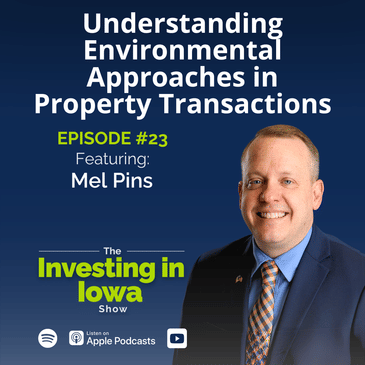
Thinking about buying or developing property in Iowa? Mel Pins spills the beans on everything from pesky environmental regulations to turning those brownfield eyesores into goldmines. Learn how to navigate site assessments, dodge potential liabilities, and make your next project a green success story.
What you'll learn from this episode
-
The role of environmental due diligence in Iowa real estate transactions
-
How to conduct and understand Phase One and Phase Two environmental site assessments
-
Opportunities and challenges of redeveloping brownfield sites
-
Key considerations for property owners dealing with contamination
-
Available financial assistance for developers through tax credits and grants
Resources mentioned in this episode
About Mel Pins
Mel Pins has 32 years of professional experience in environmental regulatory compliance and public policy, with a strong focus on environmental issues in real estate transactions and economic redevelopment projects. He has extensive expertise in managing solid waste and recycling issues. In his current role at the Iowa Department of Natural Resources (DNR), where he has served for 19 years, Mel is also involved in the recruitment and facilitation of human resource and hiring processes. His deep knowledge of environmental regulations and public policy makes him a key resource for developers, landowners, and local governments navigating complex environmental challenges in real estate and redevelopment projects.
Connect with Mel
-
Website: Iowa DNR
-
LinkedIn: Mel Pins
-
Email: Mel.Pins@dnr.iowa.gov
-
Phone: 515-729-4616
Connect with us
For more insights and updates, follow us on social media and visit our website: https://theinvestinginiowashow.com/.
[00:00:00] [SPEAKER_04]: It's easier to deal with something when it's not a big surprise.
[00:00:02] [SPEAKER_04]: It's a lot easier, we understand ahead of time, much like the used car.
[00:00:07] [SPEAKER_04]: I know I'm going to have to put some money into it to fix it up, to use it the way I
[00:00:10] [SPEAKER_04]: want, plan for it ahead of time and we can be here to help guide that.
[00:00:15] [SPEAKER_00]: From cornfields to high rises, office to industrial, houses to hotels and every other
[00:00:20] [SPEAKER_00]: asset class in real estate, we cover the people, the projects and the profit.
[00:00:25] [SPEAKER_00]: Welcome to The Investing in Iowa Show.
[00:00:28] [SPEAKER_00]: This show is for go-doers, action takers and business owners.
[00:00:32] [SPEAKER_00]: It's for people like you who are sick of Uncle Sam taking a huge bite of your apple.
[00:00:37] [SPEAKER_00]: If you're looking to get ahead of what's taking place in Iowa, learn who is doing
[00:00:41] [SPEAKER_00]: what and how you can get in on the action.
[00:00:44] [SPEAKER_00]: You're in the right place.
[00:00:46] [SPEAKER_00]: Posted by Neil Timmins, an Iowa native who has been involved in over $300 million
[00:00:51] [SPEAKER_00]: dollars in real estate, right here in Iowa.
[00:00:54] [SPEAKER_00]: Recording in studio from West Des Moines, here's your host Neil Timmins.
[00:01:00] [SPEAKER_00]: I've got Mel Pins here on this show.
[00:01:02] [SPEAKER_03]: Mel, welcome.
[00:01:03] [SPEAKER_03]: Good afternoon, Neil.
[00:01:04] [SPEAKER_03]: Glad to be with you today.
[00:01:05] [SPEAKER_03]: You're here.
[00:01:06] [SPEAKER_03]: Say for the audience to say who are you, where are you from, what do you do?
[00:01:08] [SPEAKER_04]: Sure.
[00:01:09] [SPEAKER_04]: Well, again, Mel Pins kind of a Des Moines area native, but I'm an urban
[00:01:13] [SPEAKER_04]: planner by degree.
[00:01:14] [SPEAKER_04]: But I have spent all of my 30 plus year career working with environmental
[00:01:18] [SPEAKER_04]: regulations.
[00:01:20] [SPEAKER_04]: The last 20 of that has been at the Iowa Department of Natural Resources.
[00:01:24] [SPEAKER_04]: And at the DNR, I help developers, landowners, buyers, purchasers with
[00:01:30] [SPEAKER_04]: questions I have about environmental liability.
[00:01:33] [SPEAKER_04]: I actually have some assistance that I can provide to local governments
[00:01:37] [SPEAKER_04]: and nonprofits with some grants.
[00:01:39] [SPEAKER_04]: But it's kind of a topic that most people don't like to talk about.
[00:01:43] [SPEAKER_04]: But I certainly love to talk about it if people have questions.
[00:01:46] [SPEAKER_03]: You and I connected here a few months back.
[00:01:49] [SPEAKER_03]: I heard you speak at a breakfast at IKRIA.
[00:01:52] [SPEAKER_03]: Sure.
[00:01:52] [SPEAKER_03]: And as we were rolling out the show, I thought Mel's got to come on because
[00:01:56] [SPEAKER_03]: what you shared there, we're going to certainly get into a whole bunch of it
[00:01:59] [SPEAKER_03]: today is I think of tremendous value to those who buy real estate in Iowa.
[00:02:04] [SPEAKER_03]: Whether you think you have environmental problem or you don't, you
[00:02:08] [SPEAKER_03]: need to have an understanding about what are some of the risks out there?
[00:02:11] [SPEAKER_03]: What are some of the pitfalls and what you should be doing as proper
[00:02:14] [SPEAKER_03]: buyer due diligence.
[00:02:16] [SPEAKER_03]: Mm-hmm.
[00:02:17] [SPEAKER_03]: Through the process.
[00:02:18] [SPEAKER_03]: Sure.
[00:02:18] [SPEAKER_03]: Let's start here.
[00:02:19] [SPEAKER_03]: Is there any sort of environmental due diligence that the state even requires
[00:02:24] [SPEAKER_03]: for a buyer when they will purchase a property?
[00:02:26] [SPEAKER_04]: That's a fundamental question.
[00:02:28] [SPEAKER_04]: It's a good one.
[00:02:29] [SPEAKER_04]: There's a lot of assumptions with that.
[00:02:31] [SPEAKER_04]: Basically, the simple answer is no, you can buy, sell and trade real estate
[00:02:36] [SPEAKER_04]: all day long in the state of Iowa.
[00:02:38] [SPEAKER_04]: The DNR does not require any kind of environmental assessment prior to
[00:02:43] [SPEAKER_04]: property transactions.
[00:02:44] [SPEAKER_04]: The only thing there is in state law is what's called the groundwater hazard
[00:02:48] [SPEAKER_04]: statement and it's been around for decades.
[00:02:51] [SPEAKER_04]: Everybody sees it, sometimes it's been a check the box, move it on.
[00:02:55] [SPEAKER_04]: But the fundamental behind that is in Iowa law, a seller is required to
[00:03:01] [SPEAKER_04]: disclose any known information that they have as their common knowledge
[00:03:06] [SPEAKER_04]: about any weird things that might be present on the site like any old
[00:03:11] [SPEAKER_04]: landfills or dumps, any underground storage tanks, any wells or
[00:03:16] [SPEAKER_04]: cisterns or by golly even a buried body like literally.
[00:03:20] [SPEAKER_04]: Are there any graves on the property?
[00:03:22] [SPEAKER_04]: But it's only to the best of their knowledge.
[00:03:25] [SPEAKER_04]: So if I have a warehouse that's been around 80 years and I'm going
[00:03:28] [SPEAKER_04]: to sell it on the groundwater hazard statement, it used to be you
[00:03:32] [SPEAKER_04]: fill out a form and you said, nope, nope, nope, don't know about
[00:03:35] [SPEAKER_04]: that.
[00:03:35] [SPEAKER_04]: And you turned it over to the seller.
[00:03:37] [SPEAKER_04]: They looked at it for a few seconds and you moved on.
[00:03:39] [SPEAKER_04]: Now there have been some changes to simplify that process.
[00:03:43] [SPEAKER_04]: About three years ago, the Iowa legislature made some changes.
[00:03:47] [SPEAKER_04]: It used to be no matter what the transaction was, whether it was a
[00:03:50] [SPEAKER_04]: house, an empty lot, a garage or an industrial site, the whole
[00:03:54] [SPEAKER_04]: groundwater hazard statement form and document had to be completed
[00:03:58] [SPEAKER_04]: and recorded as part of that deed transfer.
[00:04:01] [SPEAKER_04]: That was a lot of paperwork taken up a lot of space at the
[00:04:04] [SPEAKER_04]: county recorders.
[00:04:05] [SPEAKER_04]: So they changed the state law.
[00:04:07] [SPEAKER_04]: If you're not aware of any of these kind of issues, there's
[00:04:11] [SPEAKER_04]: some boilerplate language that goes into the transfer deed and
[00:04:14] [SPEAKER_04]: just says we're not aware of anything.
[00:04:16] [SPEAKER_04]: And you're done.
[00:04:17] [SPEAKER_04]: If there are issues to disclose, then you do complete the
[00:04:21] [SPEAKER_04]: form and that form is recorded.
[00:04:24] [SPEAKER_04]: But that is the fundamental it in Iowa law for anything related
[00:04:29] [SPEAKER_04]: to environmental disclosure.
[00:04:31] [SPEAKER_04]: That's it.
[00:04:32] [SPEAKER_04]: That's it.
[00:04:33] [SPEAKER_04]: Yeah.
[00:04:33] [SPEAKER_04]: Yeah.
[00:04:34] [SPEAKER_04]: Now there's a big difference between yes, so that nothing else
[00:04:37] [SPEAKER_04]: is really required, but there's certainly a time and a place
[00:04:41] [SPEAKER_04]: where people may want to say, Hey, I want to look a little
[00:04:44] [SPEAKER_04]: closer before I buy this property.
[00:04:46] [SPEAKER_04]: And generally with commercial properties, there's going to be
[00:04:50] [SPEAKER_04]: a lender or an investor or maybe somebody's getting a loan
[00:04:53] [SPEAKER_04]: through the Small Business Administration.
[00:04:55] [SPEAKER_04]: They may have and they do have requirements.
[00:04:58] [SPEAKER_04]: They're like, yes, you will start with what's commonly known
[00:05:02] [SPEAKER_04]: as a phase one environmental site assessment.
[00:05:04] [SPEAKER_04]: And that's also a big misnomer.
[00:05:07] [SPEAKER_04]: People say, well, I did a phase one and I sampled for this
[00:05:10] [SPEAKER_04]: and that.
[00:05:10] [SPEAKER_04]: I'm like, no, you didn't do a phase one then.
[00:05:13] [SPEAKER_04]: A phase one is just the resume of the site's history.
[00:05:16] [SPEAKER_04]: How has it been developed?
[00:05:17] [SPEAKER_04]: Are there any known environmental records on it or nearby it?
[00:05:21] [SPEAKER_04]: Kind of like your medical history report, your FICO score.
[00:05:24] [SPEAKER_04]: But if a phase one would say, well, this used to be a
[00:05:27] [SPEAKER_04]: mercury thermometer factory in the 1950s, just like at the
[00:05:32] [SPEAKER_04]: doctor's office, here is what my history is.
[00:05:35] [SPEAKER_04]: Now we have an idea or you would have an idea what maybe
[00:05:38] [SPEAKER_04]: you should look for.
[00:05:39] [SPEAKER_04]: That's called a phase two and that's subject to the buyer
[00:05:42] [SPEAKER_04]: and the seller negotiating that certain sellers may say,
[00:05:45] [SPEAKER_04]: no, take it as it is.
[00:05:47] [SPEAKER_04]: Other sellers may say, well, if I want to move this in
[00:05:50] [SPEAKER_04]: the marketplace for a decent price, I'm going to have
[00:05:53] [SPEAKER_04]: to let them check this out.
[00:05:55] [SPEAKER_04]: So I would want to sample soil and groundwater for mercury
[00:05:58] [SPEAKER_04]: if I was going to buy the old thermometer fact.
[00:06:01] [SPEAKER_03]: That's right.
[00:06:01] [SPEAKER_03]: Yeah.
[00:06:02] [SPEAKER_03]: So a phase one from the state's perspective, DNR's perspective,
[00:06:05] [SPEAKER_03]: this is all done in the private industry.
[00:06:08] [SPEAKER_03]: Yeah.
[00:06:08] [SPEAKER_03]: DNR is not involved in this there.
[00:06:10] [SPEAKER_03]: You're not issuing phase ones.
[00:06:11] [SPEAKER_03]: It's a private company going and completing a phase one
[00:06:14] [SPEAKER_03]: who's ultimately hired either by the buyer or for the benefit
[00:06:18] [SPEAKER_03]: of the buyer.
[00:06:18] [SPEAKER_03]: Maybe the lender requires that and they're going to hire it done.
[00:06:22] [SPEAKER_04]: Right.
[00:06:22] [SPEAKER_04]: That's a great observation on that too.
[00:06:24] [SPEAKER_04]: Yeah.
[00:06:25] [SPEAKER_04]: The DNR doesn't do phase ones.
[00:06:27] [SPEAKER_04]: We don't review phase ones for more than 30 years.
[00:06:31] [SPEAKER_04]: There's been a national standard on how a phase one is to be
[00:06:34] [SPEAKER_04]: conducted.
[00:06:34] [SPEAKER_04]: There's what's called an ASTM standard, just like you buy
[00:06:37] [SPEAKER_04]: a piece of lumber or a piece of PVC pipe at the home
[00:06:40] [SPEAKER_04]: improvement store ASTM number.
[00:06:42] [SPEAKER_04]: You know how it was built to what quality.
[00:06:44] [SPEAKER_04]: Same thing for conducting a phase one.
[00:06:47] [SPEAKER_04]: It's done to an ASTM standard and an environmental
[00:06:51] [SPEAKER_04]: consulting firm or an environmental engineering firm.
[00:06:54] [SPEAKER_04]: They should know what that ASTM standard is.
[00:06:57] [SPEAKER_04]: If they don't, don't deal with them.
[00:06:59] [SPEAKER_04]: A phase one is not done by just interviewing the owner
[00:07:02] [SPEAKER_04]: about what they know.
[00:07:03] [SPEAKER_04]: It's not done on the back of a notepad.
[00:07:06] [SPEAKER_04]: It's a very defined process because it's supposed to
[00:07:10] [SPEAKER_04]: lead that consultant to do we know of any environmental
[00:07:14] [SPEAKER_04]: conditions that are obvious through records or just
[00:07:17] [SPEAKER_04]: visually observing the site or even based on the
[00:07:20] [SPEAKER_04]: history of the site.
[00:07:21] [SPEAKER_04]: Do we then recommend to confirm or deny it?
[00:07:24] [SPEAKER_04]: And that's what we call a phase two site assessment.
[00:07:27] [SPEAKER_03]: A phase two, you're going to come out, you're taking soil
[00:07:29] [SPEAKER_03]: samples.
[00:07:29] [SPEAKER_03]: What type of either user buyer, they're buying a
[00:07:33] [SPEAKER_03]: particular site.
[00:07:33] [SPEAKER_03]: Sure.
[00:07:34] [SPEAKER_03]: At what point do you typically see that phase
[00:07:36] [SPEAKER_03]: two being done?
[00:07:37] [SPEAKER_03]: I've got some of the things like if you're going
[00:07:39] [SPEAKER_03]: to develop, you want to know what that soil is.
[00:07:42] [SPEAKER_03]: Exactly.
[00:07:42] [SPEAKER_03]: You're going to turn that ground over.
[00:07:44] [SPEAKER_03]: Yes.
[00:07:45] [SPEAKER_03]: If there used to be a gas station there, which
[00:07:47] [SPEAKER_03]: would typically be yielding a phase one, you're
[00:07:50] [SPEAKER_03]: going to want to know.
[00:07:51] [SPEAKER_04]: Right.
[00:07:52] [SPEAKER_04]: Most of the time, yeah, the thing that would trigger
[00:07:54] [SPEAKER_04]: like, yeah, you should probably check this site
[00:07:56] [SPEAKER_04]: out with real sampling.
[00:07:58] [SPEAKER_04]: Certainly if there's all, if the site has already
[00:08:00] [SPEAKER_04]: been developed with any kind of intensive
[00:08:02] [SPEAKER_04]: industrial or commercial activities that either
[00:08:04] [SPEAKER_04]: used or generated hazardous materials.
[00:08:07] [SPEAKER_04]: So easy examples, a gas station site, whether it
[00:08:10] [SPEAKER_04]: was there 10 years ago or is still operating
[00:08:13] [SPEAKER_04]: today.
[00:08:13] [SPEAKER_04]: Dry cleaners for years and decades, the kind
[00:08:16] [SPEAKER_04]: of solvents that were used, they're very
[00:08:18] [SPEAKER_04]: volatile.
[00:08:18] [SPEAKER_04]: In other words, they get out.
[00:08:20] [SPEAKER_04]: They react.
[00:08:21] [SPEAKER_04]: They can also be hazardous to our health if, you
[00:08:23] [SPEAKER_04]: know, there's gross quantities.
[00:08:25] [SPEAKER_04]: So dry cleaning locations, automotive facilities
[00:08:29] [SPEAKER_04]: of any type and certainly manufacturing
[00:08:31] [SPEAKER_04]: industrial that handles that kind of stuff.
[00:08:34] [SPEAKER_04]: Most of the time, let's say if it's a mini
[00:08:36] [SPEAKER_04]: storage unit that's 20 years old and it was
[00:08:38] [SPEAKER_04]: built on a cornfield, the phase one is
[00:08:40] [SPEAKER_04]: probably going to say, hey, there was nothing
[00:08:41] [SPEAKER_04]: here before.
[00:08:42] [SPEAKER_04]: The use is innocuous.
[00:08:44] [SPEAKER_04]: And again, sometimes what's around it is just
[00:08:47] [SPEAKER_04]: as important as the site itself.
[00:08:48] [SPEAKER_04]: Because contamination in groundwater can move
[00:08:51] [SPEAKER_04]: or emanate over to your site.
[00:08:53] [SPEAKER_04]: So you want to hope that such sites are what we
[00:08:56] [SPEAKER_04]: call down gradient from you.
[00:08:57] [SPEAKER_04]: They're down the hill, so things don't roll
[00:09:00] [SPEAKER_04]: uphill.
[00:09:01] [SPEAKER_04]: But those are the kinds of past uses or
[00:09:03] [SPEAKER_04]: industries that are common that would
[00:09:07] [SPEAKER_04]: probably have that consultant recommending
[00:09:09] [SPEAKER_04]: a phase two to confirm or deny contaminants.
[00:09:11] [SPEAKER_04]: Yep.
[00:09:12] [SPEAKER_04]: No, that makes sense.
[00:09:13] [SPEAKER_03]: I'm going to go on a couple other paths.
[00:09:14] [SPEAKER_03]: Maybe one on a ship.
[00:09:15] [SPEAKER_03]: Sure.
[00:09:15] [SPEAKER_03]: So these scenarios, I own a building.
[00:09:18] [SPEAKER_03]: I own a property.
[00:09:20] [SPEAKER_03]: Now all of a sudden it has moved downstream
[00:09:21] [SPEAKER_03]: and I happen to be downstream.
[00:09:23] [SPEAKER_03]: What's my liability?
[00:09:25] [SPEAKER_03]: What's my exposure?
[00:09:25] [SPEAKER_03]: What am I supposed to do?
[00:09:27] [SPEAKER_03]: What happens?
[00:09:28] [SPEAKER_04]: This is the sophomore level of the course.
[00:09:30] [SPEAKER_04]: That's a good question.
[00:09:32] [SPEAKER_04]: So yeah, so if you've got a situation where
[00:09:34] [SPEAKER_04]: you didn't cause a contamination.
[00:09:36] [SPEAKER_04]: So in your example, yeah, it's upgrading.
[00:09:37] [SPEAKER_04]: It was uphill for me, but it's coming down.
[00:09:40] [SPEAKER_04]: So you didn't cause it so you can't be
[00:09:42] [SPEAKER_04]: made to clean it up.
[00:09:43] [SPEAKER_04]: But there's always a big but with these things.
[00:09:46] [SPEAKER_04]: Or I should say, however, however, if you are
[00:09:49] [SPEAKER_04]: aware of the condition, you can't continue to
[00:09:53] [SPEAKER_04]: cause any undue exposures by others.
[00:09:55] [SPEAKER_04]: So we had a situation in, I'll just say a
[00:09:57] [SPEAKER_04]: college town in Iowa where there was an
[00:10:00] [SPEAKER_04]: apartment complex and there had been
[00:10:01] [SPEAKER_04]: an upgrading site and there was some
[00:10:04] [SPEAKER_04]: releases have not way.
[00:10:06] [SPEAKER_04]: So the apartment building, they put in what
[00:10:09] [SPEAKER_04]: we call a vapor mitigation system.
[00:10:11] [SPEAKER_04]: They wanted to make sure any vapors
[00:10:13] [SPEAKER_04]: that came out of the groundwater through
[00:10:14] [SPEAKER_04]: the soil that were getting in the lower
[00:10:15] [SPEAKER_04]: levels that that was vented out much like
[00:10:18] [SPEAKER_04]: a radon vending system.
[00:10:20] [SPEAKER_04]: Not necessarily all that expensive or intrusive,
[00:10:23] [SPEAKER_04]: but because they knew there was an impact,
[00:10:25] [SPEAKER_04]: they didn't want to cause any certainly
[00:10:27] [SPEAKER_04]: even potential health risks to those
[00:10:31] [SPEAKER_04]: renters tenants occupants.
[00:10:33] [SPEAKER_04]: So it's kind of a do care approach
[00:10:36] [SPEAKER_04]: and federal law does recognize that.
[00:10:39] [SPEAKER_04]: But in general, you can't be made to
[00:10:41] [SPEAKER_04]: clean up anything as long as you don't
[00:10:43] [SPEAKER_04]: cause undue exposures or make it worse
[00:10:45] [SPEAKER_04]: through your own activity.
[00:10:46] [SPEAKER_03]: Got it. All right. So new scenario,
[00:10:48] [SPEAKER_03]: buy an old property. It's a gas station.
[00:10:51] [SPEAKER_03]: It clearly has been a gas station.
[00:10:54] [SPEAKER_03]: The convenience store, let's call it
[00:10:55] [SPEAKER_03]: still there. I'm going to turn into a
[00:10:57] [SPEAKER_03]: little trinket shop.
[00:10:58] [SPEAKER_03]: Sure.
[00:10:59] [SPEAKER_03]: What happens? What do I do?
[00:11:00] [SPEAKER_03]: What's my kind of my exposure from that
[00:11:02] [SPEAKER_03]: regard?
[00:11:02] [SPEAKER_04]: Yeah, that's another good scenario.
[00:11:05] [SPEAKER_04]: The first one is knowledge is power.
[00:11:07] [SPEAKER_04]: So with your phase one, if you started
[00:11:09] [SPEAKER_04]: with it, you would have found out, OK,
[00:11:10] [SPEAKER_04]: it was a gas station.
[00:11:12] [SPEAKER_04]: DNR was very involved.
[00:11:14] [SPEAKER_04]: The huge majority of sites we deal
[00:11:16] [SPEAKER_04]: with everybody thinks they like get
[00:11:17] [SPEAKER_04]: cleaned up where they're perfectly clean.
[00:11:20] [SPEAKER_04]: No impact whatsoever.
[00:11:21] [SPEAKER_04]: That's a misnomer.
[00:11:23] [SPEAKER_04]: Sites are cleaned up or risk evaluated
[00:11:26] [SPEAKER_04]: to the point if there's no risk,
[00:11:28] [SPEAKER_04]: then why do further cleanup?
[00:11:30] [SPEAKER_04]: There's not an endless supply of money
[00:11:32] [SPEAKER_04]: and some cleanups would cost more than
[00:11:34] [SPEAKER_04]: the property would ever be worth.
[00:11:36] [SPEAKER_04]: So a lot of gas stations, well,
[00:11:37] [SPEAKER_04]: with the building sitting where it does,
[00:11:39] [SPEAKER_04]: with utilities where they are,
[00:11:42] [SPEAKER_04]: oftentimes the DNR will sign off as no
[00:11:44] [SPEAKER_04]: further action as is.
[00:11:46] [SPEAKER_04]: So if you want to move in and set up a
[00:11:47] [SPEAKER_04]: trinket shop in the same building
[00:11:49] [SPEAKER_04]: and you don't really change anything,
[00:11:51] [SPEAKER_04]: no new exposure, no real risk,
[00:11:54] [SPEAKER_04]: but it's kind of like a used car.
[00:11:56] [SPEAKER_04]: It's not perfect.
[00:11:57] [SPEAKER_04]: It's not brand new.
[00:11:59] [SPEAKER_04]: But if you take care of it properly,
[00:12:01] [SPEAKER_04]: it can still work just fine
[00:12:03] [SPEAKER_04]: and you'll get a good value out
[00:12:06] [SPEAKER_04]: of it probably for a lower price,
[00:12:08] [SPEAKER_04]: just like a used car.
[00:12:09] [SPEAKER_04]: Yeah.
[00:12:10] [SPEAKER_04]: That's the fundamental with that.
[00:12:11] [SPEAKER_04]: But if you wanted to really change
[00:12:13] [SPEAKER_04]: that side around...
[00:12:14] [SPEAKER_03]: Let's go further.
[00:12:14] [SPEAKER_03]: Yeah.
[00:12:15] [SPEAKER_03]: I want to turn this trinket shop into
[00:12:17] [SPEAKER_03]: whatever, you know, a three story
[00:12:19] [SPEAKER_03]: apartment complex.
[00:12:20] [SPEAKER_03]: I'm going to put a few things up.
[00:12:21] [SPEAKER_03]: Yeah.
[00:12:22] [SPEAKER_04]: A little different scenario.
[00:12:23] [SPEAKER_04]: So like we discussed earlier,
[00:12:25] [SPEAKER_04]: if you're going to cause new
[00:12:27] [SPEAKER_04]: exposures or disturbed contaminants,
[00:12:29] [SPEAKER_04]: now you have to think through that one.
[00:12:31] [SPEAKER_04]: So you would want to evaluate
[00:12:33] [SPEAKER_04]: where is the soil contamination?
[00:12:35] [SPEAKER_04]: Where is the groundwater contamination?
[00:12:38] [SPEAKER_04]: So some people with new structures,
[00:12:39] [SPEAKER_04]: they put in what we call a vapor barrier,
[00:12:41] [SPEAKER_04]: pretty much like a big plastic tarp
[00:12:43] [SPEAKER_04]: that's even underneath the foundational cement.
[00:12:46] [SPEAKER_04]: So any vapors that would emanate upwards,
[00:12:48] [SPEAKER_04]: they're vented to the outside of the building
[00:12:50] [SPEAKER_04]: or they have contingency plans
[00:12:52] [SPEAKER_04]: if they dig up contaminated soil,
[00:12:55] [SPEAKER_04]: you can't just throw it in somebody else's backyard.
[00:12:57] [SPEAKER_04]: You're going to have to take it to a proper
[00:12:59] [SPEAKER_04]: landfill for treatment or disposal.
[00:13:02] [SPEAKER_04]: So again, you can plan through these things
[00:13:04] [SPEAKER_04]: and like anything in life,
[00:13:06] [SPEAKER_04]: it's easier to deal with something
[00:13:08] [SPEAKER_04]: when it's not a big surprise.
[00:13:10] [SPEAKER_04]: It's a lot easier.
[00:13:11] [SPEAKER_04]: We understand ahead of time,
[00:13:12] [SPEAKER_04]: much like the used car.
[00:13:14] [SPEAKER_04]: I know I'm going to have to put some money into it
[00:13:16] [SPEAKER_04]: to fix it up, to use it the way I want,
[00:13:18] [SPEAKER_04]: plan for it ahead of time.
[00:13:20] [SPEAKER_04]: And we can be here to help guide that.
[00:13:22] [SPEAKER_04]: That's what the DNR can help you with
[00:13:23] [SPEAKER_04]: is that planning that step by step.
[00:13:26] [SPEAKER_04]: Yeah.
[00:13:26] [SPEAKER_01]: Hi, it's Ava Baukamp,
[00:13:28] [SPEAKER_01]: the investment relations manager
[00:13:29] [SPEAKER_01]: for Neils Firm, legacy impact investors.
[00:13:32] [SPEAKER_01]: I'm inviting you to join us for our next
[00:13:34] [SPEAKER_01]: investor workshop, our monthly legacy briefings.
[00:13:37] [SPEAKER_01]: In these tactical Zoom calls,
[00:13:39] [SPEAKER_01]: we cover topics and case studies
[00:13:40] [SPEAKER_01]: for subjects such as taxes and depreciation,
[00:13:43] [SPEAKER_01]: navigating macroeconomic shifts
[00:13:45] [SPEAKER_01]: and evaluating deals as a passive investor.
[00:13:48] [SPEAKER_01]: At each virtual workshop,
[00:13:50] [SPEAKER_01]: we are joined by an industry guest
[00:13:51] [SPEAKER_01]: who covers their topic in 45 minutes or less.
[00:13:55] [SPEAKER_01]: No fluff, no pitches,
[00:13:57] [SPEAKER_01]: just education and conversation
[00:13:58] [SPEAKER_01]: with an expert each month.
[00:14:00] [SPEAKER_01]: Every workshop ends with live Q&A
[00:14:02] [SPEAKER_01]: from Neil and our guest.
[00:14:04] [SPEAKER_01]: All briefings happen on the last
[00:14:06] [SPEAKER_01]: Tuesday of the month at 3 p.m. Central.
[00:14:08] [SPEAKER_01]: If you can't make it live,
[00:14:10] [SPEAKER_01]: recordings are sent out exclusively
[00:14:11] [SPEAKER_01]: to those who've registered in advance.
[00:14:14] [SPEAKER_01]: To join us on the last Tuesday
[00:14:15] [SPEAKER_01]: of this month, visit legacybriefing.com.
[00:14:19] [SPEAKER_01]: Go to legacybriefing.com to register.
[00:14:22] [SPEAKER_01]: If you're a first time registrant,
[00:14:23] [SPEAKER_01]: I'll send you a free resource at sign up.
[00:14:26] [SPEAKER_01]: Head to legacybriefing.com
[00:14:27] [SPEAKER_01]: and I'll see you soon.
[00:14:28] [SPEAKER_03]: Where do you see people?
[00:14:30] [SPEAKER_03]: Maybe we got a story too.
[00:14:31] [SPEAKER_03]: Where do you see people?
[00:14:31] [SPEAKER_03]: Certainly who get it right,
[00:14:32] [SPEAKER_03]: they follow this process as you're lining up.
[00:14:35] [SPEAKER_03]: The people who get it wrong.
[00:14:36] [SPEAKER_03]: What are some of the stories
[00:14:37] [SPEAKER_03]: that you've seen that you're going on?
[00:14:39] [SPEAKER_03]: If you just follow the path A,
[00:14:41] [SPEAKER_03]: it does lead to path B.
[00:14:43] [SPEAKER_04]: Yep.
[00:14:45] [SPEAKER_04]: So yeah, kind of not necessarily a huge horror story,
[00:14:47] [SPEAKER_04]: but we did have a business guy
[00:14:49] [SPEAKER_04]: and he wanted to buy an old gas station
[00:14:52] [SPEAKER_04]: and demolish it and build a new building.
[00:14:54] [SPEAKER_04]: Great idea.
[00:14:55] [SPEAKER_04]: He looked up the DNR records.
[00:14:57] [SPEAKER_04]: We have a public database of any site we've been involved with.
[00:15:00] [SPEAKER_04]: He saw that the old gas station had what's called
[00:15:02] [SPEAKER_04]: a no further action certificate and NFA.
[00:15:05] [SPEAKER_04]: And for those familiar with those terms,
[00:15:07] [SPEAKER_04]: some people believe in NFA means,
[00:15:10] [SPEAKER_04]: oh, the site's all clean again.
[00:15:11] [SPEAKER_04]: No.
[00:15:12] [SPEAKER_04]: And NFA just means under our risk review,
[00:15:15] [SPEAKER_04]: as is there's no outstanding risk.
[00:15:18] [SPEAKER_04]: So in our example,
[00:15:20] [SPEAKER_04]: by the existing gas station with an NFA,
[00:15:22] [SPEAKER_04]: put a trinket shop,
[00:15:23] [SPEAKER_04]: you're not changing anything, no big deal.
[00:15:25] [SPEAKER_04]: In this case, they decided to just go full bore.
[00:15:28] [SPEAKER_04]: They tore the building down.
[00:15:29] [SPEAKER_04]: They dug a big hole in the middle of the site somewhere else
[00:15:32] [SPEAKER_04]: for a foundation of a three-story building.
[00:15:35] [SPEAKER_04]: Came up with a lot of stinky dirt.
[00:15:37] [SPEAKER_04]: Green, gray colored dirt
[00:15:39] [SPEAKER_04]: smelled like when the gasoline trucks unloading
[00:15:41] [SPEAKER_04]: at your local convenience store don't like a match.
[00:15:45] [SPEAKER_04]: Somebody called the DNR because it stunk.
[00:15:48] [SPEAKER_04]: And so the DNR came out and we said,
[00:15:49] [SPEAKER_04]: hey, you dug up all this contamination.
[00:15:51] [SPEAKER_04]: You got to deal with it now.
[00:15:53] [SPEAKER_04]: And the property owner developer was very upset
[00:15:56] [SPEAKER_04]: because they thought there was an NFA.
[00:15:58] [SPEAKER_04]: They didn't understand what the NFA meant.
[00:16:02] [SPEAKER_04]: The, I guess you could say contingencies
[00:16:03] [SPEAKER_04]: or the situation of the site itself.
[00:16:06] [SPEAKER_04]: They just saw an NFA on a line
[00:16:08] [SPEAKER_04]: and thought they were good as gold.
[00:16:10] [SPEAKER_04]: So it cost them a little bit more money,
[00:16:12] [SPEAKER_04]: I think is like $30,000.
[00:16:14] [SPEAKER_04]: Now that, of course, on the pro forma,
[00:16:17] [SPEAKER_04]: well, that's another cost.
[00:16:19] [SPEAKER_04]: But once they understood how to deal with it,
[00:16:21] [SPEAKER_04]: they dealt with it, continued on with the construction
[00:16:24] [SPEAKER_04]: and they have a great project today.
[00:16:26] [SPEAKER_04]: So that's kind of the horror story side.
[00:16:29] [SPEAKER_04]: But the other side again is with good planning ahead of time.
[00:16:34] [SPEAKER_04]: Some people do have experience with this.
[00:16:36] [SPEAKER_04]: A lot of developers say, hey, this environmental stuff,
[00:16:40] [SPEAKER_04]: it's just part of the process.
[00:16:41] [SPEAKER_04]: It's just like running the business model.
[00:16:44] [SPEAKER_04]: If you're trying to figure out your,
[00:16:45] [SPEAKER_04]: how much can you get per square foot on leasing?
[00:16:48] [SPEAKER_04]: Right. I know nothing about that.
[00:16:49] [SPEAKER_04]: But you already as a broker, realtor, developer,
[00:16:53] [SPEAKER_04]: you're running numbers on things you know
[00:16:56] [SPEAKER_04]: that are risks for you.
[00:16:58] [SPEAKER_04]: And if those risks look okay,
[00:17:00] [SPEAKER_04]: you can work this environmental stuff
[00:17:02] [SPEAKER_04]: and in essence manage or mitigate that risk.
[00:17:06] [SPEAKER_04]: You don't have to run away.
[00:17:07] [SPEAKER_04]: But we usually fear what we don't know.
[00:17:09] [SPEAKER_04]: Correct.
[00:17:10] [SPEAKER_04]: Yeah. So a lot of people that are great professionals
[00:17:12] [SPEAKER_04]: like you and your clients sometimes
[00:17:14] [SPEAKER_04]: they might go, eh, I don't want to mess with that.
[00:17:16] [SPEAKER_04]: Right.
[00:17:16] [SPEAKER_04]: And they leave these sites behind
[00:17:18] [SPEAKER_04]: and I describe those sites as what we call brown fields.
[00:17:22] [SPEAKER_04]: It's just a general descriptor term,
[00:17:24] [SPEAKER_04]: but there are sites where people have left
[00:17:26] [SPEAKER_04]: them sit late and they're vacant,
[00:17:28] [SPEAKER_04]: think dirty, dingy, rusty, tarnished.
[00:17:30] [SPEAKER_04]: That's a brown field.
[00:17:31] [SPEAKER_04]: So it's easier to go out to maybe
[00:17:33] [SPEAKER_04]: an undeveloped suburban farm field
[00:17:35] [SPEAKER_04]: and build new than to work through
[00:17:38] [SPEAKER_04]: these questions step by step to get to your project.
[00:17:42] [SPEAKER_03]: Is there a list?
[00:17:43] [SPEAKER_03]: Have you identified places that are brown fields in?
[00:17:45] [SPEAKER_03]: I'm wondering either on the for profit side
[00:17:49] [SPEAKER_03]: or the not for profit side.
[00:17:50] [SPEAKER_03]: Are there programs out there that help people
[00:17:53] [SPEAKER_03]: navigate these things and get a project
[00:17:54] [SPEAKER_03]: from start to finish as it relates to the environment?
[00:17:56] [SPEAKER_04]: Sure. So kind of on both parts,
[00:17:58] [SPEAKER_04]: people ask us all the time,
[00:18:00] [SPEAKER_04]: do I have a brown field or tell me how many sites are this?
[00:18:04] [SPEAKER_04]: The databases we do have,
[00:18:05] [SPEAKER_04]: the public databases,
[00:18:06] [SPEAKER_04]: any site where we've obtained environmental data,
[00:18:09] [SPEAKER_04]: where we've reviewed contamination reports
[00:18:11] [SPEAKER_04]: or we had to direct people for cleanup
[00:18:13] [SPEAKER_04]: like the site I referenced, the old gas station.
[00:18:16] [SPEAKER_04]: Yes, we have a database of sites.
[00:18:18] [SPEAKER_04]: We call it the contaminated sites database.
[00:18:20] [SPEAKER_04]: Some aren't really all that contaminated,
[00:18:22] [SPEAKER_04]: but they had a review under that authority.
[00:18:25] [SPEAKER_04]: So those are in there.
[00:18:26] [SPEAKER_04]: But the general descriptor,
[00:18:27] [SPEAKER_04]: do I have a brown field or maybe like
[00:18:29] [SPEAKER_04]: the city of Marshalltown or city of Ames?
[00:18:32] [SPEAKER_04]: How many brown fields are there?
[00:18:34] [SPEAKER_04]: That's on the eye of the beholder.
[00:18:35] [SPEAKER_04]: The East Village in Des Moines
[00:18:37] [SPEAKER_04]: could have contaminated sites.
[00:18:38] [SPEAKER_04]: Are they brown fields?
[00:18:39] [SPEAKER_04]: Likely not.
[00:18:41] [SPEAKER_04]: Things are pretty hot in the East Village
[00:18:42] [SPEAKER_04]: and that's in a good way.
[00:18:44] [SPEAKER_04]: Yeah, right.
[00:18:45] [SPEAKER_04]: But if developers do see,
[00:18:47] [SPEAKER_04]: well I've got a site,
[00:18:48] [SPEAKER_04]: it does have a history with DNR.
[00:18:50] [SPEAKER_04]: There are going to be some speed bumps here
[00:18:52] [SPEAKER_04]: and other developers have said,
[00:18:54] [SPEAKER_04]: no forget it.
[00:18:55] [SPEAKER_04]: There are some programs for assistance at the DNR.
[00:18:59] [SPEAKER_04]: If you're a nonprofit developer
[00:19:01] [SPEAKER_04]: and there are some,
[00:19:02] [SPEAKER_04]: there may be city, county based
[00:19:04] [SPEAKER_04]: neighborhood development corporation in Des Moines is one,
[00:19:07] [SPEAKER_04]: they're a nonprofit developer.
[00:19:08] [SPEAKER_04]: We can help them with some grants to do assessments
[00:19:10] [SPEAKER_04]: or some small grants for smaller cleanups.
[00:19:14] [SPEAKER_04]: But larger developers,
[00:19:16] [SPEAKER_04]: there are some tax credits available
[00:19:17] [SPEAKER_04]: through the Iowa Economic Development Authority.
[00:19:20] [SPEAKER_04]: And those are competitive as a lot of tax credits are.
[00:19:25] [SPEAKER_04]: But if you have what I would call a good site,
[00:19:28] [SPEAKER_04]: which means it's been sitting there late and in the weekend.
[00:19:30] [SPEAKER_03]: A good bad site.
[00:19:31] [SPEAKER_04]: Yeah, a good bad site.
[00:19:32] [SPEAKER_04]: Some people want those.
[00:19:34] [SPEAKER_04]: Yep.
[00:19:34] [SPEAKER_04]: The tax credit program IED has can offer anywhere
[00:19:37] [SPEAKER_04]: from a 12 to 24 percent tax credit reimbursement
[00:19:40] [SPEAKER_04]: on your development project,
[00:19:42] [SPEAKER_04]: all costs demolition, renovation,
[00:19:44] [SPEAKER_04]: environmental and even new construction or remodeling
[00:19:47] [SPEAKER_04]: up to the potential for a million and a half dollars
[00:19:51] [SPEAKER_04]: at the top end.
[00:19:52] [SPEAKER_04]: So 12 to 24 percent up to a million and a half.
[00:19:56] [SPEAKER_04]: That's worth talking about because banks will only loan so much.
[00:20:00] [SPEAKER_04]: Banks don't like to loan on demolition or environmental cleanup.
[00:20:03] [SPEAKER_04]: All right.
[00:20:04] [SPEAKER_04]: Yeah, they like to loan on new construction.
[00:20:06] [SPEAKER_04]: Correct.
[00:20:06] [SPEAKER_04]: So that program has been around for almost 20 years.
[00:20:09] [SPEAKER_04]: Again, it's managed at IEDA but we at the DNR,
[00:20:12] [SPEAKER_04]: we are one of the, in essence, entities that helps review
[00:20:16] [SPEAKER_04]: the tax credits and I do that myself representing DNR.
[00:20:20] [SPEAKER_04]: And I'm so happy that we can help invest in a lot of these projects.
[00:20:24] [SPEAKER_04]: We've had projects from Dyersville to Dubuque and Denison
[00:20:28] [SPEAKER_04]: and everywhere in between.
[00:20:29] [SPEAKER_03]: Well, it's tremendous work because there's a lot of projects.
[00:20:32] [SPEAKER_03]: I can imagine a lot of sites that would just never get touched
[00:20:35] [SPEAKER_03]: without some sort of assistance to be able to move
[00:20:38] [SPEAKER_03]: that a little further along.
[00:20:39] [SPEAKER_04]: Yeah, I always say that the dollar assistance is helpful.
[00:20:42] [SPEAKER_04]: But again, knowledge is power.
[00:20:44] [SPEAKER_04]: I've met some developers that the things we've just talked about,
[00:20:48] [SPEAKER_04]: it was stuff they were scared of, frightened of.
[00:20:51] [SPEAKER_04]: Once they figured it out, then with that confidence,
[00:20:54] [SPEAKER_04]: they can make better informed risk evaluations and march this forward.
[00:21:00] [SPEAKER_04]: Good consultants and there is a role for a good environmental attorney.
[00:21:04] [SPEAKER_04]: No sales pitch here for attorneys.
[00:21:06] [SPEAKER_04]: But if you're dealing with certain properties, especially if they do have
[00:21:10] [SPEAKER_04]: a history or they've been involved in larger federal regulatory history,
[00:21:14] [SPEAKER_04]: the feds have what they call the Superfund program.
[00:21:17] [SPEAKER_04]: Sites that not to rub the term in, but the worst of the worst contaminated
[00:21:21] [SPEAKER_04]: sites, if you're thinking about buying a Superfund site,
[00:21:24] [SPEAKER_04]: you could potentially do that, but you're going to want to take your time
[00:21:27] [SPEAKER_04]: and work with a good environmental attorney.
[00:21:30] [SPEAKER_03]: When somebody gets to that level, it's a pass a DNR at that point.
[00:21:34] [SPEAKER_03]: You're into the Fed at that point.
[00:21:36] [SPEAKER_04]: Depending on what the situation is.
[00:21:38] [SPEAKER_04]: Yeah, a site that still has plenty of potential now owned by the city of Des Moines
[00:21:41] [SPEAKER_04]: is what's called Daico right down there behind Meredith's, right?
[00:21:45] [SPEAKER_04]: Brown Fluor Drive at the Raccoon River.
[00:21:47] [SPEAKER_04]: That's had federal oversight for over 45 years now.
[00:21:50] [SPEAKER_04]: But the DNR has worked closely with the EPA,
[00:21:53] [SPEAKER_04]: City of Des Moines to get that site to move forward.
[00:21:56] [SPEAKER_04]: And for those that have seen it in the past, drive by today,
[00:22:00] [SPEAKER_04]: the buildings are now gone.
[00:22:01] [SPEAKER_04]: There's lots of discussion on some pretty nifty plans.
[00:22:05] [SPEAKER_04]: Some of them are concepts.
[00:22:07] [SPEAKER_04]: Some could come to pass, but there are ways just like that used car.
[00:22:11] [SPEAKER_04]: You can fix it.
[00:22:12] [SPEAKER_04]: You can get value out of it and you can move it down the road again.
[00:22:15] [SPEAKER_04]: So I don't want people to be scared of those things.
[00:22:18] [SPEAKER_04]: It's just the step by step approach.
[00:22:20] [SPEAKER_04]: How'd you get into this line of work?
[00:22:23] [SPEAKER_04]: Well, it's kind of funny.
[00:22:24] [SPEAKER_04]: You ask, I'm an urban planner by degree.
[00:22:27] [SPEAKER_04]: While I was in school at Iowa State, you could kind of focus
[00:22:30] [SPEAKER_04]: your planning studies and there was transportation planning
[00:22:34] [SPEAKER_04]: and historic preservation planning, neighborhood planning.
[00:22:37] [SPEAKER_04]: I chose environmental policy as a track and I was all set to go work
[00:22:41] [SPEAKER_04]: at Polk County.
[00:22:42] [SPEAKER_04]: I worked at their planning office all my summers in college.
[00:22:45] [SPEAKER_04]: Unfortunately, there was a hiring freeze.
[00:22:48] [SPEAKER_04]: The spring I was graduating, there was a horse track where some bonds were due
[00:22:52] [SPEAKER_04]: and there were no table games yet.
[00:22:55] [SPEAKER_04]: And obviously today that's a great success.
[00:22:58] [SPEAKER_04]: But the job I was after that I pretty much thought I had a shoe in
[00:23:01] [SPEAKER_04]: for, there was a hiring freeze.
[00:23:03] [SPEAKER_04]: So with my environmental studies, combined with my planning degree,
[00:23:07] [SPEAKER_04]: there was a growing consulting firm in West Des Moines.
[00:23:10] [SPEAKER_04]: There was a lot of underground storage tank work starting about 30 years ago.
[00:23:13] [SPEAKER_04]: So I started working privately, dealt with the DNR a lot.
[00:23:18] [SPEAKER_04]: Had to go down there for meetings a lot.
[00:23:20] [SPEAKER_04]: And after about five years, I had a position and I'm like, hey,
[00:23:23] [SPEAKER_04]: I'd love to not just help businesses but serve the state of Iowa as a whole.
[00:23:27] [SPEAKER_04]: So I've been there now for 28 years.
[00:23:30] [SPEAKER_04]: Yep. He's been fun.
[00:23:31] [SPEAKER_04]: You grew up here in town.
[00:23:32] [SPEAKER_04]: Yeah. In Iowa.
[00:23:33] [SPEAKER_04]: Yeah, I was born in Des Moines, grew up south of town a bit out in the country.
[00:23:36] [SPEAKER_04]: So I always say I can talk urban or rural depending on my audience.
[00:23:40] [SPEAKER_02]: If you're a house flipper, execute the birth strategy
[00:23:44] [SPEAKER_02]: or do double closings and are in need of money.
[00:23:47] [SPEAKER_02]: Little Guy loans is your go-to lender here in the Des Moines area.
[00:23:51] [SPEAKER_02]: Time is money.
[00:23:52] [SPEAKER_02]: Loan approvals in 24 hours.
[00:23:55] [SPEAKER_02]: Closings in five days.
[00:23:57] [SPEAKER_02]: Little Guy loans was founded by Neil Timmons, an investor just like you.
[00:24:01] [SPEAKER_02]: Since he has been in over 10,000 homes in Des Moines, there's never an appraisal.
[00:24:06] [SPEAKER_02]: Houses, multifamily and commercial property loans up to one million.
[00:24:11] [SPEAKER_02]: Check out www.littleguylones.com.
[00:24:15] [SPEAKER_02]: I'm curious what keeps you here?
[00:24:16] [SPEAKER_03]: If you could have done this anywhere, you chose to go to school a year.
[00:24:19] [SPEAKER_03]: You chose a day a year.
[00:24:20] [SPEAKER_03]: Just served the state.
[00:24:22] [SPEAKER_03]: Yep. Why? What drives that?
[00:24:23] [SPEAKER_03]: What's the fuel?
[00:24:24] [SPEAKER_04]: Well, I was born and raised in Iowa and people often say, Iowa,
[00:24:29] [SPEAKER_04]: why do you live there?
[00:24:30] [SPEAKER_04]: And my response is, I guess I was lucky to be born here.
[00:24:34] [SPEAKER_04]: Iowa just was ranked by US News and World Reports as the sixth best state
[00:24:38] [SPEAKER_04]: in the United States to live in.
[00:24:40] [SPEAKER_04]: We don't have mountains.
[00:24:41] [SPEAKER_04]: We don't have a seashore, but we beat out some states that do.
[00:24:44] [SPEAKER_04]: Quality of life is good here.
[00:24:46] [SPEAKER_04]: Affordability, education, lots of things.
[00:24:49] [SPEAKER_04]: But basically my family was here and even working privately.
[00:24:53] [SPEAKER_04]: My company wanted to send me to Texas, but I had established enough
[00:24:58] [SPEAKER_04]: relationships with business people and just my pride in our state.
[00:25:01] [SPEAKER_04]: I'm just kind of a stubborn, proud Midwest.
[00:25:04] [SPEAKER_04]: So yeah, and Des Moines, if anybody has lived here for any length of time,
[00:25:08] [SPEAKER_04]: then I'm just amazed in the growth, certainly of the Des Moines metro area.
[00:25:12] [SPEAKER_04]: I remember when the Ruan building was built, that was a big deal,
[00:25:16] [SPEAKER_04]: especially since it was brown, rusty steel already.
[00:25:18] [SPEAKER_04]: The day it went up on purpose.
[00:25:21] [SPEAKER_04]: But just the changes in the metro, including this was the end of town
[00:25:25] [SPEAKER_04]: where we're sitting at your office.
[00:25:27] [SPEAKER_04]: Correct.
[00:25:28] [SPEAKER_04]: Yes, at one point.
[00:25:29] [SPEAKER_04]: It's amazing.
[00:25:30] [SPEAKER_04]: Yeah.
[00:25:30] [SPEAKER_04]: But my career at DNR, we have a great agency, great dedicated people,
[00:25:34] [SPEAKER_04]: great leadership.
[00:25:35] [SPEAKER_04]: It seems like yesterday that I started there.
[00:25:38] [SPEAKER_04]: So if you like your job, time passes quickly.
[00:25:41] [SPEAKER_03]: There's no doubt about that.
[00:25:42] [SPEAKER_03]: What has been one of the biggest changes since you've started to wear
[00:25:46] [SPEAKER_03]: things sit today?
[00:25:47] [SPEAKER_03]: What have been a couple of the biggest changes that you've seen
[00:25:49] [SPEAKER_03]: in the DNR, in the state, perhaps in the real estate development world?
[00:25:54] [SPEAKER_03]: Maybe some of the interactions.
[00:25:55] [SPEAKER_03]: Sure.
[00:25:55] [SPEAKER_03]: DNR or the perspective.
[00:25:58] [SPEAKER_04]: Boy, those are some good ones.
[00:26:00] [SPEAKER_04]: I could certainly ponder and probably come up with a list, but a couple
[00:26:04] [SPEAKER_04]: of ones that really stick out.
[00:26:06] [SPEAKER_04]: It used to be like 20 years ago, we only thought about groundwater.
[00:26:10] [SPEAKER_04]: Contamination and ground wire, an old gas station that leaks benzene,
[00:26:13] [SPEAKER_04]: key component gasoline, and it gets into a city well and people drink it.
[00:26:17] [SPEAKER_04]: We don't want that.
[00:26:18] [SPEAKER_04]: So a lot of the assessment work and risk evaluation was on groundwater
[00:26:23] [SPEAKER_04]: protection and certainly even today, that's obviously hugely important.
[00:26:28] [SPEAKER_04]: But over time it was realized, oh, it's not just groundwater.
[00:26:31] [SPEAKER_04]: Volatile chemicals in groundwater can vaporize.
[00:26:34] [SPEAKER_04]: They turn into what we call vapor intrusion.
[00:26:37] [SPEAKER_04]: So about 20 years ago, vapor intrusion became something, hmm, you may need
[00:26:40] [SPEAKER_04]: to evaluate that, you may need to mitigate that.
[00:26:43] [SPEAKER_04]: But in the last five years, PFAS or PFAS, one of the forever chemicals,
[00:26:49] [SPEAKER_04]: it was used as a fire suppressant.
[00:26:51] [SPEAKER_04]: It's slick.
[00:26:52] [SPEAKER_04]: It was used in Teflon.
[00:26:53] [SPEAKER_04]: In essence, a great chemical for the use it was intended for.
[00:26:58] [SPEAKER_04]: But it doesn't really go away.
[00:26:59] [SPEAKER_04]: It doesn't break down in the environment and by itself in a small quantity,
[00:27:04] [SPEAKER_04]: probably no worry.
[00:27:06] [SPEAKER_04]: But if it would be in a drinking water supply and a concentration that
[00:27:09] [SPEAKER_04]: somebody could have, let's say what we call a chronic exposure, small amounts
[00:27:14] [SPEAKER_04]: over time can lead to risk.
[00:27:17] [SPEAKER_04]: So PFAS is probably what I would call the emerging contaminant.
[00:27:21] [SPEAKER_04]: And under federal law, you know, the current administration and the EPA,
[00:27:26] [SPEAKER_04]: they are promulgating some standards here.
[00:27:29] [SPEAKER_04]: So PFAS will be one of those contaminants that in a phase two, if it was used
[00:27:35] [SPEAKER_04]: or manufactured nearby, that's going to be one that's looked for.
[00:27:39] [SPEAKER_04]: PFAS, PFAS, polyfluoro.
[00:27:41] [SPEAKER_04]: I can't tell you the rest because I can't remember.
[00:27:44] [SPEAKER_03]: Well, it's just like all things.
[00:27:45] [SPEAKER_03]: There's an evolution.
[00:27:46] [SPEAKER_03]: There's a science that continues to evolve.
[00:27:48] [SPEAKER_03]: You have to learn more as a result policy changes.
[00:27:51] [SPEAKER_03]: Right.
[00:27:52] [SPEAKER_04]: But generally speaking, just I'd say three out of four brownfield sites don't
[00:27:57] [SPEAKER_04]: have any issues at all.
[00:27:59] [SPEAKER_04]: And that last quarter, it's just like kind of eating the elephant.
[00:28:03] [SPEAKER_04]: You just start breaking it down.
[00:28:04] [SPEAKER_04]: I've rarely seen a site that can't be safely redeveloped.
[00:28:08] [SPEAKER_04]: So again, I don't want people to be scared.
[00:28:10] [SPEAKER_04]: I just want them to be informed and kind of walk in with some good background.
[00:28:14] [SPEAKER_04]: We have some fact sheets of DNR and some information we can help
[00:28:18] [SPEAKER_04]: explain everything from that groundwater hazard statement to how phase
[00:28:21] [SPEAKER_04]: one's and phase two's work.
[00:28:24] [SPEAKER_04]: So your customers and subscribers can reach out to us.
[00:28:26] [SPEAKER_04]: We'd be glad to help them.
[00:28:28] [SPEAKER_03]: Mel, are you ready for the final three questions?
[00:28:30] [SPEAKER_04]: Yes.
[00:28:30] [SPEAKER_04]: I hope they're even more fun than these.
[00:28:33] [SPEAKER_03]: We're going to see.
[00:28:35] [SPEAKER_03]: These are always exciting.
[00:28:36] [SPEAKER_03]: If you had one piece of advice to your 20 year old self, what would it be?
[00:28:40] [SPEAKER_04]: Oh my, that's a good one.
[00:28:42] [SPEAKER_04]: It would be the advice that I was given by other older people.
[00:28:46] [SPEAKER_04]: Honesty, hard work and dedication.
[00:28:49] [SPEAKER_04]: You show that at every level of anything you do engaging with everyone.
[00:28:54] [SPEAKER_04]: That's the best way to prepare yourself to be an adult and frankly, to be successful.
[00:28:58] [SPEAKER_03]: Yeah.
[00:28:59] [SPEAKER_03]: Two books that changed your life.
[00:29:01] [SPEAKER_04]: Oh boy, that's an even better one.
[00:29:04] [SPEAKER_04]: I would probably say Stephen Ambrose and his book, Citizen Soldiers,
[00:29:10] [SPEAKER_04]: about the World War II soldiers because and it doesn't matter what era or what time.
[00:29:15] [SPEAKER_04]: Citizen soldiers think about the term difficult times in our nation.
[00:29:20] [SPEAKER_04]: Average citizens stepped up, whether they were drafted or whether they signed up and
[00:29:25] [SPEAKER_04]: volunteered, they went and served.
[00:29:27] [SPEAKER_04]: And the citizen soldiers, they started our nation.
[00:29:30] [SPEAKER_04]: They defended our country or I guess the things we were supposed to be founded
[00:29:35] [SPEAKER_04]: on in Civil War and defended our country in two World Wars, a Cold War and
[00:29:40] [SPEAKER_04]: other things here in the last 30 years.
[00:29:42] [SPEAKER_04]: So that's one book.
[00:29:43] [SPEAKER_04]: And the second book, gosh, I would probably say, boy, that's a tough one to
[00:29:48] [SPEAKER_04]: think through because I just love history so much.
[00:29:51] [SPEAKER_04]: I'd probably say just read the Constitution.
[00:29:55] [SPEAKER_04]: And that's not a red or a blue statement.
[00:29:57] [SPEAKER_04]: Read the Constitution.
[00:29:59] [SPEAKER_04]: People talk about the Constitution on both sides, but most of the time they
[00:30:02] [SPEAKER_04]: don't understand what that amendment is.
[00:30:05] [SPEAKER_04]: For us.
[00:30:06] [SPEAKER_04]: And that's not a DNR statement.
[00:30:09] [SPEAKER_03]: All right.
[00:30:10] [SPEAKER_03]: If you were cast away on an island.
[00:30:12] [SPEAKER_03]: Oh man.
[00:30:12] [SPEAKER_03]: Yeah.
[00:30:13] [SPEAKER_03]: You could only get three pieces of data about your business, what you do day in
[00:30:17] [SPEAKER_03]: and day out, three pieces you can get each and every month to know how your
[00:30:21] [SPEAKER_03]: business is running.
[00:30:22] [SPEAKER_03]: Hmm.
[00:30:23] [SPEAKER_04]: Um, okay.
[00:30:25] [SPEAKER_04]: I'll make it very general.
[00:30:26] [SPEAKER_04]: It can still fit exactly what I do or what you do customer satisfaction.
[00:30:30] [SPEAKER_00]: Okay.
[00:30:31] [SPEAKER_04]: I do have people that call us at DNR the way I help them.
[00:30:33] [SPEAKER_04]: They may not like what I say.
[00:30:36] [SPEAKER_04]: It may not be the answer they're looking for, but how you give them
[00:30:39] [SPEAKER_04]: that information and how you help them.
[00:30:41] [SPEAKER_04]: That's still important.
[00:30:42] [SPEAKER_03]: Yes.
[00:30:42] [SPEAKER_04]: You know, a doctor's bedside manner, no matter what they tell you, still important.
[00:30:46] [SPEAKER_04]: So I'd probably say, yeah, customer feedback and then am I meeting my goals
[00:30:52] [SPEAKER_04]: for either what's my profit margin or in my case, what am I here to do?
[00:30:58] [SPEAKER_04]: What I'm here to do is help get those brownfield sites redeveloped.
[00:31:01] [SPEAKER_04]: So I want my reports back on my metrics is my work making that difference.
[00:31:06] [SPEAKER_04]: And then the third one, what kind of bonus do I get?
[00:31:09] I love it.
[00:31:11] [SPEAKER_03]: I love it.
[00:31:12] [SPEAKER_03]: I've got a lot of questions.
[00:31:14] [SPEAKER_03]: What's one question I did not ask, but I should have asked.
[00:31:18] [SPEAKER_04]: Yeah.
[00:31:18] [SPEAKER_04]: Well, I would probably say this when it comes to environmental data,
[00:31:21] [SPEAKER_04]: I'll just kind of cover my bases on this.
[00:31:23] [SPEAKER_04]: There is a lot of environmental assessment done in the state of Iowa.
[00:31:27] [SPEAKER_04]: I know the DNR doesn't see every one that is done most of the time.
[00:31:32] [SPEAKER_04]: Residual contaminants can be found everywhere, but I do tell people,
[00:31:35] [SPEAKER_04]: you know what?
[00:31:36] [SPEAKER_04]: If you think you found something, there's an obligation
[00:31:38] [SPEAKER_04]: in Iowa law to let us know.
[00:31:41] [SPEAKER_04]: Yeah, if somebody finds contamination where it could be an immediate
[00:31:44] [SPEAKER_04]: or a likely hazardous condition, the Iowa law says you have to notify DNR.
[00:31:49] [SPEAKER_04]: We've had people before that, well, our attorney says
[00:31:54] [SPEAKER_04]: if we don't like the data, we can walk away from the deal.
[00:31:57] [SPEAKER_04]: They can walk away.
[00:31:58] [SPEAKER_04]: Nobody says anything.
[00:32:00] [SPEAKER_04]: Sometimes those what they call non-disclosure agreements,
[00:32:03] [SPEAKER_04]: those really don't apply to state or federal law.
[00:32:05] [SPEAKER_04]: So I always say when in doubt, it's better to report.
[00:32:09] [SPEAKER_04]: And I'll leave you with this another example, but change the names.
[00:32:12] [SPEAKER_04]: I got a call on a Friday afternoon where a potential property developer
[00:32:16] [SPEAKER_04]: said, well, I'm developing some farm ground and I found an old rusty
[00:32:21] [SPEAKER_04]: drum. Is that a big deal?
[00:32:23] [SPEAKER_04]: So is there any green ooze coming out of it?
[00:32:25] [SPEAKER_04]: No.
[00:32:26] [SPEAKER_04]: I said, eh, those lay around on the barbed wire fence sides or the
[00:32:29] [SPEAKER_04]: back 40 all the time.
[00:32:31] [SPEAKER_04]: What if I found two or three?
[00:32:32] [SPEAKER_04]: Well, what's in them?
[00:32:34] [SPEAKER_04]: Well, I don't know.
[00:32:35] [SPEAKER_04]: Well, again, you know, there's just a couple of three sitting around still
[00:32:39] [SPEAKER_04]: maybe no big deal.
[00:32:40] [SPEAKER_04]: Well, what if there's like a dozen buried drums?
[00:32:43] [SPEAKER_04]: I said, well, you know what?
[00:32:44] [SPEAKER_04]: You probably want to call us.
[00:32:46] [SPEAKER_04]: So this was a Friday afternoon and he said, thank you.
[00:32:49] [SPEAKER_04]: They called Tuesday and we found an illegal burial disposal site
[00:32:55] [SPEAKER_04]: of some hazardous waste drums where a housing development was going to go in.
[00:32:59] [SPEAKER_04]: We determined where that waste was originated.
[00:33:02] [SPEAKER_04]: The company that generated the waste had followed everything they were supposed
[00:33:06] [SPEAKER_04]: to the person that illegally dispose of it was no longer around like on the planet.
[00:33:12] [SPEAKER_04]: But the company stepped up and said, hey, let's just get this figured out.
[00:33:16] [SPEAKER_04]: It was solved within two weeks.
[00:33:18] [SPEAKER_04]: So even with something like that, again, it's better to disclose, let us work
[00:33:23] [SPEAKER_04]: with you, let's figure this out together.
[00:33:25] [SPEAKER_04]: We aren't trying to come down like a thousand pound sledgehammer on anyone.
[00:33:29] [SPEAKER_04]: If you're trying to do the right thing, we're going to do the right thing with you.
[00:33:33] [SPEAKER_03]: Mel, for people they want to find you, they want to follow you,
[00:33:35] [SPEAKER_03]: they want to connect with you, work share, what should they do?
[00:33:37] [SPEAKER_04]: Yeah, a couple easy ones.
[00:33:39] [SPEAKER_04]: I'm Jen Axler, so the easiest one is call me.
[00:33:42] [SPEAKER_04]: So Mel pins just like it sounds PIN has DNR at 515-729-4616.
[00:33:49] [SPEAKER_04]: If your podcast allows, I'll have my email address there.
[00:33:52] [SPEAKER_04]: We have a general website DNR type in brownfields.
[00:33:55] [SPEAKER_04]: You can find me and I'm also on LinkedIn with all my contact info.
[00:33:59] [SPEAKER_04]: Links and email address below in the show notes.
[00:34:01] [SPEAKER_03]: Everybody Mel, I appreciate coming.
[00:34:03] [SPEAKER_03]: Thank you very much, Neil.
[00:34:04] [SPEAKER_03]: Glad to be here.
[00:34:05] [SPEAKER_03]: Thanks for listening.
[00:34:06] [SPEAKER_03]: If you're enjoying the show, may I ask a favor of you?
[00:34:09] [SPEAKER_03]: Naturally, subscribe so you never miss an episode.
[00:34:12] [SPEAKER_03]: But would you rate and leave an honest written review on Apple podcasts?
[00:34:16] [SPEAKER_03]: Does a lot force here at the show?
[00:34:18] [SPEAKER_03]: And I appreciate reading your thoughts.
[00:34:20] [SPEAKER_03]: Great guests make for a great show.
[00:34:22] [SPEAKER_03]: If you know of another island who would be a great guest or you yourself
[00:34:27] [SPEAKER_03]: have interest in being a guest, well get on our radar.
[00:34:30] [SPEAKER_03]: Visit investing in Iowa to fill out an application or recommend a guest.
[00:34:35] [SPEAKER_03]: And if you want to connect with me one-on-one, go legacyimpactinvestors.com.
[00:34:41] [SPEAKER_03]: Click on the invest with us button in the top right corner.
[00:34:44] [SPEAKER_03]: And there you can pick a time for the two of us to get on the calendar and connect.
[00:34:48] [SPEAKER_03]: Until next time, keep investing in Iowa.