
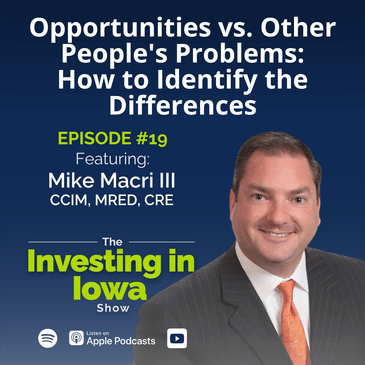
Elevate your real estate game with insights from Mike Macri III CCIM, MRED, CRE, who brings over two decades of industry expertise to the discussion. He delves into housing market dynamics, leveraging educational institutions and exploring non-traditional sectors that can transform your investing and professional growth approach.
What you'll learn from this episode
-
Factors influencing investment decisions and the fluid nature of commercial real estate markets
-
The importance of tailored investment strategies based on individual goals
-
Investment approaches when facing economic events affecting real estate markets
-
How educational programs prepare students for real-world challenges in property investment
-
Unique investment opportunities in non-traditional sectors
About Mike Macri III CCIM, MRED, CRE
Mike Macri, III, graduated from the University of Iowa's Tippie College of Business in 2002 and quickly moved to become a top-producing agent within the Iowa Market. Mike recently joined CBRE, bringing his well-built reputation for creative and critical thinking, which exemplifies his professionalism and ability to solve complex problems. He is responsible for nearly 2.0 million SF of development projects and properties in Iowa and the Des Moines metropolitan area on behalf of various Landlords and developers. In addition, Mike has built a working relationship with many investors, tenants, government agencies, and developers nationwide and with employees locally and globally. Mike currently serves as the Director of Real Estate for Business Transition Solutions for both the State and National site selections and consulting for numerous Developers and Investors. Mike also serves as a principal at PWM Companies, LLC, a commercial real estate development company based in North Liberty, IA.
Connect with Mike
-
LinkedIn: Mike Macri III, CCIM, MRED
Connect with us
For more insights and updates, follow us on social media and visit our website: https://theinvestinginiowashow.com/.
[00:00:00] [SPEAKER_04]: If incomes go up or interest rates decrease, all it's going to do is spark pent-up demand, and that pent-up demand is only going to increase prices. So if interest rates go down, it will be a benefit for some, it will be a hindrance for others.
[00:00:12] [SPEAKER_02]: From cornfields to high-rises, office to industrial, houses to hotels, and every other asset class in real estate, we cover the people, the projects, and the profit. Welcome to the Investing in Iowa Show.
[00:00:24] [SPEAKER_02]: This show is for go-doers, action-takers, and business owners. It's for people like you who are sick of Uncle Sam taking a huge bite of your apple.
[00:00:34] [SPEAKER_02]: If you're looking to get ahead of what's taking place in Iowa, learn who is doing what and how you can get in on the action. You're in the right place.
[00:00:43] [SPEAKER_02]: Hosted by Neil Timmins, an Iowa native who has been involved in over $300 million in real estate right here in Iowa.
[00:00:51] [SPEAKER_02]: Recording in studio from West Des Moines, here's your host, Neil Timmins.
[00:00:57] [SPEAKER_03]: I've got Mike McCree here on the show. Mike, welcome.
[00:00:59] [SPEAKER_02]: Thanks, Neil.
[00:00:59] [SPEAKER_03]: Good to be here.
[00:01:00] [SPEAKER_03]: It's good to have you here. Say, for the audience's sake, who are you? Where are you from? What do you do?
[00:01:04] [SPEAKER_04]: Yep. So, I'm Mike McCree, born and raised here in Des Moines. Been in commercial real estate brokerage now, getting close to 22 years.
[00:01:11] [SPEAKER_04]: From Des Moines, did my undergrad at University of Iowa. Did a graduate, the MRAD program at Iowa State University.
[00:01:17] [SPEAKER_04]: Been in real estate pretty much my whole life, whether I wanted to or not.
[00:01:20] [SPEAKER_03]: Yeah. Well, let's talk about that. How did you get into it?
[00:01:22] [SPEAKER_04]: So, started out in finance at Iowa and coming out of that, did an internship coming out of school and decided that was where I wanted to be.
[00:01:31] [SPEAKER_04]: Now, the reason for the internship was because my family's involvement in real estate.
[00:01:35] [SPEAKER_04]: So, father, grandfather were both in commercial real estate development as well.
[00:01:39] [SPEAKER_04]: Got me into it and then swore I'd never do it. And then here I am 20 some odd years later still doing it.
[00:01:45] [SPEAKER_03]: That's incredible.
[00:01:46] [SPEAKER_03]: How did you swear you were never going to do it?
[00:01:47] [SPEAKER_04]: So, I was a finance major focusing on derivatives.
[00:01:50] [SPEAKER_04]: So, I was actually focusing on commercial mortgage-backed securities back when nobody knew what that was.
[00:01:55] [SPEAKER_04]: And coming out of school, I was going to work for a group on the West Coast.
[00:02:00] [SPEAKER_04]: Be out of here. I'm gone.
[00:02:01] [SPEAKER_04]: A 9-11 happened and the training center was destroyed.
[00:02:05] [SPEAKER_04]: And so, I didn't have a place to train. Ended up doing an internship then with a real estate broker here in town because my dad said, you got to know at least a broker.
[00:02:14] [SPEAKER_04]: And met him. It was not what I usually had expected.
[00:02:17] [SPEAKER_04]: And then for a class, ironically enough, my senior year, I'd interview an entrepreneur.
[00:02:22] [SPEAKER_04]: I'll go interview him.
[00:02:23] [SPEAKER_04]: So, I interviewed him and that 30-minute interview for a class turned into a three-hour job interview.
[00:02:29] [SPEAKER_04]: And I ended up interning.
[00:02:30] [SPEAKER_04]: And about two weeks into it, I'm like, yeah, I'm just going to do this.
[00:02:33] [SPEAKER_04]: This is going to be it.
[00:02:34] [SPEAKER_03]: This is home.
[00:02:35] [SPEAKER_03]: Yeah.
[00:02:35] [SPEAKER_03]: Yeah.
[00:02:36] [SPEAKER_03]: What did you learn from your father or grandfather as it relates to the business that helped propel you along your career?
[00:02:42] [SPEAKER_04]: So, my grandfather was out of it really when I got into it.
[00:02:47] [SPEAKER_04]: But I spent a lot of time working with my father.
[00:02:49] [SPEAKER_04]: Both just growing up and being in it and then really starting out my career working with him.
[00:02:54] [SPEAKER_04]: More than anything, you can't stop.
[00:02:57] [SPEAKER_04]: You have to keep going.
[00:02:58] [SPEAKER_04]: It's not a nine-to-five business like other jobs.
[00:03:01] [SPEAKER_04]: It is a 24-7, 365.
[00:03:04] [SPEAKER_04]: You're always on.
[00:03:06] [SPEAKER_04]: Even when you're off, it's on.
[00:03:08] [SPEAKER_04]: And I use this as an example of that.
[00:03:11] [SPEAKER_04]: I'm a huge fisherman.
[00:03:12] [SPEAKER_04]: I've been fishing forever.
[00:03:13] [SPEAKER_04]: And I go up to Canada and fish.
[00:03:15] [SPEAKER_04]: We carry a satellite phone with us in the boat.
[00:03:18] [SPEAKER_04]: One for safety and two so I can keep working.
[00:03:21] [SPEAKER_04]: And so, I have a satellite phone in the boat with us.
[00:03:23] [SPEAKER_04]: So, I have been with my father in Canada on a boat jigging for walleyes on a conference call with a client to build a building.
[00:03:30] [SPEAKER_04]: And as one of us would catch a fish, we would pass the phone back and forth to each other.
[00:03:34] [SPEAKER_04]: And going back and forth.
[00:03:36] [SPEAKER_04]: You don't ever stop.
[00:03:38] [SPEAKER_04]: You're always going.
[00:03:39] [SPEAKER_04]: You're always on.
[00:03:40] [SPEAKER_04]: And you're always working, doing something, pushing towards that goal.
[00:03:43] [SPEAKER_04]: Well, what's the goal?
[00:03:45] [SPEAKER_04]: The goal is to establish the client's needs, build a project, whatever it might be.
[00:03:50] [SPEAKER_04]: And you know as well as anybody, that is not a straight line.
[00:03:54] [SPEAKER_03]: No, you're right.
[00:03:55] [SPEAKER_03]: You get whether it's construction or whether it's buying something existing.
[00:03:59] [SPEAKER_03]: You go into a thing with what you believe is a known set of facts.
[00:04:04] [SPEAKER_03]: And then as soon as you start, you realize that all the facts have changed somewhere along the line.
[00:04:09] [SPEAKER_03]: And you've got to learn how to figure out how to navigate it.
[00:04:11] [SPEAKER_04]: Even in just today's market where so many people will look at a building and say, oh, it's seven cap, a six cap, an eight cap.
[00:04:17] [SPEAKER_04]: Oh, I can't make that work.
[00:04:18] [SPEAKER_04]: Well, it really depends on quite a few other factors other than just a cap rate as to whether that project is going to work or not.
[00:04:25] [SPEAKER_04]: It just takes a lot of time.
[00:04:27] [SPEAKER_03]: Isn't that – I always get a chuckle.
[00:04:29] [SPEAKER_03]: I think it's one of the worst questions I wanted to ask, more specifically a broker.
[00:04:32] [SPEAKER_03]: What cap rate do you buy at?
[00:04:33] [SPEAKER_03]: Well, I mean, I'd buy a zero cap.
[00:04:35] [SPEAKER_03]: A building's vacant and you pay a dollar.
[00:04:38] [SPEAKER_03]: Technically, it's a zero cap.
[00:04:39] [SPEAKER_03]: Well, I mean, at some point, the vacancies and all the other things that go along with it that drive the actual income are one set of factors.
[00:04:48] [SPEAKER_03]: And the price is another set of factor.
[00:04:50] [SPEAKER_03]: And the value is another one.
[00:04:52] [SPEAKER_04]: Well, and there's a whole thing too when you're dealing with investment property that people forget about.
[00:04:56] [SPEAKER_04]: And that is one, accelerated appreciation.
[00:04:58] [SPEAKER_04]: And two, 1031 exchanges.
[00:05:00] [SPEAKER_04]: Correct.
[00:05:00] [SPEAKER_04]: If I'm buying a building and it's at a six cap and I'm exchanging out of another building that I bought at a nine cap, that cash flow doesn't work.
[00:05:08] [SPEAKER_04]: Correct.
[00:05:09] [SPEAKER_04]: So if I'm trying to make a cash flow number work on top of changing out an investment, it is not just down to a cap rate.
[00:05:15] [SPEAKER_04]: There are a ton of factors down to creditworthiness, location is – you hear everything in real estate is always location.
[00:05:21] [SPEAKER_04]: But there's so much more to it.
[00:05:23] [SPEAKER_04]: You just always have to be moving and fluid, but understand what your core criteria are.
[00:05:29] [SPEAKER_03]: Talk about that core criteria.
[00:05:31] [SPEAKER_03]: You've dealt with tons of investors over the years.
[00:05:34] [SPEAKER_03]: Yeah.
[00:05:34] [SPEAKER_03]: Helping them acquire property, disposing of property.
[00:05:36] [SPEAKER_03]: What are some of the commonalities among the most successful you've dealt with?
[00:05:42] [SPEAKER_04]: Commonalities would be people to understand what works for them.
[00:05:46] [SPEAKER_04]: What is their minimum cash they want to make each month?
[00:05:50] [SPEAKER_04]: And are they looking for cash each month or are they looking for growth on his investment?
[00:05:56] [SPEAKER_04]: If you're investing in Iowa specifically, you see some appreciation on property, but it's nothing like you see on the coast.
[00:06:02] [SPEAKER_04]: It's really a cash-based investment.
[00:06:04] [SPEAKER_04]: If you're on the coast, you may not get much cash at all, but you're going to see a 3%, 4%, 5%, 7% return on the evaluation every single year just because it exists.
[00:06:14] [SPEAKER_04]: It's a different animal.
[00:06:15] [SPEAKER_04]: And so if you're looking for mainly a return on investment, but the cash is less important for tax reasons or whatever, it changes what you're looking for and changes what you're trying to do.
[00:06:26] [SPEAKER_04]: On the other hand, you may look for a high cash return, but it may have really sketchy tenants and your risk of vacancy may be high.
[00:06:34] [SPEAKER_04]: So you have to play those and work on that all the time.
[00:06:37] [SPEAKER_03]: Dozen different investors.
[00:06:38] [SPEAKER_03]: You're going to have a dozen different criterias for acquisition.
[00:06:42] [SPEAKER_04]: I'll give you an example.
[00:06:43] [SPEAKER_04]: Yeah.
[00:06:43] [SPEAKER_04]: I'm working with various clients right now trying to locate space, and warehouse is a great example of this.
[00:06:49] [SPEAKER_04]: Looking for 40,000 square foot warehouse space.
[00:06:52] [SPEAKER_04]: Okay.
[00:06:52] [SPEAKER_04]: Seems to be fairly ubiquitous, and you can go find one.
[00:06:56] [SPEAKER_04]: You pull up on CoStar or LoopNet or wherever, and there might be 20 of them around.
[00:06:59] [SPEAKER_04]: Okay.
[00:07:00] [SPEAKER_04]: I don't care how big a space, how small a space, what you're doing, what you're looking at.
[00:07:05] [SPEAKER_04]: I don't care what your criterias are.
[00:07:07] [SPEAKER_04]: You're going to have three to five spaces that will ever meet your needs.
[00:07:10] [SPEAKER_04]: That's it.
[00:07:10] [SPEAKER_04]: There's going to be three to five because you're not going to have enough dock doors, too many drive-ins, not enough docks, no office.
[00:07:17] [SPEAKER_04]: It's too expensive.
[00:07:18] [SPEAKER_04]: Taxes are higher than they are across the street.
[00:07:20] [SPEAKER_04]: The location is bad.
[00:07:22] [SPEAKER_04]: There's no outside parks.
[00:07:23] [SPEAKER_04]: You're going to have three to five that are going to be choices.
[00:07:25] [SPEAKER_04]: And when you understand that going in and someone says, look, here's 20 spaces.
[00:07:32] [SPEAKER_04]: Let's whittle it down to five that really, truly will work.
[00:07:36] [SPEAKER_04]: And then let's figure out from those five monetary pricing location how we're going to make these things work.
[00:07:42] [SPEAKER_04]: Even within those five, it's very, very rare to get very close on price.
[00:07:47] [SPEAKER_04]: One is usually way higher, way lower for some reason.
[00:07:50] [SPEAKER_04]: Yeah.
[00:07:50] [SPEAKER_04]: And you got to make those adjustments.
[00:07:52] [SPEAKER_04]: The other thing in kind of getting on that same point is you'll hear this a lot, especially on the residential side.
[00:07:56] [SPEAKER_04]: You'll hear it's a buyer's market or it's a seller's market.
[00:07:59] [SPEAKER_03]: Yeah.
[00:07:59] [SPEAKER_04]: Right.
[00:07:59] [SPEAKER_04]: The dumbest statement.
[00:08:01] [SPEAKER_04]: I cringe.
[00:08:02] [SPEAKER_04]: You know, it's like walking into buy a car and you're kicking the tires.
[00:08:05] [SPEAKER_04]: People will say that just because they think, oh, this is, you know, there's more demand.
[00:08:08] [SPEAKER_04]: There is always demand for something.
[00:08:12] [SPEAKER_04]: And there's always a over sub buy of something.
[00:08:16] [SPEAKER_04]: You may be in a situation where maybe larger office space is harder to lease, but that doesn't mean it's impossible.
[00:08:23] [SPEAKER_04]: It means you're just going to use it for something else or you're going to do something else with it.
[00:08:27] [SPEAKER_04]: The concept of buyer's market and seller's market just absolutely drives me nuts.
[00:08:32] [SPEAKER_04]: Someone will say, well, it's rents for $15 a foot.
[00:08:35] [SPEAKER_04]: Well, let's offer them 10.
[00:08:37] [SPEAKER_04]: I'll make the statement.
[00:08:38] [SPEAKER_04]: I say, you can do that.
[00:08:39] [SPEAKER_04]: Just remember that's a 35% drop and they have a mortgage.
[00:08:43] [SPEAKER_04]: Their bank is requiring a 20% rate of return at a minimum.
[00:08:47] [SPEAKER_04]: And you're carving off 35% from the price.
[00:08:50] [SPEAKER_04]: They are most likely fundamentally just incapable of accepting your offer.
[00:08:57] [SPEAKER_04]: And that concept totally negates the fact that mortgages exist.
[00:09:02] [SPEAKER_03]: I get a kick out of that because certainly you see it in residential all the time and you'll see it typically in small commercial uses where people offer the most ridiculous of things.
[00:09:12] [SPEAKER_03]: You're going, I couldn't do that even if I wanted to do that.
[00:09:15] [SPEAKER_03]: Yeah.
[00:09:16] [SPEAKER_03]: There was an impossibility behind that.
[00:09:18] [SPEAKER_03]: You know, I go back to COVID.
[00:09:19] [SPEAKER_03]: That's what comes to mind.
[00:09:20] [SPEAKER_03]: We had, obviously we had a lot of holdings, but one of the holdings we had was retail-based.
[00:09:25] [SPEAKER_03]: We went to everybody and said, listen, as long as our bank requires us to make a payment each and every month, which they do, you're required to make a payment each and every month.
[00:09:34] [SPEAKER_03]: I would love to give you a reprieve, but if I don't get it, you're not getting it.
[00:09:37] [SPEAKER_03]: It's kind of what you signed up for and just kind of what we signed up for on the mortgage side of things to go put that in place.
[00:09:44] [SPEAKER_04]: I got a kick out of COVID.
[00:09:45] [SPEAKER_04]: You bring that up.
[00:09:46] [SPEAKER_04]: I haven't thought about this for a while.
[00:09:48] [SPEAKER_04]: When COVID hit, you saw the exact playbook from 08 get pulled out of everybody's desk drawers, dusted off, and submitted to the landlords.
[00:09:57] [SPEAKER_04]: Hey, business is down.
[00:09:58] [SPEAKER_04]: We're shut down.
[00:09:59] [SPEAKER_04]: We need X amount of rent relief.
[00:10:01] [SPEAKER_04]: And you saw it come from every single tenant within days of that hitting.
[00:10:06] [SPEAKER_04]: And every single landlord, for the most part, said, no, I can't do that.
[00:10:12] [SPEAKER_04]: The 08 financial crisis playbook was what they were pulling out and trying to go off those same rules and tips and tricks they used back in 08.
[00:10:20] [SPEAKER_04]: It was exactly the same, and it started right away.
[00:10:23] [SPEAKER_04]: As soon as they pulled it out, as soon as they tried to use it, the landlord said, no, we can't do that.
[00:10:27] [SPEAKER_04]: The banks even did the same thing, like you were explaining.
[00:10:29] [SPEAKER_04]: Great example that I remember back from 08 was Lowe's, Lowe's Home Improvement Center.
[00:10:35] [SPEAKER_04]: Sure.
[00:10:36] [SPEAKER_04]: They came to every one of their landlords in 08 and said, look, we need six months of rent-a-beam, but we will immediately execute our option to renew whatever that is in the lease.
[00:10:50] [SPEAKER_04]: We'll do it right now.
[00:10:51] [SPEAKER_04]: And so that might add five, 10 years to the lease, and we'll do it right now.
[00:10:55] [SPEAKER_04]: So you may have three years left with Lowe's, but now you got 13.
[00:10:59] [SPEAKER_04]: The value of that is significantly more.
[00:11:02] [SPEAKER_04]: It's material.
[00:11:02] [SPEAKER_04]: It's material.
[00:11:03] [SPEAKER_04]: And so if you have the cash to be able to pull that off, that's a huge thing.
[00:11:06] [SPEAKER_04]: We saw those similar plans immediately come out with the retail side, especially when COVID hit.
[00:11:12] [SPEAKER_04]: And a lot of the landlords said, I can't.
[00:11:15] [SPEAKER_04]: I'm financially not in the position where I can do that.
[00:11:17] [SPEAKER_04]: My banks won't let me do it.
[00:11:18] [SPEAKER_04]: We just can't pull that off.
[00:11:20] [SPEAKER_03]: What did all of us learn from 08?
[00:11:21] [SPEAKER_03]: Everybody gets a bailout.
[00:11:23] [SPEAKER_03]: And that's what happened in COVID.
[00:11:24] [SPEAKER_03]: Everybody gets a bailout.
[00:11:25] [SPEAKER_03]: I go off on a little rabbit hole.
[00:11:26] [SPEAKER_03]: We get this ridiculous national debt that we just keep kicking the can down the road on.
[00:11:31] [SPEAKER_03]: It appears to me that a safe haven is going to be needed sooner or later.
[00:11:36] [SPEAKER_03]: Real estate has been a staple of this world forever.
[00:11:40] [SPEAKER_03]: It is quite a safe haven, which if you go back to the 80s, somewhere in this period,
[00:11:45] [SPEAKER_03]: I started running analysis about a year ago when interest rates really started moving.
[00:11:49] [SPEAKER_03]: And you'll see interest rates move up, but cap rates do not move up in step-block fashion.
[00:11:54] [SPEAKER_03]: So I got curious to go, and you see this a lot today, certainly in your world, where you've
[00:11:59] [SPEAKER_03]: got negative leverage in place, right?
[00:12:02] [SPEAKER_03]: Meaning the cap rate is lower than the borrowing rate.
[00:12:05] [SPEAKER_03]: Well, I went back in history to go, what were cap rates in the 80s?
[00:12:08] [SPEAKER_03]: Because I was curious.
[00:12:09] [SPEAKER_03]: Well, you may have seen 1984, 85, 86, interest rates vacillated from, let's call it 11,
[00:12:14] [SPEAKER_03]: about 12% to 17, 18, somewhere in that range.
[00:12:17] [SPEAKER_03]: Cap rates barely moved over 10.
[00:12:19] [SPEAKER_03]: There was always a negative leverage component back then.
[00:12:23] [SPEAKER_03]: What were they seeking?
[00:12:24] [SPEAKER_03]: Safe haven, a refuge from inflation and hyperinflation.
[00:12:28] [SPEAKER_04]: I did an analysis where I went back to 2000 when my family was really big into building,
[00:12:34] [SPEAKER_04]: especially flex warehouse.
[00:12:35] [SPEAKER_04]: And at that time, especially right when I was getting into my career, we were renting brand
[00:12:39] [SPEAKER_04]: new 22 foot, 24 foot clear flex warehouse space for about 350 a foot.
[00:12:44] [SPEAKER_04]: Triple net, that's what you're renting it for, okay?
[00:12:46] [SPEAKER_04]: I took that same rental rate and I applied it, the CPI rate of inflation every single year
[00:12:53] [SPEAKER_04]: and I carried it forward.
[00:12:55] [SPEAKER_04]: If you look at that over the last 23 years, from 2000 to 2015, there was no rental rate
[00:13:02] [SPEAKER_04]: growth.
[00:13:02] [SPEAKER_04]: You were still renting warehouse space for 350 a foot up to almost 2015.
[00:13:07] [SPEAKER_04]: And you had zero rental rate growth, but where the landlords are making their money,
[00:13:12] [SPEAKER_04]: decreased interest rates, increased cap rates.
[00:13:14] [SPEAKER_04]: And so they would just refinance and just pull the cash out and refinance.
[00:13:18] [SPEAKER_04]: And that was the value proposition.
[00:13:20] [SPEAKER_04]: You get to 2015 and the lenders started saying, hey, you have to put in rent escalators every
[00:13:27] [SPEAKER_04]: single year.
[00:13:27] [SPEAKER_04]: And starting really after 08, but it was really 10 and 12 we started seeing in this market
[00:13:32] [SPEAKER_04]: where you would have 1% annual every other year, you get a 3%, you know, and now we're
[00:13:38] [SPEAKER_04]: to the point where it's almost 2 and 3% annual.
[00:13:41] [SPEAKER_04]: Right.
[00:13:41] [SPEAKER_04]: It's just assumed in every deal.
[00:13:43] [SPEAKER_04]: You apply back from 2000 rent of 350 a foot, apply that rate of CPI carried forward to this
[00:13:49] [SPEAKER_04]: year.
[00:13:50] [SPEAKER_04]: We're at almost $12 a foot for warehouse space.
[00:13:54] [SPEAKER_04]: Guess what new flex base rents were?
[00:13:56] [SPEAKER_04]: Just shy of 12.
[00:13:57] [SPEAKER_04]: We have not hit equilibrium based on rate of increase.
[00:14:02] [SPEAKER_04]: Based on inflation.
[00:14:02] [SPEAKER_04]: Yeah.
[00:14:02] [SPEAKER_04]: Based on inflation.
[00:14:03] [SPEAKER_04]: What that tells me is one, rent growth ain't slowing down.
[00:14:06] [SPEAKER_04]: Right.
[00:14:06] [SPEAKER_04]: Okay.
[00:14:07] [SPEAKER_04]: Two, construction isn't slowing down because we have not hit that point of equilibrium
[00:14:11] [SPEAKER_04]: where there's more supply than demand.
[00:14:13] [SPEAKER_04]: Good demand.
[00:14:14] [SPEAKER_04]: It's still there.
[00:14:15] [SPEAKER_04]: I don't see anything slowing down.
[00:14:16] [SPEAKER_04]: It's just different than it may have been the last three or four years.
[00:14:19] [SPEAKER_00]: Hi, it's Ava Baukamp, the investment relations manager for Neil's firm, Legacy Impact Investors.
[00:14:25] [SPEAKER_00]: I'm inviting you to join us for our next investor workshop, our monthly legacy briefings.
[00:14:31] [SPEAKER_00]: In these tactical Zoom calls, we cover topics and case studies for subjects such as taxes
[00:14:35] [SPEAKER_00]: and depreciation, navigating macroeconomic shifts, and evaluating deals as a passive investor.
[00:14:41] [SPEAKER_00]: At each virtual workshop, we are joined by an industry guest who covers their topic in 45
[00:14:47] [SPEAKER_00]: minutes or less.
[00:14:48] [SPEAKER_00]: No fluff, no pitches, just education and conversation with an expert each month.
[00:14:54] [SPEAKER_00]: Every workshop ends with live Q&A from Neil and our guest.
[00:14:57] [SPEAKER_00]: All briefings happen on the last Tuesday of the month at 3 p.m. Central.
[00:15:01] [SPEAKER_00]: If you can't make it live, recordings are sent out exclusively to those who've registered
[00:15:06] [SPEAKER_00]: in advance.
[00:15:07] [SPEAKER_00]: To join us on the last Tuesday of this month, visit LegacyBriefing.com.
[00:15:12] [SPEAKER_00]: Go to LegacyBriefing.com to register.
[00:15:15] [SPEAKER_00]: If you're a first-time registrant, I'll send you a free resource at signup.
[00:15:19] [SPEAKER_00]: Head to LegacyBriefing.com and I'll see you soon.
[00:15:22] [SPEAKER_03]: What's interesting is, and let's talk about the new construction side of things.
[00:15:25] [SPEAKER_03]: You do a lot of new construction money development work there.
[00:15:28] [SPEAKER_03]: I keep hearing that construction costs are up and of course, interest rates are up.
[00:15:33] [SPEAKER_03]: And that means in order to go put what's called 100,000 square foot warehouse facility,
[00:15:38] [SPEAKER_03]: bring it out of the ground, finance it to get it stabilized.
[00:15:40] [SPEAKER_03]: You got to be at X number of dollars square foot and tenants today, it's a hard swallow
[00:15:45] [SPEAKER_03]: to get them to pay up for that.
[00:15:47] [SPEAKER_03]: But that is the back end to it.
[00:15:49] [SPEAKER_03]: That's what it costs to build new today and that's what it's going to cost to lease it.
[00:15:52] [SPEAKER_04]: It's funny because that's the same argument.
[00:15:55] [SPEAKER_04]: That's the same issues.
[00:15:57] [SPEAKER_04]: That's the same conversation.
[00:15:59] [SPEAKER_04]: I've had every single day of every single year, my entire life of my career.
[00:16:04] [SPEAKER_04]: In 2000, they were renting space for 350 a foot in new construction.
[00:16:07] [SPEAKER_04]: Existing construction was two bucks a foot.
[00:16:09] [SPEAKER_04]: Why am I paying all this money?
[00:16:11] [SPEAKER_04]: It didn't make any sense.
[00:16:12] [SPEAKER_04]: If you compare the cost of rent or the cost of principal and interest for a building for
[00:16:19] [SPEAKER_04]: most, and I use the term most, most business operators in any part of the country, the
[00:16:25] [SPEAKER_04]: real estate side is less than 10% of their total annual revenue.
[00:16:30] [SPEAKER_04]: Of their revenue.
[00:16:31] [SPEAKER_04]: Trucking and fuel expense is six or seven times that.
[00:16:36] [SPEAKER_04]: Okay.
[00:16:36] [SPEAKER_04]: The real estate is almost a rounding error as compared to what trucking and logistic costs
[00:16:43] [SPEAKER_04]: are.
[00:16:43] [SPEAKER_04]: And so the increase in rent over time really hasn't affected a lot of companies because
[00:16:50] [SPEAKER_04]: they've realized that, okay, it is what it is.
[00:16:53] [SPEAKER_04]: It's still cheaper than whatever.
[00:16:56] [SPEAKER_04]: We can make adjustments to the space.
[00:16:58] [SPEAKER_04]: We can make adjustments to the racking.
[00:17:00] [SPEAKER_04]: We can make adjustments to the functionality and the efficiencies within the building.
[00:17:05] [SPEAKER_04]: Maybe take an inefficient space and make it more efficient, trying to save costs in certain
[00:17:09] [SPEAKER_04]: ways.
[00:17:09] [SPEAKER_04]: But in the grand scheme of things, the real estate costs are almost nothing.
[00:17:14] [SPEAKER_04]: So when a business is looking to lease versus a loan, they have three to five options in
[00:17:21] [SPEAKER_04]: every market they go to that are ever really going to work.
[00:17:23] [SPEAKER_04]: And they have to make then a business decision.
[00:17:26] [SPEAKER_04]: Do I want to be in this market?
[00:17:28] [SPEAKER_04]: This is what it's going to take.
[00:17:30] [SPEAKER_04]: How can I affect my rates?
[00:17:31] [SPEAKER_04]: How can I affect my prices?
[00:17:32] [SPEAKER_04]: On the public side, and I'm going to switch from industrial to retail.
[00:17:37] [SPEAKER_04]: Okay.
[00:17:37] [SPEAKER_04]: On the public side.
[00:17:39] [SPEAKER_04]: Public being the.
[00:17:39] [SPEAKER_04]: Public being the general customer person.
[00:17:41] [SPEAKER_04]: Listen, you're actually starting to see that cost affecting the customers.
[00:17:48] [SPEAKER_04]: Bottom line.
[00:17:49] [SPEAKER_04]: Correct.
[00:17:49] [SPEAKER_04]: You hear it about Starbucks.
[00:17:51] [SPEAKER_04]: You hear it about McDonald's.
[00:17:52] [SPEAKER_03]: Good Lord.
[00:17:52] [SPEAKER_03]: You can go to any retail place.
[00:17:54] [SPEAKER_03]: Go to any.
[00:17:55] [SPEAKER_03]: Certainly any food-based retail.
[00:17:56] [SPEAKER_03]: Yeah.
[00:17:56] [SPEAKER_04]: When you walk out of.
[00:17:57] [SPEAKER_04]: You know things cost more.
[00:17:58] [SPEAKER_04]: You walk out of a fast food restaurant now and it's 15, 16 bucks.
[00:18:01] [SPEAKER_04]: There's something going on.
[00:18:02] [SPEAKER_04]: Yeah.
[00:18:03] [SPEAKER_04]: You know as well as I do.
[00:18:04] [SPEAKER_04]: Freestanding triple net leases, especially restaurants, have been the rave for 10, 12 years.
[00:18:10] [SPEAKER_04]: Correct.
[00:18:10] [SPEAKER_04]: When their buildings are selling for 1,000, 1,200 bucks per foot.
[00:18:14] [SPEAKER_04]: Square foot.
[00:18:15] [SPEAKER_04]: You got to sell a lot of hamburgers.
[00:18:16] [SPEAKER_04]: You know, when you go buy a Caribou or buy a Starbucks and you know they're paying 50,
[00:18:21] [SPEAKER_04]: 60, 70, $100 a foot in rent.
[00:18:23] [SPEAKER_04]: Every single tile on that floor costs that business $100 per year.
[00:18:27] [SPEAKER_04]: Correct.
[00:18:27] [SPEAKER_04]: That's a lot of coffee.
[00:18:29] [SPEAKER_04]: Yep.
[00:18:29] [SPEAKER_04]: You got to sell a lot.
[00:18:30] [SPEAKER_04]: And at some point in time, that price has got to go up just to support that square tile.
[00:18:34] [SPEAKER_03]: You're absolutely right.
[00:18:36] [SPEAKER_03]: On a forward basis, what's that mean?
[00:18:37] [SPEAKER_03]: Where do we think it's going to go over the course of the next one to three years?
[00:18:41] [SPEAKER_04]: You brought it up earlier.
[00:18:43] [SPEAKER_04]: When you pump that much money into an economy and I'm pulling my finance hat out, which is rather dusty,
[00:18:48] [SPEAKER_04]: but I know some base concepts that I still got.
[00:18:51] [SPEAKER_04]: Correct.
[00:18:52] [SPEAKER_04]: You pump that much money into an economy, there's two ways to get out of it.
[00:18:56] [SPEAKER_04]: Raise the interest rates or decrease the money supply.
[00:18:59] [SPEAKER_04]: Yeah.
[00:18:59] [SPEAKER_04]: Only way you decrease the money supply is by shutting down loans or raise the interest rates.
[00:19:03] [SPEAKER_04]: Correct.
[00:19:04] [SPEAKER_04]: And there's 30 some trillion dollars that they still have to try to pull out.
[00:19:09] [SPEAKER_04]: Yep.
[00:19:09] [SPEAKER_04]: They've raised interest rates eight times in two years and it's almost got it to the point where
[00:19:14] [SPEAKER_04]: it's only growing at 3%.
[00:19:15] [SPEAKER_04]: Right.
[00:19:15] [SPEAKER_04]: It's not eight anymore.
[00:19:17] [SPEAKER_04]: Correct.
[00:19:17] [SPEAKER_04]: We haven't decreased the cost at all.
[00:19:20] [SPEAKER_04]: We've just slowed the amount of growth.
[00:19:22] [SPEAKER_04]: Correct.
[00:19:22] [SPEAKER_04]: Even if incomes increase, all that does is make people feel better and so they spend more
[00:19:29] [SPEAKER_04]: and it increases interest.
[00:19:31] [SPEAKER_04]: They have to pull the money out of the economy.
[00:19:32] [SPEAKER_04]: There's only two ways to do that and it's not politically popular in either scenario.
[00:19:37] [SPEAKER_03]: No.
[00:19:37] [SPEAKER_04]: Regardless of party.
[00:19:38] [SPEAKER_03]: Right.
[00:19:39] [SPEAKER_04]: It's just not politically popular.
[00:19:40] [SPEAKER_04]: Correct.
[00:19:40] [SPEAKER_04]: And so they have to figure out how to do it without pissing off everybody.
[00:19:44] [SPEAKER_03]: Oh, all right.
[00:19:45] [SPEAKER_03]: So are we going to see an interest rate decrease this year?
[00:19:48] [SPEAKER_04]: Doesn't matter.
[00:19:49] [SPEAKER_04]: Elaborate on that.
[00:19:50] [SPEAKER_04]: If interest rates decrease, like I said, if incomes go up, if incomes go up or interest
[00:19:54] [SPEAKER_04]: rates decrease, all it's going to do is spark pent-up demand.
[00:19:59] [SPEAKER_04]: Yep.
[00:19:59] [SPEAKER_04]: And that pent-up demand is only going to increase prices because the supply isn't there to support
[00:20:04] [SPEAKER_04]: it.
[00:20:04] [SPEAKER_04]: Right.
[00:20:04] [SPEAKER_04]: So if interest rates go down, it will be a benefit for some, it will be a hindrance for
[00:20:09] [SPEAKER_04]: others.
[00:20:09] [SPEAKER_04]: Right.
[00:20:10] [SPEAKER_04]: I made a, prediction's the wrong word.
[00:20:12] [SPEAKER_04]: I made a comment after 08 that with 08 in that financial crisis, we saw it as a top-down
[00:20:18] [SPEAKER_04]: recession.
[00:20:19] [SPEAKER_04]: Yeah.
[00:20:20] [SPEAKER_04]: Where the top biggest companies got slammed and really worked its way down through the
[00:20:25] [SPEAKER_04]: rest of the economy.
[00:20:25] [SPEAKER_04]: This next one is going to be bottom-up.
[00:20:27] [SPEAKER_04]: Fixed income, lower income populace are going to take the brunt of it because they don't
[00:20:33] [SPEAKER_04]: have the income growth flexibility that a company does where they can change and move
[00:20:39] [SPEAKER_04]: and do things and hire net worth individuals can.
[00:20:41] [SPEAKER_03]: What I hear you saying there is pay somebody 5% of their money market all day long or 6%
[00:20:47] [SPEAKER_03]: in a CD.
[00:20:48] [SPEAKER_03]: But when inflation's 4, 5, 6, 7, 8%, it doesn't matter.
[00:20:52] [SPEAKER_04]: It doesn't matter.
[00:20:52] [SPEAKER_04]: So here's the thing too, with banks and credit unions paying 4 and 5 and 6% on their CDs.
[00:20:57] [SPEAKER_04]: That sounds great.
[00:20:58] [SPEAKER_04]: I'm getting paid on my money.
[00:20:59] [SPEAKER_04]: What you don't realize is that when you go to borrow money, they have to make a profit
[00:21:03] [SPEAKER_04]: over and above that.
[00:21:03] [SPEAKER_04]: Correct.
[00:21:04] [SPEAKER_04]: That's why your interest rates are 7, 8% is because your CD rates, all the money in
[00:21:08] [SPEAKER_04]: the account aren't at 5.
[00:21:10] [SPEAKER_04]: Correct.
[00:21:10] [SPEAKER_04]: CD rates go down.
[00:21:11] [SPEAKER_04]: The cost that the banks have to pay for the funds that are being held.
[00:21:15] [SPEAKER_04]: Yep.
[00:21:15] [SPEAKER_04]: If those go down, you'll see rates come down.
[00:21:17] [SPEAKER_04]: Yeah.
[00:21:18] [SPEAKER_04]: But you're not going to see rates come down because all that's going to do is spike demand.
[00:21:21] [SPEAKER_04]: So what I hear you saying is you're in the hire for longer camp as it relates to interest
[00:21:25] [SPEAKER_03]: rates.
[00:21:26] [SPEAKER_04]: I'm in the hire for longer camp and I'm in the very odd position of it doesn't matter.
[00:21:32] [SPEAKER_04]: It's a weird thing to say.
[00:21:34] [SPEAKER_04]: It sounds ignorant.
[00:21:35] [SPEAKER_04]: It doesn't matter because if rates go down, demand is going to spike.
[00:21:39] [SPEAKER_04]: As soon as demand spikes, the supply that's even there goes away and all of a sudden prices
[00:21:43] [SPEAKER_04]: go up again and now you're in the same position.
[00:21:45] [SPEAKER_04]: Right.
[00:21:45] [SPEAKER_04]: Or if rates stay high, it will decrease the amount of money in the economy, but it hurts
[00:21:50] [SPEAKER_04]: everybody else over here.
[00:21:51] [SPEAKER_04]: You're going to lose either way.
[00:21:53] [SPEAKER_04]: It just depends on which pool are you going to lose from.
[00:21:56] [SPEAKER_03]: So we've been here before.
[00:21:58] [SPEAKER_03]: Interest rates have been here before.
[00:21:59] [SPEAKER_03]: Interest rates have historically been higher than this.
[00:22:02] [SPEAKER_04]: Right.
[00:22:03] [SPEAKER_04]: We're still not bad.
[00:22:05] [SPEAKER_04]: We just have been in a situation where rates have been so low for so long that you've got
[00:22:10] [SPEAKER_04]: decades of investment that's been made at cap rates that are 8% or below that all of a
[00:22:18] [SPEAKER_04]: sudden they're break even.
[00:22:20] [SPEAKER_04]: Right.
[00:22:20] [SPEAKER_04]: If you're looking at somebody that's investing at 8% and they did it 10 years ago, they better
[00:22:24] [SPEAKER_04]: have had some appreciation or they better have had some return from that because you're going
[00:22:29] [SPEAKER_04]: to sell it at equal to what your cap rate was before.
[00:22:33] [SPEAKER_04]: The banks saw this coming.
[00:22:35] [SPEAKER_04]: That's why they started forcing annual rent increases in the leases.
[00:22:40] [SPEAKER_04]: They forced the hands of the landlords to do this.
[00:22:42] [SPEAKER_03]: Well, that's the only way.
[00:22:43] [SPEAKER_03]: At the end of the day, in a cash basis market, in a cash return market, that is the only way
[00:22:50] [SPEAKER_03]: to get growth.
[00:22:51] [SPEAKER_03]: And when we underwrite a deal, it's to that standard to go, okay, if we buy it at X cap,
[00:22:56] [SPEAKER_03]: we're going to sell it at the same cap rate.
[00:22:58] [SPEAKER_03]: Very little we can do affects the cap rate.
[00:23:00] [SPEAKER_03]: How about that?
[00:23:01] [SPEAKER_03]: And at the end of the day, a triple net retail Starbucks, it is what it is.
[00:23:05] [SPEAKER_03]: There's not much you can do.
[00:23:07] [SPEAKER_03]: You can get an extension for the same term, same everything.
[00:23:09] [SPEAKER_03]: It is what it is.
[00:23:10] [SPEAKER_03]: That's all it's ever going to be unless you can find, you know, buy a dented and scratched,
[00:23:14] [SPEAKER_03]: I use that quote, property.
[00:23:16] [SPEAKER_03]: Change the NOI.
[00:23:17] [SPEAKER_04]: Change even the dented and scratched properties though.
[00:23:20] [SPEAKER_04]: You're going to change the NOI.
[00:23:21] [SPEAKER_04]: That change isn't free.
[00:23:23] [SPEAKER_03]: No, it's not free.
[00:23:24] [SPEAKER_04]: Yeah.
[00:23:25] [SPEAKER_04]: You're not just instantaneously.
[00:23:26] [SPEAKER_04]: Oh, I'm going to go from charging five bucks to 15.
[00:23:28] [SPEAKER_04]: There's renovations.
[00:23:29] [SPEAKER_04]: There's releasing costs.
[00:23:31] [SPEAKER_04]: There's costs to acquire the income.
[00:23:32] [SPEAKER_03]: You're absolutely right.
[00:23:33] [SPEAKER_03]: So the only way you get real growth in it is that bottom line has to grow.
[00:23:37] [SPEAKER_03]: It's coming through multitude of things.
[00:23:38] [SPEAKER_03]: But one of those being, as you said, rail rate increases.
[00:23:42] [SPEAKER_03]: Yeah.
[00:23:42] [SPEAKER_03]: That's how you have to do it.
[00:23:43] [SPEAKER_03]: How does this play out?
[00:23:44] [SPEAKER_03]: You and I have talked about this offline.
[00:23:46] [SPEAKER_03]: There's a bunch of people who are in sub 4% commercial mortgages.
[00:23:51] [SPEAKER_03]: The days coming where that five-year balloon rolls and they're coming back on the books
[00:23:55] [SPEAKER_03]: at seven or eight.
[00:23:56] [SPEAKER_03]: And there's a percentage of them, in my opinion.
[00:23:58] [SPEAKER_03]: They're going to be looking at their options to go, okay, we're short on equity.
[00:24:02] [SPEAKER_03]: The bank's going, in order for you to keep this, you've got to write a check.
[00:24:06] [SPEAKER_03]: Some are going to be just fine.
[00:24:07] [SPEAKER_03]: No doubt about it.
[00:24:08] [SPEAKER_03]: They've raised their income enough over a period of time.
[00:24:10] [SPEAKER_03]: They're a fine to value position, loan to value position.
[00:24:13] [SPEAKER_03]: Some are going to have to write a check and some are going to have the check to write.
[00:24:16] [SPEAKER_04]: So there's two things I see happening.
[00:24:18] [SPEAKER_04]: And I'm going to go back to 08 again with one.
[00:24:20] [SPEAKER_04]: I did quite a bit of work in 08 with owner-occupied business owners.
[00:24:27] [SPEAKER_04]: Someone that had always wanted to own their own building, always wanted to be their own landlord.
[00:24:32] [SPEAKER_04]: And they end up with family LLC buying and owning a building.
[00:24:37] [SPEAKER_04]: And then business XYZ rents from the family.
[00:24:41] [SPEAKER_04]: And you're paying yourself.
[00:24:42] [SPEAKER_04]: That's the dream everybody always has, right?
[00:24:45] [SPEAKER_04]: What happened in 08, and it really was 09 and even 10, is people would have bought these buildings and built these buildings in 04, 05, and 06.
[00:24:53] [SPEAKER_04]: They got a 20-year amortization.
[00:24:55] [SPEAKER_04]: They got a five-year note with the bank, okay?
[00:24:58] [SPEAKER_04]: They put 20% down.
[00:24:59] [SPEAKER_04]: They finance the rest.
[00:25:00] [SPEAKER_04]: And they've got a 10-year lease on their building with their own company.
[00:25:04] [SPEAKER_04]: Company's doing fine.
[00:25:05] [SPEAKER_04]: They're growing at least if not being stable.
[00:25:07] [SPEAKER_04]: And they're going to make it through 08 just fine.
[00:25:10] [SPEAKER_04]: Businesses is okay, right?
[00:25:12] [SPEAKER_04]: But five years down the road.
[00:25:13] [SPEAKER_04]: So they built it in 05.
[00:25:14] [SPEAKER_04]: They come out in 010.
[00:25:16] [SPEAKER_04]: All of a sudden, the bank says, well, wait a minute.
[00:25:18] [SPEAKER_04]: Commercial real estate market is really down.
[00:25:20] [SPEAKER_04]: Where valuations are down 30%.
[00:25:22] [SPEAKER_04]: You built this building for a million bucks.
[00:25:25] [SPEAKER_04]: You put $200,000 down.
[00:25:26] [SPEAKER_04]: Well, that million-dollar building is now only worth $700,000.
[00:25:29] [SPEAKER_04]: We're going to refinance you, but I need an extra $150,000.
[00:25:33] [SPEAKER_04]: And the business owner says, I just put everything I had into it to do this.
[00:25:37] [SPEAKER_04]: I can't come up with another $150,000.
[00:25:39] [SPEAKER_04]: And they'll waffle back and forth.
[00:25:42] [SPEAKER_04]: And ultimately, they get called for a technical default, and the bank takes the building back.
[00:25:46] [SPEAKER_04]: And they lose the business because the business is tied to it.
[00:25:49] [SPEAKER_04]: So you lost everything.
[00:25:50] [SPEAKER_04]: That happened much more than you ever want to admit in 08.
[00:25:55] [SPEAKER_04]: You ask where this is going now.
[00:25:57] [SPEAKER_04]: You've got people that bought buildings in the four and five caps, especially in the apartment side.
[00:26:01] [SPEAKER_04]: Their loans are going to come due.
[00:26:03] [SPEAKER_04]: And some of them will be able to cross-collateralize, refinance, do something.
[00:26:07] [SPEAKER_04]: Others just doesn't work.
[00:26:09] [SPEAKER_04]: Right.
[00:26:09] [SPEAKER_04]: And they're going to have to get out of it.
[00:26:11] [SPEAKER_04]: Okay.
[00:26:12] [SPEAKER_04]: That's the unfortunate nature of where we're going.
[00:26:14] [SPEAKER_04]: That's what's going to happen.
[00:26:15] [SPEAKER_04]: Now, we have a unique situation that's happening now that didn't happen in 08.
[00:26:20] [SPEAKER_04]: It happened in 08, but at a completely different level.
[00:26:23] [SPEAKER_04]: We have a situation now where those tenants, those buyers, those owners may be in amazing financial position.
[00:26:30] [SPEAKER_04]: It may be great.
[00:26:31] [SPEAKER_04]: But that loan's coming due.
[00:26:32] [SPEAKER_04]: It has to be refinanced.
[00:26:33] [SPEAKER_04]: The bank literally does not have the cash on the books to do the loan.
[00:26:37] [SPEAKER_04]: To do the loan.
[00:26:38] [SPEAKER_04]: Not that they don't want to.
[00:26:39] [SPEAKER_04]: They can't.
[00:26:40] [SPEAKER_04]: They can't.
[00:26:41] [SPEAKER_04]: Yeah.
[00:26:41] [SPEAKER_04]: The money's not there.
[00:26:42] [SPEAKER_04]: The tenant, the buyer, everybody's done everything right.
[00:26:45] [SPEAKER_04]: The money is not there in cash to actually fulfill the loan obligation.
[00:26:49] [SPEAKER_04]: And so the bank says, I can't do it.
[00:26:52] [SPEAKER_04]: Now you've got to go somewhere else and figure that out.
[00:26:54] [SPEAKER_04]: Right.
[00:26:54] [SPEAKER_04]: That is probably as scary as the alternative.
[00:26:59] [SPEAKER_01]: If you're a house clipper, execute the birth strategy or do double closings and are in need of money.
[00:27:05] [SPEAKER_01]: Little Guy Loans is your go-to lender here in the Des Moines area.
[00:27:08] [SPEAKER_01]: Time is money.
[00:27:10] [SPEAKER_01]: Loan approvals in 24 hours.
[00:27:12] [SPEAKER_01]: Closings in five days.
[00:27:14] [SPEAKER_01]: Little Guy Loans was founded by Neil Timmons, an investor just like you.
[00:27:19] [SPEAKER_01]: Since he has been in over 10,000 homes in Des Moines, there's never an appraisal.
[00:27:27] [SPEAKER_03]: Well, the bank's coffers ran up as we came through COVID for multiple reasons.
[00:27:38] [SPEAKER_03]: One of them is that nobody went anywhere and did anything.
[00:27:41] [SPEAKER_03]: So they saved more money.
[00:27:43] [SPEAKER_03]: In theory.
[00:27:44] [SPEAKER_04]: Yeah.
[00:27:45] [SPEAKER_04]: In theory.
[00:27:45] [SPEAKER_04]: I know this.
[00:27:46] [SPEAKER_04]: I got a lot more Amazon boxes coming to my house now that it did pre-COVID.
[00:27:49] [SPEAKER_03]: No doubt about that.
[00:27:50] [SPEAKER_03]: Banks, you know, just general cash.
[00:27:53] [SPEAKER_03]: In the banks grew.
[00:27:55] [SPEAKER_03]: A whole bunch of bailout money got sent to businesses.
[00:27:59] [SPEAKER_03]: Again, at the end of the day, it ends up in a deposit.
[00:28:01] [SPEAKER_03]: And now you see deposits running off.
[00:28:04] [SPEAKER_03]: People are using their cash.
[00:28:05] [SPEAKER_03]: This is where it's not that the banks have grown in their loans outstanding.
[00:28:11] [SPEAKER_03]: It's that their deposits have shrunk.
[00:28:13] [SPEAKER_04]: There's a, when you think of the deposits of the bank, you have the residential and the commercial side.
[00:28:17] [SPEAKER_04]: Your residential checking account, your family's checks go in there.
[00:28:20] [SPEAKER_04]: You've got what you've got.
[00:28:21] [SPEAKER_04]: Then you have the commercial side where you have high cash businesses, especially, tell me this sounds familiar, restaurants and retail.
[00:28:29] [SPEAKER_04]: And when restaurants or retail now are seeing dips in sales, they're not seeing the traffic that they had before.
[00:28:35] [SPEAKER_04]: They're not making the same cash deposits that they were making a year or two ago.
[00:28:39] [SPEAKER_04]: The cash is in the banks to make the loans for the houses or for the commercial deals or for those things.
[00:28:45] [SPEAKER_04]: And God forbid they have a write-off of some kind.
[00:28:49] [SPEAKER_04]: All that does is just make it even worse.
[00:28:50] [SPEAKER_03]: Any market up, down, or sideways, there's always opportunity.
[00:28:54] [SPEAKER_03]: Where do you see the opportunity in the current market?
[00:28:56] [SPEAKER_04]: So I am seeing the opportunity right now in non-traditional things.
[00:29:02] [SPEAKER_04]: Energy, power, schools, education, the charter schools that are being passed right now.
[00:29:08] [SPEAKER_04]: There's opportunity there.
[00:29:09] [SPEAKER_04]: Okay.
[00:29:09] [SPEAKER_04]: It may not be politically popular depending on which areas you're in, but there's a demand for it.
[00:29:15] [SPEAKER_04]: There is an absolute demand for it and they do good things.
[00:29:19] [SPEAKER_04]: That is going to see changing in how facilities are used.
[00:29:23] [SPEAKER_04]: And it's going to see revitalization in areas that needed to have that opportunity before.
[00:29:28] [SPEAKER_03]: What are you most excited about this year?
[00:29:30] [SPEAKER_04]: I'm most excited about this year, I would say the uniqueness of this year.
[00:29:35] [SPEAKER_04]: I've got more projects, more things on the books that are going now that are very, very unique from what you would see before.
[00:29:42] [SPEAKER_04]: People a lot of times think of commercial real estate as office, retail, industrial, and multifamily.
[00:29:46] [SPEAKER_04]: Okay.
[00:29:47] [SPEAKER_04]: You lose out on all the various other little niches that are out there and things that are opportunities and things that can happen.
[00:29:55] [SPEAKER_04]: When I talk with economic developers and the city officials around the state, because I work all over the state, they are as busy right now as they've ever been, ever.
[00:30:04] [SPEAKER_04]: What's driving that?
[00:30:05] [SPEAKER_04]: There is a lot of growth that is still coming from the coast here and businesses that are located here that are doing very well, but don't worry about where to go.
[00:30:17] [SPEAKER_04]: Yeah.
[00:30:17] [SPEAKER_04]: You've had those mom and pop shops that have been in the same building for 50 years and the same small that was out, and they need to go from 50,000 feet, 600,000 feet.
[00:30:25] [SPEAKER_04]: And they're trying to get it figured out.
[00:30:27] [SPEAKER_04]: They are all over the state.
[00:30:29] [SPEAKER_04]: And the economic officials, obviously, they'll keep a very good poker face.
[00:30:34] [SPEAKER_04]: They're as busy as they've ever been before right now.
[00:30:37] [SPEAKER_04]: Tell me about your work with Iowa State University.
[00:30:39] [SPEAKER_04]: So I did my master's at Iowa State University in the master's of real estate development program.
[00:30:44] [SPEAKER_04]: I was part of the first cohort that graduated in 2001.
[00:30:48] [SPEAKER_04]: I was asked to come back and interview for a position to teach real estate development.
[00:30:52] [SPEAKER_04]: And so I started doing that last fall was my inaugural semester.
[00:30:56] [SPEAKER_04]: And so in the fall, I teach real estate development to the graduate students, both on the finance, design, the engineering, any of the professorial students, and then also the master's of real estate students.
[00:31:08] [SPEAKER_04]: In the springtime, I started teaching it in the college of design to the design and architectural students that were graduating with the intent, at least my intent, to make sure that what is being designed and what is being put out is financeable and actually buildable.
[00:31:21] [SPEAKER_04]: Because sometimes that becomes a problem.
[00:31:23] [SPEAKER_04]: No doubt.
[00:31:24] [SPEAKER_04]: It's not there.
[00:31:24] [SPEAKER_04]: And so my goal is to teach these students coming out.
[00:31:28] [SPEAKER_04]: I use an example of a three-legged stool.
[00:31:30] [SPEAKER_04]: You have to have all three legs in balance, being your finance, your governmental requirements and codes, and your design and engineering.
[00:31:37] [SPEAKER_04]: All three of those have to be in balance for any project to work.
[00:31:40] [SPEAKER_04]: And if you don't have your finances right, nothing else is going to happen.
[00:31:43] [SPEAKER_04]: If you don't have the engineering design right, that's not going to work.
[00:31:46] [SPEAKER_04]: If your codes and your governmental approvals don't work, none of this matters.
[00:31:50] [SPEAKER_04]: So I try to teach real estate development under that overarching concept that you have to have all three.
[00:31:56] [SPEAKER_04]: It's not just about one.
[00:31:58] [SPEAKER_04]: And so I'm teaching basic finance to architects and designers.
[00:32:02] [SPEAKER_04]: So as they're designing office renovations or they're designing build-outs or home site plans, they understand what the minimum finance requirements are going to be for somebody to develop it and what that end buyer is going to have to have.
[00:32:15] [SPEAKER_03]: You could do just about anything and you could do it just about anywhere.
[00:32:19] [SPEAKER_03]: Why do you choose to be here in Iowa?
[00:32:21] [SPEAKER_03]: That's an interesting thought.
[00:32:22] [SPEAKER_04]: And I think of that a lot when I'm sitting on a beach usually.
[00:32:24] [SPEAKER_04]: It's something nice.
[00:32:25] [SPEAKER_04]: Darren Ferguson, who I worked with when I first got started, said something to me and I've never forgot it.
[00:32:30] [SPEAKER_04]: And I will probably use it as a quote forever.
[00:32:32] [SPEAKER_04]: He says, you can be in any market, in any town and work anywhere, but the cost of living here is so much lower.
[00:32:40] [SPEAKER_04]: We have about everything you have in every other market.
[00:32:43] [SPEAKER_04]: Maybe it's a AAA version of it, but we have it.
[00:32:45] [SPEAKER_04]: And we have an airport and I can fly anywhere I want to go and go experience whatever I want to experience and come back and live much less expensively than anywhere else.
[00:32:55] [SPEAKER_04]: Mike, you ready for the final three questions?
[00:32:57] [SPEAKER_04]: Let's go for it.
[00:32:58] [SPEAKER_04]: One piece of advice that you would give to your 20-year-old self?
[00:33:01] [SPEAKER_04]: I'll tell my 20-year-old self the same thing I tell my 20-year-old students, read everything.
[00:33:06] [SPEAKER_04]: And I would tell myself too to stretch more, read everything.
[00:33:09] [SPEAKER_03]: All right.
[00:33:10] [SPEAKER_03]: In that vein, two books that changed your life.
[00:33:12] [SPEAKER_03]: I don't do the books.
[00:33:13] [SPEAKER_03]: So you give advice, but you don't take it.
[00:33:16] [SPEAKER_03]: Is that how this works, Mike?
[00:33:17] [SPEAKER_03]: Here's what I say.
[00:33:18] [SPEAKER_04]: Read everything.
[00:33:19] [SPEAKER_04]: Okay.
[00:33:20] [SPEAKER_04]: I have a personal issue with a lot of the self-help, the advisory books and things.
[00:33:26] [SPEAKER_04]: They don't do a really good job of actually what it is they're trying to do.
[00:33:30] [SPEAKER_04]: I read a ton of periodicals.
[00:33:33] [SPEAKER_04]: I will read medical journals.
[00:33:35] [SPEAKER_04]: I'll read whatever it is about any topic.
[00:33:37] [SPEAKER_04]: But I say read everything.
[00:33:39] [SPEAKER_04]: I mean, be as at least up to date as you can be on a broad variety of topics.
[00:33:44] [SPEAKER_04]: So you could hold a conversation with someone while you're in a business meeting, while you're at a dinner party or whatever it is, and be at least halfway understanding of what they're talking about.
[00:33:53] [SPEAKER_04]: But I don't read the business books.
[00:33:56] [SPEAKER_03]: I don't like them.
[00:34:26] [SPEAKER_03]: Okay.
[00:34:28] [SPEAKER_03]: You can only get three pieces of data each and every month about your business.
[00:34:32] [SPEAKER_03]: What three things must you know about your business to know how it's right?
[00:34:35] [SPEAKER_04]: I want to know what the rent rolls are.
[00:34:38] [SPEAKER_04]: I want to know what the occupancy rates are in the market.
[00:34:42] [SPEAKER_04]: And this one's going to be maybe a little different than what you would expect.
[00:34:45] [SPEAKER_04]: I want to know what the community college graduates are majoring in and studying and kicking out and how those change.
[00:34:53] [SPEAKER_04]: You're right.
[00:34:53] [SPEAKER_04]: It is different now on the follow-up.
[00:34:55] [SPEAKER_04]: Why?
[00:34:56] [SPEAKER_04]: In Iowa, people don't know this, but there was a stat that came out.
[00:34:59] [SPEAKER_04]: We are the number one state in the country for the use of robotics in manufacturing.
[00:35:04] [SPEAKER_04]: We don't have automotive.
[00:35:05] [SPEAKER_04]: We don't have any of those big ones that you would expect.
[00:35:07] [SPEAKER_04]: We're the number one state, the community colleges especially, the trade schools.
[00:35:11] [SPEAKER_04]: What they're kicking out is directly related to those, I'll call it blue-collar manufacturing, labor jobs, jobs in demand.
[00:35:19] [SPEAKER_04]: Yeah.
[00:35:20] [SPEAKER_04]: If you look at what the community colleges are doing, that tells you directly what businesses are going to be in the area or what should be in the area.
[00:35:27] [SPEAKER_04]: And you want to know where the jobs are, look in the graduating pools, community college.
[00:35:31] [SPEAKER_04]: It's the same reason why in June you see a ton of doctors coming out.
[00:35:34] [SPEAKER_04]: You see 50 different chiropractors opening up in August because they just graduated from Palmer and they're all here in the state.
[00:35:40] [SPEAKER_04]: You look at what those community colleges outside of the big three or you would call it big four are doing.
[00:35:46] [SPEAKER_04]: That's where your jobs basis is coming from.
[00:35:49] [SPEAKER_04]: And if you know what that is and in your particular market, if you know what they're producing and what they're trying to do, I'm going to tell you right away what businesses are going to be there.
[00:35:57] [SPEAKER_03]: Mike, I've asked lots of questions.
[00:35:59] [SPEAKER_03]: What's one question I did not ask that I should have asked?
[00:36:02] [SPEAKER_04]: Well, as you made fun of me, I got a ton of notes on things.
[00:36:07] [SPEAKER_03]: You come in more prepared with notes than any other person who's ever been here.
[00:36:12] [SPEAKER_03]: So hats off.
[00:36:13] [SPEAKER_04]: I would say, I brought it up a little bit earlier, but it's the imperfectness of the real estate market where it's not a perfect commodity.
[00:36:21] [SPEAKER_04]: How do you deal with properties when you do have ups and downs?
[00:36:26] [SPEAKER_04]: Because it's not like it's a container load of vegetables.
[00:36:29] [SPEAKER_04]: Right.
[00:36:29] [SPEAKER_04]: They're going to go bad in a week.
[00:36:30] [SPEAKER_04]: Right.
[00:36:30] [SPEAKER_04]: And you just lower your price and sell it.
[00:36:32] [SPEAKER_04]: Yep.
[00:36:32] [SPEAKER_04]: That building is going to be there for a hundred years.
[00:36:34] [SPEAKER_04]: Sure.
[00:36:34] [SPEAKER_04]: You know, you got a hundred buildings in the entire market.
[00:36:38] [SPEAKER_04]: You have a down year and all of a sudden the demand for those buildings is up.
[00:36:41] [SPEAKER_04]: You still have a hundred buildings.
[00:36:42] [SPEAKER_04]: You're not going to blow them up.
[00:36:43] [SPEAKER_04]: What do you do with those?
[00:36:45] [SPEAKER_04]: And that's the million dollar question.
[00:36:47] [SPEAKER_03]: Yeah.
[00:36:47] [SPEAKER_03]: You know, office of course comes to mind how specifically downtown Des Moines and certainly
[00:36:52] [SPEAKER_03]: they're going to have us an office segment of office be challenged in any given market.
[00:36:57] [SPEAKER_03]: What happens?
[00:36:57] [SPEAKER_04]: I think it's funny with office, especially if you look historically at the vacancy rates in
[00:37:02] [SPEAKER_04]: the metro area for office, I cannot remember a time where as a market, it has been below
[00:37:08] [SPEAKER_04]: 9% of vacant.
[00:37:09] [SPEAKER_04]: It's always got a vacancy.
[00:37:10] [SPEAKER_04]: It always does.
[00:37:12] [SPEAKER_04]: So the question now becomes these buildings that were built in the seventies, eighties,
[00:37:16] [SPEAKER_04]: seventies, sixties.
[00:37:17] [SPEAKER_04]: What are you going to do with them?
[00:37:18] [SPEAKER_04]: What are you going to do?
[00:37:18] [SPEAKER_04]: Some of them don't lend themselves well to conversion.
[00:37:22] [SPEAKER_04]: Right.
[00:37:22] [SPEAKER_04]: Some of them really are just going to be office and it's okay.
[00:37:25] [SPEAKER_04]: How is this going to be reused and rethought?
[00:37:27] [SPEAKER_04]: Right.
[00:37:27] [SPEAKER_04]: The interesting thing right now is this concept of open office environments.
[00:37:32] [SPEAKER_04]: I don't know that's going to last forever.
[00:37:33] [SPEAKER_04]: It's a great solution to reducing costs for renovation.
[00:37:37] [SPEAKER_04]: Yeah.
[00:37:37] [SPEAKER_04]: It is a horrible solution as it comes to certain business types where you are dealing in privacy
[00:37:44] [SPEAKER_04]: and HIPAA regulations and the various things that you can't have that type of an open environment.
[00:37:49] [SPEAKER_03]: Correct.
[00:37:49] [SPEAKER_03]: Yeah.
[00:37:49] [SPEAKER_03]: There's plenty of businesses that it does not lend itself well to.
[00:37:52] [SPEAKER_03]: Yes.
[00:37:52] [SPEAKER_03]: Yeah.
[00:37:54] [SPEAKER_03]: Making accountants shipping away at things, right?
[00:37:56] [SPEAKER_03]: Yeah.
[00:37:57] [SPEAKER_03]: Just as an example.
[00:37:58] [SPEAKER_03]: Attorneys.
[00:37:58] [SPEAKER_03]: Lots of other things.
[00:37:59] [SPEAKER_03]: Yeah.
[00:37:59] [SPEAKER_03]: Attorneys and conversations.
[00:38:01] [SPEAKER_03]: Good heavens.
[00:38:02] [SPEAKER_03]: Yeah.
[00:38:03] [SPEAKER_03]: No thanks for the open office.
[00:38:04] [SPEAKER_03]: Yeah.
[00:38:05] [SPEAKER_03]: Exactly.
[00:38:05] [SPEAKER_03]: Yeah.
[00:38:05] [SPEAKER_03]: It's going to be interesting.
[00:38:06] [SPEAKER_03]: As you mentioned, as you said, there's plenty of buildings that don't lend themselves to
[00:38:09] [SPEAKER_03]: conversion.
[00:38:10] [SPEAKER_03]: The office to apartment conversion, of course, comes to mind in several of those scenarios.
[00:38:15] [SPEAKER_03]: If you'd echo this, it would be less expensive to build from the ground up starting from scratch
[00:38:20] [SPEAKER_03]: than to convert an existing building.
[00:38:22] [SPEAKER_04]: So I actually looked at one here recently to do a office conversion to apartments.
[00:38:27] [SPEAKER_04]: Yeah.
[00:38:28] [SPEAKER_04]: And the cost of the renovation was so high that you'd have to have some kind of a development
[00:38:35] [SPEAKER_04]: agreement with the city where they would have to give you the ground for free.
[00:38:37] [SPEAKER_04]: The building for free.
[00:38:38] [SPEAKER_04]: For free.
[00:38:39] [SPEAKER_04]: And then get Tiff and Tax Abate for 20 years on top of it just to make it work.
[00:38:43] [SPEAKER_04]: Some lend themselves better than others.
[00:38:46] [SPEAKER_04]: Some, they're just going to be office buildings soon.
[00:38:48] [SPEAKER_04]: That's what it is.
[00:38:49] [SPEAKER_03]: Mike, it's been a great conversation.
[00:38:50] [SPEAKER_03]: Your world of knowledge.
[00:38:52] [SPEAKER_03]: For people that want to find you, they want to follow you, they want to connect with you,
[00:38:55] [SPEAKER_03]: where can they go?
[00:38:55] [SPEAKER_03]: What should they do?
[00:38:56] [SPEAKER_04]: They can go on to LinkedIn, find me on LinkedIn.
[00:38:58] [SPEAKER_04]: Mike McCree, the third on LinkedIn.
[00:39:00] [SPEAKER_04]: They can check out CBRE and our local page here in Des Moines.
[00:39:03] [SPEAKER_04]: My information is there as well.
[00:39:04] [SPEAKER_04]: And I work all over the state.
[00:39:07] [SPEAKER_04]: So a lot of times I'll see me just driving around.
[00:39:09] [SPEAKER_03]: There you go.
[00:39:10] [SPEAKER_03]: Links below in the show notes, everybody.
[00:39:11] [SPEAKER_03]: Mike, I appreciate being here.
[00:39:12] [SPEAKER_03]: Thank you much.
[00:39:13] [SPEAKER_03]: Thanks for listening.
[00:39:14] [SPEAKER_03]: If you're enjoying the show, may I ask a favor of you?
[00:39:17] [SPEAKER_03]: Naturally, subscribe so you never miss an episode.
[00:39:20] [SPEAKER_03]: But would you rate and leave an honest written review on Apple Podcasts?
[00:39:24] [SPEAKER_03]: Does a lot for us here at the show.
[00:39:26] [SPEAKER_03]: And I appreciate reading your thoughts.
[00:39:28] [SPEAKER_03]: Great guests make for a great show.
[00:39:30] [SPEAKER_03]: If you know of another island who would be a great guest, or you yourself have interest
[00:39:35] [SPEAKER_03]: in being a guest, well, get on our radar.
[00:39:38] [SPEAKER_03]: Visit Investing in Iowa to fill out an application or recommend a guest.
[00:39:43] [SPEAKER_03]: And if you want to connect with me one-on-one, go LegacyImpactInvestors.com.
[00:39:49] [SPEAKER_03]: Click on the Invest With Us button in the top right corner.
[00:39:52] [SPEAKER_03]: And there, you can pick a time for the two of us to get on the calendar and connect.
[00:39:56] [SPEAKER_03]: Until next time, keep investing in Iowa.