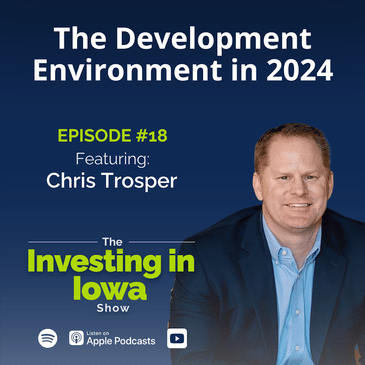
Join us as Chris Trosper shares insights from his extensive career, which spans across notable companies, and is now at Opus Development Company. Dive into the complexities of asset management, construction lending, and commercial development with his expert guidance. Don't miss this deep dive into the dynamic world of real estate development!
What you'll learn from this episode
-
Asset management and its importance in real estate
-
The Opus Group: Operations and Chris's current focus in the company
-
How rising interest rates affect real estate development
-
Business advice on the value of partnering with trustworthy individuals
-
Challenges and opportunities in the current real estate market
Resources mentioned in this episode
About Chris Trosper
Chris Trosper is the Director of Real Estate Development at Opus Development Company, L.L.C., where he spearheads commercial development initiatives. With an educational background in structural engineering from Vanderbilt and extensive professional experience, including significant roles at Principal Global Investors and Hubbell Realty, he brings a unique engineering and finance perspective to real estate development. At Principal, he was integral in asset management and construction lending, navigating the complexities of the Great Recession. Now at Opus, Chris continues to leverage his expertise in development deals and property management across various states.
Connect with Chris
-
Website: The Opus Group
-
Email: Chris.Trosper@opus-group.com
Connect with us
For more insights and updates, follow us on social media and visit our website: https://theinvestinginiowashow.com/.
[00:00:00] From cornfields to high-rises, office to industrial, houses to hotels and every other asset class in real estate, we cover the people, the projects, and the profit. Welcome to the Investing in Iowa Show. This show is for go-doers, action takers and business owners.
[00:00:35] It's for people like you who are sick of Uncle Sam taking a huge bite of your apple. If you're looking to get ahead of what's taking place in Iowa, learn who is doing what and how you can get in on the action. You're in the right place.
[00:00:49] Hosted by Neil Timmins, an Iowa native who has been involved in over $300 million in real estate, right here in Iowa. Recording in studio from West Des Moines, here's your host, Neil Timmins. I've got Chris Trosper here on the show. Chris, welcome.
[00:01:05] Welcome, Vett. Thanks for having me. I appreciate it. I'm excited you're here. Hey, see, for the audience's sake, who are you? Where are you from? What do you do?
[00:01:11] Yeah, so Chris Trosper grew up in Aikene, went to Vanderbilt, structural engineering, bounced around at some design-build company in Atlanta, came back to Iowa, worked for principal for 14 years, worked at Hubble for seven.
[00:01:25] Those are kind of the largest segments and currently at Opus Development Company. So great transition, great people over there. I'm curious. Talk to me about principal and what you did there.
[00:01:36] I was a little bit of an abnormality at principal because a lot of people that come into the real estate group maybe came right out of UNI or something like that. Sure.
[00:01:47] They had a great real estate program. They'd go into either debt underwriting or something in the equity department, asset management, and they basically do that their whole career. There's a number of people that have been there 30, 40 years, long-standing careers.
[00:02:00] I was a little bit of an oddball because I had an engineering background, structural engineering by undergrad. So I came in, in this little group called Engineering Services and had the central part of the United States anywhere from Houston to Minneapolis and then east-west from Phoenix to Louisville.
[00:02:20] Had the whole country and would kind of deal with development deals or big TIs or acquisitions due diligence, kind of engineering related items. Loved that, transitioned into asset management. So I've covered asset management in Texas for a number of years.
[00:02:39] By that time, this was probably about 2005, principal had a construction lending platform that was doing $300 million in lending year and was kind of a one-man operation and they needed some help. And I kind of fit the bill because I had this engineering and finance background.
[00:02:58] So they pulled me over to that. So I did construction lending up until 2007 when that number went quickly to, you know, went from 300 million to about 700 million to zero overnight.
[00:03:10] And so transitioned a little bit into almost like a, I would call it quasi like a portfolio management type of role where we had a couple billion dollars of loans. We're trying to get stabilized and just make sure we're performing during the recession.
[00:03:27] And then coming out of that as the economy recovered, I did debt underwriting. So I was doing traditional mortgage lending, core mortgages, MES loans, prep equity deals and did that until I left in 2016, 2017, something like that. You touched on a whole lot of things there.
[00:03:47] The audience as a whole can conceptualize construction. We all see that to a degree, understand that. But asset management is one of those things that sits in a background that maybe what is the sounds interesting?
[00:03:58] We were like, I'm not sure. You know, I know exactly what that means. So when you were in that role, what did that look like? What does an asset manager actually do?
[00:04:06] Yeah. So, I mean, it was a couple different functions because on one end we were out looking for development deals because that was a little bit more profitable segment.
[00:04:14] Could be bigger deals. And so like in Texas, you know, we were looking for where can we go build apartments? Where can we build industrial buildings? So that was a component.
[00:04:26] The core component of asset management was let's say we would have had several million square feet of industrial plus a couple thousand apartment units, plus a million square feet of retail. You know, you had this hodgepodge of a portfolio and obviously decisions need to get made.
[00:04:44] So we would hire property managers, you know, whether it be a CBRE, JLL or Cushman-Wadefield. Typically a third party though. Yeah, third party doing the property management, handling the day-to-day calls.
[00:04:55] But when leasing decisions need to get made or capital decisions need to get made, then that's rolling up to our team to say, okay, we're going to do this, this, this. And in the background, we're valuing assets.
[00:05:07] And so what a lot of people don't realize is, you know, principal's big into 401ks. Or so, you know, Joe or Mary off the street that are checking, I want real estate in my portfolio when I contribute to my 401k.
[00:05:22] Well, where does that money go? It's rolling into a fund. That fund is then investing in real estate all across the country, potentially all across the world. And it's getting managed by these asset management arms like what we had at principal.
[00:05:36] And so you're doing those day-to-day items to try and maximize income, maximize ROI. And hence the returns to 401k, or the other day.
[00:05:47] What are two or three nuggets that in order for an asset manager to be successful, what are two or three things they must do, must have, must get consideration to in the role? I'm asking not just as an asset manager, but for the audience's sake.
[00:06:01] If you have a property, you have a third party manager, you are the asset manager. You know, always kind of like speed of responsiveness. You know, when people say time kills deals, they mean it. You know, especially in an environment today that's a little bit more challenging.
[00:06:17] It's like you let something go out of your fingers. You're going to be regretting it. It's timely. You better be able to follow and you better be working those deals when they come through. Attention to detail.
[00:06:27] So, you know, one of the things that a group like principal, there's a lot of them out there, but principal did this well, dove into market dynamics. What's happening? What are vacancies? What are rental rates doing? Are they pushing up?
[00:06:39] Are they giving concessions? What's happening so that you can help influence? And the property managers were good at this too. Hiring a good property manager, they'll help. You can work really well together to make some of those decisions.
[00:06:52] But keeping your pulse on that makes a whole lot better informed decision to try and maximize the value of a property over time. There is a potential for a conflict of interest between the asset manager and the property manager.
[00:07:04] Here's where I'm going with that. Meaning that a property manager or an asset manager, you have goals. You have a portfolio requirements. You have returns to deliver to an investor. There are things that need to be done in there and sometimes decisions that need to be made.
[00:07:18] Sometimes transaction that may need to occur. A property manager would love that you never sell the property. Is that fair? That's how they make money.
[00:07:26] Yes, but generally, and Opus does this the same way where we say, look, if we're going to do a deal with somebody, we want to round the bases. We want to do the due diligence, acquire something, lease it up, stabilize it, and sell it with the same group.
[00:07:41] That's ideally. So in a property management role, let's say you're dealing with one of these larger firms that has multiple disciplines. While it may be negative to the property manager to sell because they lose the income stream, it's beneficial because you're doing leasing with the same TAS.
[00:07:59] You're doing a sale with the same team. So they might lose a minor stream of income, but they might be gaining the benefit of a commission on a sale or something like that.
[00:08:08] That makes sense. I'm curious about what you learned through that phase of the career working on the lending side. Maybe also how you've applied that.
[00:08:16] Well, I don't think I really recognize this because I went back and forth from the equity team to the debt team and then back into the equity world. And people would say it's a different mindset.
[00:08:29] You know, when I was young enough where I was like, OK, you know, what does that really entail? When you're doing lending, if you talk to a banker or you talk to a mortgage lender, generally the line of thinking is defensive. Risk mitigation. Risk mitigation.
[00:08:44] What could happen to this and how far down the capital stack can it go before I get impacted? And it's a different mindset than being an acquisitions guy or an asset management person because there's upside to that too. Correct.
[00:09:00] You know, on the debt side, if you do a loan and somebody just kills it and crushes a deal, you see none of that upside. So it's just a different mindset. I like the more aggressive side, but I mean there were benefits of seeing all of that.
[00:09:13] I loved, you know, in my roles, which was a real benefit, was seeing how a bunch of different asset managers worked because I was traveling all over the country with multiple people.
[00:09:26] And then when I was on the debt team, I was traveling all over the country with multiple debt underwriters. And so you see how it'd be like working around town and seeing how 15 different brokers work behind the scenes and how they're doing what they're doing.
[00:09:40] So if you're a house flipper, execute the burst strategy or do double closings and are in need of money. Little Guy Loans is your go-to lender here in the Des Moines area. Time is money. Loan approvals in 24 hours. Closings in five days.
[00:09:56] Little Guy Loans was founded by Neil Timmons, an investor just like you. Since he has been in over 10,000 homes in Des Moines, there's never an appraisal. Houses, multifamily and commercial property loans up to one million. Check out www.littleguyloans.com.
[00:10:14] It was an interesting role. So you get a kind of pulling back the curtain. Yeah. And seeing a whole bunch of things. You mentioned preferred equity. That is something that, you know, for a long time, I'm thinking kind of post-COVID until interest rates started moving.
[00:10:28] Nobody talks about preferred equity. And now the last two years, I just hear every week I'm hearing about preferred equity. Talk a little about what is preferred equity and where do you see it utilized inside of capital stack?
[00:10:41] Yep. I'm going to try and talk generically because you can really go down a rabbit hole of like technical issues. Generally, I would say preferred equity and mezzanine debt are used somewhat similarly.
[00:10:55] And they're used to kind of help fill out a capital stack and kind of reduce the amount of equity. So if you're an investor and just to use like round numbers, say there's a $10 million deal and lenders are maybe they're really,
[00:11:09] really conservative and they're willing to lend you $5 million at a screaming rate. But that's just not enough leverage for you to make a deal happen. So you got $5 million of your $10 million capital stack figured out. Well, let's say you've got $2 million of equity that you've raised.
[00:11:26] Well, you got a $3 million gap. How are you going to fill that? So a mechanism to kind of fill that is going to what some people would refer to as structured finance. That's mezzanine debt or preferred equity.
[00:11:40] To me, at a very high level for more lay persons is that they kind of operate the same depending on whether or not there's crude returns to like oppressed equity or in the foreclosure rights are different between the two.
[00:11:56] And so if things blew up, it's a whole lot easier to foreclose out somebody's mezzanine interests than a preferred equity partner. So there are some technical differences, but essentially what you're doing is trying to like get a little bit more leverage to try and make a deal work.
[00:12:13] So I've seen a lot of it in being utilized really over the course of the last 18 months, largely because banks have gotten growing more conservative. Right? Yes. There's still deals out there. Deals still penciled, but the banks have gotten more conservative.
[00:12:26] They just don't want to go that high in leverage. Yes. And so you see this preferred equity sit in, fill that gap. And in my opinion, our risk of justice basis in many cases get paid extremely well. Very well. It depends. Some can be creditory.
[00:12:38] Yes, correct. You don't want that. No. Yeah. You eventually move on to Hubble. What were you doing at Hubble? I started in the development department and so largely I started with kind of a portfolio of senior housing assets.
[00:12:51] Both I was doing some asset management and some development work for senior housing. Over the course of that time, there was a couple of senior folks at the company that retired and I stepped into doing kind of leading the commercial development.
[00:13:06] Now there was a coworker of mine that handled like the development of the multifamily portfolio. I was doing more of the commercial portfolio. And then I eventually was raising equity at the same time. So kind of doing a dual role. Yeah. Senior housing, you know, the silver tsunami.
[00:13:23] I hear about this a lot, right? Yep. I don't know what that number is, but maybe like 10,000 plus maybe members retired. Some numbers that are just wild. Yep. I may not even have that right. Yep. But it's incredible what's coming and you're involved in that.
[00:13:38] What's unique about senior housing? Because it's like an apartment, but not really. Well, maybe physically. People would think that. My perspective is that it's a whole lot more about care and how you're dealing with people if you have either, let's say a hospitality or hotel type of background
[00:13:59] or an apartment background. You might be used to like bodies in and out and more of a kind of a transactional type of situation. If you're in senior housing, you're caring for somebody's mother or father. And, you know, you're dealing with day-to-day stuff that's way more intense.
[00:14:16] So just having the right operator to me is huge. It's operations first, real estate second. I agree with that. Some people wouldn't, but I wholeheartedly agree with that. What's unique about that space or are there physical considerations about a space,
[00:14:31] maybe some economies of scale perhaps, where infrastructure needs to be of a certain size for it to really make sense operationally? I would think it's very similar to like an apartment complex in the sense that,
[00:14:43] let's say on an apartment side you get up over 120 units or something like that. Well, now you might be able to get a manager and assistant manager and a full-time maintenance guy and that gets way more efficient just on your expense side.
[00:14:58] The same will be true on senior housing and a lot of it depends on what levels of care are you covering. You know, is it assisted? Is it memory care? Is it more like hospitalization type of care?
[00:15:11] Those are way different types of things and depend on a lot of different factors. If mom or dad needs help going to the bathroom and requires two people to help them, now you're into some dynamics that are way different than just normal,
[00:15:28] I've got to keep the water running, the toilets fixed and all these other kind of property management type of issues. So totally different subset of issues. Commercial development, and so you did that in a big way at Hubble.
[00:15:40] Is there a project or two that stands out as either home runs or maybe uniquely interesting in the way you had to solve all the challenges that always come up on the development side? The one that probably jumps to my mind is we would have called it Grimes 5
[00:15:57] and there were a lot of people that had some input in this, so I'm not trying to... But it was a really unique deal that honestly, if you look back how some of these associations give awards for deals of the year,
[00:16:10] if you could have looked behind the curtain as to what it took to get something like that done, it would have merited. Some people are like, you don't realize the hoops that had to go through.
[00:16:20] So when I was at Hubble, we were working with Marty Herman and Chris Pendroy on the CB side. Chris is part of Bill Wright's team, great guys. So Amazon filled that building and they came to us and were like, we need 1,200 parking spaces.
[00:16:36] And we're like, we don't have 1,200 parking spaces. Let's figure that out. And so we did a lease arrangement and constructed parking and worked all of that into the economics of the deal to pull that deal off. And they were remarkably patient and things fell in our favor.
[00:16:55] We pulled that off and it led to another deal. So the other last mile Amazon deal in Ankeny was kind of a post-cursure of having done the first deal and kind of made that work. And evaluating deals as a passive investor.
[00:17:31] At each virtual workshop, we are joined by an industry guest who covers their topic in 45 minutes or less. No fluff, no pitches, just education and conversation with an expert each month. Every workshop ends with live Q&A from Neil and our guest.
[00:17:47] All briefings happen on the last Tuesday of the month at 3 p.m. Central. If you can't make it live, recordings are sent out exclusively to those who've registered in advance. To join us on the last Tuesday of this month, visit LegacyBriefing.com. Go to LegacyBriefing.com to register.
[00:18:04] If you're a first time registrant, I'll send you a free resource at signup. Head to LegacyBriefing.com and I'll see you soon. Yeah, oftentimes when you get known as a person who gets executed, people are the best.
[00:18:15] Yeah, it was a lot of hustling behind the scenes on a lot of people's part. So we moved to Opus. What does Opus for those who don't know, I never, you know, in the city of Des Moines and certainly the rest of the city everybody knows, Opus.
[00:18:27] What does Opus do in case somebody's not aware? Yep. So design, build, contractor, developer. So both. What is unique, there are several different offices. So we're headquartered in Minneapolis, but have regional offices in Indianapolis, Chicago, Kansas City, Denver, Phoenix, Kansas City.
[00:18:47] So what they're really, really good at is a design build process. If you need to have some, a building built and how do I make this widget really operate for a customer? Our team is really good at that. Jeff Smith, Mike Anthony, our team, they're second to none.
[00:19:02] They do a really good job. And so what people don't know about Opus locally is, you know, we have a lot of industrial that we've built. Right. You know, a couple million square feet. Right. We do that really well. We also do apartments. We've done senior housing.
[00:19:17] We've done student housing. Like there's a student housing deal in Ames that most people would have no idea was an Opus deal. We've done works for universities. We've done deals for Creighton. We've done deals for ConAgra.
[00:19:29] You know, we're, we've done a whole bunch of stuff in terms of both construction and development. Our team here locally is a little bit unique in that about half the business that comes out of our office is just construction, third party construction.
[00:19:44] Whereas in some of our other offices is totally driven by what the development team is doing. So it's nice to have a compliment to be able to do a metal building or, you know, something very user specific. We've done all kinds of different things for that. Interest rates.
[00:20:03] You know, the five-year treasury doubled in one of the shortest period times in history. In fact, it's the only time since the Fed has tracked the five-year treasury back in 1951 that the five years ever doubled in a year.
[00:20:14] And it has had some ripple effects in various segments and no effects in other segments. How is it affecting what you're seeing in your world? It's definitely slowed things, you know. So it's not just the rates, but it's also what we talked about earlier with lenders.
[00:20:30] You know, those lending parameters, the loan to values, loan to costs have come down. So you haven't put in more equity into a deal. The costs of the debt are obviously higher.
[00:20:40] It's making it harder to pencil, do development deals work, which is by nature kind of what they're trying to do when they're raising interest rates. They're trying to slow the economy and slow the inflation. So it's right. In my mind, it's having that fact to your point.
[00:20:56] It hasn't stopped things. The end user that has been growing and has been doing well still needs space and still has needs that need to be back. They've got a business to run. So we're still out doing proposals. We're still active.
[00:21:12] I just think the way I describe it to brokers that we do business with is there's fewer at bats. They take longer to kind of work through. And you better try and hit the ball when it's pitched at you.
[00:21:23] You better be trying to close if you get an opportunity. So you could do this anywhere and certainly you've had exposure and traveled for principal to tons of places throughout this country. Why Iowa? Why did you choose to be here?
[00:21:37] Well, I grew up in Aikene and it's primarily family driven. I got three kids in the Lockheed school system there. 15, 17, 19. My oldest is now at the University of Iowa. So as long as they're still hanging around, I'm hanging around too. So yeah, that's the driver.
[00:21:53] Chrissy, you ready for the final three questions? Hit me. If you had one piece of advice to give to your 20 year old self, what would it be?
[00:22:01] A piece of career advice that I feel like I often give to younger people is when you're doing business with some things get a whole lot easier to do when you work with people you like and you trust.
[00:22:13] The deals that I look back on that have maybe not gone as smoothly. It's like you get that little sixth sense, that little something's hairs on the back of your neck is standing up like this just doesn't feel quite right. Stop what you're doing. Put your pencil down.
[00:22:27] Run out of the room. Those are the type of people that you just it's life is too short. Something's going to go wrong and you're going to spend the next X amount of time unwinding it. So that would be one piece. Two books that change your life.
[00:22:40] I love reading different books about like Navy SEALs and different things that they like Lone Survivor, those kinds of books that have what they've had to overcome. But try to remember the name of the author. Outliers by Malcolm Gladwell. Malcolm Gladwell.
[00:22:55] I kind of get a kick out of now some of it you got to take with a grain of salt. But like just the statistical side of OK, to be really good at something spend 10,000 hours doing it. Correct.
[00:23:06] You know, like little statistical things that I'm like, that makes some sense to me. So keep being gritty. You'll get there.
[00:23:13] If you were cast away on an island for a year, you can only get three pieces of data about your business each month to know how your business is running. What three things do you need to know each month to know how your business is running? And why?
[00:23:27] In some ways, I would say, you know, in our business, like occupancies would be. How's that going? You know, what's coming to mind is I want to say like cap rates or valuations.
[00:23:36] But really, if you boil it down and you think of it like a small business, like any deal, what's happening with the cash? You know, so you can break that down to revenue and expenses. Right. But what's happening with the cash? How is that going up or down?
[00:23:49] Of course, I've asked lots of questions here. What's one question I did not ask that I should have asked? Oh, that's interesting. You know, I think I don't know a normal one might be a forecast, but my crystal ball is just as bad as anybody else's.
[00:24:04] I'd be sitting on the beach somewhere thinking about other problems. But I've enjoyed being here and I guess I don't have, you know, like what's the next on the horizon? You know, I just keep plugging.
[00:24:14] It's an interesting environment which we're in and just go out there and navigate fight every day to get through this. And those who stay around and play the game ultimately prosper when the ride goes up. It's a unique time, which we're in and operating right now.
[00:24:30] And it still sounds like you guys are out there bidding and order users, as we talked about before we came on, order user market. There's so many businesses thriving today and thriving here in in Ultima in Iowa. Yep. Variety of reasons they continue to grow.
[00:24:46] For people who want to find you, they want to follow you, they might connect with you. Where can they go? What should they do? You know, my OPUS website's got a myriad of information. Easiest way for me is my email is just chris.trosper at opus-group.com.
[00:25:02] Easiest way to start a conversation is find a time to talk and go from there. Information is below in the show notes for everybody. Chris, I appreciate you being here. Thank you. Appreciate you. Thanks for listening. If you're enjoying the show, may I ask a favor of you?
[00:25:15] Naturally, subscribe so you never miss an episode. But would you rate and leave an honest written review on Apple Podcasts? Does a lot for us here at the show, and I appreciate reading your thoughts. Great guests make for a great show.
[00:25:28] If you know of another island who would be a great guest or you yourself have interest in being a guest, well get on our radar. Visit Investing in Iowa to fill out an application or recommend a guest.
[00:25:41] And if you want to connect with me one-on-one, go legacyimpactinvestors.com. Click on the invest with us button in the top right corner. And there you can pick a time for the two of us to get on the calendar and connect. Until next time, keep investing in Iowa.