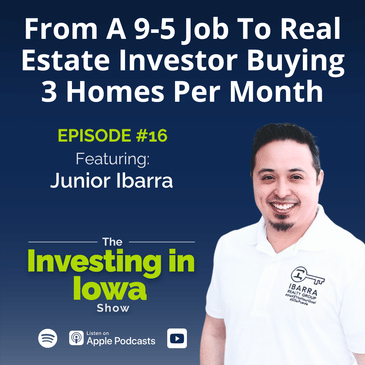
From his humble beginnings, driven by the desire to honor his parents' dreams, to his strategic shift from engineering to full-time real estate entrepreneurship, Junior Ibarra will share pivotal moments, the mentors who shaped his path, and the powerful strategies that turned his vision into reality. Don't miss out on this opportunity to learn from a true industry trailblazer!
What you'll learn from this episode
-
The role of mentorship in real estate success
-
Strategies to create and lead a highly successful real estate team
-
Actionable steps for managing profitable property investments
-
Junior's perspective on the future of the Des Moines housing market
-
The importance of work ethic and perseverance as an investor
Resources mentioned in this episode
-
The Richest Man in Babylon by George S. Clason | Paperback, Hardcover, and Kindle
-
How to Win Friends and Influence People by Dale Carnegie | Paperback, Hardcover, and Kindle
-
The Millionaire Real Estate Agent by Gary Keller, Dave Jenks, and Jay Papasan | Paperback and Kindle
About Junior Ibarra
Junior Ibarra is the CEO and Team Leader of Ibarra Realty Group (IRG), a 28-member team recognized for its performance in helping 315 families achieve their real estate goals in 2021.
Born in Mexico, Junior moved to Perry, Iowa, and later settled in Des Moines. He graduated with honors from North High School and earned degrees in Industrial Engineering and Business from Iowa State University.
Junior transitioned from an engineering career to real estate in 2013, driven by his passion for homeownership and addressing wealth disparities. He founded IRG to promote home ownership and advocate for affordable housing in Iowa.
Connect with Junior
-
Website: Team IRG
-
LinkedIn: Jorge Junior Ibarra
-
Instagram: @jorge_junior_ibarra
-
Facebook: Jorge Junior Ibarra
-
TikTok: @jorge_junior_ibarra
For more insights and updates, follow us on social media and visit our website: https://theinvestinginiowashow.com/.
[00:00:00] Whenever there's a problem and whenever there's an opportunity, it's never the what, it's always who. So who in your world can be your partner because 25 to 50% of a watermelon is better than 100% of a grape. And so he's like, you have the lead flow, the partnerships, the ecosystem to bring deals into an acquisition model.
[00:00:17] From cornfields to high-rises, office to industrial, houses to hotels and every other asset class in real estate, we cover the people, the projects and the profit. Welcome to the Investing in Iowa Show. This show is for go-doers, action takers and business owners. It's for people like you who are sick of Uncle Sam taking a huge bite of your apple. If you're looking to get ahead of what's taking place in Iowa, learn who is doing what and how you can get in on the action.
[00:00:47] You're in the right place. Hosted by Neil Timmins, an Iowa native who has been involved in over $300 million in real estate right here in Iowa. Recording in studio from West Des Moines. Here's your host, Neil Timmins.
[00:01:03] I've got Junior Ibarra here in the studio. Junior, welcome to the show.
[00:01:06] Thank you for inviting me. I'm excited to do this.
[00:01:08] I'm excited to be here. Say, for the audience's sake, who are you? Where are you from? What do you do?
[00:01:12] Yeah, yeah. So full name's Jorge Valupi Barra Gonzalez. Everybody calls me Junior.
[00:01:17] I try to say that 10 times over fast. And here from Des Moines, Iowa. Was born in Mexico.
[00:01:23] Yet, this has been home since I was four years old. And I am a real estate professional.
[00:01:28] And I have a real estate team that helps here, home buyers and home sellers and investors and builders
[00:01:33] get to that next goal, whatever that is in their real estate journey.
[00:01:36] How long have you been in real estate?
[00:01:39] Officially now, 10 years as far as an entrepreneur goes. Yet, as an investor now for about 12 years.
[00:01:46] Okay. So you said officially. Talk to me about unofficially. Let's talk about the first year,
[00:01:51] how you got into real estate, what you might deem unofficial.
[00:01:55] Yeah, yeah. So I'm a first-generation immigrant American. And so my parents really wanted me to
[00:02:02] pursue kind of what they foresaw as the American dream, which is go to school, go to university,
[00:02:08] get a job. And so I really wanted to pay homage to and honor them and did that. And so I really
[00:02:16] focused on school for most of my life and was able to get an academic scholarship to Iowa State
[00:02:21] because I excelled at math and science. And I had to choose a STEM-related field. So I became an
[00:02:27] engineer based on that scholarship. And so I worked as an engineer. It was my first job out of college.
[00:02:32] It's kind of how it all started. And then out of college, I started actually reading books I wanted
[00:02:38] to read versus what was assigned to me. And I came across like many other probably investors is
[00:02:43] Rich Dad, Poor Dad, right? And Richest Man in Babylon, How to Win Friends and Influence People,
[00:02:48] a lot of that. And I saw one of the most common denominators to building wealth in this world is
[00:02:55] real estate. And so the analytical side of me, the engineer in me said, well, why fight that?
[00:03:00] Just follow what works, right? And so I started buying real estate while I was still an engineer
[00:03:07] when all my other engineering colleagues were out there buying the biggest house they could buy
[00:03:11] or the biggest car they could buy. I grew up with very little with immigrant parents breaking two,
[00:03:17] three jobs their whole life to put food on the table. I said, I didn't need any of that.
[00:03:22] And so the book said, buy real estate and don't wait to buy real estate, buy real estate, wait.
[00:03:27] And so I actually own three properties, investment properties, even before I moved out on my first
[00:03:34] apartment.
[00:03:35] Incredible. What year was that?
[00:03:37] That was around 2012.
[00:03:40] Around 2012. Tremendous buys could have been had in 2012, but it was a scary time.
[00:03:44] I'm wondering mentally how you excelled through that because a bunch of people sat on the
[00:03:50] sidelines and did nothing. It felt like the world was coming to an end in kind of the 08 even forward.
[00:03:56] Yeah, we caught the last tail end of the foreclosure crisis, at least here in Des Moines, Iowa,
[00:04:01] because foreclosures were for sale on the open MLS up and down the street.
[00:04:05] Obviously, it didn't hit as hard as maybe the West Coast or East Coast. I didn't know what I
[00:04:09] didn't know back then. I just knew that these are foreclosures. And I wanted to find a mentor
[00:04:15] to help. The book said, every book had mentors and advisors. And I'm like, well, I want one.
[00:04:22] And so my philosophy was, I went to Craigslist back then, what now is more like Facebook marketplace.
[00:04:33] And I just made an assumption that anyone who listed multiple houses for rent or multiple
[00:04:39] houses for sale on Craigslist was an investor. And so I just emailed over a hundred different people
[00:04:46] on Craigslist and tell them I wanted to talk to them and talk about real estate. Out of like over
[00:04:53] the hundred emails I sent on Craigslist, six of them responded to me. And on those, I asked them out
[00:05:00] for a coffee to see if I could pick their brain. And then out of those six, I sat down with two of
[00:05:05] them of which still have helped me to this day. You know, I know my mentors to this day and helped
[00:05:12] me get into real estate. It's incredible. Yeah. So fast forward, you started buying properties in 2012.
[00:05:19] And then sooner or later, that morphed into a career as an agent. Yeah. Talk to me about that.
[00:05:26] Yeah. So right around 2013, you know, I had already bought in some properties. I can't remember if we had
[00:05:33] two or three by that time. But I, you know, and I just fell in love with the real estate aspect of
[00:05:39] like, oh, this is just math. Right. And so one of the things that kind of one of the my mentors sons
[00:05:47] at that time, he, we had bought two properties from him and I asked him, I'm like, man, you're not that
[00:05:56] much older than me. How many houses do you own? And he's like, you know, like 26. And I'm like,
[00:06:02] how the heck do you own 26 being under 30? And, and, and he kind of was like, well, my,
[00:06:08] my dad, my mentor has, you know, has taught me how to acquire assets. Right. And I was like, oh man,
[00:06:15] I want to learn how to do that. Right. So how can I be a value to you? And I told them I'll work for
[00:06:22] free for you nights, weekends when I'm not traveling as an engineer. So this was still about 2012.
[00:06:28] And I just want to learn how you do this real estate thing, like how you're acquiring this
[00:06:31] much so quickly, two to three a month. Right. And he did. I was like, the value I can provide to you
[00:06:36] is I have contract. Like I grew up with my dad, who's very handy and he did a lot of side jobs growing
[00:06:43] up when he wasn't working and I would tag along with him. And so I knew a lot of contractors through
[00:06:48] my dad's ecosystem. I was like, I can bring you contractors that could help you on your project.
[00:06:52] So that's kind of what I started doing. I started being a project manager for his team nights and
[00:06:57] weekends. He just gave me like one project and gave me like a flat fee, project management fee.
[00:07:02] And he said, wow, you're connecting us to a lot of people. Why don't you just come work for us?
[00:07:07] And I was like, well, what does that mean? Right. And he said, well, you know, here's what we can pay
[00:07:14] you to be a project manager. And I'm like, wow, that's like a fifth of what I'm used to making as
[00:07:18] an engineer, you know? So why would I leave one job to go to another job? And then that's when I
[00:07:23] kind of heard the first time, like you work to learn, not to earn when you're young, we're going
[00:07:27] to teach you how to immerse yourself in this real estate ecosystem. And I was like, wow.
[00:07:32] And so I approached my dad and I said, dad, I want to like, I want to quit engineering because in
[00:07:39] my culture, it's a tradition that we get the blessing of our parents before we make any kind
[00:07:44] of big life decision move. And I said, I want to quit engineering and go work for these guys for
[00:07:49] this pay. And he's like, what? Why? And I'm like, they're doing things at a different level. They
[00:07:56] think differently. It's like the rich dad, poor dad, like book happening in reality. Right. And so
[00:08:03] I didn't get his blessing for some time. Yet I finally convinced him because I stayed at my
[00:08:08] engineering room when he didn't give me his blessing. And I went back to him six months later.
[00:08:14] And, you know, I had seen a lot of other engineers being let go because there was always corporate
[00:08:19] turnover. Right. New management, the older engineers that have been there 15, 20, 25 years would get
[00:08:24] let go. Us younger engineers would get the work for less pay. Less pay. Right. Yeah. Turn over the
[00:08:31] expensive one. Yep. Yep. And we get our 3% bump every year. And so I was like, I don't know if I want to
[00:08:35] be that person 20 to 25 years from now. So I felt bad for them because they had kids in high school and
[00:08:41] college. And unless they wanted, we were in such a niche engineering field, oil and gas,
[00:08:45] unless they wanted to move to like Austin or El Segundo, California or Alaska, they were taking
[00:08:50] huge pay cuts to continue to live here in Des Moines. And so I went back to my dad and I said,
[00:08:56] Hey dad, remember when you were an engineer and a college professor in Mexico, yet you gave all that up
[00:09:02] because I was born, your first born. And you knew that there was no climbing the ladder of success in
[00:09:07] Mexico. And you came to Iowa to go work for meat packing plants, slaughterhouses, chicken farms,
[00:09:14] uh, to, to put our, our family on that path. So I'm not going to that extreme. I'm not going to quit
[00:09:22] engineering to go make soccer balls for a living in China. I'm literally going to stay in Des Moines.
[00:09:26] If anything happens, I can fall back to engineering yet. I'm seeing a trend here that real estate could
[00:09:33] take our family to the next level as we continue to build the legacy here in the greatest country in the
[00:09:37] world, which is the United States. And he says, you got me son, you have my blessing. And so that's when I quit
[00:09:42] engineering right around 2013 to go work for these guys as a full-time project manager. And that's how I got
[00:09:50] immersed myself fully in that before I started the team IRG company, which was in 2014.
[00:09:56] So as a project manager, you're running projects, they're fixing and flipping or they're portfolioing the homes
[00:10:00] to keep them. And you got to keep contractors moving. You got a budget you got to work on and
[00:10:04] time's always against you. Yeah, absolutely. You got to move quick to get through these things because
[00:10:09] time is money. Yeah. And there's an extra project probably waiting for you to start.
[00:10:13] Yeah. As soon as you finish this one. Yeah, absolutely. I learned those time management
[00:10:17] skills and organizational skills from a real estate perspective. Right. And so I learned quickly,
[00:10:23] like everything had a system, which adhere to the engineer in me. Like we'd go in and within like 15
[00:10:30] months, we know what the material scope was, right? Because we had a checklist and it's like
[00:10:34] contractor next to me. Okay. How many sheets of sheetrock, right? How many boxes of flooring,
[00:10:41] right? Because what I also noticed that this team did is everything looked the same.
[00:10:45] Yeah. Right. And so, and everything was ordered from the same company. And so it was just like,
[00:10:51] check, check, check, quantity, quantity, quantity, take a picture with my phone, scan it,
[00:10:54] send it over to the warehouse company. They would deliver it. And I just make sure that everything
[00:11:00] that was checked off was delivered. And then off they go to, to actually do the work.
[00:11:04] No, you couldn't get away with that in new construction, going down the line and making
[00:11:07] them all look the same. But in the resale world, right? You're buying these homes that are
[00:11:11] whatever, 20 to a hundred years old. Yeah.
[00:11:13] You don't buy enough in one neighborhood to where it's a problem that they'll look the same.
[00:11:17] If you're a house clipper, execute the burst strategy or do double closings and are in need
[00:11:22] of money. Little Guy Loans is your go-to lender here in the Des Moines area. Time is money. Loan
[00:11:29] approvals in 24 hours, closings in five days. Little Guy Loans was founded by Neil Timmons,
[00:11:35] an investor just like you. Since he has been in over 10,000 homes in Des Moines, there's never an
[00:11:41] appraisal. Houses, multifamily and commercial property loans up to 1 million. Check out www.littleguyloans.com.
[00:11:51] Yeah, yeah, exactly. And they're not right next to each other, right? So yeah, that's what I
[00:11:55] learned to do. And we did 60 properties in one year. Yet 2014 came about, right? And then within
[00:12:02] that 60, because I didn't have a lot of money back then, I brokered a deal with that with my new
[00:12:09] partners in where they created another LLC for me, of which they gave me sweat equity in, you know,
[00:12:17] and is minority share in it. Yet I, that's what I told them I would do if I left engineering,
[00:12:24] I wanted some sweat equity in something. And so that's kind of, we did 60, 20 of which I was able
[00:12:30] to keep on that other entity where I was a minority shareholder, 40 of which stayed with them,
[00:12:35] which were predominantly buy and hold rentals. And then come 2014, for whatever reason,
[00:12:43] and you were part of this during that time, like the foreclosures, like literally dried up overnight.
[00:12:48] They were gone, right? So it wasn't really easy to go out and find houses at 60, 70 cents on the
[00:12:54] dollar or whatnot. And so our, the person that was providing all the money said, stop buying because we
[00:13:01] don't know what's going to happen with this market. They're not as easy to find. Let's just, let's
[00:13:05] this portfolio season for the next eight to 10 years and see how it does before we acquisition
[00:13:11] anything more hindsight being 2020. I wish we'd have kept buying, but it's all good. You learn a
[00:13:18] lot of things and it's cool. And yeah, I didn't have a job anymore. Cause we weren't rehabbing houses.
[00:13:24] They want to put pause on the acquisition. Yeah. You don't have an engineering job.
[00:13:28] Yeah. Yep. Something's got to give, you got to go do something.
[00:13:30] Yes, exactly. So they did give me like, Hey, why don't you try being a property manager for the
[00:13:36] four? You know, I was selling a model of selling houses on contract. Uh, their 40 were predominantly,
[00:13:42] like I said, uh, mine hold rentals. They said, why don't you become a property manager for us? And
[00:13:46] I gave that maybe two weeks.
[00:13:49] Was it two weeks too many?
[00:13:51] Yeah. Yeah. Like getting those calls with the tenants at all hours of the day. And like,
[00:13:57] I don't know, it was just not my thing. Right. And so I said, you know what, that's not, I can't do that.
[00:14:03] Um, and cause I've never made decisions necessarily on my life based on money. It's like the challenges
[00:14:09] and the puzzle piece aspect of the next challenge is how I live my life. And as, and am I having fun
[00:14:16] with the people around me? Right. I love people. Um, and so like what was coming to life was what
[00:14:22] my dad warned me of. He's like, well now what? So I almost did go back to engineering. I started
[00:14:27] reapplying for engineering jobs at that time. And I did, um, get offers really quickly. Um, cause
[00:14:33] I've always been a sales engineer, technical enough to be, you know, in the engineering field yet
[00:14:39] that my personality to be, uh, in sales. Right. And so I got offers quickly yet at that moment in
[00:14:46] time, uh, you know, my fiance and then wife, you know, had ours also, um, told me, you know what?
[00:14:53] Like I told my wife, I was like, I know I've made the least amount of money I've ever made and
[00:14:57] worked the most amount of hours I've ever worked yet. I had the most amount of fun. Right. And so she
[00:15:03] said, you know what? You helped me through beauty school. I know I'm not making a ton,
[00:15:08] but we can totally still live off of what I'm making, um, for you to go out and pursue
[00:15:13] your passion. And I was like, oh, this is why I married her, you know? Um, and, uh, we've always
[00:15:19] supported each other so much. And so I still married. And to this day, my wife, Trish, and we
[00:15:24] have three beautiful kids, uh, right now. And so, um, so yeah, so I went back into knowing what I know
[00:15:30] how to do best reading. I started reading. I got, I'm like, I got to find the answer in books,
[00:15:35] right? There's no need to reinvent the wheel. What can I do in real estate? And so I came across
[00:15:40] a book called the millionaire real estate agent, uh, which is a red book written by Gary Keller.
[00:15:44] And it was literally how to build a hundred million dollar team by using the systems and
[00:15:51] models that other team leaders have done all across the country. And on average, I can't remember if it's
[00:15:55] 21 or 23 years of what it takes to build that level of team. And so I said, I told my wife,
[00:16:01] I found what I'm going to do next. It's this book. This is a business in a book following systems
[00:16:07] and models, which adheres to the engineer me. I'm going to do that. And that's how I started
[00:16:11] looking into getting my real estate license. So you decided to get your real estate license,
[00:16:14] decided to go in and build a team. And what was that first year like?
[00:16:18] Yeah. So the book says, you know, I found out it was really easy to get your license. It's like
[00:16:24] 60 hours past the test. I'm like, I can't believe it shouldn't be that easy.
[00:16:27] As your wife, Rich would tell you, it's a lot harder to go to get a license as a beautician
[00:16:32] in this state. It's way too easy to get a license to sell a house, to sell property.
[00:16:37] To help someone invest in the biggest investment in their life. It's a little crazy, right?
[00:16:42] Ironic or whatnot. Yet I followed the instructions in the book and the book says, you know, you're
[00:16:48] supposed to go into the office every single day and proactively call people that need help
[00:16:54] in the real estate world. And you're supposed to do it from 830 to 1130 every single day.
[00:17:00] And so I was like, I'll just do that. I'll download all my contacts from my phone into a CSV file
[00:17:07] from Facebook, from LinkedIn, from all my social media platforms. I'll add them to a Google spreadsheet
[00:17:13] and I'll just call them proactively every single day to see who I can help now that I'm licensed.
[00:17:17] And I can tell people I can help people get into homes.
[00:17:21] And so I said, and I'll one up it because I've always, I've gotten my work ethic from my
[00:17:26] parents and I'll say, okay, I'm going to show up. If everyone else shows up at 830,
[00:17:31] I'm going to show up at 630 or seven in the morning since they gave me a key to the office
[00:17:36] and I'll do, I'll one up them because I know they know more than I do.
[00:17:40] So I have to work them and I may not be as smart as them or have the skillsets they have,
[00:17:44] but I know I can work way harder.
[00:17:45] And so I would show up at seven in the morning thinking everyone shows up at 830 and then quickly
[00:17:51] find out no one shows up till after lunch, right? In the real estate world. And so yet I stuck to my
[00:17:58] book. I had a little magnetic whiteboard and the book says I needed to get in front of and shake
[00:18:05] hands with three people a week to talk about real estate. And so I would move those little markers
[00:18:11] from the left hand column to the right. Every time I would find someone when I called them that needed
[00:18:17] help, that would be open to meeting me in person to see how I could educate them about the real estate
[00:18:22] process. And so that's what I did. And no matter if it took me 40 hours or 70 hours or 80 hours,
[00:18:30] I was meeting with at least three people a week. And if I didn't have my third person by Friday at five,
[00:18:36] my punishment to myself was I'd stay till 10 or I'd be up at six in the morning and back at the office
[00:18:42] Saturday morning till I got my third marker set over. And so that's how I started my real estate
[00:18:48] journey. So I'm glad I didn't know what I didn't know. I didn't know that the average agent in their
[00:18:53] first two years sells anywhere from two to four deals, which it has an 80, why it has an 80 to 90%
[00:18:58] failure rate within three years, because there's, that's not enough money and you need to renew your
[00:19:03] license at the third year or, well, they don't renew. Right. I was able, I got licensed in May of
[00:19:08] 2014. And I was able to help from May to December of 2014, 12 families. And the book says, if you're
[00:19:19] going to be helping at least three families per month, you actually need someone to help you with
[00:19:24] the administrative work. That's right. Right. And so I looked at my pipeline. And by 2015, I was like,
[00:19:31] I'm definitely helping three families per month. And so I started looking for an administrative
[00:19:37] assistant. And then the people and my colleagues in the real estate world, they're like, I've been in
[00:19:42] the business for 15 years or 10 or five or whatever. I don't have an assistant. You shouldn't be spending
[00:19:48] money on an assistant. But I'm like, the book says that if I'm going to be helping three families,
[00:19:54] I need to have someone help me with the paperwork and everything so I can continue to build new business
[00:19:59] and find more people that need my help. And so I emptied out my savings and I said, I'm going for
[00:20:06] this. And so I hired my first assistant and a part-time assistant in 2015. And that year I helped
[00:20:12] 48 families by four, for a full calendar year by sticking to the model. You found a model that,
[00:20:18] you know, was written and ultimately a model that existed ultimately was written, brought together
[00:20:23] by Gary Keller, interviewing tons of people, top producers, right? Yeah.
[00:20:27] Team leaders in his organization, put a model together to share with the world. And all you
[00:20:32] simply did was follow the model. Yeah.
[00:20:34] Yep.
[00:20:35] Right. I don't mean to oversimplify because I'm aware of the work that goes into
[00:20:39] that level of accomplishment. Yeah.
[00:20:41] But you followed a model that was there.
[00:20:43] Yeah. Yeah. I mean, yeah, I followed the model. Yes, you're right. The 80 to 100 hour weeks,
[00:20:48] right? Like in the beginning to be able to do that. And so I just kept following the model.
[00:20:54] Like in 2015, I think I helped like over 80 families, you know, with one person helping
[00:20:59] me. And then I wanted to continue to partner with Ryan, who was my engineering partner who
[00:21:06] I had met back in 2010, who I had bought those first three properties with because we had
[00:21:11] teamed up to acquisition them because we knew we wanted to do real estate. Both of us had
[00:21:16] very little money and very little experience. Yet we were already partners at the engineering
[00:21:20] firm. We were the yin and yang. I'm the one that always says, you know, here's the vision
[00:21:26] one to 10. And he's the one that says, well, junior, yeah, we can do that. But he forgot
[00:21:31] steps four, five and six and the tools and systems and steps four, five and six to actually
[00:21:36] get to 10. And so he was always my business partner to this day is my business partner.
[00:21:41] And I told him, hey, the book says this is going to take whatever 21 years to do.
[00:21:45] I think if we truly team up, like we can do it in half the amount of time, right, maybe
[00:21:50] 12 or whatever. And so it took me two years to like, send him a bunch of selfies of me
[00:21:56] like closing deals, right with my clients and showing them the checks and stuff and saying,
[00:22:00] hey, this model works, this book works to where he came on board in 2016. And that's where
[00:22:05] we truly started growing.
[00:22:06] Yes, because he was still engineering. He's still at the firm.
[00:22:08] Yeah, yeah.
[00:22:09] It's up until you convinced him in 2016.
[00:22:11] Yeah, he's more way more conservative than I am. Right. And so I can't believe he actually
[00:22:15] made the leap. And I always ask him why he actually made the leap. And he's like, you
[00:22:20] know what, I wanted to at least I wanted to live a life of what I did versus what if,
[00:22:25] right?
[00:22:26] Yeah, what might have been what might have been, you know, and so I was like, super cool.
[00:22:30] And we haven't looked back since. So that's when we really, really started growing in 2016.
[00:22:34] Um, and because he took over operations, and I continued to grow sales. And again, I love
[00:22:41] people, I get more thrill out of helping coach mentor and help others succeed than I do out
[00:22:47] of my own personal stuff. Right. And so that's the true reason I think I wanted to create a
[00:22:53] certain culture within the team of people helping others just because you're the only you in the
[00:22:58] world. I'm the only me. We each have unique superpowers. And so us sharing and collaborating
[00:23:03] our superpowers just makes that much stronger of a team.
[00:23:05] Well, as Zig Zilder said, you know, you can, you can get what you want as long as you help
[00:23:09] enough other people get what they want.
[00:23:11] Yes.
[00:23:12] And then you're heavily focused on that team. What does it look like today?
[00:23:16] Yeah. So fast forward from 2016 to 2024, eight years, and there's 30 of us on the team,
[00:23:22] right? So we have 17 on the sales side. And then the remaining are like, we have client care
[00:23:29] coordinators that take care of our inbound calls because we have a lot of leads coming
[00:23:34] in through our system because all business boils down to is marketing, sales and service.
[00:23:39] And so we took away the 80% of the activities that don't make a sales agent money so that
[00:23:46] they can focus on the 20% of activities that do. So we took off all the marketing, we took
[00:23:50] out all the service so that they can just focus on sales. So yeah, so we have a listing
[00:23:55] coordinator, marketing coordinator, transaction coordinators, client care coordinators, inside
[00:24:00] sales agents. We have an in-house handyman, we have an in-house cash offer partner. And
[00:24:06] so we have an in-house runner. So no one picks up signs, picks up lock boxes, picks up checks,
[00:24:12] none of that. And we have everything built out internally so that we can help our partners,
[00:24:17] our agent partners succeed at a higher level.
[00:24:19] Yeah, absolutely incredible. What kind of volume are you guys doing?
[00:24:22] Yeah. So we help about over 300 families per year here in the Des Moines metro area. And on the path
[00:24:29] to reclining that, our goal is to continue to do more.
[00:24:33] That's incredible.
[00:24:34] Yeah.
[00:24:35] Talk to me about the investing side. So talk heavily about the brokerage side building out a tremendous
[00:24:41] business, but you didn't stop buying property either.
[00:24:43] Yeah. Yes and no. So we kept buying, I think we maybe, I can't remember what we got to,
[00:24:49] maybe like seven or eight. And then when we were like really super deep in building the team,
[00:24:56] we stopped buying because we were just head down working, coaching, mentoring, building systems,
[00:25:02] adding talent, adding leverage. And so Ryan and I stopped buying for some time.
[00:25:08] And I had another like mentor, a new mentor that came into our lives. And don't get me wrong,
[00:25:14] we were, it's like, we were maybe like still buying maybe one a year or two, but not,
[00:25:18] or not to the level that maybe we should have been or whatnot. So one of the mentors said,
[00:25:23] Junior, why did you get started in real estate? I was like, investing. He's like, so now you have
[00:25:30] this team and this ecosystem that literally is getting you into 300 plus doors a year.
[00:25:36] And you're only buying one house a year. And he's like, here's the hierarchy of real estate. He drew
[00:25:42] me an upside down triangle. And he said at the top is you should be asking yourself, should I buy it?
[00:25:49] Because that makes you money for the rest of your life. Or, you know, other, and all you're doing is
[00:25:55] being a solution provider. And at the bottom is, should I list it? Because you make a real estate
[00:26:02] tip or whatever the commission is. Right. Yeah. I love that. Real estate tip. The least amount of
[00:26:08] money in the whole transaction that hired. Yeah. Yeah. So, and I was like, well, man,
[00:26:14] I'm so dialed in and coaching, mentoring, and supporting my partners that it's become hard to
[00:26:19] be out in the field, you know, acquisitioning. And he's like, so he reminded me whenever there's a
[00:26:25] problem and whenever there's an opportunity, it's never the what, it's always the who.
[00:26:29] So who in your world can be your partner? Because 25 to 50% of a watermelon is better than 100% of a
[00:26:37] grape. And so he's like, you have the lead flow, the partnerships, the ecosystem to bring deals into
[00:26:43] an acquisition model. So who can be your partner to help be that acquisition specialist? And so
[00:26:49] I started circling back to my mentors who are continuing to buy. And I said, wow, this is an
[00:26:56] opportunity to do more deals with them. And so we circled back and it was great timing with one of
[00:27:03] our partners named Dave, who wouldn't wanted to actually amp up his acquisitions. And so we're like,
[00:27:09] well, what if we provided all the leads? Right. And so that's how that started. And that's been
[00:27:15] almost three years ago, I think at this point. So now what we do, anytime we get a seller that wants
[00:27:22] to sell a house, we ask them, would you entertain a cash offer? And if they say no, we respect that. And
[00:27:29] the agent goes and does their agent thing and gives them full market value of analysis, right? If they say
[00:27:36] yes, I would entertain it. That's where currently the agent goes and Dave goes or Dave's person that
[00:27:44] also helps our contractor or project manager goes with one of the agents and they put on the table,
[00:27:50] hey, here's your market value, which if you want to net the most amount of money, it's putting it on
[00:27:55] the open market. Absolutely. Right. Just put it on the open market. Yeah. Here's our cash offer solution.
[00:28:00] If you want a quick close, no inspection, no commissions, and we'll close as quick as two weeks
[00:28:07] or you pick your close date and you pick what's best for you. Most decide to list, right? Yet we're doing
[00:28:13] enough deal flow, right? Where two to three, we'll say yes to cash. Two to three a month. Yeah. Yep.
[00:28:20] And so we acquisition those and we, depending on the exit strategy or what that looks like,
[00:28:26] because we punch them into different calculators or to a calculator that tells us what the potential
[00:28:30] exits are, depending on the rehab estimate and everything in that world. And so, so we provide
[00:28:36] one of the things that I really love that we're doing now is we're actually, we close on every single
[00:28:41] deal. And cause we never want to put the seller in a compromised position. And so we close on them.
[00:28:49] Yet one of the things I'm passionate about is helping my team also continue to build their wealth.
[00:28:54] So one of the things we have is called the IRG Wealth Builder Club to where once you eliminate all
[00:28:59] your personal debt, except your house, your personal house payment, you're part of the IRG Wealth
[00:29:04] Builder Club to where we will help you acquisition deals for you and your family. And so we have,
[00:29:11] it's cool to see, I think over 60% of my team now is debt-free outside of their own house.
[00:29:17] And out of those 60% that are debt-free, about half of them have started acquisition properties
[00:29:22] for themselves. When you say you help them acquisition properties, what do you mean by that?
[00:29:26] How does that actually look?
[00:29:27] Hi, it's Ava Bauckamp, the investment relations manager for Neil's firm,
[00:29:31] Legacy Impact Investors. I'm inviting you to join us for our next investor workshop,
[00:29:36] our monthly legacy briefings. In these tactical Zoom calls, we cover topics and case studies for
[00:29:41] subjects such as taxes and depreciation, navigating macroeconomic shifts, and evaluating deals as a
[00:29:47] passive investor. At each virtual workshop, we are joined by an industry guest who covers their topic
[00:29:53] in 45 minutes or less. No fluff, no pitches, just education and conversation with an expert each
[00:30:00] month. Every workshop ends with live Q&A from Neil and our guest. All briefings happen on the last
[00:30:06] Tuesday of the month at 3 p.m. Central. If you can't make it live, recordings are sent out exclusively
[00:30:12] to those who've registered in advance. To join us on the last Tuesday of this month, visit
[00:30:17] LegacyBriefing.com. Go to LegacyBriefing.com to register. If you're a first-time
[00:30:23] registrant, I'll send you a free resource at signup. Head to LegacyBriefing.com and I'll see you soon.
[00:30:29] So yeah, so we close on all those off-market deals. Well, it looks in so many different ways
[00:30:34] because we're like, if you find your own deal, like on whatever, every deal is different, whether
[00:30:39] you find it yourself or you find it on the list, we'll go and like share all the knowledge we have
[00:30:44] of what not to do. Yeah. Right. And don't do this or don't buy that because it's, you make your money
[00:30:51] when you buy, not when you sell. And so we coach and mentor that way. That's one way. If we
[00:30:58] acquisition a property, well, there's plenty of meat on the bone in those scenarios. So we'll just
[00:31:02] do a smaller markup for them to have plenty of meat on the bone, whether they're going to turn it into a
[00:31:07] rental or, or a flip for themselves. Yep. And so, so that's one way we will also, if they want to,
[00:31:15] we'll actually put it into our own pipeline for a bigger fee and do all the rehab as a partnership
[00:31:21] and just put it right into our pipeline. So those are kind of some of the various ways we do it.
[00:31:26] When you punch it into the calculator, what are the various exits? I assume keeping the property
[00:31:30] is an exit for you. Yep. Right. Buy and hold. Buy and hold, fix and flip. Yep.
[00:31:34] Hold tailing it. Hold tailing it. All right. Clean it, clean it out. Just take it to the MLS,
[00:31:37] sell it in the open market to another investor. Yep. Any other exits? Nope. Those are the main ones
[00:31:42] that we do essentially. What are you most excited about?
[00:31:48] 2024. The market has shifted since last year, 2023, 2024. Last year, I think unit count and was down
[00:31:54] 30% Des Moines Metro, like units closed, closed. And my mentors, this is my first actually down market
[00:32:02] since I became a real estate entrepreneur, right? 2014, it was right up. Yes. Yeah. And so,
[00:32:09] yeah, one thing I've always hung my hat on is I will always work harder than the next person next
[00:32:14] to me. And I've still stuck true to this day. If I showed you a snapshot on my calendar,
[00:32:19] 830 to 1130, proactively generating, right? Alongside my teammates. And so we have realized
[00:32:28] that that actually is an outlier in this market and people notice that. So we're doing really well
[00:32:32] in a market where a lot of agents and lenders are out there getting jobs. And so work works,
[00:32:38] right? That's one of my hashtags, work works. And so we continue to show up and provide value and
[00:32:44] education to the consumers and our client base and our community that need that level of value
[00:32:49] and education to move on to the next phase of their real estate life. So I'm excited to continue to put
[00:32:54] in that work. In the network circles that I'm in, they say, you know, there's probably a whole
[00:33:00] another year of this. Like we're doing more work to do the same amount of business, right? In this
[00:33:05] market. Correct.
[00:33:06] And so before we see another 10 year cycle, only God knows what the reality of it is. Just I'm excited
[00:33:13] that we're taking market share. Yeah, the market was down 30%. We were only down 7%. Right? So that's
[00:33:20] us beating the market by 23%. Right? And so my mentors have told me that during shifts in the market,
[00:33:27] just beat the market and that you take in market share. So that when the next write up waves, you'll
[00:33:32] have more business than what you know what to do with. And you'll see more success for those people
[00:33:36] that are writing the way with you. I'm of the opinion that there is an immigrant advantage that
[00:33:41] exists in this country, that people come from different places, they have a different viewpoint
[00:33:47] of where they come from, and what this place, this country offers. And they take advantage of that.
[00:33:55] Yeah. To an extent that people who are multiple generations here, I'm included in that,
[00:34:00] just don't have that viewpoint, that advantage. I'm interested in your,
[00:34:03] your thoughts and opinion on what I just said. Yeah, I agree. I mean, the backbone of the United
[00:34:08] States is immigrants, right? Correct. Correct. Yeah. It's just a function of what day did you show up?
[00:34:14] Yeah. Yeah. So it's just that continuation of that. And is how I see it. And I would agree. Like,
[00:34:21] I still know, and remember, you know, now I look back as an adult. And yes, my parents were too,
[00:34:28] like, when we work a day shift, when we work a night shift, in order to watch my brother and I,
[00:34:34] and there'd be times where, for what I thought was a delicacy of eating tortillas and salt,
[00:34:40] it looked back and actually we were having some hard times. Right. And so, so I respect that I respect
[00:34:47] seeing my mom cry because she didn't understand the language. Right. And I was the translator. Right.
[00:34:53] And so I remember that I was the oldest of my brother and I. And so when, you know,
[00:34:59] when conference time came, right, they'd be like, Hey, junior talks too much. Right. Like,
[00:35:04] believe it or not. And I turn around and say, Hey, mom, they just said I'm the best student in class.
[00:35:08] Right. So there's advantages there. But no, also just, you know, giving the honor of like,
[00:35:16] we came from, you know, in a house where some fit, you know, some of us that when it rained,
[00:35:22] you had pots and pans in your house. Right. Like my dad tells me that. And we, when we went back to
[00:35:26] visit, I saw that. And it's really hard to really reap what you sow in our country. And here in the
[00:35:33] United States, if you put in the work, you're rewarded for it. And so that's why I say that it's
[00:35:38] the greatest country in the world because you can learn the systems and models of what it takes to be
[00:35:43] successful in this. And as long as you are known for someone that executes, you can reap those awards.
[00:35:49] Yeah. Absolutely incredible. I'm curious, speaking about family still,
[00:35:53] the blessing of your father and what was required in order for you to ultimately make,
[00:35:58] make that move full-time into real estate. I'm curious as your kids come of age,
[00:36:03] how that, and that tradition in, in the, in Latino culture, how that plays out for you.
[00:36:09] If you've given thought to that with your children. Yeah. Yeah. I mean, same thing with
[00:36:13] my wife. There's a sacrifice that goes into building something like this. Right. And so she's always
[00:36:19] been just one of the biggest supporters and I owe her everything. Right. Like, like a little emotional
[00:36:24] with that. Cause I do, I owe her everything. And so seeing my kids grow up and they have a one up
[00:36:31] for the next, the next generation. Right. And it's cool. And I love it. Um, and so yet we're also of the,
[00:36:39] of the mindset of, we're not going to give them everything. Right. And so they, my daughter, uh,
[00:36:46] they take turns, but my daughter, uh, and my, my son, my daughter, I have boy, girl, boy, right. Eight,
[00:36:53] uh, five and three. They each take turns coming into the office with me, uh, either through the
[00:36:59] week or, and sometimes when I work on Saturdays and they don't go there to play, they go there to
[00:37:05] work. So I give them stuff to do just like my dad did to me when he was working side jobs and I pay
[00:37:11] them for it. And I want them to know that that's what it takes. And they don't get paid to be part
[00:37:16] of our household and do the chores that they do at home. They get paid to do work that requires work
[00:37:22] for it just like in real life. And when they get paid, I have a little TikTok video. If you ever see
[00:37:27] it of my kids, literally, you know, they get paid and they get paid in quarters for a reason
[00:37:31] because they have four buckets at home, right. Of where they put one quarter in taxes, one quarter
[00:37:39] in savings, one quarter in their investment bucket and one quarter for toys. Right. And they're only
[00:37:46] allowed to spend whatever's in toys when that bucket gets big enough. And so that's my way
[00:37:52] of educating them on the things that I've learned in real life that I hope is going to give them
[00:37:58] that advantage in the future. That's incredible. You could do this anywhere.
[00:38:04] You built a wildly successful business. You choose to be here in Iowa. Why?
[00:38:09] Iowa is awesome. It's the reason we moved here out of all, we landed in Watsonville, California.
[00:38:20] My dad, that's where he first moved when he, when there was an early amnesty in the early 90s between
[00:38:26] the US and Mexico. And he went to California and he found out very quickly that he needed to get up at
[00:38:35] 4am in the morning versus 5am in the morning so that he would get on the truck of picking water
[00:38:41] or picking strawberries instead of picking watermelons for the day. And when he raised enough money to
[00:38:47] bring my mom and I over, they had borrowed a truck to buy groceries for a living. They heard an
[00:38:52] announcement on the radio that was in Spanish from IBP in Perry, Iowa, that said Iowa was a faith-based
[00:38:58] community and family-based community. And it was a really great state to build a family, to grow a
[00:39:05] family. And that's all it took for my mom, who's one of the true leaders in the family, to look at
[00:39:10] my dad and say, we're moving to Iowa in the dead of winter. And it's become very, very true.
[00:39:18] Iowa is a great place to raise a family. The Iowa nice is so true. The Midwestern values of hard work
[00:39:25] are here, right? It's funny to see like at a four-way stop is like, you go, no, you go. Versus,
[00:39:32] you know, I've traveled all over the country and all over the US and then all over North and South
[00:39:38] America. And it's not like that everywhere else. So that, obviously we're always in the top five for
[00:39:45] wealthiest cities in America, right? When it comes to the average cost of living and versus average
[00:39:53] household income. And so one of my mentors has always said, I love living here so that my cost
[00:39:59] to live is low and I can travel the world. And I was like, oh, awesome. I want to do the same thing.
[00:40:06] You know, you're ready for the final three questions. Yeah. If you had one piece of advice
[00:40:10] for your 20 year old self, what would it be? If I had one piece of advice for my 20 year old self,
[00:40:17] it would be to, yeah, continue to do the right thing because it's the right thing to do.
[00:40:21] And always remember that work does work. And so just continue to put the values of faith,
[00:40:29] family, then business in that order and everything will work itself out.
[00:40:32] Two books that changed your life.
[00:40:34] Yeah. How to win friends and influence people. I still read that once a year to this day
[00:40:39] and definitely Rich Dad Forden.
[00:40:42] If you were cast away on an island for a year, you can only get three pieces of data about your
[00:40:47] business each and every month. Three pieces of what?
[00:40:50] Of data. Okay. What three things must you know every month to know how your business is running?
[00:40:55] Oh, okay. In my business, it'd be number of conversations had every single day, number of
[00:41:04] appointments held and number of exclusive agency signed. That's how I'm going to know it. It's not even
[00:41:10] the number of closings. It's the activities that lead to those results. That's what I would need
[00:41:14] to know. The activities drive the outcome. Yes. You're going to ask lots of questions and I know
[00:41:19] we could talk for days on end, but we won't. What's one question that I did not ask, but I should have asked.
[00:41:27] One question that that's a great question because I always ask that question. It was the first time
[00:41:31] someone asked me that. I would say, what do you foresee happening here in Des Moines Metro over
[00:41:40] the next 20 years? Oh, excellent. I love that. Let's do it. All right. So what do I see happening in the
[00:41:46] next 20 years? That is a great question. That is a great question.
[00:41:52] No, it's cool to kind of see like I was actually in Austin, Texas. And one of my mentors, Mark King,
[00:42:00] who's part of the KW world said he's familiar with the Midwest because he did sales in Kansas City and
[00:42:06] is familiar with different brokerages and whatnot. And so he said, Junior, do you know what the average
[00:42:12] price point was of Austin, you know, 15 years ago? And I was like, I don't know, like 400. He's like,
[00:42:19] no, less. He's like, it was like 265. And then he's like, okay, cool. And then he said, what do
[00:42:27] you think it is now? And I don't know much about us. I don't know, five, 600. He's like, yeah,
[00:42:31] it's about 675. I was like, okay. He's like, so that's what's going to happen in Des Moines 20 years
[00:42:37] from now. Your average price point is what right now? It's about 275, 285, right?
[00:42:42] Depending on where you're at. And he's like 20 years, he's like, you guys are blowing up.
[00:42:47] You're just now getting access to Topgolf and all these big name brands like Famgah, right? Facebook,
[00:42:55] Amazon, Microsoft, Google, and Apple, the acronym Famgah, the biggest, some of the biggest
[00:42:59] companies in the world are just now anchoring in Des Moines. So that's what's going to happen to you.
[00:43:04] That's what happened to us 15 years ago. So you're just becoming Austin, you know, you're just early
[00:43:11] stages of it. So your average price point will go from whatever to 675 in the next 15, 20 years
[00:43:17] will be above 600. So this is why you should go back. He's the same one that told me, why aren't
[00:43:22] you acquisitioning anymore? Continue to don't wait to buy real estate, buy real estate.
[00:43:28] You need to spend a great conversation for people who want to find you, they want to follow you,
[00:43:32] they want to connect with you, where can they go? What should they do?
[00:43:34] Yeah. You can follow me personally, all my handles are Jorge. So J-O-R-G-E underscore Junior,
[00:43:43] J-U-N-I-O-R underscore Ibarra. It's just I-B-A-R-R-A. So whether you find me on Facebook,
[00:43:51] LinkedIn, or Instagram, or TikTok, those are all my handles. And I post a lot of content. And I always
[00:43:57] tell everyone, feel free to even take my content and make it your own, because that's all I'm doing,
[00:44:01] too. And I have a lot of fun, obviously. I put my own personality and spin to all that. So feel
[00:44:07] free to reach out to me if I can be of value in any which way. I love meeting people, whether it's
[00:44:11] through Zoom, phone call, or in person. Would be more than happy to have coffee with anyone out
[00:44:15] there that wants to do that. Like I said, I just love networking and meeting new people. And then in
[00:44:20] regards to my team, you can look us up at Team IRGKW. That's our handle for everything on Facebook
[00:44:27] and Instagram or TikTok. Link's below in the show notes, everybody.
[00:44:31] Yeah. Appreciate you being there.
[00:44:32] Awesome. This is fun. It'd be cool.
[00:44:33] Yeah. Thanks for listening. If you're enjoying the show, may I ask a favor of you? Naturally,
[00:44:38] subscribe so you never miss an episode. But would you rate and leave an honest written review
[00:44:43] on Apple Podcasts? It does a lot for us here at the show, and I appreciate reading your thoughts.
[00:44:49] Great guests make for a great show. If you know of another island who would be a great guest, or you
[00:44:55] yourself have interest in being a guest, well, get on our radar. Visit Investing in Iowa to fill out
[00:45:02] an application or recommend a guest. And if you want to connect with me one-on-one, go LegacyImpactInvestors.com.
[00:45:10] Click on the Invest With Us button in the top right corner, and there you can pick a time for the two of
[00:45:15] us to get on the calendar and connect. Until next time, keep investing in Iowa.