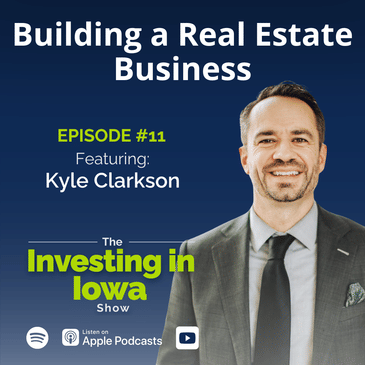
Dive into insightful discussions with Kyle Clarkson about the highs and lows of property management, the benefits of investing in real estate, and the importance of turning a job into a structured business. Tune in to discover how leveraging your strengths and investing wisely can lead to sustained success in the real estate market.
What you'll learn from this episode
-
The impact of family legacy in real estate
-
Perks of investing in real estate early
-
Strategies for managing investment properties
-
Lessons learned from challenging real estate projects
-
Advice for new investors on starting early
Resources mentioned in this episode
-
Rich Dad Poor Dad by Robert T. Kiyosaki | Kindle, Paperback, and Mass Market Paperback
About Kyle Clarkson
For over 20 years, Kyle Clarkson has helped buyers and sellers realize their dream of home ownership. He prides himself on attention to detail, hard work, and being available for his clients. Since 2004, Kyle has worked with clients to assist them in their real estate needs and trained real estate agents on how to better their business and serve the consumer. He believes his knowledge and experience help his clients achieve their goals of home ownership.
Connect with Kyle
-
Website: Clarkson Realty Group
-
Facebook: Clarkson Realty Group
-
Instagram: @clarksonrealtygroup
-
Phone Number: 515-554-2249
Connect with us
For more insights and updates, follow us on social media and visit our website: https://theinvestinginiowashow.com/.
[00:00:00] Some of the numbers we should have known were quite a bit higher than what they should have been. So, having a feel for that, I think about we've built some houses and going back to, hey, if I'm gonna do a custom home,
[00:00:10] we're gonna itemize everything that's going into this house. From cornfields to high-risis, office to industrial houses, to hotels, and every other asset class in real estate, we cover the people, the projects, and the profit. Welcome to the Investing in Iowa Show!
[00:00:26] This show is for go-doers, action-takers, and business owners. It's for people like you who are sick of Uncle Sam taking a huge bite in your app. If you're looking to get ahead of what's taking place in Iowa,
[00:00:38] learn who is doing what, and how you can get in on the action, you're in the right place. Posted by Neil Timmins, an Iowa native who has been involved in over $300 million in real estate, right here in Iowa, recording in studio from West of Boy.
[00:00:55] Here's your host, Neil Timmins! How Clarkson's here? Welcome to the show. I appreciate you having me. Thank you. Look forward to it. You're safe for the audience to thank those who don't know you. Who are you from what do you do?
[00:01:06] I'm from Des Moines, Portland, Raisin, Ancony, and been selling real estate in Ancony, Des Moines for 20 years, 2004 jumped into real estate, followed the family business. So doing it and having a lot of fun with it.
[00:01:19] I didn't realize until right now that we got in the industry at the UXM time. Oh, you're 2004? Yeah. Yeah. Good time to get in. Good class, good time to be granted. Right before everything crashed. So yeah. Yeah. All right, tell your from here, your from Ancony.
[00:01:33] Talked me, it's a family business. Yeah. That's where you have your teeth in, how many generations who came before you what they do? My grandfather was in real estate. He opened his own real estate company. I think 50, 60, something like that.
[00:01:45] He brought the century 21, franchise in the 80s to Des Moines. Then my dad and my uncle both went to work for him. They were managers for him at Century 21. So a little bit of family business, my sister's license real estate agent,
[00:01:59] my dad and Uncle still are licensed real estate agents. So just kind of jumped into the family business. What were those conversations like growing up at home? Yeah. You know that once I remember the most was when my dad had a bad day,
[00:02:14] you know, because you work with people and people can let you down or you invest in a lot of time and energy, and then they didn't buy a house or work with someone else. So I remember those moments more than anything because, you know,
[00:02:27] they kind of stuck with them and he's type of person gets really invested with people in a positive way and invest into them. And so I think you always feel like there's a let down in a relationship when that happens. And so I remember those moments still.
[00:02:40] And now I feel those moments from time to time. Yeah, because it's an investment. It's a personal investment. That's the end business piece. Yeah, right. That's a beautiful thing about real estate is yeah.
[00:02:49] I mean, there is a business piece, but they amount of time and you spend with people and people are calling you and hey, we're having a baby. Nobody knows yet or you know, last week, hey, we're getting divorced.
[00:03:01] You know, our kids don't know yet, but they're calling you first because there's major life changes. Good and bad. And so you kind of get to go life through life with people. So yeah. When did you know you wanted to be in real estate?
[00:03:13] Well, I didn't know what else to do. I got to a point where I'm like, what do I do next? I'm going to Mike. Well, my family could do real estate. Yeah. I think I can do it too. Yeah. So was that during college, post-cog? Where was that?
[00:03:26] It was post-cog. Like I didn't have this great dream to, I'm going to fall on my father's footsteps. I'm going to fall with a family business. You got to a point where I really didn't know what I was going to do next.
[00:03:37] And real estate seemed like my family had done it. They knew it. I'd been around it. So I'm like, oh, I'll give this a try. Yeah. And so I end up falling into my footsteps, my dad and never intended to do it.
[00:03:48] And for being a broker to a trainer, it's going to funny. Because he was a broker at Colibanker. He was a trainer at Centro 21. Why was a broker at Centro 21? And I was a trainer at Colibanker.
[00:03:58] So I still, I have his Centro 21 gold jacket in my closet still. So yeah. That's very cool. Talking about the, I'm curious on the train side of things. What does one learn? What were the benefits you got out of that experience?
[00:04:12] So that did more for my business than anything. So I jumped in 2004. My dad was a great salesman and Colibanker was great at training in sales. I learned the sales side and the market tanked. And we had coffee recently talked about getting the bad of that.
[00:04:29] But at that time, I didn't know what was going to do. So I became the trainer because those that can't do teach. So I became the real estate educator. Is at that time when I really like starting real estate and realize,
[00:04:42] this is more than just making sales calls. Whatever. I need a build of business. And so learning during that time, what it looked like to run a business. Just happened to be real estate. And certainly the sales skills that I learned early in my career were beneficial.
[00:04:58] But it was those three years as a trainer. They did more for my business than any of the other 17 I've been in it. So yeah. That's a crunch. So gone on to build the business and have a team. Have a structure that resembles a business. Yeah, just. Yeah.
[00:05:12] Not just a job in real estate. That's right. Yeah. Yeah. Tell me about that. What does that look like? Yeah. I mean, so it started. I got into coaching at the same real estate coach that I had now for seven or eight years. And I started an LLC.
[00:05:25] I just started paying myself a salary. You know, I started hiring employees. I started spending money on marketing. And, you know, just things that normal businesses do that I hadn't really done.
[00:05:36] I just kind of was a hope and a prayer that I hope the phone rings and pray they actually by house. Yeah. Now I had a plan. And so that is grown over time.
[00:05:45] And we're talking before we start here, you know, some of the things that work and don't work. And the ones that don't work, you kind of, you learn from and grow from. And that's all been a process. Yeah.
[00:05:55] Well, one of the things I think is unique about you is that you've invested very heavily in your business and then alongside that you occasionally, you got to handful of investment properties. Yeah. Things that you've purchased, which I think runs parallel to the thought of successful business
[00:06:11] owner, successful attorneys and doctors where they stand there laying they do what they do exceptionally well. They earn very good money and then they deploy that capital someplace. Yeah. And oftentimes, you know, they pick up a property either directly go off and put it together or
[00:06:27] indirectly they invest through people. Tell me about your experience in investing. Yeah, you know, when we are around real estate, it's much easier because it's we're around it. So for me, I was something again when I got back into selling after my three years as
[00:06:42] educator as we started going down that road. I mean, that was one of the things I knew I wanted to do is start at Best and Real Estate. And so I've invested on the new construction side a little bit and then we bought a couple
[00:06:52] of vacation rentals that are outside of the Des Moines area. And then my first one, I bought was a duplex and ancony was a good opportunity that presented itself because I was in real estate. I heard about it. You know, I wouldn't have heard about it otherwise.
[00:07:06] And so jumped on that opportunity and, you know, currently on a four plex in the mind. And so yeah, it was being around it just for himself the opportunity to jump in. Tell me about the duplex. How do you manage that? I've brought my manager.
[00:07:19] So one of the things I love my father, but I watched him the time he has always managed his own and so he's got a couple rental properties. And he's always managed his own and I would see him trying to track down money and trying
[00:07:31] to get things fixed and just the time and effort and frustration that kind of came along with doing that and I'm like, I don't want to do that. So when I bought mine, I called a property manager and I'm like, if I know I own this,
[00:07:46] I'm going to sell it because me being a property manager is not going to work. I think it'll hurt other things I want to do. And so I told them, I'm like, you just take care of it. I want to own it.
[00:07:56] I don't want to mess with it and not that I don't want to have a relationship with people. But I don't want to lose there and I don't want to have to hate they do not go on their door if they're not paying rent all that stuff.
[00:08:05] Hi, it's Eva Boutcamp. The investment relations manager for Niels firm legacy impact investors. I've inviting you to join us for our next investor workshop, our monthly legacy briefings. In these tactical zoom calls we cover topics and case studies for subjects such as taxes
[00:08:21] and depreciation, navigating macroeconomic shifts and evaluating deals as a passive investor. At each virtual workshop we are joined by an industry guest, covers their topic in 45 minutes more or less. No fluff, no pitches. Just education and conversation with an expert each month.
[00:08:40] Every workshop ends with live Q&A from Neil and our guest. All briefings happen on the last Tuesday of the month at 3 PM Central. As you can't make it live, recordings are sent out exclusively to those who registered in advance.
[00:08:53] To join us on the last Tuesday of this month visit legacyreving.com. Go to legacyreving.com to register. If you're a first time registered, I'll send you a free resource at Tina. Head to legacyreving.com and I'll see you soon. You want to be an actual investor? Yes.
[00:09:10] Not a property manager. Not a property manager. No, and it's a component of the business on investee. How do you, how does it get executed? But it doesn't have to be you. It's the management component has a cost associated with it.
[00:09:24] Whether you do it or there's somebody else. What I'm saying is that if you dial either do it, the cost is much heavier. Yes. It's a much heavier burden. Absolutely. I'm curious, is to how long you've been on that?
[00:09:35] I think it's probably been five, maybe five years or so somewhere that both are. What's happened to the value of that? It's doubled. Maybe more. I don't know. I haven't done a market on a while, but it's worth quite a bit more than a bit. Yeah.
[00:09:49] Tell me about the fourplex in the market. Yeah, so this experience is probably not a positive one. I had a guy that was by sold in the fourplex and he wanted out. We had it sold a couple times, fell through whatever.
[00:10:02] He's like, hey, I'll just sell it to you for what I owe. I'm like, well, it looks good on paper and says, all right, he needs out whatever. So I bought it and then the process of one, there was a rental certificate because there
[00:10:17] were some issues with the city of Des Moines. So I had done a little homework. Okay, what's this going to cost me? I probably didn't do enough due diligence on it to know where those numbers are going
[00:10:27] to be and everything, of course, was quite a bit higher than when I anticipated and the process of, you know, I've never really tried to get people out of a property before and
[00:10:36] I'm thinking, hey, I'll just be a nice guy and tell them, hey, this what I got to do, city and I'm thinking that's going to be no problem. And of course, nobody moves and I had to get attorneys involved and all that good stuff
[00:10:46] and that drug on way too long. So then I'm sitting on this, getting no rent and I was a little bit of an issue and we finally have just finished it up and now have three to four units are rented and you know, they're
[00:10:59] getting quite a bit more rent than we were previously. But as we were talking about, those are the lessons that we learned maybe the most or the ones that don't go well. Correct. And that's not didn't go well. Well, with that, what did you learn?
[00:11:12] What would have been done? Say next time I'm working out to do it again. What would you have done to them? I think maybe stronger numbers like one we were looking at are like, okay, what's
[00:11:21] it going to be to do some foundation repair and what's it going to be and so contract are working with. Like, oh, each unit to kind of do just kind of rough numbers and maybe just trusting the rough numbers more than we should have.
[00:11:35] I mean, you know, it is like you get into projects and there's always something you're not correct. Yeah, but I think some of the numbers we should have known were quite a bit higher than what they should have been.
[00:11:46] And so I think having a feel for that, I think about we've built some houses and going back to hey, if I'm going to do a custom home, we're going to itemize everything that's going into this house to lay it out.
[00:11:57] So when we give a client a number, we're going to stick by that number. Right. And because, you know, we've researched it, you know, the subs have given you that number. They're going to stick by that number. Don't feel like I had that done on this property.
[00:12:10] So, I hear you saying apply the same methodology utilize in new construction when you're at a better house. Yeah. Apply that same thing to the remodel project. Yeah, and leave room for unknowns when you start digging into those walls. But yeah, how old is the property? Roughly.
[00:12:24] It's about 100. Yeah. So that's a great whole new kind of thing. Yeah. Unlike a new construction, there's a great level of certainty associated with new stuff. Yes. So, you can get into 100-year-old property. Yeah. Whereas things that you're becoming challenging to account for. Yeah.
[00:12:39] So, we've tried to, you know, since that time, my real estate team, I've got a group, we kind of opened it up and we started an investment group. And so within our real estate team.
[00:12:47] And so we're, as we looked at that, I want to make sure because it was more than just me, like, hey, we've got a better method to kind of solidify those numbers before we purchase a house and finalize it.
[00:12:58] So we feel better about, you know, moving forward than I did on this one. Is that change given the age of that? Does that change your buy box moving forward at all? Yeah.
[00:13:08] I still think, I got a sense of what I can sell something for by doing quick, market analysis. And so buying right is always kind of what matters. So I don't think I'd stay away.
[00:13:16] I've renovated house before and I think a one that was early 1900s that ended up being a great project for us. And better due diligence on that one than this one. And so that's probably the biggest takeaway of what I need to improve on. Yeah.
[00:13:31] Do you like flipping properties? I like flipping and not that I just like the process of flipping them. Is that because there's not a management component to it? That's probably it. There's no right around. Yeah.
[00:13:43] I think that probably plays into it, you know, I always live with this fear of managing properties. And now that's probably amplified after this four of likes we just did and thinking about renters and getting them out of there.
[00:13:53] And did was have one guy threaten your life a couple times. And so let me get to stay away from that. Yeah. And I'll be running for management. Yeah. That'll make total sense. The looking forward. What do you interested in in the investment side?
[00:14:06] Is it some more flips, keep them rentals, kind of cherry picking them as you see fit? I actually had a couple opportunities recently. One on the commercial space. I wasn't really into space. And it's being opportunity.
[00:14:15] We'll see if it is as my real estate company is looking for space. Opportunity to purchase something as opposed to lease. Right. And that peaked my interest for sure. And then an opportunity for another four plex that just much newer and ready to go.
[00:14:29] And already has renters and nothing to do. And so both of those excited me. We've got a house in California that has been a great vacation rental for us. And that part has been fun because I love Iowa.
[00:14:41] But it's a little California's little more fun to go and visit and spend time there. There's a little different. So my wife and I are going there next week and spend four days.
[00:14:49] And we just had people in there for Coachella and you know, people in there for this big tennis tournament there. So that one's a little more exciting than a four plex into boy. What's unique about that management of a property out of town versus in town, even
[00:15:06] when you're using third party management. Yeah, you've perhaps had probably trust them a little more because like that duplex and ain't kidding, I can drive by and check it out. And they said, hey, there's a tree that needs to run.
[00:15:14] Well, let me go look at this and see, well, if they say something there, I can't just drive by and there's something to do. So I have a good relationship with the property manager, which we do. We've this our second house.
[00:15:25] We've had there in same management company because we trust them. And they got great people to go and do the work if something needs done. Hopefully that's not often, but you know, so they've got great resources.
[00:15:36] And you got to trust them pricing wise because I've had another one in Arizona where the property manager didn't have a great gauge and feel of, okay, when do we lower it? When do we raise it? And so we have too much vacancy.
[00:15:48] And then again, go to back the fact I'm just trusting someone to do it. Well, they had prices way too high. So you got to find that sweet spot out of it. We don't want to slower to get someone in, but what's a price someone still will
[00:15:59] to pay. And so these guys in California have done an amazing job of that. How do you use to the point where you do trust them? You know, when I'm thinking for the audience to say, yes, is there an out of, you
[00:16:07] know, is there someone not an eye on who's looking at it and besting an eye? Well, so how do they, you know, these questions, no matter independent of the geography apply? Right?
[00:16:17] How do you get to a point where you can find something you can come to, you know, like a trust when it comes to the management of either your short to more you're going to run on. Yeah, I think a personal referral goes a long way.
[00:16:29] I mean, that's what these guys were personally referred to us. I mean, you know, when I sell houses, 90% of the business I do today is because someone personally, they had a good experience working with me and they're referring and love that type of business.
[00:16:41] And for this, what I found is it was a personal referral because they had a great experience with them. And you're not always afforded that luxury because you may not know anybody but he in the area. I was.
[00:16:53] I knew a couple people there that had investment properties, they had great experience with this property manager and we've had the same. So yeah. In your brokerage business, do you deal with investors very often? Is it primarily homeowners? Yeah, we deal with a decent amount of investors.
[00:17:09] We don't have some massive investor that just spying up all kinds of property. But yeah, I mean, I closed on one to day where that they were flipping a house. And so right opportunity comes long.
[00:17:20] I've probably got five, 10 people that I work with that if you would bring them the right house today, they would probably do it and jump in and whether it be a hold or flip, jumping and do something.
[00:17:32] If your house flipper, execute the burst strategy or do double closings and are in need a money. Little guy loans is your go-to lender here in the Des Moines area. Time is money. Loan approvals in 24 hours, closings in five days.
[00:17:47] Little guy loans was founded by Neil Timmins and investor just like you since he has been in over 10,000 homes in Des Moines. There's never an appraisal. Houses, multi-family and commercial property loans up to 1 million. Check out www.luygilones.com.
[00:18:05] You think your experience at a investing has helped you as you broker when it comes to dealing with investment clients? Yeah, I think so. Having been down that road and we talked about this, but the mistakes I made would have
[00:18:18] been bloody, but learning what not to do, the one that closed a day, having that conversation. It was his first one and talk with him, it's like okay, one thing I've learned is like I made the house too nice.
[00:18:32] Not that you don't want nice things, but you can still make it nice without feeling like I'm turning this $300,000 house into a half million dollar house. Thank you, never doing it. Yeah, I can over-comprove. Yes, and totally over-proved it.
[00:18:44] It was a lesson for him to say okay he enjoys doing it, he enjoys the renovation part, but what's important and what's not important in for him like having that conversation will maybe there needs to be more communication even from me and him during the process.
[00:18:58] Counter-tocks, how nice do I have to go on this? Are there any of that stuff? So you learn as you go and for him doing that one, it was a great experience. He didn't make as much as he wanted, but learning and going through it was key.
[00:19:12] I'm going to measure some of that as I'll simplify it actually. Simple as you, Pauline, comparables. Yep. Here's what's all the past. Here's where the market's going to be. This is the product that went into that house so anything past that is not going to move the needle.
[00:19:25] Back you might be going backwards under profit. That's right. So finding those cops from the beginning and when we did form, but once you're in it and start going, do you find that I have seen that multiple times in the past, my experience has
[00:19:37] been primarily when guys are doing their own work versus when they have crews. Because there's maybe a higher level of emotional test rate to their work right now. Yeah, for your exact, and which is what this guy was doing, who's doing his own work. And you're exactly right.
[00:19:50] There's that emotional tie because I am doing this. I want to make sure it looks nice. I would live here, you know, flexion. Yes, that's right. Yeah, that's great. What do you most excited about this year? I'm excited about the market in general.
[00:20:01] Everybody's talking about rates and rates are not amazing right now. They're not amazing because the market still goes pretty strong. And I was talking to a developer recently and he was talking, hey, if rates drop, there's all these big developers that they got deals ready to go.
[00:20:18] And we're going to see the same thing. We saw a code with it that would happen. If rates drop, all of sudden the price is going to go up 25%, we don't want to be back in that position. So I'm excited where the market is at.
[00:20:28] I think it feels very strong considering where the rates are and we're plugging away right now. So yeah, it seems pretty manageable. Yeah, let's do something on the bottom to the final segment. Like all the final three.
[00:20:39] If you had one piece of advice, you could give to your 20 year old self. Oh, it would be. I mean, in investment real estate, I just set molten for DR or enough talk to him several times.
[00:20:48] He's like, I wish I would have held on to all my houses because they've gone up and value and you got to learn those, let me want to get him money when you're 20 is difficult thing to do sometimes. But we're all those stages in life.
[00:21:00] I look back and I'm like, you know, I'm 46 now and I look back in my 36 year old self. I'm like, man, I wish he wouldn't known this. Yeah. And I know when I was 36, look back at 26. And so there's lessons that you have to go through and learn.
[00:21:13] But man, investing in real estate has never been a bad thing, right? Right. I mean, you look even when the market went down a little bit, there was one little blimp, you know, in the last 40, whatever year to invest in real estate in early rage,
[00:21:28] I think would have been something I definitely would have done. Yeah, to invest a proper level of debt and then be good. And that's where we go way earlier when actually how much the do-plexage change in value and only get to participate in that.
[00:21:40] You only get to reap any of the benefits by participating by being in it oftentimes. So the city of the sideline with liquidity, waiting for the market to change. Yeah. Just doesn't change. It doesn't change in the fast and fast and hindsight for all of us is 2020.
[00:21:55] We were about a ton. Yeah. 1112. Yeah. Had we known. I was just trying to stay afloat and do that. So it's like as far as what it is. Yeah, opportunity does come most people on the side. Yes, do you have resources?
[00:22:07] Yeah, and do you have the intestinal fordone? Yeah, no, that's a win the day is dark. Yeah. Two bucks to change your life. Oh, two books that changed my life. Well, I loved rich dad for dad. They probably want a lot of people to have.
[00:22:21] And then another book that changed my life that trying to think of a real estate book, and I greatly impacted me. I'll think about that one. If you were to be cast away in Ireland for a year, you could only get three pieces of data about your business.
[00:22:35] Okay, piece of data about your business each and every month. What three things must you know, every month? Well, I am very numbers driven. You know, I live by spreadsheet. So as long as I can continue to receive those spreadsheets, you know, give me my P&L.
[00:22:49] We got a few different aspects of my business. We have our online lead generation money. We're, let's go and out money that's coming in. But even within that we track everything from, did we set the appointment on the call?
[00:23:01] How many calls does it take to actually land a appointment? How many appointments to land a contract? I think having those numbers because I look at those frequently. That would be important. So give me my P&L.
[00:23:14] Those numbers specifically, Zillos, where we do a lot of our lead generation. And so they send me those numbers weekly. So I'm like pouring over those and analyzing it for our agents. Yeah, for people that want to find you, they want to follow you.
[00:23:27] They want to connect with you. What should they do? Where should they go? Yeah, I mean, you can find a social media, Clarkson, Realty Group, Facebook, Instagram, wherever my phone number is 515-554-224-9. I'm pretty easy to find there by caller text. But yeah, absolutely.
[00:23:43] Wow, we'll put the likes below. Yeah, it's right. Yeah, I appreciate you coming on. It's a fun story. Deep family history in this business. You're not even halfway through the career now. Yeah. I can't wait to see what happens in a couple of decades
[00:23:55] and as your business grows and matures and your kids come up age, what happened? Yeah. Have the same meal. We'll see if it stays in the family. I got a son that is feels like he has the personality and we'll see what he does. But yeah, that's good.
[00:24:08] I appreciate it. Yeah, thanks. Thank you. Appreciate it. Thanks for listening. If you're enjoying the show, may I ask a favor of you. Naturally, subscribe so you never miss an episode. But would you rate and leave an honest, written review on Apple Podcasts?
[00:24:21] It does a lot for us here at the show and I appreciate reading your thoughts. Great guests make for a great show. If you know of another island, it would be a great guest for you yourself have interest in being a guest. Well, get on our radar.
[00:24:35] Visit investing in Iowa to fill out an application or recommend a guest. And if you want to connect with me on one, go Legacy, Impact, Investors, Gotcom, click on the Invest with us button in the top right corner. And there you can pick a time for
[00:24:51] the two guests to get on the calendar and kidnapped. Until next time, keep investing in Iowa.