
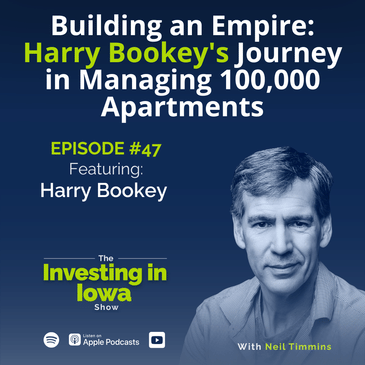
Dial in to uncover the remarkable journey of Harry Bookey, from lawyer to real estate mogul. Learn how he built a top apartment management empire and ventured into billion-dollar institutional investments. Hear about his challenges, community impact, and passion projects in his transformative career.
What you'll learn from this episode
-
Harry's transition from law to real estate investment
-
Why you should build an investment strategy with institutional partners
-
The rise of institutional investors in U.S. real estate
-
Floating rate debt vs. fixed rate financing
-
Main impact of rising insurance costs on real estate
Resources mentioned in this episode
About Harry Bookey
Harry Bookey is a prominent real estate investor and founder of a major apartment management company. Starting his career in law, he transitioned into real estate, where he forged partnerships with high-profile investors and institutional clients. Known for his sharp investment acumen and attention to detail, Harry built a real estate empire with thousands of apartment units across the U.S. Today. He is engaged in philanthropic work, community development, and passion projects that reflect his dedication to history, art, and global initiatives.
Connect with us
For more insights and updates, follow us on social media and visit our website: https://theinvestinginiowashow.com/.
[00:00:00] I could look at something and know immediately, conceptually, what was wrong and how they were operating and where the location was. I could put a lot together and decide whether or not it was a good deal.
[00:00:11] From cornfields to high-rises, office to industrial, houses to hotels, and every other asset class in real estate, we cover the people, the projects, and the profit.
[00:00:21] Welcome to the Investing in Iowa Show. This show is for go-doers, action-takers, and business owners.
[00:00:28] It's for people like you who are sick of Uncle Sam taking a huge bite of your apple. If you're looking to get ahead of what's taking place in Iowa, learn who is doing what and how you can get in on the action, you're in the right place.
[00:00:42] Hosted by Neil Timmins, an Iowa native who has been involved in over $300 million in real estate right here in Iowa.
[00:00:50] Recording in studio from West Des Moines, here's your host, Neil Timmins.
[00:00:56] I've got Harry Bookie here on the show. Harry, welcome to the program and I appreciate you taking the time to connect.
[00:01:01] Thank you very much. Be happy to.
[00:01:03] Say for the audience's sake, in case they don't happen to know who you are, who are you, where are you from, what do you do?
[00:01:08] I grew up in Des Moines, Iowa. I went to Roosevelt High School. I went to University of Wisconsin. I was at Georgetown for a while, getting my law degree and then came back to Wisconsin.
[00:01:19] And I had a relationship going and it didn't work out. So I moved to Australia for a couple of years, worked in a large department store.
[00:01:29] Notwithstanding, I had a law degree and spent a lot of time in Australia and I was actually going to stay there.
[00:01:34] But my father got sick. So I came back to Des Moines and started practicing law at the Davis Law Firm at the time.
[00:01:43] And I knew a woman from the University of Wisconsin and we got back together and we got married. Her name is Pamela Bass. She's from Chicago area.
[00:01:54] And when we decided where we were going to live, I was thinking Chicago and she loved being in Des Moines. Obviously, she gave us the call.
[00:02:03] And I worked in Des Moines for as a lawyer for about, I don't know, 16 years. I always wanted to be the client.
[00:02:10] I was with a couple of the larger firms and one of the clients of mine was a real estate syndicator.
[00:02:17] He was out of California and he used to enjoy me being his lawyer and traveling with him to put together a lot of apartment deals with him.
[00:02:26] Going back a little bit, I was getting very bored. I always wanted, like I say, be the client.
[00:02:31] So I decided to leave the law practice cold turkey and I did.
[00:02:36] There was a fellow named Tim Urban who I knew he was a client of ours as well.
[00:02:41] And he had an extra room in his office building on Ingersoll.
[00:02:45] And so I took it and spent the next six months trying to put a deal together with kind of people I knew from the law practice.
[00:02:54] And aside, my whole room, which was, I think, six by eight, there was next door to us, there was a client.
[00:03:01] She was a psychiatrist and she used the primal scream method of treatment.
[00:03:06] For about six or seven months, every 45 minutes, I would hear somebody make a primal scream.
[00:03:14] So anyway, but I got really lucky.
[00:03:16] I had a friend in the law practice who gave me a call and said there was a deal in Texas that there was a guy who had it under contract.
[00:03:25] The guy that had it under contract had gone bankrupt in the 80s.
[00:03:29] He couldn't raise any money, but he had looked like a really good situation.
[00:03:32] So I went down to Texas for the first time.
[00:03:35] And I had never been in Texas.
[00:03:36] I looked at the property.
[00:03:38] I couldn't believe my eyes.
[00:03:39] It was, I think, $18,000 a door at the time.
[00:03:43] And there's 156 units.
[00:03:46] And we only had to raise $300,000.
[00:03:49] So I told him we'd go ahead with him.
[00:03:52] And so at any rate, I raised the $300,000.
[00:03:55] And I went to a closing.
[00:03:57] And this is where my luck changed dramatically.
[00:04:00] In those days, you physically went to a closing.
[00:04:02] And these days, you send paper back and forth.
[00:04:06] So I went to the closing.
[00:04:07] And the savings alone was selling the business, selling the apartment community.
[00:04:12] And the closing lasted for about seven or eight hours.
[00:04:16] Wow.
[00:04:16] And so it was like 435 o'clock.
[00:04:19] And so I said to the owner of the savings alone, I said, David, would you like to have dinner?
[00:04:24] And he said, I'd love to.
[00:04:26] He said, but I have to go to a closing.
[00:04:28] And I said to him, we were at the closing.
[00:04:31] He said, no.
[00:04:32] He said, you're closing.
[00:04:33] He said, I go down to the Federal Home Loan Bank.
[00:04:35] And they give me the difference between my mortgage and what you're paying me.
[00:04:40] So I looked at him and I said, so David, you don't care what the price is.
[00:04:44] And he looked at me in that kind of Texas look.
[00:04:47] He said, nope.
[00:04:49] And I said, do you have any more of these?
[00:04:50] He said, five.
[00:04:52] That they were going bankrupt or whatever.
[00:04:54] I cut a deal on those five.
[00:04:56] And that's how I got started.
[00:04:57] You were in business.
[00:04:58] Wow.
[00:04:59] So I was in business.
[00:05:00] And that kind of got me started.
[00:05:02] And I knew a lot of, started to know some people in the industry and so forth.
[00:05:05] What year was that?
[00:05:07] 1992.
[00:05:08] 1992.
[00:05:08] How did you manage those first two properties?
[00:05:11] I hired a management company to do.
[00:05:14] I was out about, after we had bought a number of properties, like I was described to you,
[00:05:19] I caught them.
[00:05:20] There was a guy named Arnold Golib.
[00:05:22] He was an accountant here in Des Moines, great accountant.
[00:05:25] And he had led me to a number of investors.
[00:05:29] And he looked at the financials each month.
[00:05:30] And he called me.
[00:05:32] He said, Harry, your management company is stealing from you.
[00:05:35] And I said, what do you mean?
[00:05:37] Apparently, on the capital improvements, it was an even number every month.
[00:05:42] And so as an accountant, he said, not possible.
[00:05:44] Right.
[00:05:45] So as a result of that, we got together with our lawyer and I had to make my call whether
[00:05:51] or not to hire another management company or do it ourselves.
[00:05:54] So I decided to start my own management company.
[00:05:57] And that was 1994 or five.
[00:05:59] And we started with, I think we had eight or nine properties.
[00:06:03] And that was our lower end that we started.
[00:06:06] And we ended up with, when I sold the business a couple of years ago, it was, we had about
[00:06:11] 120,000 apartments under management.
[00:06:14] Yeah.
[00:06:14] Yeah.
[00:06:15] Doors.
[00:06:15] It's a good way to put it.
[00:06:16] That's what got me started in the industry.
[00:06:18] And then it was a good time because pricing was good.
[00:06:22] Rents, financial interest rates were reasonably low.
[00:06:25] And one thing led to another.
[00:06:27] And I developed a lot of clients.
[00:06:30] From the early 90s to today, have you noticed that the industry has become more sophisticated,
[00:06:35] more institutionalized over the years?
[00:06:38] Definitely more institutional, especially in the last couple of years.
[00:06:43] What's happening a lot is that a lot of the money is coming in from the Middle East.
[00:06:48] And what they're looking for is they're investing a ton of money.
[00:06:52] If you look at the world as a whole right now, you got South America's a mess.
[00:06:57] China, nobody wants to invest in anymore.
[00:06:59] Asia is really a problem.
[00:07:02] Russia, nobody's going to do anything with.
[00:07:04] And Europe, England broke out of its zero interest rates and so forth.
[00:07:09] So a lot of the money that's coming out of the Middle East is coming in billions or trillions,
[00:07:15] I think.
[00:07:16] And a lot of it's going to the United States.
[00:07:18] And one of the things that they're asking for now is they want a good share of what
[00:07:24] they're investing in real estate because they know it's real.
[00:07:27] They're patient.
[00:07:28] And as a result of that, I think it's driven the value disproportionately high on apartments
[00:07:35] and so forth.
[00:07:37] And so that's what is happening in the industry.
[00:07:40] Kind of the main thing that's happened in the industry the last few years, though, is
[00:07:45] with the value, the purchase price of apartments has gone way up.
[00:07:49] So rents are pretty high.
[00:07:51] And with COVID and all, people want to live in a home.
[00:07:55] And as a result of that, but they can't afford a home because if the home's $400,000, they
[00:08:01] got to show up with $100,000 to get a purchase agreement.
[00:08:05] And so what's happening is the industry has now turned towards what you call BTR.
[00:08:11] It's called build to rent.
[00:08:13] And so there's tons of build to rent projects being built all over the country.
[00:08:19] So that's where the industry is today.
[00:08:21] Nobody really has to be close to downtown anymore because there's so few people downtown.
[00:08:27] You're right.
[00:08:28] And that's made a big change.
[00:08:30] You could certainly spread out and get much further away outside of that central business
[00:08:34] district as a result of that.
[00:08:36] Did you guys participate in ground up construction on the build to rent side?
[00:08:40] Hey, Iowa investors.
[00:08:41] This is Ava Baukamp, chief of staff at Legacy Impact Investors.
[00:08:45] Have you thought about adding real estate to your portfolio but don't have the time or desire
[00:08:49] to play landlord?
[00:08:50] At Legacy Impact Investors, we do the heavy lifting.
[00:08:53] Our team finds the deals, manages the properties, and handles all the day-to-day operations.
[00:08:58] Our select group of qualified investors co-invest with us, gaining ownership equity without opening
[00:09:04] a tenant email or responding to a maintenance call.
[00:09:07] They just share in the income, appreciation, and tax benefits.
[00:09:10] These opportunities aren't for everyone.
[00:09:12] They are for qualified, accredited investors only.
[00:09:15] If you want to learn more, please visit LegacyImpactInvestors.com to apply.
[00:09:20] We really didn't do build up construction, but we did a lot of takeouts with companies that
[00:09:25] were doing construction, mostly in Florida, Alabama.
[00:09:29] Most of the apartment properties that we had were mostly in Florida.
[00:09:33] We had 60 or 70 properties that we were operating there.
[00:09:37] Phoenix has been a big market for us.
[00:09:39] Colorado, to some degree, the Midwest, to some degree, and then on the East Coast, Florida,
[00:09:46] and going up to the Carolinas.
[00:09:48] Has been those that are, they called the, what they called?
[00:09:52] Oh, the sunshine or the smiles day.
[00:09:55] It's a sunbelt.
[00:09:55] Yeah.
[00:09:55] The smile.
[00:09:56] Yeah.
[00:09:56] It was like the smile.
[00:09:57] That's what they called it.
[00:09:58] So those are the areas that we were in, and those were people were moving, and apartments
[00:10:02] were being built.
[00:10:03] So anyway, that's...
[00:10:04] So this business requires, it's very capital intensive.
[00:10:07] And at some point, as you're scaling, I suspect you certainly had to leave the more from mom
[00:10:12] and pop investors into institutional dollars.
[00:10:15] Maybe tell me about how you cracked that nut or a story or two about getting into that
[00:10:19] world.
[00:10:20] It's really an interesting story.
[00:10:22] The owners of the Mets, the Wilpont brothers, own the Mets.
[00:10:25] And it's a long story, but we had a partner that knew the Wilponts, and there was a deal
[00:10:32] for sale in Washington, D.C. area.
[00:10:36] It was a huge project, like 1,500 apartments.
[00:10:39] Wow.
[00:10:39] And this person said to us, we had done a great job managing for them.
[00:10:44] They happened to know the Wilponts, but the Wilponts wanted them...
[00:10:49] The Wilponts own the New York Mets.
[00:10:51] They're major league players, billionaires, blah, blah, blah.
[00:10:54] So anyway, I got to meet Richard Wilpont and Fred Wilpont.
[00:10:59] And we underwrote it and so forth and had a good reputation as a manager.
[00:11:04] They said they would put in the money to do, which was the original investment from them.
[00:11:09] And this was in 1990s.
[00:11:11] They put in, I think, close to $100 million.
[00:11:15] We put in our million, million, or do run some of my investors.
[00:11:18] But we managed the property and it was really...
[00:11:21] So that kind of gave us a reputation in the industry.
[00:11:23] So we started doing with some bigger players like that.
[00:11:27] But really, the biggest break of my life really came about in the...
[00:11:31] We sold that property, a 1,500-unit property.
[00:11:35] We sold it and the Wilponts themselves made $110 million.
[00:11:40] Incredible.
[00:11:40] And that was in a three or four-year time frame.
[00:11:44] Yeah.
[00:11:46] And actually, when they originally bought the property for $100 and some million, they refinanced
[00:11:51] it and got back half their money to begin with.
[00:11:54] And on top of that, they made another $110 million.
[00:11:57] So they had a friend, they had an assistant that I talked a lot to, worked with a little
[00:12:03] bit.
[00:12:03] His name was Tom Dolan.
[00:12:05] And I said, Tom, we just sent you a check for $108 million or something like that.
[00:12:11] And I said, I didn't hear anything from Richard.
[00:12:13] There's no bonus.
[00:12:14] There's no nothing.
[00:12:15] I said, and he said, oh, he says, that's just the way they are.
[00:12:18] So I said, I guess that's the way it is.
[00:12:20] So as it turns out, and this is a long, but it really is the story that made Art Mike.
[00:12:26] Any rate, a few years later, like I say, we had $108 million and was getting no response
[00:12:32] back.
[00:12:33] And then I got a call from Richard Wilpont's secretary in New York.
[00:12:36] She said, Mr. Wilpont would like to meet with you at 11 Madison, which was the most expensive
[00:12:41] restaurant in New York and would like to meet with you.
[00:12:44] So I figured, oh, okay, I made it up.
[00:12:46] This is it.
[00:12:47] Yeah.
[00:12:48] This is it.
[00:12:49] I'm going to show me the money, all this kind of stuff.
[00:12:51] So anyway, we go to 11 Madison.
[00:12:55] There's Danny Myers.
[00:12:56] Do you know who he is?
[00:12:57] He's-
[00:12:57] I know of him.
[00:12:58] Yes.
[00:12:58] Yeah.
[00:12:59] Yeah.
[00:12:59] He was our waiter because they wanted the shake shack at the meth stadium.
[00:13:03] So anyway, he was our waiter and pretty fancy.
[00:13:06] We sat down with Richard for about an hour and a half and really just didn't talk about
[00:13:10] anything.
[00:13:11] So afterwards we stood up and Richard said, there's something I've been meaning to talk to
[00:13:16] you about.
[00:13:17] And I said, well, show me the money or whatever it is.
[00:13:19] I didn't say it, but I was thinking that Richard said that one of the properties we were operating
[00:13:24] for them in Arlington, Texas, there was grass on the tennis courts.
[00:13:30] And I looked at him with an out-of-body experience and I said, I'm going to fix that as soon as
[00:13:35] we leave this luncheon.
[00:13:36] And he said, thank you.
[00:13:37] And that was it.
[00:13:39] That was it.
[00:13:40] So I called Tom Dolan, his assistant.
[00:13:43] I said, Tom, I told him the story about the grass on the tennis court.
[00:13:46] He said, oh, that's just Richard.
[00:13:48] Don't worry about it.
[00:13:49] So a week later, I get a call from Tom again.
[00:13:51] Tom said, Harry, the Cincinnati Fireman's Pension Fund would like to invest $5 million
[00:13:57] with us.
[00:13:58] Would you accept a call from them?
[00:14:00] They wanted to hear about some of the people they do business with.
[00:14:03] I said, sure, that's fine.
[00:14:04] He said, would you take the call?
[00:14:06] So I took the call and I spoke to the people from the Cincinnati Fireman's Fund Pension.
[00:14:11] They said, what's it really like to work with the Wilpons?
[00:14:14] And I told him about the grass on the tennis court.
[00:14:17] And so the next day, I get a call from Tom Dolan.
[00:14:21] He said, Harry, what did you tell those guys?
[00:14:23] I said, Tom, I told him about the grass on the tennis court.
[00:14:26] He said, they were going to give us $5 million and they gave us $25 million invested with
[00:14:32] them.
[00:14:32] And that taught me the best, the most important lesson of my life, attention to detail.
[00:14:37] If Richard Wilpon was more worried about the grass on the tennis court at Arlington, Texas,
[00:14:42] this is a multi-billionaire.
[00:14:44] That's the kind of guy you want to give money to or do business with if you're an investor.
[00:14:49] And so I thought about that.
[00:14:51] And I would say that our company had one of the highest levels of attention to detail of
[00:14:57] any of the management companies.
[00:14:58] And that created a lot of third-party management business and our reputation grew pretty quickly.
[00:15:04] Fair to say that was the genesis probably of your DNA, your culture at the management
[00:15:08] business.
[00:15:08] It changed my culture.
[00:15:10] It changed the culture a lot because you tell them the grass on the tennis court story and
[00:15:15] everybody starts to understand what it meant.
[00:15:17] And so we would have these, we would take 30 of our managers out and have them walk a site
[00:15:23] and tell us, list the number of things that could be better.
[00:15:27] Whether there was any crabgrass growing, whether it's one hair of grass or a whole lawn, just
[00:15:33] everything about it.
[00:15:35] And sometimes we'd get, even on properties that we were doing a good job operating,
[00:15:39] we were getting 50 to 100 things that we could improve on.
[00:15:42] That made a huge difference in our company going forward.
[00:15:45] It's a long story, but I didn't mean to.
[00:15:47] It's a fantastic story.
[00:15:49] As a result of Larza becoming institutional focus, did you find yourself at some point
[00:15:55] gravitating towards B plus or A properties and outside of maybe where you would have began
[00:16:00] your career acquiring properties?
[00:16:02] Or did you have a fair mix?
[00:16:03] Well, we were, it's definitely a mix.
[00:16:05] We've done some higher end properties.
[00:16:07] It depends on who the client was then.
[00:16:09] But if we're doing it with our own funds, I just looked at properties to see whether it
[00:16:14] was a good deal.
[00:16:14] Wasn't looking for a certain type of property.
[00:16:17] And that's just the way.
[00:16:18] So we had this, we found properties in St. Louis.
[00:16:21] We were in smaller markets in Texas.
[00:16:23] We were in major markets in Miami.
[00:16:26] And so I always look and underwrote, we underwrote deals.
[00:16:29] That was probably my best talent.
[00:16:32] We have a lot of people that were much more skilled than me in operating and stuff like
[00:16:36] that.
[00:16:37] But as far as evaluating and looking at things, I think I had a pretty good skill in that
[00:16:42] regard.
[00:16:43] You've got a knack for finding value.
[00:16:44] I could look at something and know immediately conceptually what was wrong and how they were
[00:16:50] operating and where the location was.
[00:16:53] I could put a lot together and decide whether or not it was a good deal.
[00:16:57] And when you say you kept an eye open for good deals, put some context around that.
[00:17:02] What for me, what does good deal?
[00:17:04] What did that mean in your world?
[00:17:05] It depended on the time, good leverage.
[00:17:08] That's who we're looking for.
[00:17:09] We were the high leverage guy.
[00:17:11] And I, for many years, was a floating rate, which made a huge, huge difference.
[00:17:17] That and then I knew what our client was looking for.
[00:17:20] Sometimes some of our clients, like the Wilpons, they would only invest in major markets.
[00:17:25] But we had a number of investment groups that were willing to invest in Des Moines, Iowa.
[00:17:30] We were in a lot of small towns, large towns.
[00:17:33] So we were open to that.
[00:17:34] So looking for properties, if I knew if a property was in Amarillo, Texas, that the deal had to make 18 to 19, 20%.
[00:17:42] And we never tried to kick.
[00:17:44] And we knew what the market would be up there.
[00:17:47] If somebody wanted to invest in Amarillo, we knew that we could get better returns.
[00:17:53] But you'd have to get better returns to have people invest in Amarillo.
[00:17:57] And Des Moines would be in that same category as well.
[00:18:00] Yeah.
[00:18:00] When you move into that primary, secondary, or tertiary markets, the returns have to be.
[00:18:04] You're going to attract that capital.
[00:18:06] Yeah.
[00:18:06] If you're in downtown Dallas area, at the Times, we might have been paying $140 a door.
[00:18:12] That same exact product in Cincinnati might be $105.
[00:18:17] But you had to look at the market.
[00:18:19] You just had to have a proper underwriting is the way we looked at it.
[00:18:23] And then the other thing is that I think we had an advantage on was value add.
[00:18:28] I could look at it.
[00:18:29] And we had a few other people that I had taught this to.
[00:18:33] We'd look at a property.
[00:18:34] And we could have immediately evaluate how we could add value to it.
[00:18:38] And so that we were considered a value add shop as opposed to a new construction group.
[00:18:44] When you acquire these properties, I'm curious about the structure, about what portion of your,
[00:18:48] the properties in which you managed.
[00:18:49] You were just the third party manager versus you had an investment, some level of participation
[00:18:54] in the outcome.
[00:18:55] Yeah.
[00:18:56] My level of participation ranged from deals where I was the sole general partner to deals
[00:19:03] where we might've had 10 or 15% of the GP interests.
[00:19:08] Like with the Wilpons, they would own probably 60, 70% of the general partnership interest.
[00:19:15] And maybe they'd ask us to put in 20, 25, 30%.
[00:19:19] And we did a bunch of deals for BlackRock and Blackstones.
[00:19:23] They like to push you down and squeeze you big time.
[00:19:26] And the other thing is being from the Midwest, there was a presumption that you were very
[00:19:31] honest.
[00:19:32] And we were, but there's a lot of these organizations that were getting into the real estate business,
[00:19:37] especially apartments.
[00:19:38] They played a little around with the truth a lot.
[00:19:41] And so we were regarded as very conservative, very honest type operators.
[00:19:47] And there was quite a few that aren't in the department of development.
[00:19:50] Yes.
[00:19:51] Anybody can make it look good in Excel.
[00:19:54] That's right.
[00:19:54] That's right.
[00:19:55] We had a lot of conditions that way in terms of our underwriting.
[00:19:59] Sure.
[00:19:59] And so we pretty much knew what we're doing.
[00:20:01] And like I said, we probably bought, I don't know, I think we were managing close to 300
[00:20:06] some operations and we were probably had some ownership and maybe 140 or so.
[00:20:12] You mentioned you were very heavy, large on the floating rate.
[00:20:16] I'm curious, although of course the last two, two and a half years, how that impacted what
[00:20:21] you did and or the portfolio as rates rose.
[00:20:24] If you're a lot of it depended on our investor, like the Wilpons, not the Wilpons, Stonepoint
[00:20:30] Capital.
[00:20:31] I don't know if you know who they are.
[00:20:32] They're a major, you know, who Stonepoint is.
[00:20:35] Yes.
[00:20:35] I love them.
[00:20:36] Very significant.
[00:20:37] Yes.
[00:20:37] Yeah.
[00:20:38] And they're a big private equity group and they, that we became very friendly with
[00:20:43] them and actually sold them a portion of our management company.
[00:20:45] They liked doing business with us.
[00:20:48] And so they were just Charles Davis.
[00:20:51] He used to run what's the largest company in the New York Stock Exchange, whatever it
[00:20:56] is.
[00:20:56] He was Charles Davis.
[00:20:59] They liked fixed debt, fixed rate debt.
[00:21:02] Sure.
[00:21:02] So we would meet with them every year.
[00:21:05] And I would say, I keep asking Chuck, I said, why would you want fixed rate debt?
[00:21:10] Because lower interest rates were unbelievable.
[00:21:13] Like 2% or something.
[00:21:16] And Chuck said, he said, I like to sleep at night.
[00:21:18] So I like fixed rate debt.
[00:21:20] And I said to him, I said, Chuck, I like to sleep at night too.
[00:21:24] That's why I have floating rate debt.
[00:21:25] So that was every year for, I think, 10 or 11 years, I'd walk in.
[00:21:31] He'd say, we had the same discussion every year.
[00:21:34] A couple of years ago when rates started going up and so forth, we changed the language a little
[00:21:40] bit.
[00:21:40] And so he says, I'm winning.
[00:21:42] And I said, you are winning now.
[00:21:44] So we have had a few properties that we were in floating rate and they just floated right
[00:21:49] up.
[00:21:49] And it's hard to get the leverage today because insurance has gone way up.
[00:21:54] It's just, it's a whole different business than it was.
[00:21:56] You mentioned insurance.
[00:21:57] I'm curious, would you indicate that's probably the single largest challenge that's taken
[00:22:01] place outside of interest rates that's taken place over the last couple of years, especially
[00:22:04] in that South, more specifically the Southeast where you're going to explain it?
[00:22:08] Oh, it's a killer.
[00:22:09] Yeah.
[00:22:10] It's a killer.
[00:22:11] We used to do insurance at 180 a door.
[00:22:13] And now you're talking in certain markets, 1,200 to 1,500 a door.
[00:22:18] And that's on older apartments.
[00:22:20] It wouldn't even be that expensive.
[00:22:22] And so between insurance and higher interest rates, that's what drove the market values
[00:22:30] up so high.
[00:22:30] And so it's been a challenge.
[00:22:33] Right now there's a shortage of apartments nationally by about 10 to $15 million.
[00:22:38] But I think people, because of COVID right now, the big issue, the industry right now
[00:22:44] is going to BTR, build to rent apartments.
[00:22:48] Because like here in Des Moines, like in Dallas, for example, we had an office there of 140
[00:22:54] people.
[00:22:55] Today, we don't have an office in Dallas.
[00:22:57] We have a little satellite places where people go, a Starbucks or places like that, or people
[00:23:03] work from home.
[00:23:05] And it's just people were, and the same thing is like in Des Moines, Iowa.
[00:23:10] You have people who would just assume here we have 180 in the Des Moines area, and we're
[00:23:17] down to 30.
[00:23:18] People come in a couple of days a week.
[00:23:20] And those are people that are involved in the actual evaluations and things like that.
[00:23:25] But the people that are just doing accounting work and so forth, some of them are full-time
[00:23:31] outside the office.
[00:23:32] And that's the world we're living in right now.
[00:23:35] I learned a lot more in the office than out, but that's the way younger people are today.
[00:23:40] In fact, in my office here, a number of younger people come in.
[00:23:44] There's 20 feet from the owner of the company, and I barely talk to them.
[00:23:49] I know who they are, and they know me, but they're not inquisitive about things.
[00:23:53] I don't know.
[00:23:54] It's just a different world we're living in.
[00:23:56] It is different, yes.
[00:23:57] It's all about COVID and Zoom and all this kind of thing.
[00:24:00] Yeah, it's morphed it.
[00:24:01] It's moved that a long way.
[00:24:02] And actually, the office world has been highly challenged since then.
[00:24:06] Oh, killer.
[00:24:07] And although a huge percentage of people would like a single-family home, it's become largely
[00:24:12] unaffordable.
[00:24:13] The Atlanta Fed puts out the Home Affordability Index in almost every primary market that exists
[00:24:20] in the country.
[00:24:21] It is unaffordable.
[00:24:23] They base that on typically 30% or one-third of one's income being attributed to the housing
[00:24:30] costs and as a result of high prices and interest rates.
[00:24:34] If you're a house flipper, execute the burst strategy or do double closings and are in
[00:24:39] need of money.
[00:24:40] Little Guy Loans is your go-to lender here in the Des Moines area.
[00:24:44] Time is money.
[00:24:45] Loan approvals in 24 hours.
[00:24:47] Closings in five days.
[00:24:49] Little Guy Loans was founded by Neil Timmons, an investor just like you.
[00:24:54] Since he has been in over 10,000 homes in Des Moines, there's never an appraisal.
[00:24:59] Houses, multifamily, and commercial property loans up to $1 million.
[00:25:03] Check out www.littleguyloans.com.
[00:25:07] That's why they're building Build to Rent.
[00:25:10] Correct.
[00:25:11] Yep.
[00:25:11] All these all over the country.
[00:25:13] We sold the management company a few months ago, but they're all of a sudden, because think
[00:25:19] about it, if you have a kid in, a young kid in, when you go to these, what do you call
[00:25:23] it, children missing facilities for kids to go when their parents are away.
[00:25:27] Daycare facility of some nature.
[00:25:28] Daycare, excuse me, daycare.
[00:25:29] That kind of skipped my mind.
[00:25:31] The daycare facilities, sometimes they're anywhere from $2,200 to $3,000 a month, I think, isn't
[00:25:38] it?
[00:25:39] They could be very expensive.
[00:25:40] Yeah, depending on what market.
[00:25:41] All of a sudden, now you have, and that's why you go out to these suburbs, they can build
[00:25:45] these massive single family homes for $1,800.
[00:25:49] Yes, your rent is closer to $3,000, but you're saving $22,000 a year.
[00:25:56] You're saving all this money.
[00:25:57] So it's just been, it's the hot location in the industry right now.
[00:26:02] We've seen that, or I've seen that in certainly all the primary markets, some secondary markets.
[00:26:07] You get in these tertiary areas.
[00:26:08] Even Omaha comes to mind.
[00:26:09] Des Moines comes to mind where there is, it has not been a purpose built.
[00:26:12] You look at Des Moines, you go out, we operate, I think, five or six properties here like that.
[00:26:17] Just go out and look at Ankeny or Waukee and places like that.
[00:26:22] Yeah, especially in a place like Waukee, rents are sky high, but they're saving a lot of money.
[00:26:28] They don't have to show up with $75,000 or whatever.
[00:26:32] Correct.
[00:26:33] Yeah, so we're actually working with a client that's building their building, and we're going
[00:26:38] to be managing and funding it.
[00:26:40] Yep, fantastic.
[00:26:42] When you give thought to the totality of your career, is there anything that you wish you
[00:26:47] did differently?
[00:26:48] I was an unhappy lawyer for 15 years.
[00:26:51] So my time here, I was just building the business, and I, like I say, I was traveling a lot.
[00:26:57] I started late in life, and I didn't really think about it in those terms.
[00:27:01] I thought about how lucky I was.
[00:27:03] Yeah.
[00:27:04] I was lucky that Richard Wilpon didn't give me a bonus at Levin Madison.
[00:27:09] There's just things that happen that are good luck, and there's been some bad.
[00:27:13] But for the most part, I've been pretty, I got in the right industry at the right time
[00:27:17] during the savings and loan crisis.
[00:27:19] And you have a woman that is running our, has been running the management company, and
[00:27:24] she's phenomenal.
[00:27:26] And that's because the person she was working for absconded with a woman from Brazil or something
[00:27:32] like that.
[00:27:33] And so we were managing some of their properties.
[00:27:35] So she called me.
[00:27:36] I said, she was, that's what happened.
[00:27:38] So I said, why don't you come up to Des Moines?
[00:27:40] And she loved it.
[00:27:41] And so she actually lives in Michigan, but she's a superstar in the industry.
[00:27:47] So that really helped a lot too.
[00:27:49] I'm curious, as a result of the business being largely institutionalized, things look very
[00:27:55] different today than when they did 30 and 40 years ago.
[00:27:59] In your opinion, can a Harry Bookie exist again in today's environment?
[00:28:02] That's good.
[00:28:03] I think that's a good question.
[00:28:05] It's a little harder to break in because it's such a popular business right now.
[00:28:11] Retail is that if you want to get into real estate, retail is pretty much out.
[00:28:16] Even net leases are questionable.
[00:28:19] Starbucks want to renew 10 years from now.
[00:28:21] We actually, I developed the Temple for Performing Arts.
[00:28:24] I don't know if you've seen it in Des Moines, but we had the first-
[00:28:27] Chent Road on the corner.
[00:28:28] You bet.
[00:28:29] Yeah.
[00:28:29] We started Chent Road.
[00:28:30] But we had the first Starbucks in the state of Iowa.
[00:28:34] And a year and a half ago, they canceled their lease and they're moving across the street
[00:28:40] because they did over a million dollars on 900 square feet when they were in the temple.
[00:28:45] But now they're across the street.
[00:28:47] They could double the size of everything and all that.
[00:28:50] But that's what I'm trying to say.
[00:28:52] But the idea that real estate today, if you look at it, nobody's going retail.
[00:28:56] Office is pretty much a disaster.
[00:28:59] Warehousing, yes, to some degree.
[00:29:02] But so you look at housing and that's the answer for a lot of people.
[00:29:06] So a lot of money is floating into this industry.
[00:29:10] So it's much more of a challenge.
[00:29:12] I got into the industry at the right time.
[00:29:14] Going through 2008 era, what was your biggest takeaway?
[00:29:18] What were the lessons that you learned coming out of that timeframe?
[00:29:21] Coming out of the-
[00:29:22] Yeah, coming out, no, 2008, the great financial crisis.
[00:29:26] All financial crisis?
[00:29:27] Yes, yes.
[00:29:28] 2008.
[00:29:29] That's the other thing is 9-11 and 2008, we were pretty leveraged pretty high.
[00:29:35] I'm a leveraged guy.
[00:29:37] But during 2001, every minute, every dollar that I had, I put in to save deals that were
[00:29:44] having challenges.
[00:29:45] 2001 and 2008.
[00:29:48] 9-11 and 2008.
[00:29:49] So I never missed once any payment of any property that I've ever done.
[00:29:55] And that gave me a phenomenal reputation in the industry, in the lending industry.
[00:30:01] And also, it gave me a great reputation for a lot of our investors.
[00:30:06] So I spent every dom I had ever made the first 10 years of my business in protecting those assets.
[00:30:13] And of course, the market became frothy a year later.
[00:30:18] And so from there to 2008, we were just, we got all my money back immediately and everything.
[00:30:25] But it was challenging at the time.
[00:30:26] And a lot of people, they asked the lenders to redo their loans and all this kind of stuff.
[00:30:31] So all the lenders loved us because we didn't, we made our payments.
[00:30:35] So that, I think that part, we grew a lot because we had a good reputation.
[00:30:39] And the other thing is, we had a lot of variation of the properties.
[00:30:42] A lot of people in our industry, my industry, they would want to buy in the Southeast and only,
[00:30:47] or they would buy in Phoenix.
[00:30:49] And so we were in all those markets and the smaller markets in the Midwest that a lot of
[00:30:54] people wouldn't touch.
[00:30:55] So that's, so I think we had a lot of diversity in our acquisitions.
[00:31:00] Give me some comfort level in your cash flows being diverse.
[00:31:03] You, just in the last year, you took a large exit in the property management business.
[00:31:08] And I think one of the other lines, what was the precipice to that?
[00:31:11] I'm in my seventies now and the industry, it's getting harder.
[00:31:16] There's so many people in it now.
[00:31:18] And there's a company called Prady, the ones that bought us.
[00:31:22] I don't know if you saw it in the newspaper.
[00:31:23] I did.
[00:31:24] And Prady, it's just, I'm looking to do a lot of other things.
[00:31:27] My wife and I are involved in a lot of elements in the community and nationally.
[00:31:32] And I just wanted to spend more time doing that, that I just felt that now was a good
[00:31:36] time to sell.
[00:31:38] And I had no idea of the value and what they were asking, what they were putting out there
[00:31:44] was beyond what I had ever dreamt about.
[00:31:47] Let's put it that way.
[00:31:48] Yeah.
[00:31:48] Good for you.
[00:31:49] So what's next for you?
[00:31:50] You've got a number of passion and interests today.
[00:31:53] What do you focus on these days?
[00:31:54] I collect model soldiers, I guess, soldiers, politicians, and so forth.
[00:31:59] These metal alloy.
[00:32:02] And I probably have the, I commission a lot through artists throughout the world.
[00:32:05] And whether it's the Battle of Monteperati or famous people, I just did Harper's Ferry.
[00:32:12] And so these, I have these artists all over the world that do that.
[00:32:15] So that's something that I'm interested in.
[00:32:17] And we're thinking of building a historical museum in Italy.
[00:32:21] So that's one thing.
[00:32:22] I'm also involved with the International Crisis Group.
[00:32:25] I don't know if you've ever heard of them.
[00:32:27] And it's an organization.
[00:32:30] Actually, George Soros founded it.
[00:32:32] They have Tony Blair.
[00:32:33] They have all these people.
[00:32:34] But people who I can join, I can't be in that category or on the board or anything.
[00:32:41] But they integrate people like myself.
[00:32:43] And we've been to Nepal and other places to see what they're doing.
[00:32:47] They try to resolve crises throughout the world.
[00:32:50] So that's something that we've been involving a lot.
[00:32:52] And then on the local stage, we're heavily involved in the art center.
[00:32:57] We're heavily involved in the opera.
[00:32:59] That's probably one of our main things.
[00:33:01] And other institutional things and politics, too.
[00:33:06] But I don't think you'd want to talk about that in this type of call.
[00:33:09] So I'm curious.
[00:33:11] I want to take us back to the beginning.
[00:33:13] You spent a couple of years in Australia.
[00:33:15] Was there a takeaway from your time there that somehow influenced your life that's played out over the course of your career, personally or professionally?
[00:33:23] Let me see.
[00:33:24] I was pretty young then.
[00:33:25] I just wanted out of the States at the time because of the breakup of my girlfriend.
[00:33:30] I actually ended up near Arnhem Land, which is where the Aboriginals lived.
[00:33:35] And I worked on a cattle station, stuff like that, and a big department store in Melbourne.
[00:33:40] But I never really thought about it.
[00:33:42] I was happy there.
[00:33:43] I was going to stay there.
[00:33:44] But like I say, my dad got sick.
[00:33:46] We had cancer.
[00:33:47] And so I flew back.
[00:33:49] I really hadn't.
[00:33:50] And then I was a lawyer because I had a law degree.
[00:33:52] So I thought, this is what you should and only should do.
[00:33:56] And then, so I was pretty reasonably unhappy during my law practice.
[00:34:01] I always, like I say, I always wanted to be the client.
[00:34:04] So, and then the last day I was in the law office, I was walking down the corridor and all the doors were shut.
[00:34:10] So I knew everybody was behind these doors trying to figure out how to screw everybody else because you were dividing up the profits.
[00:34:17] And I don't know.
[00:34:18] I just said, I'm leaving.
[00:34:20] And that's, like I say, three days later, I was out of there.
[00:34:23] And like I say, I had a couple of clients that were in this industry.
[00:34:27] So I had at least a modicum of knowledge about what to do.
[00:34:31] Good for you.
[00:34:32] You've had a fantastic career.
[00:34:34] And this has been a wonderful conversation.
[00:34:37] I really appreciate it.
[00:34:39] It's inspirational.
[00:34:40] There's a lot of, there's a number of takeaways here personally and professionally.
[00:34:44] So I sincerely appreciate you making the time to have a conversation here, Harry.
[00:34:49] No problem with that.
[00:34:50] I'll say the likes of it.
[00:34:51] We've been producing currently this year, two episodes a week.
[00:34:55] And we've talked to a number of folks and-
[00:34:57] Mostly in the Des Moines area?
[00:34:59] Mostly in Des Moines area and or they have exposure to the Des Moines market.
[00:35:03] There's not a lot, as you already know.
[00:35:05] There's a few institutions who have some exposure here, but not heavy concentration to exposure here.
[00:35:11] So it's largely the Des Moines of theirs.
[00:35:13] Yeah.
[00:35:14] I'm kind of sad about what's going on.
[00:35:16] I gave a talk a number of years ago and I mentioned 30 different companies.
[00:35:20] And I think there's two left that I had incorporated into my speech.
[00:35:25] Yeah.
[00:35:26] And it's sad that all the, I don't know, it's just everything's been gobbled up, including now.
[00:35:31] It might be me selling a share to it.
[00:35:34] So I don't, it's challenging in a lot of the, I think that's, and I'm very upset about the Des Moines and its suburbs used to integrate with each other.
[00:35:43] Now it's totally different.
[00:35:45] I asked you a lot about the institutionalization of this.
[00:35:48] I talked to a professor from Wharton.
[00:35:50] This has probably been a year or so ago.
[00:35:52] I talked to him at a conference and we just had a fight.
[00:35:54] My daughter went to Wharton, so I've been there a few times.
[00:35:56] Okay.
[00:35:57] His name escapes me, but you would recognize that I'm certain in the real estate school.
[00:36:01] He actually started the real estate school, so it'll come to me maybe.
[00:36:04] At any rate, I asked him at one point, I said, hey, what's the biggest change in your year?
[00:36:07] He's probably about your age, I would guess.
[00:36:09] And he said the institutionalization, the professionalism and the institutionalization of the industry.
[00:36:14] It was the largest singular change in my whole career.
[00:36:17] Things just look different.
[00:36:19] Private equity, they're getting all this money from overseas.
[00:36:22] We were involved with a lot of the money that came in to buy some of our properties with American companies, a lot of private equity.
[00:36:29] And they're literally, they're sending people all over the world because the United States is where you want your money right, or has been for the last 10 or 12 years.
[00:36:39] And this massive amount of money, and they got to deploy it.
[00:36:42] 25% of whatever they deploy is going to be real estate or something or tangible assets.
[00:36:49] And so the whole world's changed as far as I'm concerned.
[00:36:53] And I don't know.
[00:36:54] I don't think the phones, everything, it's a whole different world.
[00:36:57] And I don't know whether people are getting more or less out of it.
[00:37:02] It's just too old-fashioned for that.
[00:37:04] Thanks for listening.
[00:37:06] If you're enjoying the show, may I ask a favor of you?
[00:37:08] Naturally, subscribe so you never miss an episode.
[00:37:11] But would you rate and leave an honest written review on Apple Podcasts?
[00:37:15] It does a lot for us here at the show, and I appreciate reading your thoughts.
[00:37:19] Great guests make for a great show.
[00:37:21] So if you know of another Iowan who would be a great guest, or you yourself have interest in being a guest, well, get on our radar.
[00:37:29] Visit Investing in Iowa to fill out an application or recommend a guest.
[00:37:34] And if you want to connect with me one-on-one, go LegacyImpactInvestors.com.
[00:37:41] Click on the Invest With Us button in the top right corner.
[00:37:43] And there, you can pick a time for the two of us to get on the calendar and connect.
[00:37:48] Until next time, keep investing in Iowa.